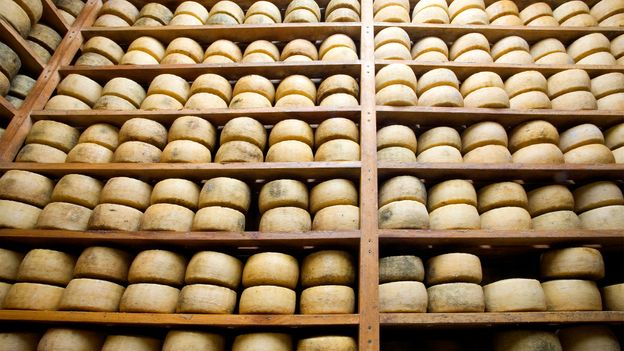
When Covid hit Italy in 2020, the pecorino industry careened towards life support. But thanks to the ingenuity of several producers, the cheese is now perhaps better than ever.

www.bbc.com
"Pecorino Romano, a version originally hailing from the Lazio region near Rome (hence the name 'Romano'), is the cheese that defines the Italian kitchen. It's lighter, drier and saltier than other pecorino varieties, and bonds so many Italian dishes such as cacio e pepe, pasta carbonara and bucatini all'amatriciana (a typical Roman dish made of pasta, pig's cheek and tomatoes). It's seasoned for up to two years and is delicious with a dab of honey and a glass of wine. And it has been around Italy for 2,000 years.
During the Roman Republic (508-27 BCE), shepherds needed to do something with their excess sheep's milk and so they made what is Pecorino Romano. The Roman Empire's renowned agricultural writer, Lucio Moderato Columella, wrote about what appeared to be Pecorino Romano in 50 CE in De Re Rustica. Turns out, Pecorino Romano was an ideal food for Roman armies as it had a lifespan longer than many soldiers. In the Middle Ages, people started adding salt to Pecorino Romano and discovered that it helped preserve the cheese. Soon, it spread beyond the Italian peninsula.
Pecorino Romano has survived the fall of the Roman Empire, earthquakes and fascism."
Very cool
"Under the floor of his restaurant, Necci dal 1924, is a 2,000-year-old cave left over from the Roman Empire where he stores all his pecorino."
And under my place is probably mud, clay, rats and roaches.


 www.vice.com







:max_bytes(150000):strip_icc():focal(959x319:961x321)/Todd-Julie-Chrisley-112122-2000-077f687cc9bc48e6930d99ab803bbe96.jpg)