- Messages
- 40,417
This is a subject that I've taken a lot of interest in lately, so I'm going to discuss some of the ways to do things and repost some of the tips and tricks I pick up around the web.
Follow along with the video below to see how to install our site as a web app on your home screen.
Note: This feature may not be available in some browsers.
History
Until the introduction of Chip and PIN, all face-to-face credit or debit card transactions used a magnetic stripe or mechanical imprint to read and record account data, and a signature for verification. Under this system, the customer hands their card to the clerk at the point of sale, who either "swipes" the card through a magnetic reader or makes an imprint from the raised text of the card. In the former case, the account details are verified and a slip for the customer to sign is printed. In the case of a mechanical imprint, the transaction details are filled in and the customer signs the imprinted slip. In either case, the clerk verifies that the signature matches that on the back of the card to authenticate the transaction.
This system has proved reasonably effective, but has a number of security flaws, including the ability to steal a card in the post, or to learn to forge the signature on the card. More recently, technology has become available on the black market for both reading and writing the magnetic stripes, allowing cards to be easily cloned and used without the owner's knowledge.
How it works
To solve this, banks and retailers are replacing traditional magnetic stripe equipment with smartcard technology, where credit and debit cards contain an embedded microchip and are authenticated automatically using a personal identification number (PIN). When a customer wishes to pay for goods using this system, the card is placed into a "Point of Sale" terminal or a modified swipe-card reader, which accesses the chip on the card. Once the card has been verified as authentic, the customer enters a 4-digit PIN, which is submitted to the chip on the smartcard; if the two match, the chip tells the terminal the PIN was correct, otherwise it informs it the PIN was incorrect.

When I went to Central America, even if places took cards, it was almost always only Visa. Not even MasterCard.
But I'd sooner gargle hot asphalt rather than bank with BoA
Fidelity has a similar service like Schwab. It's not a true checking account since the money is tied to money market accounts, but you can write checks (never used them once) and get a Visa debit card. I keep a small stash in there when I'm not near my banks ATMs and need cash.
It doesn't save me a ton, but usually $25-30 a year. Better me than the fucking banks.
And yes BoA sucks.


I'm reading over the bluebird terms and that actually seems like a really good backup debit card. Are there any downsides I'm not seeing?
Citi launched the Citi Hilton Reserve card which should be useful for folks looking to get free Hilton hotel stays, for Big Spenders to get top-tier Diamond elite status and a free weekend night, and for folks who stay at a Hilton for a few nights a year to get Hilton Gold elite status for free breakfast and internet.
In 2007 Chase hired Gordon Smith, a top American Express credit card executive to head their credit card division. Citi followed in 2010 by hiring Jud Linville, another American Express credit card executive to head their US credit card operations.
And the new Citi Hilton Reserve card goes head-to-head with the American Express Hilton Surpass card, and in my opinion, is a better card than the American Express Surpass card.
With the Citi Hilton Reserve, you get 2 free weekend nights valid at most Hilton hotels, free Hilton gold elite status (free internet and breakfast) which can save at least $30 a day, and no foreign transaction fees.
If I was new to miles and points, I wouldn’t apply for this card instead of the 2 Citi American Airlines cards first. But the Citi Hilton Reserve card is worth considering later on (and perhaps you can get 2 of them) – especially since it isn’t a Chase card and because almost everyone can save money with the free weekend nights at a Hilton hotel or with Hilton gold status.
1. 2 Free Weekend Nights
You get 2 free weekend night certificates (weekend = Friday, Saturday, or Sunday) at any Hilton hotel after spending $2,500 within 4 months. The certificates are valid for 12 months from when they are issued and your Citi Reserve card must be open when you redeem the certificate.
The good news is that this includes category 1 to 7 Hilton hotels which cost 7,500 to 50,000 points a night AND Waldorf Astoria hotels which cost 60,000 to 80,000 points a night.
The annual fee is $95, so you’re effectively getting each night for $47.50 in addition to the free internet and breakfast because of the Hilton gold status!
The bad new is that you can only redeem the free night certificates for weekends i.e. Friday, Saturday, or Sunday, so you can’t use them to have a week long vacation in Paris. But you could use the certificates for the weekends and use regular Hilton points for the remaining days since there are many other ways to earn 450,000 Hilton points.
You also cannot use the free night certificates at all-inclusive or Hilton Grand hotels in addition to Waldorf Astoria hotels which do not offer standard rooms and have all suites or villas.
Hilton has over 3,800 hotels, and I’ve been told that fewer than 50 hotels are excluded. I’ve asked for a list of excluded hotels.
You can use the free night certificates at the Grand Wailea in Hawaii, the Hilton in Paris, or the Hilton in Bora Bora which offer standard rooms, but won’t be able to use them at the Waldorf Astoria in the Maldives which has only suites & villas.
You can usually get 2 Citi Hilton or Thank You cards every 3 to 4 months, unlike the Citi American Airlines personal cards which require a wait of 18+ months before applications. I wonder if folks can get 2 Citi Reserve cards and 2 sets of free weekend nights at the same time as well…
2. Free Gold Elite Status
You get free Hilton Gold elite status for as long as you have the card. Hilton Gold elite status is the best mid-tier status of any hotel chain because it includes free internet AND free breakfast, in addition to 25% extra points for paid stays, and a shot at room upgrades.
You also get a 15%, 20% & 25% discount when redeeming for a 4, 5 or 6 or longer night award as a Gold member.
The benefits of Gold elite status apply to both paid as well as award reservations using Hilton points.
Granted that there are often other ways to earn free Hilton Gold status, but for some folks Gold status can save you money when you stay at Hilton hotels and may be a reason to keep this card after the 1st year.
For example, if internet and breakfast each cost $10 per day at the hotel, you save $30 per day (more in expensive cities) if there are 2 of you in a room. So you recover the $95 annual fee in about 3 nights.
The American Express Hilton Surpass card offers free Gold status, but only for the 1st year after which you get only Silver elite status.
Status matching to get free Hyatt nights in suite
You may also be able to match Hilton Gold status to a Hyatt Diamond trial if you have a few points in your Hilton account, though sometimes you need to have a few stays in your Hilton account. You may only be able to match to Hyatt Diamond status once in your life so choose wisely!
This means that you have Hyatt Diamond status for 60 days and 4 confirmed suite upgrades in Hyatt hotels for paid stays. And you can keep the Diamond status if you stay 12 nights within the 60 days of your trial Diamond membership.
But if you apply for the Chase Hyatt credit card as a Diamond member (even on a trial), you should get the 2 free Hyatt nights in a suite!
You can email Hyatt at goldpassport@hyatt.com.or call Hyatt to ask for the status match
3. Free Weekend Night After Spending $10,000 Each Year
You get a free weekend nightafter spending $10,000 within your membership year (1 year from the date when you are approved and resets each year).
The free weekend night is not valid at all-inclusive or Hilton Grand hotels in addition to Waldorf Astoria hotels which do not offer standard rooms and have all suites or villas.
This isn’t, in my opinion, as good as the Chase Priority Club card which gets you a free night every year just by keeping the card (worth every cent of its $49 fee) or even the Chase Hyatt card which gets you a free night in a category 1 to 4 Hyatt hotel.
But I do see this as the trend going forward – cards which make you spend money to earn an additional benefit each year.
4. Top Tier Hilton Diamond Status After Spending $40,000
The Citi Hilton card also gets you top-tier Hilton Diamond status after spending $40,000 within a calendar year (January to December). The Diamond status is valid for the year in which you earn in and the entire next year.
Diamond status gets you a 50% point bonus on paid rooms and a real shot at good room upgrades.
The American Express Surpass card also gets you Hilton Diamond status after spending $40,000 a year, but you do NOT get the free weekend night which you get with the Citi Reserve card after spending $10,000.
So Big Spenders are better off earning Hilton Diamond status on the Citi Hilton Reserve card since they will get top tier Hilton Diamond status AND a free weekend night for spending $40,000.
5. No Foreign Transaction Fees & Card Has a Chip
Unlike the American Express Surpass card which charges a 2.7% foreign transaction fee, the Citi Hilton Reserve does NOT charge a foreign transaction fee.
Paying a foreign transaction fee is usually never worth the miles and points you earn, so this is a welcome feature of the card.
The card also has Chip and Signature technology, which could make using automated machines in certain countries easier to use, but don’t count on it.
6. 10 Points at Hilton Hotels, 5 Points for Airline and Car Rental and 3 Point per $1 for Everything Else.
You earn 10 points per $1 spent at Hilton hotels which is better than the 9 points per $1 spent using the American Express Surpass card. And this is also the better card for using at Hilton hotels outside the US because it doesn’t charge foreign transaction fees.
However, you do earn 500 points for online bookings made using an American Express Surpass card, so the extra 1 point per $1 could be a wash depending on how much you pay per stay.
The American Express Surpass card earns 6 points per $1 at spent supermarkets, drugstores, gas stations, phone, internet & cable, so that could be more valuable to some than the 5 points per $1 spend on airlines and car rentals with the Hilton Surpass card.
7. $95 Annual Fee
The $95 annual fee is not waived for the 1st year, but I’d gladly pay that for 2 free weekend nights at a Hilton hotel worldwide and free Hilton Gold status.
Why you still want a no-fee American Express Hilton card
Both the American Express Surpass card and the no-fee American Express card get you access to AXON awards where you can redeem 4 nights at a top category 7 hotel for 145,000 points.
With the Citi Hilton Reserve, you would have to pay 170,000 points for 4 nights at a top category 7 Hilton after the 15% discount.
So the best strategy if you collect Hilton points (and there are lots of ways to do that) could be to get the Hilton Reserve Card for the free nights, gold elite status, and potential to earn Hilton Diamond status, but to also get a no-fee American Express Hilton card for access to discounted award redemptions.
Bottom Line: The Citi Hilton Reserve card is a welcome addition from Citi which hasn’t had a lot of new offers in the miles and points world. I wouldn’t get the card for the free weekend nights unless I knew I was going to use them within the next 12 months since the free night certificates expire, but the card does give you an easy way to get 2 free weekend nights & free internet and breakfast.
If you stay at Hilton hotels more than 3 or 4 times a year and don’t have Hilton Gold status, it could be worth paying the annual fee for Hilton Gold Status. And the card is the best option for Big Spenders who can spend $40,000 for Hilton Diamond status.
Of all the hotel programs, Hilton points are the easiest to acquire via credit card sign-up bonuses (sometimes more than once)AND amongst the easiest to earn by regular spending via the American Express or Citi co-branded Hilton cards.
Credit Card
Sign-On Bonus
Minimum Spending Required
Annual Fee
Total440,000 Points + 2 Free Nights$13,750$418
Citi Hilton Reserve 2 free nights + Hilton Gold Status (free breakfast & internet) $2,500 in 4 months $95, but well worth the free Hilton Gold elite status
Bank of America Virgin Atlantic 50,000 miles (transferable to 100,000 Hilton points) $2,500 in 3 months $90 NOT waived for 1st year
Bank of America Hawaiian Airlines Visa 35,000 miles transferred to 70,000 Hilton points $1,000 in 4 months $79 NOT waived for 1st year
Bank of Hawaii Hawaiian Airlines Visa 35,000 miles transferred to 70,000 Hilton points $1,000 in 4 months $79 NOT waived for 1st year
American Express Hilton Surpass 60,000 Points $3,000 within 3 months $75 NOT waived for 1st year
American Express Hilton HHonors 50,000 Points $750 within 3 months No Annual fee
Citi Hilton HHonors Visa 50,000 Points $1,500 within 6 months No Annual fee
Citi Hilton HHonors Visa 40,000 Points $1,500 within 6 months No Annual fee
For example, you can get ~440,000 Hilton points + 2 free nights + Hilton gold status by applying for 8 credit cards from 3 different banks. These 450,000 points + 2 free nights can be redeemed for 12 nights at a top tier category 7 Hilton hotel using an AXON award (think the Maldives, Hawaii, London, Paris, Tokyo, etc.) or for many more nights at lower-tier Hilton group hotels.
The lowest category Hilton group hotels start at 7,500 points a night and the highest category cost 50,000 points per night. Waldorf Astoria hotels range between 50,000 points to 80,000 points per night. Here’s a link to the Hilton award chart.
And you may be able to get some of these either more than once in a short period of time or twice at the same time, which means that it is easier to replenish Hilton points via credit card sign up bonuses than other hotel points. Even better – none of these cards are from Chase which usually has the best offers.
However, these are Emily and my personal experience, and your experience could be completely different.
I’ve written about the cards individually, but never listed together all the different ways to rack up Hilton points.
I wouldn’t start off with these cards if you were new to miles and points because you can usually save more money by using credit card sign-up bonuses for airfare, but at some point you’ll need hotel points.
I value 1 Hilton point at ~0.6 cents per point, but I value Hyatt hotel points much higher (~1.5 to 1.8 cents per point). The main reason is because it takes a lot more Hilton points (50,000 points) to earn a top tier hotel room versus only 22,000 points for a top tier Hyatt.
However, the Hilton brand has hotels almost everywhere versus much fewer hotels for Hyatt, and you can earn Hilton points much faster.
This post will cover Hilton, and I’ll cover the different ways to earn Hyatt points tomorrow.
450,000+ Hilton Points + 2 Free Nights
If you apply for cards below i.e. the Virgin Atlantic, 2 Hawaiian Air, AMEX Hilton Surpass, AMEX (non-surpass) Hilton and 2 Citi Hilton cards at the same time, you can get ~450,000 Hilton points + 2 free nights + Gold elite status (free breakfast and internet).
You shouldn’t apply for them all at the same time (unless you know what you’re doing!), and should not apply for credit cards if you have a big loan in the next 2 years.
Even better, the Citi Hilton Reserve, Virgin Atlantic, Hawaiian Air, & regular Citi Hilton, cards are churnable which means that you may be able to get another 240,000 Hilton points every 3 to 4 months.
Let’s see the different ways to rack up Hilton points:
1. 2 Free Nights – Citi Hilton Reserve. This card gets you 2 free nights which can be used at any Hilton on the weekend. That’s ~100,000 points if you redeem at top category Hilton hotels.
Even better the card gets you free Hilton Gold elite status for as long as you have the card. This means free breakfast and free internet which will save you money when you use your points at Hilton hotels. The card (unlike the others below) also has no foreign transaction fee so is great for using outside the US and saving the 3% foreign transaction fee.
Here’s a link to a detailed review on the Citi Hilton Reserve. Emily and I were both able to get 2 Citi Hilton Reserve cards for 4 free nights each! Note that you can NOT get 2 Citi Hilton Reserve cards at the same time any longer.
2. 100,000 Points – Bank of America Virgin Atlantic Credit Card. Isn’t it strange that the card which offers the most Hilton points isn’t a Hilton branded card?
You earn 20,000 miles after your 1st purchase and an additional 25,000 miles after spending $2,500 within 90 days. You also get 5,000 miles by adding 2 authorized users to your account for a total of 50,000 Flying Club miles. Here’s my earlier review of the card.
You can convert 50,000 Flying Club miles to 100,000 Hilton Points by calling Virgin Atlantic (800-365-9500) and asking them to transfer the miles to your Hilton account.
Emily and I are on our second Virgin Atlantic card and we didn’t cancel the previous version before applying for a new one. We had to call Bank of America’s reconsideration line, but were both quickly approved for the card. We waited ~5 months since we last applied before getting another Virgin Atlantic card.
Some readers have written that they were able to get another card after 3 months and some reported being approved for 2 cards at the same time after calling the reconsideration line. But of course, your experience could be different.
You earn 1.5 Virgin Atlantic miles or 3 Hilton points per $1 spent and 3 Virgin Atlantic miles per $1 spent on Virgin Atlantic.
3. 70,000 points – Bank of America Hawaiian Air Credit Card. The Bank Of America Hawaiian airlines credit card gets you 20,000 Hawaiian Miles after the first purchase and an extra 15,000 miles after spending $1,000 within 4 months. Here’s my earlier review of the card.
These 35,000 Hawaiian Air miles can be converted to 70,000 Hilton points by calling Hawaiian Air (877-426-4537).
Note that you may instead receive the Platinum Visa card which offers only 10,000 HawaiianMiles after the first purchase if you do not qualify for the Signature card.
4. 70,000 points – Bank of Hawaii Hawaiian Air Credit Card. Same deal as the Bank of America Hawaiian Air card in #2, except that this card is issued by FIA card services, a division of Bank of America, and you may be able to get more than 1 card every few months like with the other Bank of America credit cards.
Note that you may instead receive the Platinum Visa card which offers only 10,000 HawaiianMiles after the first purchase if you do not qualify for the Signature card.
5. 60,000 points – American Express Hilton Surpass Credit Card. If you have Hilton points, you should strongly consider getting either the AMEX Hilton Surpass card or the AMEX Hilton regular card (#5). Why? Note that you can’t have both the AMEX Hilton cards open at the same time.
Because you get access to AXON awards which give you a significant discount on award redemptions. For example, instead of paying 200,000 points for a 4 night Hilton stay in a Category 7 hotel, you’ll pay only 145,000 points or 27.5% less.
You also get free Gold status for the 1st year (free internet, breakfast, and a shot at upgrades) and then Silver status which gets you access to the discounted VIP awards. If you’re a big spender you can earn Gold status by spending $20,000 a year (free if you have the Citi Reserve card) or top tier Diamond status for $40,000 a year.
You earn 9 Hilton points per $1 spent at Hilton hotels, 6 points per $1 at supermarkets, drugstores, gas stations, phone/internet/cable & 3 points per $1 for everything else which makes it pretty easy to rack up Hilton points via regular spending as well (but of course the big pay off for most folks is to focus on the credit card sign-up bonuses).
6. 40,000 to 50,000 points – American Express (Regular) Hilton Credit Card. This card has NO annual fee which makes it a great card to build a long term history with American Express. You get free Hilton silver status which makes you eligible for discounted VIP awards.
7. 40,000 to 50,000 points – Citi Hilton Visa. The regular affiliate link is for 40,000 points, but there is a link to a 50,000 point version which also works based on reader feedback. You get free Hilton Silver elite status which makes you eligible for discounted VIP awards
Another reason to get this card is because it doesn’t have an annual fee and is a nice card to plan to keep for a long time and build a long-term relationship with Citi.
Hawaiian Air Debit Cards
Bank of America used to offers a Hawaiian Air debit card for a $30 annual fee which earns 1 mile per $2 spent. But I can’t find a link to it anymore.
Bank of Hawaii offers Hawaiian Air debit cards, but doesn’t have any branches in the mainland US. You can transfer Hawaiian Air miles to Hilton points at a 1:2 ratio so the net effect is that you’re earning 1 Hilton point per $1 spent.
Other options
There are other ways to get Hilton points, such as transferring American Airlines miles to Hilton, but I don’t recommend that because the transfer ratio (1.67 Hilton point for every 1 American Airlines mile) is not worth it to me.
Bottom Line: It is fairly easy to rack up lots of Hilton points for Big Travel with Small Money. If you do collect Hilton points, you should consider an American Express Hilton card, because it will get you access to discounted VIP or AXON awards which means paying less points for Hilton awards.
Good read but we may wanna start spoilering that stuff. My thumb hurts scrolling down to the bottom.
3. Ask about repositioning flights or cruises. Airlines use repositioning flights to move aircrafts from one airport to another, and the same applies to cruise lines, which typically reposition ships twice a year. These flights or cruises tend to be cheaper but provide services similar to traditional offerings, according to Greenberg. He suggests asking about these options on the phone.Pat and Wayne Dunlap, who have chronicled their travels to 100 countries on Unhooknow.com, have taken five repositioning cruises, including from Miami to Barcelona and Vancouver to Japan. Repositioning cruises tend to be longer than traditional cruises, so if you're short on time, this might not be for you. However, the Dunlaps use their time at sea to relax and research the rest of their trip using the travel books they bring along. Once they arrive, they typically explore the destination and later use frequent flyer miles to return home, since repositioning cruises are one-way. Pat says they've found several cruises using the website VacationsToGo.com. "The cruises are set up by country alphabetically so look for 'R' for repositioning," she says.
Note that with repositioning flights many of them don't have cabin crew on them and as such we can't sell them to passengers.
If they do though you're in luck.
Finding great deals for car rentals is not something I’ve spent much time looking into in the past. Last year, during the Daily Getways (which are coincidentally going on right now), I bought a pile of Hertz points. Since then, my car rental plan has been simple: Search for the best price. If the best price is $50 per day or higher, use Hertz points. If less than $50 per day, then pay.
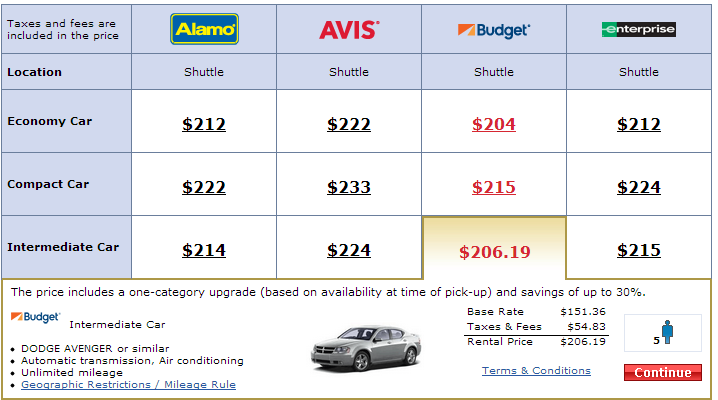
Million Mile Secrets has run a nice series on getting cheap rental cars. For example, see this recent post. I needed a two day rental, so I tried some of his tricks as well as my own to see where I’d find the best price. With 5 people travelling together, I needed an intermediate size car or larger. Here is what I found:
Costco Travel: $206.19
Costco Travel often has very competitive prices for vacation packages, cruises, and rental cars. I ran a quick search for the dates I needed. Total cost $206.19.
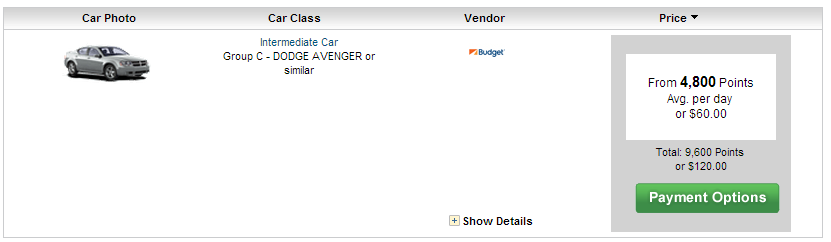
Ultimate Rewards: $120 (or 9,600 points)
I logged into Ultimate Rewards, selected “Travel… Flights, Hotels, & Car Rentals” and searched for a car. Total cost $120.
I repeated the search twice. First, I logged in with a premium card (Ink Plus), and the second time I logged in with a no annual fee card (Freedom). The price ws the same both times (except the number of points required would be more with the Freedom card since the premium cards give a point discount).
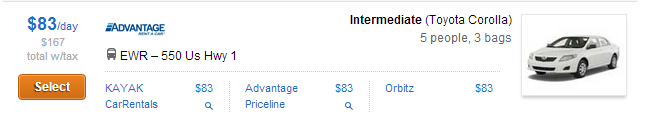
Kayak: $167
I ran a simple search through Kayak. Kayak found a total rate of $167.
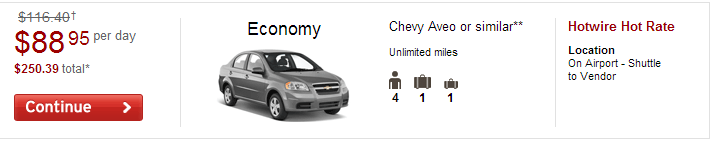
Hotwire: $244.25
Hotwire was disappointing. $250.39 total.
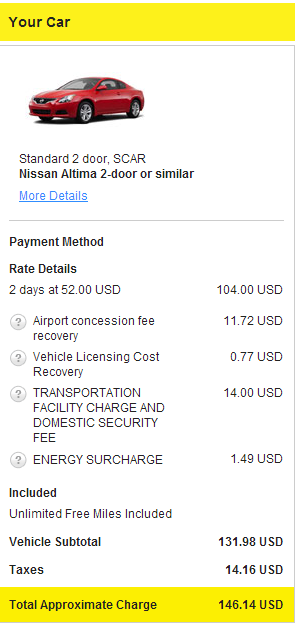
Hertz w/ corporate code: $146.14
Through my prior employer, a corporate discount code was attached to my Hertz account, and it’s still there. I find that this code gives me better rates than other discount options through Hertz. Total cost: $146.14. With no discount code, Hertz offered a rate of $188.73. Using the discount code that comes with an Amex Platinum card brought the best rate to $178.37.
Avis Preferred
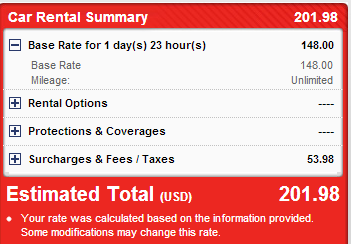
Thanks to my Amex Platinum card, I have Avis Preferred status which offers discounted rentals. With this status, I got a rate of $201.98.
I then tried using my Ink Insiders discount number (which is available to Chase Ink cardholders) and got the same results. Without either number, Avis quoted a rate of $242.20, so either discount number saves about 17% for this rental at Avis. If I pay with a business MasterCard (such as Chase Ink) card registered to the MasterCard Easy Savings program I would save an additional 5%.
Summary
Here are the results I found, listed from best to worst:
The Ultimate Rewards search engine found the best price overall. This matches Million Mile Secret’s finding (here). It’s important to note, though, that this was just one very specific search. I’ve done similar comparative searches in the past and usually I’ve found that the Ultimate Rewards price is no better than the best price available through Kayak. So, despite these findings, it still makes sense to search multiple sites to find the best price.
- Ultimate Rewards: $120 (or 9,600 points)
- Hertz with Corporate Code: $146.14
- Kayak: $167
- Hertz Amex Platinum discount: $178.37
- Hertz no-discount: $188.73
- Avis Preferred: $201.98
- Costco Travel: $206.19
- Avis no-discount: $242.20
- Hotwire: $244.25
In the end, even though the Ultimate Rewards price was really good, I booked through Hertz using points. With points, I was able to pick an even larger car at no additional cost for this two day rental, and with 5 people and luggage, I think we’ll need it.
[/spoiler]
Follow up using Priceline:
In yesterday’s post (Finding the best car rental deal) I wrote about my search for an upcoming two day rental. Of the options I looked at, I found Chase’s Ultimate Rewards site to be the cheapest. In the comments of that post, readers suggested many other ways to find good rental rates, but the most common suggestion was Priceline.
Priceline has two modes for renting cars. They offer a regular online travel agency search which basically returns the same rates you’ll find through sites like Expedia and Travelocity. The other option is to “Name your own price.” When you do the latter, you tell Priceline how much you are willing to pay after selecting your desired car type (compact, midsize, etc.), pickup and drop-off location, and pickup and drop-off dates and times. You do not have the option of specifying a rental car company. After giving Priceline your credit card info, it runs a search to see if your bid is accepted. If it is, your credit card will be charged immediately for that rental car.
I’m usually not a fan of this approach for a couple of reasons:
On the other hand, it is sometimes possible to save a lot of money…
- I hate being locked in by prepaid rates. What if my plans change?
- When renting cars this way, I may be stuck in long lines waiting for my car keys. I much prefer picking up my pre-assigned car (with Hertz, for example) or walking the Emerald Aisle (with National).
The best consolation prize
A few years ago my family had plans to take Amtrak from Tampa to Delray Beach, FL, but the train was massively delayed. We looked to rent a car instead, but found very high rates. We then tried Priceline. I put in what I thought was a reasonable bid, but it was rejected. Then Priceline offered a consolation prize. They listed special car rental offers “just for me”. Amazingly, one of the offers was for a slightly larger car and was far cheaper than the price I had bid! Awesome. Would that technique work again?
Testing Priceline for an Intermediate size car
After all the work I did yesterday comparing different rates for intermediate cars, I decided that we really needed a bigger car for this trip. That being said, I wanted to compare Priceline directly to my prior results, so I bid on an intermediate car, but I didn’t want to win the bid!
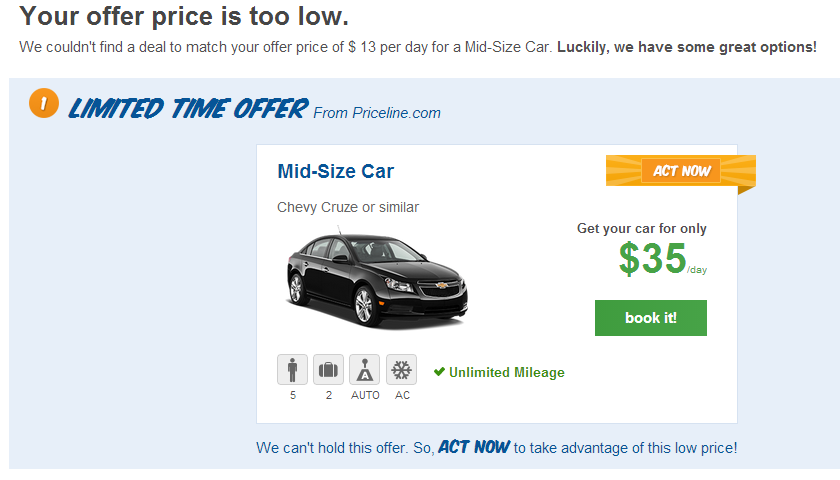
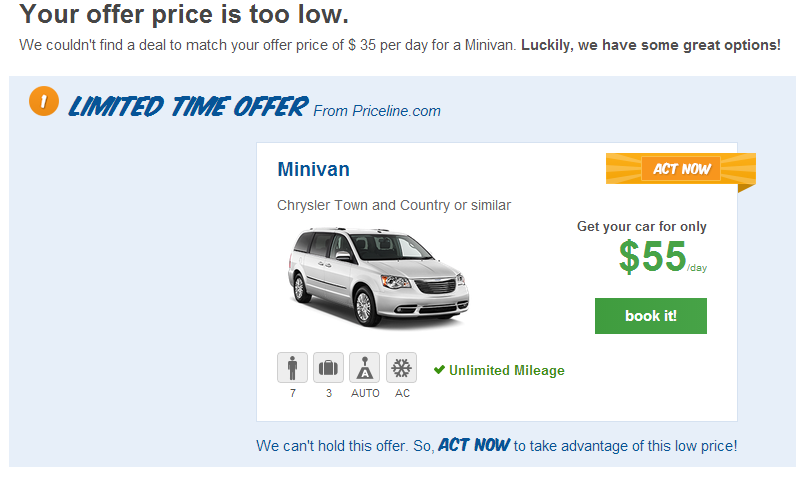
I purposely put in a bid that was far lower than they would possibly accept, and just for good measure I put in the wrong security code for my credit card. Not surprisingly, the bid was rejected. I was then offered the chance to change my bid for the same car. I raised my offer by a dollar or two and the bid was rejected again. That was OK because I wanted to get to my consolation offer. After the second rejected bid, I received the consolation offer:
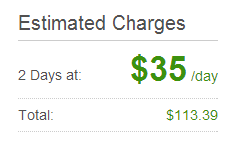
$35 per day sounds amazingly cheap since the best alternative I found for the same size car was $60 per day via Ultimate Rewards. But this $35 price was without taxes. When I clicked through to “book it!” I found the real price:
So, the total comes to $113.39 which is the best price I’ve found yet, but not that much cheaper than Ultimate Rewards (which priced at $120 total).
If I were really interested in the intermediate car, I’d try again the next day with a more reasonable bid. Given the result above, I would try to find a good price that was less than $35 per day before taxes. I could try $20 one day, $25 the next, etc.
A bigger vehicle
Since I had decided that I really wanted a bigger car for this trip, I decided to see what kind of deal I could get for a standard SUV or Minivan. Kayak says that for those two days, the best all-in price for an SUV would be $196, and the best all-in price for a Minivan would be $210. Ultimate Rewards quoted $204.50 for a Minivan, but didn’t seem to have an SUV option. The best Hertz could do for me was $254 for an SUV. No thanks.
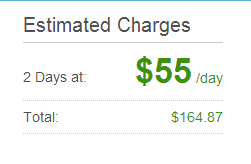
I tried the too-low bid approach that I described above and got this:
$164.87 for a Minivan isn’t bad. It’s about $25 more per-day than the best intermediate car price, but it is also about $20 less per day than Ultimate Reward’s Minivan price.
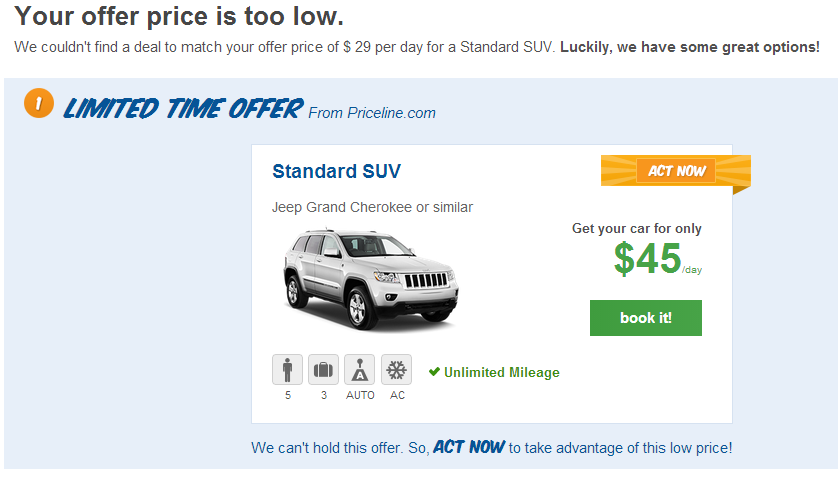
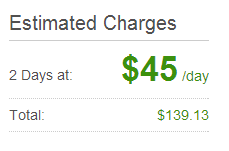
I then tried the too-low bid approach to get to the SUV consolation prize price:
$139.13 is a really good price for an SUV. It’s only $13 more per day than the intermediate car option, and $29 per day cheaper than the best price found via Kayak.
Next Steps
Priceline rejected my $29 per day bid for a standard SUV, but then offered me a rate of $45 per day (before taxes). My plan is to try to snag a rate in-between those two. In the next several days, I’ll bid about $5 more each day with the hopes of getting an accepted price of around $35 per day before taxes. We’ll see!

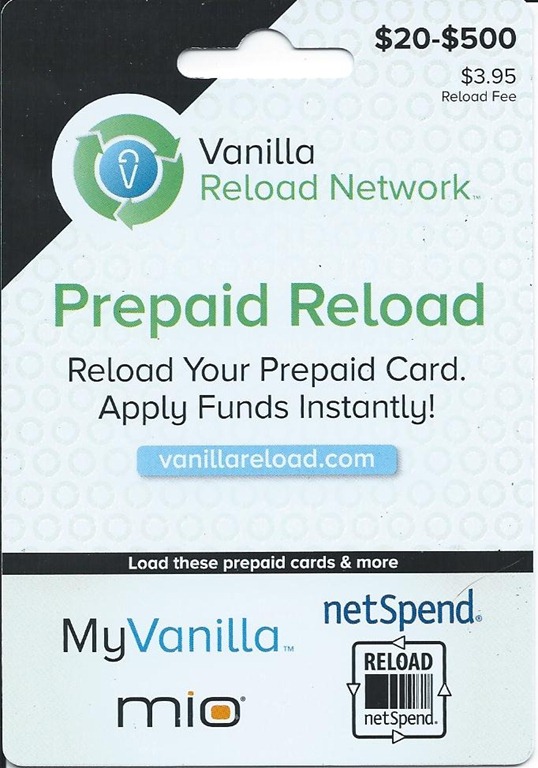
Would like to hear how others are doing their manufactured spending. Vanilla re-loads have been yanked from the CVS shelves in my area (St. Louis) and 7-11 won't take credit for them any longer. I have been buying Chase gift cards (shipped for free and no fees when purchased with a Chase credit card) and using a Visa Buxx cards that can be re-loaded online up to a little over $500 at a time for $2.50. The only bad thing is periodic trips to the ATM and you can only withdraw $200 at a time. The Chase gift cards can be loaded to Bluebird via Wal-Mart (hate going there).
Can anyone else share success stories? If you are purchasing Vanilla re-loads it would be great to hear where? What about Green Dot and Account Now?
Not as bad as it sounds. And happens rather frequently with the hackersHoly shit!