- Messages
- 12,492
Those people are mostly idiots. I don't know what their income bracket is.Don't understand. Are those people the 99%?
Follow along with the video below to see how to install our site as a web app on your home screen.
Note: This feature may not be available in some browsers.
Those people are mostly idiots. I don't know what their income bracket is.Don't understand. Are those people the 99%?

Those people are mostly idiots. I don't know what their income bracket is.

Well, I'm afraid you won't get very far with me defending the super rich. Despite whatever data distortion that article is talking about, there are a quadrillion data points showing that the elite in America are growing more-so.
Exactly.i am tired of 99% victims. aren't these the same kind of chimps who are taken in by channellers and new age fakirs? The quoted 1% cutoff is $343,000 USD. So, are the 99%ers who are fighting for income equality fighting for everyone from $0.00 to $342,999.00? What if I made $250,000.00? I'm in the 99%? who is fighting for me? no one? Oh, some of the 99% are more worthy than others? K. Then why don't you do some math and clean up your 99% and stop fucking referring to the 1% until you do.
i am tired of 99% victims. aren't these the same kind of chimps who are taken in by channellers and new age fakirs?
That's kind of the point, the 1% aren't the super rich. The .01% are.
I get it. It's a bit of a pointless distinction, and the WSJ should really stop wasting time trying to poke holes in it using these kinds of petty tactics.
That wasn't the WSJ. That was me. The WSJ article was about big (really big) distortions used in some of these studies that seriously need to be address in order to be fully informed when making policy decisions and talking about issues. Did you read the article?
The first sentence was about the article Rambo posted. The second was about distortions in the data. It was a quick segue with no notice.Well you sorta indicated the opposite above, or perhaps I'm confused. I skimmed it, I'm in a meeting.
Regardless, being informed doesn't necessarily mean you differentiate 1% from .01%. We're talking about very wealthy. Me and you can distinguish the value, but we're talking about a population of people of which only 70% finish high school.
The first sentence was about the article Rambo posted. The second was about distortions in the data. It was a quick segue with no notice.
The greater overreaching point is that the bulk of the populous is wrong. It doesn't matter how informed they are. A guy making 250k a year has way more in common with the guy making 50k than the guy making 2.5 million. He has a house payment, saves for his kids college, leads a basically normal life. He has a slightly nicer car and gets to fly to his vacation instead of drive. The guy making 2.5 million a year does none of these things, and actually exists in a completely different social group that associates with each other exclusively. You aren't going to run into that guy at Wal Mart. This guy also doesn't pay any taxes because his money doesn't come from a wage. If you want to work on wealth distribution, it needs to be set at a much higher bar than 1%er's and it needs to be tailored to take into account income realities. On top of this is layered that the middle class gets the overwhelming amount of government assistance already, not the poor.
If you model the shift in the curve had you not made those Regan era adjustments, the graphs would chart equally and the income gap wouldn't be a discussion topic.
That's most likely an incorrect supposition. The money was just buried in different places, and didn't show up on income statement, which is a key data piece in the WSJ article. The gap was there, it just depends on how you measure it. Also, the gap started widening in the 70's even with erroneous accounting.
I'll gladly pay you Tuesday for a chunk of obsidian today.The gap has always been there, probably since we started trading rocks as money.
I'll gladly pay you Tuesday for a chunk of obsidian today.
I'll gladly pay you Tuesday for a chunk of obsidian today.


A society's system of money is inseparable from other aspects of its relationship to the world and the relationships among its members. Money as we know it today both reflects and propels the objectification of the world, the paradigm of competition, and the depersonalization and atomization of society. We should therefore expect that any authentic change in these conditions would necessarily also involve a change in our system of money.
As a matter of fact, there are money systems that encourage sharing not competition, conservation not consumption, and community, not anonymity. Pilot versions of such systems have been around for at least a hundred years now, but because they are inimical to the larger patterns of our culture, they have been marginalized or even actively suppressed. Meanwhile, many creative proposals for new modes of industry such as Paul Hawken's Ecology of Commerce, and many green design technologies, are uneconomic under the current money system. The alternative money systems I describe below will naturally induce the economies described by visionaries such as Hawken, E.F. Schumacher, Herman Daly, and others. They will also reverse the progressive nationalization and globalization of every economic sector, revitalize communities, and contribute to the elimination of the "externalities" that put economic growth at odds with human happiness and planetary health.
Given the determining role of interest, the first alternative currency system to consider is one that structurally eliminates it. As the history of the Catholic Church demonstrates, laws and admonitions against interest are ineffective if its structural necessity is still present in the nature of the currency. A structural solution is needed, such as the system proposed by Silvio Gesell in The Natural Economic Order. Gesell's "free-money" (as he called it) bears a form of negative interest called demurrage. Periodically, a stamp costing a tiny fraction of the currency's denomination must be affixed to it, in effect a "user fee" or a "maintenance cost"; another way to look at it is that the currency "goes bad"—depreciates in value—as it ages.[3]
If this sounds like a radical proposal that could never work, it may surprise you to learn that no less an authority than John Maynard Keynes praised the theoretical soundness of Gesell's ideas. What's more, the system has actually been tried out with great success.
Although demurrage was applied as long ago as Ancient Egypt in the form of a storage cost for commodity-backed currency,[4] the best-known example was instituted in the town of Worgl, Austria, in 1932 by its famous mayor Uttenguggenberger. To remain valid, each piece of this locally-issued currency required a monthly stamp costing 1% of its face value. Instead of generating interest and growing, accumulation of wealth became a burden—much like possessions are a burden to the nomadic hunter-gatherer. People therefore spent their income quickly, generating intense economic activity in the town. The unemployment rate plummeted even as the rest of the country slipped into a deepening depression; public works were completed, and prosperity continued until the Worgl currency was outlawed in 1933 at the behest of a threatened central bank.
Demurrage produces a number of profound economic, social, and psychological effects. Conceptually, demurrage works by freeing material goods, which are subject to natural cyclic processes of renewal and decay, from their linkage with a money that only grows, exponentially, over time. As established in Chapter Four, this dynamic is what is driving us toward ruin in the utter exhaustion of all social, cultural, natural, and spiritual wealth. Demurrage currency merely subjects money to the same laws as natural commodities, whose continuing value requires maintenance. Gesell writes:
Gold does not harmonise with the character of our goods. Gold and straw, gold and petrol, gold and guano, gold and bricks, gold and iron, gold and hides! Only a wild fancy, a monstrous hallucination, only the doctrine of "value" can bridge the gulf. Commodities in general, straw, petrol, guano and the rest can be safely exchanged only when everyone is indifferent as to whether he possesses money or goods, and that is possible only if money is afflicted with all the defects inherent in our products. That is obvious. Our goods rot, decay, break, rust, so only if money has equally disagreeable, loss-involving properties can it effect exchange rapidly, securely and cheaply. For such money can never, on any account, be preferred by anyone to goods.
Only money that goes out of date like a newspaper, rots like potatoes, rusts like iron, evaporates like ether, is capable of standing the test as an instrument for the exchange of potatoes, newspapers, iron and ether. For such money is not preferred to goods either by the purchaser or the seller. We then part with our goods for money only because we need the money as a means of exchange, not because we expect an advantage from possession of the money.
In other words, money as a medium of exchange is decoupled from money as a store of value. No longer is money an exception to the universal tendency in nature toward rust, mold, rot and decay—that is, toward the recycling of resources. No longer does money perpetuate a human realm separate from nature.
Gesell's phrase, "... a monstrous hallucination, the doctrine of 'value'..." hints at an even more subtle and more potent effect of demurrage. What is he talking about? Value is the doctrine that assigns to each object in the world a number. It associates an abstraction, changeless and independent, with that which always changes and that exists in relationship to all else. Demurrage reverses this thinking and thus removes an important boundary between the human realm and the natural realm. When money is no longer preferred to goods, we will lose the habit of thinking in terms of how much something is "worth".
Whereas interest promotes the discounting of future cash flows, demurrage encourages long-term thinking. In present-day accounting, a rain forest generating one million dollars a year sustainably forever is more valuable if clearcut for an immediate profit of 50 million dollars. (In fact, the net present value of the sustainable forest calculated at a discount rate of a mere 5% is only $20 million.) This discounting of the future results in the infamously short-sighted behavior of corporations that sacrifice (even their own) long-term well-being for the short-term results of the fiscal quarter. Such behavior is perfectly rational in an interest-based economy, but in a demurrage system, pure self-interest would dictate that the forest be preserved. No longer would greed motivate the robbing of the future for the benefit of the present. As the exponential discounting of future cash flows implies the "cashing in" of the entire earth, as illustrated in Chapter Four, this feature of demurrage is highly attractive.
Whereas interest tends to concentrate wealth, demurrage promotes its distribution. In any economy with a specialization of labor beyond the family level, human beings need to perform exchanges in order to survive. Both interest and demurrage represent a fee for the use of money, but the key difference is that in the former system, the fee accrues to those who already have money, while in the latter system it is levied upon those who have money. Wealth comes with a high maintenance cost, thereby recreating the dynamics that governed hunter-gatherer attitudes toward accumulations of possessions.
Whereas security in an interest-based system comes from accumulating money, in a demurrage system it comes from having productive channels through which to direct it—that is, to become a nexus of the flow of wealth and not a point for its accumulation. In other words, it puts the focus on relationships, not on "having". Metaphorically, then, and perhaps more than metaphorically, the demurrage system accords with a different sense of self, affirmed not by defining more and more of the world within the confines of me and mine, but by developing and deepening relationships with others. In other words, it encourages reciprocation, sharing, and the rapid circulation of wealth. It is conceivable that wealth in a demurrage system would evolve into something akin to the model of the Pacific Northwest or Melanesia, in which a leader "acts as a shunting station for goods flowing reciprocally between his own and other like groups of society."[5] These "big man" societies were not fully egalitarian and bore some degree of centricity, as perhaps is necessary in any economy with more than a very basic division of labor; the key point is that leadership was not associated with the accumulation of money or possessions, but rather with a huge responsibility for generosity. Can you imagine a society where the greatest prestige, power, and leadership accorded to those with the greatest inclination and capacity for generosity?

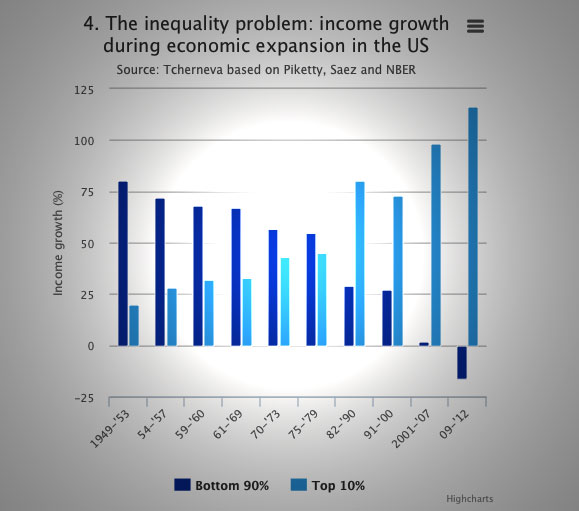
Why do I earn less than Donald Trump? This isn't fair.
Because you don't work hard enough. It's obvious!Why do I earn less than Donald Trump

He's not a drunkardWhy do I earn less than Donald Trump? This isn't fair.