Good Articles That Don't Deserve Their Own Threads

http://www.businessinsider.com/global-cities-too-expensive-paris-2013-6
International Cities Are Turning Into 'Elite Citadels'
SIMON KUPER, THE FINANCIAL TIMES JUN. 17, 2013, 3:14 PM 5,669 10

Two mournful friends dropped by our flat in Paris last Sunday.
They are a well-paid couple from the caste known in Paris as “bobos”: people with bourgeois incomes and bohemian tastes.

In the popular narrative, bobos have invaded Paris, driving out pure bohemians and the working class. But my bobo friends had a new story: they themselves were being driven out of Paris.

To get enough space for their kids, they were leaving for the suburbs. When they’d told the headmaster at the children’s school, he had looked sad and said: “Everyone is leaving.” Paris is pricing out even the upper middle-class.

There is a wider story here. The great global cities – notably New York, London, Singapore, Hong Kong and Paris – are unprecedentedly desirable. At last week’s fascinating New Cities Summit in São Paulo, the architect Daniel Libeskind said: “We live in a time of renaissance … cities are coming back to life, after a long neglect.” Edward Luce chronicled the urban revival in last Saturday’s FT Magazine. However, there’s an iron law of 21st-century life: when something is desirable, the “one per cent” grabs it. The great cities are becoming elite citadels. This is terrifying for everyone else.

At the New Cities Summit I had a coffee with Saskia Sassen of Columbia University, leading thinker on cities. That took some doing: Sassen arrived from Bogotá that morning, and was flying to Zurich hours later. “Cities were poor,” she told me, in between. “In the 1970s London was broke, New York was broke, Tokyo was broke, Paris was much poorer than now. And the built environment was a bit run down.”

But from the 1980s, these cities recovered. An increasingly complex financial sector needed more sophisticated networks of lawyers and accountants. Corporate mergers and takeovers meant global headquarters got concentrated in fewer places. Crime declined, making cities less scary. And so great cities grew richer. Fancy architects put up lovely buildings. House prices rose.

First, the working classes and bohemians were priced out. Nowadays the only ribald proletarian banter you hear inside Paris is from the market sellers, who don’t live there anymore.

That was gentrification. Now comes plutocratisation: the middle classes and small companies are falling victim to class-cleansing. Global cities are becoming patrician ghettos. In 2009, says Sassen, the top 1 per cent of New York City’s earners got 44 per cent of the compensation paid to its workers. The “super-prime housing market” keeps rising even when the national economy collapses. After Manhattan, New York’s upper-middle classes are being priced out of Brooklyn. Sassen diagnoses “gradual destruction”.

Global cities are turning into vast gated communities where the one per cent reproduces itself. Elite members don’t live there for their jobs. They work virtually anyway. Rather, global cities are where they network with each other, and put their kids through their country’s best schools. The elite talks about its cities in ostensibly innocent language, says Sassen: “a good education for my child,” “my neighbourhood and its shops”. But the truth is exclusion.

When one-per-centers travel, they meet peers from other global cities. A triangular elite circuit now links London, Paris and Brussels, notes Michael Keith, anthropology professor at Oxford. Elite New Yorkers visit London, not Buffalo.

Sassen says: “These new geographies of centrality cut across many older divides – north-south, east-west, democracies versus dictator regimes. So top-level corporate and professional sectors of São Paulo begin to have more in common with peers in Paris, Hong Kong et cetera than with the rest of their own societies.”

. . .

All through history, bright young people migrated to metropolises: think of Dick Whittington, the semi-mythical medieval English country boy who ended up mayor of London. But today Dick wouldn’t be able to afford a bedsit in London. He’d have to turn down an internship. To buy in these cities now, you must either earn a fortune or inherit a house there – and often the same people do both. Outsiders who reach the city late rarely have the education and contacts to succeed.

Inevitably, the one per cent in the global city shapes national policies. Sassen mentions core features of the “neoliberal project”, such as deregulating finance or privileging control of inflation over job growth. “The work was done in Wall Street, the City of London,” she says. Elite opinion-formers, who live in global cities alongside financiers (albeit in smaller flats), assured the little people that these policies would help everyone.

Sassen sighs: “The capture by a very small number of cities of a lot of the excitement and wealth produced by the system – this is a problem.” Outside these hubs, things are less desirable. Most western cities have lost manufacturing. Market towns struggle as small-scale agriculture fades. A few secondary cities (Lyon, Denver, Bristol) thrive. Most don’t. Even cities as prominent as São Paulo, Moscow or Johannesburg may prove too violent or congested to succeed. “You also have cities that simply die – Detroit,” adds Sassen. But if they’re out in the sticks, nobody powerful will hear them scream.
 
Interesting infographic on growing up with social media.

GrowingUpSocial_728x5349_Compressed.jpg
 
The FBI admitted to using drones over American soil today:
http://www.wired.com/threatlevel/2013/06/fbi-drones/
FBI Director Robert Mueller said today the bureau was surveilling the United States with drones.
The revelation was during an FBI oversight hearing before the Senate Judiciary Committee and comes as the bureau, along with the National Security Agency, are on the defensive about revelations that they are obtaining metadata on Americans’ phone records and Americans’ private data from companies like Google, Facebook, Microsoft and others.
The FBI is not alone in monitoring the U.S. with drones.
Federal agencies use them to survey U.S. borders, help fight wildfires and survey dams after hurricanes. Dozens of local law enforcement agencies nationwide deploy the unmanned crafts, too.
“Our footprint is very small. We have very few,” Mueller said in response to an inquiry on unmanned aircraft by Sen. Chuck Grassley (R-Iowa).
Grassley asked: “Does the FBI own or currently use drones and for what purposes?”
“Yes, for surveillance.”
Grassley continued: “Does the FBI use drones for surveillance on U.S. soil?”
“Yes, in a very, very minimal way, and seldom.”
Moments later, Sen. Dianne Feinstein (D-California) said drones were a huge privacy threat to Americans. The director was unprepared to answer Feinstein’s questions on what “privacy strictures” are in place to protect Americans’ privacy in connection to FBI drone use.
Still, Mueller said the drone program “is very narrowly focused on particularized cases and particularized leads.”
The bureau had employed drones to monitor a kidnapping scene in Alabama in February, when the FBI rescued a 5-year-old boy from a bunker, unnamed sources told CNN at the time.
 
Interesting infographic on growing up with social media.

GrowingUpSocial_728x5349_Compressed.jpg
Wow, the bullied/was bullied percentages actually add up to 100%. That never happens. Newflash to the 43% that wish they could uplug sometimes:
You can. Almost anytime.

Also, I'm sure everyone has noticed that MW ads feature people is atrociously ill-fitting suits while doing a voice over to the contrary. That guarantee is a lie!
 
http://www.thetruthaboutcars.com/20...or-insulting-language-on-ticket-payment-form/
Defendant is charged with Aggravated Harassment pursuant to Penal Law §240.30(1)(a) which allegedly occurred August 20,2012. It is alleged that Mr. [Barboza] signed a traffic payment correspondence with the words “FUCK YOUR SHITTY TOWN BITCHES” written across the top.
...
Defendant has submitted an extensive brief with numerous citations. However, no citation is necessary for this Court to determine that the language under the circumstances here, offensive as it is, is protected. The charge is dismissed.
 
http://www.rollingstone.com/politic...ng-ratings-agencies-with-chris-hayes-20130621
'You F--ked Up, You Trusted Us': Talking Ratings Agencies With Chris Hayes
  • by Matt Taibbi, Peter Travers, David Fricke, Rob Sheffield, RS Politics Daily, Tech Blog, Fashion Blog, more Blogs »
  • June 21, 2013
"Standard & Poor's has long had strict policies to reinforce the independence of our analytical processes. . . . We make our methodology transparent to the market."​
That was among the response of a spokesperson for the ratings agency Standard & Poor's when I contacted him a few weeks ago in advance of a new Rolling Stone feature, "The Last Mystery of the Financial Crisis," which describes the role the ratings agencies played in causing the 2008 crash. The company was genuinely miffed that anyone would impugn its honesty. In one relatively brief e-mail, the spokesperson used variables of terms like "independent," "integrity" and "transparent," upwards of nine times.
Hold that thought.
"The Last Mystery of the Financial Crisis" makes great use of documents uncovered in years of painstaking research by attorneys at Robbins Geller Rudman & Dowd, a San Diego-based firm that was at the forefront of major lawsuits against the industry. The material those lawyers found leaves virtually no doubt that the great ratings agencies like Moody's and S&P essentially put their analysis up for sale in the years leading up to the crash.
I picked some of the more damaging of these documents to ask about. Like for instance, an email from a company executive reading, "Lord help our fucking scam. . . . This has to be the stupidest place I have worked at."
Out of context, they said.
What about other highly suggestive emails, like the one in which an analyst joked that "we have just stuck our preverbal [sic] finger in the air!!", or the one in which an analyst admitted his quantitative model was only marginally more reliable than "flipping a coin"?
Not only cherry-picked and out of context, but "contradicted by other evidence," is how the S&P man put it.
"They do not reflect our culture, integrity or how we do business," he said. Note the word integrity again.
I point this out because the ratings agencies' responses to the questions we posed for the piece were almost as revealing as the extremely damaging emails and internal documents the Robbins Geller lawyers uncovered.
It wasn't just that there was apparently an entire generation of internal email correspondence that had been taken out of context (apparently, the context was taken out of context). More interesting was another line of defense.
Not long before I contacted them, S&P had made, in a very graphic and comical manner, a very strange argument in court. In an attempt to dismiss a federal Justice Department lawsuit pending against S&P, the company had, in a court motion, cited a Florida court case, Boca Raton Firefighters and Police Pension Fund v. Bahash.
In that case, the Second Circuit ruled that the plaintiffs suing S&P could not make a fraud claim based upon the company's reassurances in its Code of Conduct of its "objectivity, integrity and independence."
Moreover, the Court said, plaintiffs could not make a claim based on a public statement by S&P touting its "credibility and reliability," or another saying, "[S&P] has a longstanding commitment to ensuring that any potential conflicts of interest do not compromise its analytical independence."
Why, you might ask, could one not make a fraud claim based upon those statements? Because, the Second Circuit ruled, those statements were transparently not meant to be taken seriously. The following passage is a summary written by S&P's own lawyersdescribing the Second Circuit ruling (emphasis mine):
The Second Circuit affirmed the district court's dismissal of the plaintiffs' claims in their entirety, finding that the statements concerning the "integrity and credibility and the objectivity of S&P's credit ratings" were exactly "the type of mere 'puffery' that we have previously held not to be actionable."​
More from that same memo from S&P's lawyers:
The Court found . . . that "generalizations about [S&P's] business practices and integrity" were "so generalized that a reasonable investor would not depend on [those statements]. . . ."
Because S&P's statements about its objectivity, independence and integrity are the sort of vague, general statements that courts both within and outside this Circuit have found insufficient to support a fraud action, the Government's first "alleged scheme to defraud" fails.​
Now, in response to my questions, the S&P spokesman made a series of arguments about the plaintiffs in the lawsuits in question. All of these points came down to the same idea: that these investors were big boys, and should have known better than to rely upon an S&P rating.
"Most of the plaintiffs were sophisticated institutional investors that did not actually rely on the ratings in making decisions," he wrote. These plaintiffs, he went on, were "large institutional investors with significant investment staffs of their own," and some of them, he pointed out, didn't cover themselves in glory with their background research.
One institutional investor, he wrote, "admitted that it did no more than look at the rating and the yield on a Bloomberg screen, spending no more than five minutes deciding to invest $50 million." All they did was look at our rating before investing! What idiots!
This is straight out of Animal House. It's the Wall Street version of, "You fucked up – you trusted us!"
I don't often get angered by the things press spokespeople say. Most of these people have difficult jobs and are often forced to be the public faces of policies they had nothing to do with creating.
But in this case, S&P just a few weeks before had sworn before a judge that its reassurances about objectivity, integrity and independence were not legally binding, vague, and so generalized as to be essentially meaningless.
Yet when I contacted this company, they sent me exactly, and I mean exactly, the same reassurances about objectivity, integrity, and independence that they themselves had laughed at as "mere puffery," "vague," and "so generalized that a reasonable investor would not depend" on them.
Then they went on to deride the plaintiffs in their lawsuit for not being smart enough to do their own research and make their own assessments about the meaning of an S&P rating, and the value of its reassurances of independence and integrity. Yet us reporters are apparently still expected to take such assurances at face value, which if my math is correct means that in their eyes, we must be even dumber than the investors in the products they rate. What a bunch of assholes!
Anyway, if you want the full lowdown on what actually goes on internally at these companies, check out the piece, which is full of the devastating material dug up by those San Diego lawyers.
Also, thanks so much to the excellent Chris Hayes at MSNBC, who had me on last night to discuss the issue. It was a very fun talk.
 
UGH!
http://www.slate.com/articles/arts/..._that_makes_european_dvrs_so_much.single.html
Why Do Americans Have the Worst DVRs?

Our digital recorders cut off the last minutes of sporting events and our favorite shows. That doesn’t happen in Europe.
  • by Josh Levin
  • June 21, 2013
It took a few minutes shy of forever to get to the end of Game 1 of hockey’s Stanley Cup Final, but at least for non-Bostonians, it was worth the wait. Four hours and 38 minutes after the game began, Andrew Shaw finally scored the winning goal to push the Chicago Blackhawks past the Boston Bruins in the third overtime. The game’s not-so-sudden death didn’t come quite quickly enough for one unlucky hockey watcher. As that anonymous fan explained on Reddit, adding an extra two hours to the end of his DVR recording seemed like a smart move. But in the end, those buffer hours left him just six seconds shy of seeing the winning goal. Ain’t that a puck in the teeth.
I can relate. In the interest of sleep and sanity, I time-shifted the early rounds of the NBA playoffs, catching up on the previous night’s games each morning. Alas, my recording of Game 1 of the NBA’s Western Conference semis, in which the Spurs beat the Warriors 129–127 in double overtime, ended just before the final shot went in the air. (I think the Warriors could still pull this one out!) As a savvy DVR user, I of course padded my recording by an extra hour, just in case the game extended beyond its scheduled end time. But an hour, or even two, sometimes isn’t enough. That’s the peril of taping live sporting events. A long fifth set, a bee delay, or yet another period without the puck going in the net—all can lead to a game overspilling its programming window by hours. Worst of all, the sporting events most likely to be ruined in this manner are precisely the ones we most want to watch to the end: those extra-long, extra-tense games that go into overtime or extra innings.
It’s easy to imagine a universe in which DVRs worked better. Rather than forcing TV watchers to pad their recordings manually, broadcasters could send a signal to cable and satellite providers when a program begins and another when it ends. Your DVR would grab these signals, ensuring that it starts each recording when it should start and ends it when should end—not at some (often-wrong) scheduled time, but at the real time. This wouldn’t just solve ball, stick, and puck problems. It would also benefit everyone who’s suffered the pain of missing the last joke on 30 Rock because the show runs just a little bit beyond its allotted time.
Here’s the good news: This hypothetical DVR utopia actually exists, and a lot of people are living in it. The bad news for me and my fellow Americans: The United States is trapped in the bowels of DVR hell, and we’re not going to escape any time soon.
Now, let us take a journey to this magical land where DVRs work as they should. Our tour guide is Raj Patel, the chief solutions architect for the United Kingdom’s Freesat, a partnership between ITV and the BBC that provides free satellite TV service to 1.7 million homes. Patel explains that broadcasters supply Freesat and certain other international television providers with what’s called “present and following” information—that is, the identity of the program that’s airing right now and the one that’s scheduled to air next. Even if a program (like, say, a sporting event) is supposed to end at 10:30 p.m., the broadcaster will not change that present and following data until the game is actually over. A customer’s DVR, in turn, will not stop recording until it’s been signaled that the present and following information has changed. This feature is called “accurate recording,” and that’s exactly what it is. It means you’ll never miss the end of a game—not even a Champions League final that goes into extra time.
This isn’t a special feature reserved exclusively for couch potatoes with British accents. NorDig, the body that specifies digital TV standards in Scandinavia and Ireland, also mandates that DVRs come equipped with accurate recording technology. This feature is also available in Australia, where the TV provider Freeview calls it “intuitive recording” and brags that “you will never miss the end of a recorded show again” thanks to a system in which each show gets a unique reference code.
Why do Brits and Aussies get to watch impeccable recordings of “football” while red-blooded, American football gets cut off by our inferior American DVRs? It’s not because the technology somehow doesn’t work on our side of the pond. Based on interviews with multiple people at various industry stakeholders, I believe that accurate/intuitive/non-terrible recording would be feasible in the United States. The reason it doesn’t exist, I believe, is that American broadcasters and service providers don’t want it to exist. But we need to make our voices heard. The time is now to save our country from substandard DVR technology.
Broadcast standards aren’t uniform across the world. Europe, Australia, India, parts of Africa, and a bunch of other places comply with the DVB standard, while North America goes by something called ATSC. But Dave Arland, a spokesman for ATSC, says there’s nothing about the North American broadcast standard that would prevent any company here from implementing accurate recording.
Similarly, a source at a major U.S. television service provider—who refused to go on the record, perhaps fearing an onslaught of marauding customers—told me the company’s DVRs are capable of accurate recording. The issue, the source said, is that the broadcasters would need to provide them with real-time data on the start and end times of live events. That’s already happening in the United Kingdom and other places with accurate recording, but not in North America.
So what do the broadcasters have to say for themselves? Three networks I reached out to—Turner, Fox, and CBS—did not reply substantively prior to publication of this article. (I will update this story if they do.) And after initially offering to field questions on the topic, an ESPN spokesperson replied via email, saying, “At this time, ESPN will not be able to contribute here—it’s not entirely relevant to us as [the] majority of our content is consumed live.”
ESPN is not necessarily a huge villain here—their WatchESPN app and online service allows subscribers to watch full replays of recent games. Even so, the Worldwide Leader and other purveyors of sports programming would clearly prefer for all of us to watch sporting events live. An estimated 46 percent of American homes have DVRs, up from 3 percent a decade ago. As DVR penetration increases, people watch less live TV and skip more commercials. By comparison to pre-recorded fare, sporting events are relatively resistant to time-shifting—many of us want to watch with our friends, chime in on Twitter, and go outside and set a car on fire the instant the game is over. It makes sense, then, that broadcasters would do everything they can to preserve this last thin slice of programming that people seem inclined to watch live. So long as DVRing sporting events remains an uncertain proposition, those live viewership numbers should stay steady. If you can’t be sure that you’ll see the last few minutes of OT, then you’ll want to watch every important game as it happens—without fast-forwarding through the ads.
In this land without accurate recording, American cable and satellite companies have fashioned a jury-rigged system that works most of the time, for most kinds of shows. In the absence of real-time signals from broadcasters, time-shifters must use on-screen programming guides to schedule recordings. These guides are programmed by third parties like Rovi Corp. and Tribune Media Services, which obtain listings information (dates, times, titles, scheduled run times, etc.) from broadcasters, normalize that data, and provide it in a packaged format to Comcast, Dish Network, and the like.
As you’ve probably noticed, these guides don’t get updated in real time. According to TiVo’s vice president of product marketing Jim Denney, it takes about a day for a programming guide change—say, a program shifting to a different time slot—to ripple through that company’s entire system. That’s why, in the event of a last-minute scheduling shift, your DVR won’t record your favorite show. It also explains why providers have created something of a hack to deal with the uncertain end times of live programs. The set-top box provided my cable company, Comcast, takes note when I’m DVRing a live event, and asks if I want to extend my recording by up to two hours. This is standard functionality across the United States: Instead of recording television shows for us, our cable companies ask that we scratch our heads and predict how long they’re going to last. It’s like hiring someone to mow your lawn, with the catch that he’ll only cut the grass for as long as you guess it will take him to finish the job. Hopefully you’ll guess right.
What are the chances that accurate recording will become a standard feature in these United States? TiVo’s Denney says that, though such a thing is technically possible, it would require a lot of coordination between content providers, cable companies, and technology firms. There would also have to be some deep thinking on what to do in the event of programming conflicts, such as an extended live event interfering with another, previously scheduled recording. “Everything is doable, but it's a matter of how much effort someone's willing to put into it,” he says.
What’s holding everyone back, Denney adds, is the lack of demand from customers. “We don't have a whole lot of people saying, My God, I wish we could do this.”
I don’t think that’s evidence American TV viewers don’t want accurate recording. Rather, it reveals that they don’t know it exists. Well, America, it does exist, and it sounds amazing. Email your cable company. Call every TV station. Tweet at your congressman. Leave a copy of this article under your neighbor’s door. Say it loud, everyone: We want accurate recording, and we want it now.
 
http://www.forbes.com/sites/adamtan...easons-not-to-give-stores-your-zip-code-ever/
There's A Billion Reasons Never To Give Stores Your ZIP Code
  • by Adam Tanner
  • June 19, 2013
Why do merchants sometimes ask us for our ZIP code when we buy something?
I recently visited the Mob Museum in Las Vegas, an interesting addition to Sin City’s attractions. I paid my admission with a credit card, prompting the museum ticket seller to ask me: “What’s your ZIP code?”
When I paused for a moment, she added: “It’s for marketing purposes.”
As much as I had heard good things about the museum, I was unlikely to return soon as I live far from Las Vegas, so I was not anxious to receive subsequent marketing. She said it was okay not to give the ZIP code, and then addressed me by name in wishing me a good visit.
Jo Anna Davis remembers one ZIP code request that did not end well. A California victim of domestic violence who works at a group to help other victims, she guards her privacy carefully. Over the years she became a loyal customer of Ulta, the beauty care company. On one occasion she purchased a skin care kit which caused an unpleasant reaction. She brought the kit back to the store for a refund, and the clerk asked for Davis’ ZIP code to process the transaction.
Concerned about her privacy, she declined to provide the information, prompting the clerk to remark that no one had ever refused before. The clerk called the manager, who showed irritation. Davis asked for her receipt back, the manager refused, so she took it herself. An argument ensued. The manager locked the store’s door and demanded it back. “It was absolutely insane. I’m sure I looked rather crazy myself,” Davis says.
The whole scene emerged only because Davis did not want to share her ZIP code. Why make such a big deal over five digits that only records that someone lives in the same area as many thousands of others? Because along with other information, the ZIP code may provide the final clue to figuring out your address, phone number and past purchasing details, if a sales clerk sees your name while swiping your credit card.
How does this work? In one of their brochures, direct marketing services company Harte-Hanks describes the GeoCapture service they offer retail businesses as follows: “Users simply capture name from the credit card swipe and request a customer’s ZIP code during the transaction. GeoCapture matches the collected information to a comprehensive consumer database to return an address.” In a promotional brochure, they claim accuracy rates as high as 100%.
Fair Isaac Corp., a company best known for its FICO credit scores, also offers a similar service which they say can boost direct marketing efforts by as much as 400%. “FICO Contact Builder helps you overcome the common challenges of gathering contact information from shoppers—such as complicating or jeopardizing the sales process by asking for an address or phone number, or complying with regulations,” it says. “It requires minimal customer information captured at point-of-sale, just customer name or telephone number and the customer or store ZIP code.”
Mr. ZIP promoted the use of ZIP codes for the USPS during the 1960s and 1970s. (Photo credit: Wikipedia)
Because customers are usually not told that stores are building a marketing database from the transactions, some object.
In one high-profile case, the home furnishings and cookware chain Williams-Sonoma matched names from its credit card sales and ZIP codes with a database to obtain addresses and other information for future marketing. One woman sued, saying she provided her ZIP code thinking it was necessary to complete the credit card transaction. In the resulting case the Direct Marketing Association and privacy groups showed sharply different outlooks on the practice. The case eventually made its way up to the California Supreme Court, which ruled in 2011 that stores cannot require patrons to furnish their ZIP code. California later confirmed the ruling in a law that bars firms from collecting personally identifying information during credit card transaction. Courts in other states such as Massachusetts earlier this year have reviewed the issue.
As for Ulta, I contacted Cynthia Payne, the company’s senior vice president of store operations, to ask about Jo Anna Davis’s experience. “It is extremely disappointing for me to know that we have lost a valuable customer and that the service in any one of my stores was less than stellar,” Payne said. She added the company seeks to provide an exceptional guest experience and she offered to contact Davis to undo the damage from that visit.
Just because businesses ask for a ZIP code does not necessarily mean that they will append data to their files to know where you live, your phone number, email and other information. The process costs money, and unless they have a way to market off the data, there would be no reason to do it.
Ashley Misko, the Mob Museum’s director of marketing, did not observe to code of omerta when I asked what the year-and-a-half old museum does with its customer ZIP codes. She said they do not cross reference names and ZIP codes with other data, but just try to understand where their visitors are coming from.
“Ultimately, understanding how our patrons are finding out about us, which marketing/advertising efforts are affecting them, will give us the ability to make important decisions about our advertising resources and ZIP codes play a huge role in identifying that source,” she said. “We strictly utilize the information we receive to better understand the demographics of the market of those specific ZIP codes.”
 
http://www.theverge.com/2013/6/25/4...as-plan-fix-climate-change-flawed-say-experts
President Obama's plan to fix climate change is fatally flawed, experts say

Why the White House's proposals for curbing pollution may be mostly smoke and mirrors
By Carl Franzen on June 25, 2013 02:25 pm

President Barack Obama gave a high-profile speech this afternoon at Georgetown University in Washington, DC, to announce a massive new government plan designed to address climate change. But the plan, details of which were released by the White House on Tuesday morning ahead of the president's speech, won't do much to help fix the problems of pollution and global warming, and may actually make things worse overall, according to independent climate experts.
"It's amazing how little this all actually does."
"It's amazing how little this all actually does," said Mark Jacobson, a professor of civil and environmental engineering at Stanford University. "In many ways, this makes things worse." Jacobson, who has spent years researching the link between air pollution and human health in the United States, points out that the White House's seemingly bold objective to curb carbon pollution by 3 billion metric tons by 2030 actually equates to cutting about one-fortieth of all pollution produced by the US energy sector each year. "The numbers are so trivial, it's almost like a gimmick," he said. Another part of the White House's plan, to increase the amount of renewable energy projects on federal lands enough to power 6 million homes by 2020, is "embarrassingly trivial," in a country of over 130 million housing units, said Jacobson.
Jacobson also takes specific issue with part of the president's plan that calls for the US Energy Department to provide $8 billion in loan guarantees to what the plan calls "advanced fossil energy projects." Jacobson and other experts say that this term refers to one idea in particular: installing new equipment to capture carbon emissions from coal-fired power plants, and attempting to pump it back into underground storage areas, where it won't get into the atmosphere for many years. Such a technique could reduce between 85-90 percent of carbon emissions from coal plant smokestacks, according to estimates of companies pursuing it.
The idea sounds good in principle, but the science behind it remains largely unproven. "There's not even a single commercialized coal-with-carbon-capture plant" in the US, Jacobson pointed out. Indeed, several companies have abandoned attempts to build such plants in recent years after deciding the costs would be too high and incurring opposition from environmental groups. But several US carbon capture projects are still in development right now, including a Department of Energy-funded attempt to build one ethanol-powered carbon capture plant in Decatur, Illinois.
The science remains largely unproven
More problematically, Jacobson and other energy experts agree that such carbon capture systems would actually end up releasing many more emissions per plant than they do now, because the carbon capture systems themselves take considerably more energy to operate. "By some estimates, 40 percent of the energy generated has to go to the carbon capture and sequestration process," said Josh Galperin, associate director of the Yale Center for Environmental Law and Policy. Furthermore, the carbon capture and sequestration process doesn't eliminate several major sources of emissions from coal and fossil fuel plants, namely, the upstream production emissions — those released by mining and transporting coal to the plants.
"10 percent reduction in greenhouse gas emissions by 2050."
The offer of $8 billion in loan guarantees also strikes Galperin and Jacobson as odd: the new White House plan also aims to cut some US subsidies for the fossil fuel industry. Citing figures from the International Energy Agency, the White House's climate change plan says that globally, the fossil fuel industry — which includes coal, oil, and gas production — receives $500 billion in subsidies each year. A "phase-out" of such subsidies, as the White House proposes, would lead to an estimated "10 percent reduction in greenhouse gas emissions below business as usual by 2050." The White House notes that President Obama has called for the elimination of some subsidies in his 2014 budget, but it's unclear from the documents released today when or how exactly the White House will go about cutting them.
Still, more disconcerting than the lack of specificity to experts is the fact that the White House advocates cutting money going to the fossil fuel industry on one hand, and yet is offering $8 billion in guarantees of new loans for said industry on the other hand. "[The president] is saying he's trying to cut subsidies to fossils, but then, he's giving them, in effect, another subsidy."
"More than the entire wind and solar energy receives from the government each year."
To be clear, a loan guarantee is different than a direct subsidy or a tax credit. The government only has to pay if a company defaults on its loan. But the Obama administration has been criticized for handing out loan guarantees to energy projects before. In Obama's first term, the Energy Department offered loan guarantees for many renewable projects, including the ill-fated Solyndra solar plant, which went bankrupt in 2011 and became a target for conservatives critical of the government's attempt to spur development of renewable fuels more broadly. Offering loan guarantees to experimental projects like carbon capture or gasification of coal, which are pursued by the more mature, stable fossil fuel industry, may incur less blowback from conservatives. Still, Jacobson would rather see that money and more go to the development of purely renewable fuel technologies. "That $8 billion is much more than the entire wind and solar energy receives from the government each year," he told The Verge. Estimates from the Congressional Budget Office back that up.
Not all of the White House's new climate change plan is being faulted, though. Galperin, for his part, told The Verge he was encouraged by the White House's many new proposals for defenses against climate change. "We've been looking for years in the public sphere at how do you mitigate the problem of climate change," Galperin said. "But what we haven't done enough of, in my opinion, is figuring out how to deal with it and adapt society to it." The White House is looking to remove restrictions on how much money agencies can spend on such defenses, but the plan doesn't cite any specific restrictions targeted for elimination. The president will also create a special temporary task force made of state and local officials to give him and the federal government ideas on how they can better help local communities prepare for climate change's impacts.
"this is either climate change, or what climate change looks like."
The White House's plan specifically cites Hurricane Sandy, which hit the Northeast in October 2012 and caused substantial damage and some loss of life to many communities and the New York Metropolitan area, as an example of what the country should be preparing for going forward. "It's always perilous to point to a specific event like Sandy and say 'this is climate change,'" Galperin said. "But what people are saying is, this is either climate change, or what climate change looks like. It demonstrates exactly the kind of threats that climate scientists and meteorologists are warning us about."
 
I'm only sticking this in here because I don't think anyone gives a shit:
http://www.theverge.com/2013/6/25/4338838/all-the-presidents-hitmen-chasing-washingtons-secret-army
All the president's hitmen: chasing Washington's secret army
  • by Joseph L. Flatley
  • June 25, 2013
Additional reporting by Jesse Hicks and Joshua Kopstein
In the 1960s there was a saying: "Suppose they gave a war, and nobody came?" We'll probably never know the answer to that drug-inspired American koan, but a recent book and documentary film sets out to answer a more important question: "What if they gave a war, but didn't tell anyone?"
Dirty Wars by Jeremy Scahill is a boots-on-the-ground document of the war on terror, as it's being waged everywhere on the planet, including Afghanistan, Yemen, and Somalia. The most telling aspect of this war is how it's fought in secret, by a White House seemingly taken by its own intelligence and awesome war-making abilities. Of course, this means that we have to really be able to trust the government. As the events chronicled in the book make clear, it's high time we stopped taking the government at its word and started pressing for some real answers.

In February 2010, in a village near the city of Gardez in Afghanistan, an American military raid resulted in the death of five civilians, including two pregnant women and one teenage girl. The two male victims were local officials, a police chief and a prosecutor. After the raid, the United States issued a press release in which it claimed that a combined American–Afghan force had been following up on intelligence that placed the Taliban at the family's home when it happened upon some sort of ritual "honor killing." Unfortunately, the story goes, they were too late to save the lives of the women.
"The Americans were probably given bad intelligence," explains Richard Rowley, director of the companion film to Scahill's book. "They [arrived] at a compound where a party was happening, where they were celebrating the birth of a child. They were having a naming ceremony, and there were dozens of people and music playing and women there without head covers."

The attackers, thinking they had entered a Taliban stronghold, started firing. Afterwards, Rowley says, "They covered it up. Witnesses [and] forensic evidence collected afterwards indicated that they dug the bullets out of the bodies of the women, and then blamed it on the family themselves. And took all the men off to another province to be interrogated."
"An all-star team made up of the Army’s Delta Force, SEAL Team Six, Army Rangers, and the 160th Special Operations Aviation Regiment."
Eventually, the United States would change its story, and admit that the incident was a tragic mistake. Soon thereafter, Rowley says, "Early in the morning an armored convoy rolls up to this compound, and a US admiral gets out and offers to sacrifice two sheep at the doorstep of this family, and offers an apology, saying his men were responsible for this." But the press in Afghanistan doesn't recognize the admiral. "He's not from NATO command," Rowley continues. "He's not from RC [Regional Command] East, which owns the battle space. He's not part of the conventional force in Afghanistan at all."
The man in the photograph was Admiral William McRaven, the commander of JSOC, or the Pentagon's Joint Special Operations Command. Scahill refers to JSOC as "an all-star team made up of the Army’s Delta Force, SEAL Team Six, Army Rangers, and the 160th Special Operations Aviation Regiment." Speaking in more mythic terms, an anonymous Navy SEAL once told Dana Priest and William M. Arkin of The Washington Post that JSOC was "the dark matter ... the force that orders the universe but can’t be seen."

Operating under the authority of a confidential order signed in 2004 by Donald Rumsfeld with the blessing of President Bush, JSOC has the authority to attack the al-Qaeda terrorist network anywhere in the world. This was part of an ongoing evolution of the American military, a process that began secret detention, extraordinary rendition, and warrantless wiretaps, according to Eric Schmitt and Mark Mazzetti of the New York Times.
The "covert" in covert ops doesn't just apply to specific operational details. One of JSOC's strengths is that it exists in a legal black box, where the executive branch rarely briefs Congress in advance of a mission, and "usually not afterward," according to Priest and Arkin. Of course, some victories will get acknowledgement — the White House started springing leaks as soon as Osama bin Laden's corpse was dumped into the ocean — but it was some time JSOC took any responsibility for Gardez.

As Rowley explains, "This is the new paradigm of American militarism. It'll be a long time before [another] George Bush-style ground invasion of a country in Asia, [with] 200,000 troops on the ground and the idea that we're going to build a new democracy." Instead, our wars will be fought in secret, with "a massive covert army that is outside of the conventional chain of command, that's responsible directly to the president, [with] little meaningful oversight and no scrutiny in the press."
In Yemen, Scahill met the family of two American citizens, the infamous radical Muslim cleric Anwar al-Awlaki and his not-at-all radical, non-clerical, teenage son Abdulrahman. Both father and son were targeted and killed in separate drone strikes in late 2011. The elder al-Awlaki had long been in the US government’s crosshairs, having gained his greatest notoriety as al-Qaeda’s chief propagandist in the Arabian Peninsula. He was the very definition of a traitor, as Tom Junod has pointed out, even if he had never been indicted. The elder Awlaki met his fate in a drone strike manned by the CIA, as JSOC and some ground troops stood by to assist if necessary.
Abdulrahman was not in the same league as his father. Born in Denver, Colorado, he has been described by the New York Times as a pretty typical kid who had just turned 16, a hip-hop fan who "liked sports and music and kept his Facebook page regularly updated." On October 14th, 2011 at about 9:00 PM, a Predator drone fired the missile that killed Abdulrahman and several other teenage members of his family as they ate at an outdoor restaurant.
Nasser al-Awlaki is Anwar's father and Abdulrahman's grandfather, a Fulbright Scholar who earned his master's degree at New Mexico State University and a doctorate at the University of Nebraska. After the attack that killed his grandson, relatives located the teenager's body. "He was buried with the others in one grave," Scahill writes, "because they were blown up to pieces by the drone." All that could be recognized of his grandson was his hair. "But they could not recognize his face or anything else."
While media outlets cited "unnamed officials" inside the White House who confirmed its responsibility for the attacks, the official government line was feigned ignorance, delivered in a particularly arrogant manner. "For over the past year, the Department of State has publicly urged US citizens not to travel to Yemen and has encouraged those already in Yemen to leave because of the continuing threat of violence and the presence of terrorist organizations ... throughout the country," reads one of the highlights of a press conference by National Security Council spokesman Thomas Vietor. In the same statement, he acknowledged the existence of press reports that a known terrorist named Ibrahim al Banna was killed in the strike, "and that several others, including the son of Anwar al-Awlaki, were with al Banna at the time."
This was only the beginning of the misinformation that surrounded the killing. Banna's outfit, Al-Qaeda in the Arabian Peninsula, issued a statement saying that the terrorist was in fact alive and well — which raises the possibility that the strike had nothing to do with him in the first place. US officials, speaking at the time of Abdulrahman's death, variously claimed that the younger Awlaki was 21 years old, or that he was a militant himself, neither of which turned out to be true.
When asked at the time about Abdulrahman's death, former White House press secretary Robert Gibbs (speaking for Obama's re-election campaign) replied with characteristic compassion when he said that the boy "should have [had] a far more responsible father."

They're called "lily pads," because they're small, temporary locations that our covert army can use as a jumping-off point into regional combat, much as a cartoon frog might, if that frog was an elite, trained killer (which would make the terrorists cartoon flies, I suppose). Technically known as a CSL or Cooperative Security Location, the lily pad is central to our current war on terror. Just as the Pentagon obscures its battles by waging wars with covert troops, it obscures its empire of bases around the world by relying on lily pads established at foreign military bases. According to the US Air Force, this gives the military a springboard for attacks in places like Dakar, Entebbe, and Libreville, Gabon. There is no exact number available, but including the CSL sites it's been discovered that the American military has over 700 bases outside the United States.
Just like the number of overseas bases (and, as Nick Turse points out in The Complex, the number of overseas military golf courses), JSOC operations are rarely commented upon and almost never officially acknowledged. Instead, we have to rely on journalists like Scahill and Rowley to reconstruct the events, as if this were a mystery novel.
In Dirty Wars, Scahill pieces together one operation that took place in early 2007, at the beginning of the US-backed Ethiopian invasion of Somalia. JSOC, he writes, "Had quickly set up its makeshift 'lily pad' at the discreet US base in Manda Bay, Kenya ... and was waiting to pounce." It finally had its chance on January 7th, when a Predator drone launched from Camp Lemonnier [Djibouti] located a convoy of vehicles in southern Somalia. As it tracked the convoy, an AC-130 gunship arrived, attacking it "just before it disappeared into a forest along the Kenya–Somalia border." According to US officials, as many as a dozen fighters were killed in the engagement. Afterwards, JSOC personnel arrived to take DNA samples of the dead.
This was among the first overtures in a bloody invasion that ran over two years and killed approximately 10,000 people, creating 1.1 million refugees in the process, according to Human Rights Watch. And this is now the American way of war: small, mobile "lily pad" bases and covert operations that remain secret, so when we see the humanitarian crisis unfold on the TV news, we have no idea that our government played a hand in creating it.
In the fall 1998 issue of Covert Action Quarterly, former United States attorney general Ramsey Clark offered some insight into the nature of government secrecy. Its main purpose, he writes, isn't to hide things from our enemies as much as it is to hide things from the American people. "The Cambodians knew they were being bombed," he explains. "So did the Libyans. The long suffering Iraqis know every secret the US Government conceals from the people of the United States and every lie it tells them."
Indeed, the family of Abdulrahman al-Awlaki knew the origin of the drone strike that killed their loved one, as did the families of those killed in that village near Gardez. The only reason for a cover-up was to keep the true nature of war from mainstream America's eyes and ears.
This is why Scahill's book is such an important document. It shines a light on those things that are being done in our name, things that are being kept secret.
The next time the dim-witted pundits on cable TV "news" ask their viewers why "the terrorists" hate America, you can point to this book for the answer.
But let's hope it doesn't come to that.
 
Good point worth remembering on the Prop 8 decision:

The Big Problem With the Supreme Court's Prop 8 Decision

by Kevin Drum
In today's other decision on gay marriage, the Supreme Court declined to allow supporters of California's Proposition 8, which banned gay marriage, to appeal their case in federal court. (Opponents had sued and successfully overturned Prop. 8.) Supporters could appeal the decision in California, the court said, because California recognized their standing, but they can't sue in federal court because they don't have standing according to federal rules. Since the California Supreme Court had ruled Prop. 8 unconstitutional, this means the issue has been decided. Gay marriage is legal in California.
But this decision bothers me. The problem is that both the executive and legislative branches in California declined to defend Proposition 8 in court. This left it to the proponents of Prop. 8 to do so, but the Supreme Court decided today that they don't have a "personal stake" in the law, no matter how deeply they feel about it. I think the dissent gets at the core problem here:
The Court's reasoning does not take into account the fundamental principles or the practical dynamics of the initiative system in California, which uses this mechanism to control and to bypass public officials—the same officials who would not defend the initiative, an injury the Court now leaves unremedied. The Court's decision also has implications for the 26 other States that use an initiative or popular referendum system and which, like California, may choose to have initiative proponents stand in for the State when public officials decline to defend an initiative in litigation.​

In California, it's routine for the people to pass initiatives that neither the governor nor the legislature supports. In fact, that was the whole point of the initiative process when it was created. In cases like these, of course the governor and legislature are going to decline to defend the law in court. With today's decision, the Supreme Court is basically gutting the people's right to pass initiatives that elected officials don't like and then to defend them all the way to the highest court in the land.
To me, this has neither the flavor of justice nor of democratic governance, regardless of whether I like the outcome.
 
Rep Tammy Duckworth completely eviscerating this scumbag bastard who's abusing the VA's disabled vet contract system. You gotta watch her shame the shit out of this guy:


Tammy Duckworth Does Not Suffer Phony Disabled Vets Gladly

An IRS contractor who has been using a minor, possibly non-existent injury from his prep school days 27 years ago to secure government contracts for his company was publicly shamed by Rep. Tammy Duckworth (D-IL) in such a magnificent way that it almost made his fraud worthwhile.
Braulio Castillo, CEO of Strong Castle Inc., claims he broke his foot playing sports at a military prep school in 1984.
Before starting his technology company, Castillo filed for and received a 30 percent disability rating from the Department of Veterans Affairs (VA), allowing Strong Castle to label itself a "service-disabled, veteran-owned small business," thereby making it eligible for so-called "set-aside" government contracts.
Castillo is now embroiled in a lengthy probe into the possibility that he further gamed the system by using his friendship with top IRS official Greg Roseman to obtain contracts.
But back to Castillo's supposed disability: According to the House Oversight Committee, the fracture Castillo claimed he suffered didn't show up in X-rays taken at the time of his supposed injury.
And Castillo doesn't even remember how he got injured in the first place.
That was more than enough for Castillo to earn the ire of decorated war hero Duckworth, who lost both her legs and the use of her right arm while serving as a helicopter pilot in Iraq.
But what really pushed her over the edge was a letter sent by Castillo to the VA as part of his efforts to secure government contracts.
"These are crosses that I bear due to my service to our great country and I would do it again to protect this great country," Castillo wrote.
"I’m so glad that you would be willing to play football in prep school again to protect this great country," Duckworth responded. "Shame on you, Mr. Castillo. Shame on you. You may not have broken any laws … but you certainly broke the trust of this great nation. You broke the trust of veterans. Iraq and Afghanistan veterans right now are waiting an average of 237 days for an initial disability rating. It is because people like you who are gaming the system are adding to that backlog that young men and women who are suffering from post-traumatic stress, who are missing limbs cannot get the compensation and the help that they need."
You must watch the whole thing.
 
http://gawker.com/way-too-many-americans-spend-most-of-their-income-on-re-597705415
Way Too Many Americans Spend Most of Their Income on Rent


Flippers. Record home prices. Stock markets at record highs. Record low-interest rates. Just add some sad tales about young couples making $250,000… Read…
Throughout America, the housing market has recovered so well from its collapse five years ago that we're already talking about the next collapse. This has been great news for current homeowners. But for poor people who would prefer not to be homeless, times are only getting harder.
The Harvard University Joint Center for Housing Research's annual report on the state of housing in America is out (as if we had to tell you!). The good news: the housing recovery is "well underway," with home prices up by nearly 12% in the past year; home sales were up 20% in 2012; and home improvement and construction spending are contributing positively to the economy once again.
The bad news: this is a terrible time to be poor and want to live indoors. Even worse than usual. The rental market is tightening. Homeownership rates have fallen for eight straight years. Household incomes are down over the past decade. Low-cost apartments are continually disappearing from the housing stock. And the housing picture for the poor in America is far from sunny. A few key stats:
-On average, real home values for Hispanic owners plummeted nearly $100,000 (35 percent) between 2007 and 2010, while the decline for black owners was nearly $69,000 (31 percent). By comparison, average values for white homeowners fell just 15 percent over this period.
​
-In 2011 42.3 million households, or 37 percent, faced housing cost burdens, paying more than 30 percent of pre-tax income on housing costs, including 20.6 million households (17.9 percent) with severe cost burdens, paying more than 50 percent of pre-tax income for housing.​
-Nearly seven out of ten households with annual incomes of less than $15,000 (roughly equivalent to year-round employment at the minimum wage) pay more than half of their income for housing costs.​
The number of "extremely low-income renters" has increased by 2.5 million since 2007. There are currently almost twice as many of these poor renters as there are housing units affordable enough for them to rent.
 
Rep Tammy Duckworth completely eviscerating this scumbag bastard who's abusing the VA's disabled vet contract system. You gotta watch her shame the shit out of this guy:


All I can say is:

:applause: :applause: :applause: :applause: :applause: :applause: :applause: :applause: :applause: :applause: :applause: :applause: :applause: :applause: :applause: :applause: :applause: :applause: :applause: :applause: :applause: :applause: :applause: :applause: :applause: :applause: :applause: :applause: :applause: :applause: :applause: :applause: :applause: :applause: :applause: :applause: :applause: :applause: :applause: :applause: :applause: :applause: :applause: :applause: :applause: :applause: :applause: :applause: :applause: :applause: :applause: :applause: :applause: :applause: :applause: :applause: :applause: :applause: :applause: :applause: :applause: :applause: :applause: :applause: :applause: :applause:
 
https://www.nytimes.com/2013/06/27/...ies-to-new-york-police.html?ref=nyregion&_r=0
C.I.A. Report Finds Concerns With Ties to New York Police
  • by CHARLIE SAVAGE
  • June 26, 2013
WASHINGTON — Four Central Intelligence Agency officers were embedded with the New York Police Department in the decade after Sept. 11, 2001, including one official who helped conduct surveillance operations in the United States, according to a newly disclosed C.I.A. inspector general’s report.
That officer believed there were “no limitations” on his activities, the report said, because he was on an unpaid leave of absence, and thus exempt from the prohibition against domestic spying by members of the C.I.A.
Another embedded C.I.A. analyst — who was on its payroll — said he was given “unfiltered” police reports that included information unrelated to foreign intelligence, the C.I.A. report said.
The once-classified review, completed by the C.I.A. inspector general in December 2011, found that the four agency analysts — more than had previously been known — were assigned at various times to “provide direct assistance” to the local police. The report also raised a series of concerns about the relationship between the two organizations.
The C.I.A. inspector general, David B. Buckley, found that the collaboration was fraught with “irregular personnel practices,” that it lacked “formal documentation in some important instances,” and that “there was inadequate direction and control” by agency supervisors.
“While negative public perception is to be expected from the revelation of the agency’s close and direct collaboration with any local domestic police department, a perception that the agency has exceeded its authorities diminishes the trust placed in the organization,” Mr. Buckley wrote in a cover memo to David H. Petraeus, then the C.I.A. director.
The declassification of the executive summary, in response to a Freedom of Information Act suit, comes at a time of intense interest in domestic spying after leaks by a former contractor for the National Security Agency.
It also comes amid lawsuits against the Police Department alleging unconstitutional surveillance of Muslim communities and mosques in New Jersey and New York. And a group of plaintiffs from a 1971 lawsuit over harassment of political groups by the Police Department’s so-called Red Squad has asked a judge to tighten guidelines stemming from that case on police investigations involving political or religious activity.
Paul J. Browne, a police spokesman, said that the lawsuits were without merit. He also said that the inspector general had found nothing illegal and that the last embedded C.I.A. official left the police in 2012.
“We’re proud of our relationship with C.I.A. and its training,” he said, saying it was partly responsible for the absence of casualties from a terror attack in New York in the years since Sept. 11 and the anthrax attacks. He added that the terrorists “keep coming and we keep pushing back.”
The C.I.A.-Police Department partnership dates from 2002, when David Cohen, a former C.I.A. officer who became deputy commissioner for intelligence at the Police Department after the Sept. 11 attacks, reached out to his former agency in building up its counterterrorism abilities.
The inspector general’s office began the investigation in August 2011 after The Associated Press published an article about the C.I.A.’s relationship with the Police Department’s intelligence division. It was part of a series about New York police surveillance of Muslims that was later awarded a Pulitzer Prize for investigative reporting.
When the classified report was completed in 2011, spokesmen for the C.I.A. and the Police Department said it had concluded that the C.I.A. had not violated a law and an executive order that prohibited it from domestic spying or performance of law-enforcement powers. But the document shows that that conclusion was not the whole story. The inspector general warned in his cover letter that the collaboration raised “considerable and multifaceted” risks for the agency.
This week, it released an executive summary and cover memo in response to a Freedom of Information Act lawsuit filed by the Electronic Privacy Information Center, a nonprofit civil-liberties group, which provided it to The New York Times.
“The C.I.A. is not permitted to engage in domestic surveillance,” said Ginger McCall, the director of the group’s Open Government Project. “Despite the assurances of the C.I.A.’s press office, the activities documented in this report cross the line and highlight the need for more oversight.”
Dean Boyd, a C.I.A. spokesman, said the inspector general found no legal violations or evidence that the agency’s support to the Police Department constituted “domestic spying.”
“It should come as no surprise that, after 9/11, the C.I.A. stepped up its cooperation with law enforcement on counterterrorism issues or that some of that increased cooperation was in New York,” he said in an e-mail. “The agency’s operational focus, however, is overseas, and none of the support we have provided to N.Y.P.D. can rightly be characterized as ‘domestic spying’ by the C.I.A. Any suggestion along those lines is simply wrong.”
The report shows that the first of the four embedded agency officers began as an adviser in 2002 and went on an unpaid leave from the agency from 2004 to 2009. During that latter period, it said, he participated in — and directed — “N.Y.P.D. investigations, operations, and surveillance activities directed at U.S. persons and non-U.S. persons.”
The official received a Police Department paycheck. He told the inspector general that he “did not consider himself an agency officer and believed he had ‘no limitations’ as far as what he could or could not do.” C.I.A. lawyers said that officials on unpaid leave who are “acting in a personal capacity and not subject to C.I.A. direction” are not constrained by the law barring the agency from domestic security functions, the report said.
Another C.I.A. analyst was detailed to the Police Department in early 2008 and remained on the agency’s payroll. From about February to April 2008, he told the inspector general he had received daily files, including the police intelligence division’s investigative reports “that he believed were unfiltered.”
That meant they had not been prescreened to remove information unrelated to foreign intelligence information, like evidence of domestic criminal activity. Later, the report says, the system was changed and police analysts gave him printouts of only those reports deemed to have potential foreign-intelligence information — about 10 to 12 a day.
Still, a former Police Department intelligence analyst who now works for the C.I.A.’s National Clandestine Service maintained that the embedded C.I.A. official had not had “unrestricted or unfiltered access” to the reports. The inspector general did not clear up the discrepancy.
Meanwhile, the Police Department sent a detective to the C.I.A. from October 2008 to November 2009 to “receive agency operational training to enhance the capability” of its intelligence division’s counterterrorism efforts in the metropolitan area.
Two other agency officials also worked for a period at the Police Department. One “spent considerable time and effort trying to help N.Y.P.D. improve its volatile relationship with the local F.B.I.,” and the report said senior agency officials expressed concern that the arrangement had “placed the agency in the middle of a contentious relationship.”
“The revelation of these issues,” Mr. Buckley wrote, “leads me to conclude that the risks associated with the Agency’s relationship with the N.Y.P.D. were not fully considered and that there was inadequate direction and control by the agency managers responsible for the relationship.”
 
UHHHHHHHHHH.....NEVER GOING SWIMMING IN A LAKE AGAIN!
http://www.theverge.com/2013/6/27/4466280/brain-eating-amoeba-increasing-with-climate-change
As global warming heats waterways, brain-eating amoebas thrive in US lakes
It’s a fatal infection without an effective treatment, and one that strikes in a decidedly gruesome manner: An amoebic organism lurking in water is inadvertently inhaled during a swim on a hot summer’s day. From there, it travels through the nasal passage and into the brain, where it multiplies, devours one’s cerebral fluid and gray matter, and almost invariably causes death.
These "brain-eating amoebas" — known to doctors and scientists as Naegleria fowleri, or N. fowleri — aren’t believed to kill often. In the US, researchers estimate that between three and eight people die from N. fowleri disease, commonly referred to as PAM (primary amebic meningoencephalitis) each year. But that might not be the case for long. In recent years, N. fowleri has popped up in unexpected locations, which some experts suggest is a sign that warmer waters — caused by brutal summer heat waves and rising temperatures across the country — are catalyzing their spread.
"We’ll see N. fowleri popping up farther and farther north."
"The climate is changing, and let me tell you, so is this," says Travis Heggie, an associate professor at Bowling Green State University who’s tracked the amoebas for several years. "If warm weather keeps up, I think we’ll see N. fowleri popping up farther and farther north."
That speculation seems to be reinforced by recent cases of PAM, once a health woe confined to fresh water in southern states like Texas and Arizona. In Minnesota, public health officials were stunned to see two fatalities caused by N. fowleri — both young children — in 2010 and 2012. The cases are the only in state history, and occurred about 550 miles farther north than any previous reported PAM fatality in the US. The amoebas have also recently killed swimmers in Kansas and Virginia, both states where earlier infections have been exceedingly rare. "You could certainly say it’s a concern of ours," said Jonathan Yoder, an expert with the CDC’s division of parasitic diseases, about the seeming progression of N. fowleri to colder regions. "We’re still trying to understand this."
"An accurate diagnosis is basically serendipity."
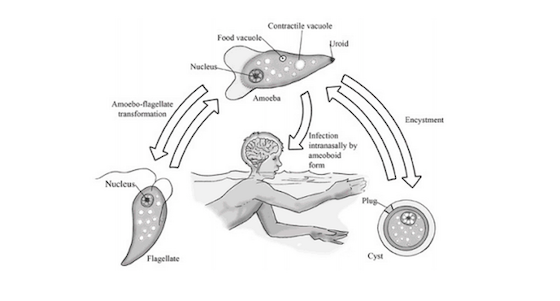
Victims of PAM are typically young men, who take in the amoeba when they dive or splash around in rivers, lakes, or swimming pools that haven’t been properly chlorinated. And in two separate 2011 instances, individuals died of PAM after using neti pots filled with contaminated tap water to rinse their nasal passages. The amoeba doesn’t cause health problems when ingested orally — stomach acid kills the organism — so a patient can only fall ill if they’re taking water up the nose. Once they do, however, a single amoeba is enough to yield disastrous consequences: individuals usually feel fine for around a week, but then experience a puzzling array of symptoms, including headaches, vomiting, and confusion. That incubation period, combined with relatively common symptoms and the rarity of the infection, make accurate diagnosis exceptionally hard. "It’s not something that’s necessarily touched on in medical school," William Schaffner, a professor of preventive medicine at Vanderbilt University, said. "You have to really probe what patients were doing in the last several days, you have to ask if they were swimming. Honestly, an accurate diagnosis is basically serendipity."
amoeba.png

The cycle whereby N. fowleri infect swimmers who inhale water through the nose. (Credit: Travis Heggie)
This diagnostic challenge is one factor that helps explain why N. fowleri is accompanied by a 99 percent fatality rate — since 1962, there’s only one documented case of a US patient surviving PAM. But researchers also note that there’s no tried-and-true treatment. Patients are often beyond saving by the time they’re diagnosed, so the existing protocol, a cocktail of antifungal and antibiotic drugs, simply hasn’t been used on enough people to know how well it works. "That’s very frustrating for us," Yoder said. "Did the treatment only work that one time? Does it work at all? Would other treatments work better? We just don’t know."
"In other brain infections, with different amoebas, we have seen it work."
Right now, experts at the CDC are working to resolve that problem — and better establish where N. fowleri might emerge in the future. Earlier this month, the agency received FDA clearance to import and stockpile miltefosine, a breast cancer drug that kills off N. fowleri in lab tests. "It’s certainly worth a shot," Yoder said. "In other brain infections, with different amoebas, we have seen it work."
The agency is also collecting environmental data on each case of PAM, in an effort to one day issue "targeted warnings" based on weather and water conditions that make the proliferation of N. fowleri — and subsequent infection — more likely. "We want to know what the water temperature was, whether there was a heat wave, what were the humidity levels," Yoder explained. In an ironic twist, however, PAM’s rareness makes such research much more difficult. "If you had thousands of observations, it would be much easier to do this," Yoder said. "Obviously, we’re short on data."
Doctors may have misdiagnosed patients who actually died because of N. fowleri
Heggie, for one, also suspects that PAM is already much more common that experts think. In his own research, he says he’s found N. fowleri in some surprising spots, including water far below 86 degrees — widely perceived as the cut-off point beyond which the amoeba thrives. And because the symptoms of PAM are similar to those of bacterial meningitis, Heggie also cautions that doctors may have misdiagnosed patients who actually died because of N. fowleri. "I’ll swear my life to that — this is being wrongly diagnosed," he said. "If someone died of meningitis, I’d suggest looking into that case a little more closely ... and looking at where the brain was eaten away at." Little research has examined the issue, but one 1970 study out of Virginia examined 16,000 meningitis deaths and found that five of those were actually caused by PAM.
Short of avoiding fresh water swims altogether, public health officials recommend plugging one’s nose during dives or periods underwater. Tightly. "You don’t need water gushing up there to get sick," Heggie said. "It doesn’t take much more than a drop."
 
http://usnews.nbcnews.com/_news/201...derly-prisoners-strains-system-taxpayers?lite
Exploding number of elderly prisoners strains system, taxpayers

State and federal prisons spend an estimated $16 billion taxpayer dollars a year keeping elderly convicts in the clink, Fathi said. Nearly a quarter of that price tag – roughly $3 billion taxpayer dollars annually – is devoted to providing health care to sick or drying prisoners.
By Daniel Arkin, Staff Writer, NBC News
The 89-year-old son of late philanthropist and socialite Brooke Astor became the oldest person ever hauled off to New York prison for a non-violent crime last Friday, four years after he was convicted of plundering his mother's massive fortune.

Apparently too frail to stand, Anthony Marshall was pushed to his jail cell in a wheelchair trailed by an oxygen tank. A pillar of Upper East Side privilege had become a monument to age and infirmity.
Marshall now joins the ranks of other high-profile, graying defendants – including accused former mobster James “Whitey” Bulger and convicted financial fraudster Bernard "Bernie" Madoff – who stand to spend their twilight years behind bars.
And they’re by no means alone: Prisoners older than 55 make up the single fastest-growing segment of the U.S. prison community – a largely invisible shadow population.
The number of elderly Americans doing hard time is swelling at a staggering rate and will only continue to balloon, researchers say.
An estimated 246,000 convicts above age 50 were in jail cells across the country last year, according to a June 2012 American Civil Liberties report.
By the year 2030, there will be upward of 400,000 elderly prisoners — nearly a third of the projected total penal population, said Inimai Chettiar, a director at the Brennan Center for Justice at NYU School of Law and the co-author ofthe ACLU report.
“The number of elderly prisoners has absolutely exploded,” Chettiar said, adding that stringent sentencing policies and “overcriminalization” of historically low-priority offenses are to blame.
Marshall, for example, could have been slapped with house arrest or probation instead of the one- to three-year mandatory minimum sentence he received, she said.
The expenditures associated with keeping elderly prisoners behind bars puts a significant strain on state and federal resources, with taxpayers bearing most of the burden, said David Fathi, the director of the ACLU’s National Prison Project.
“Incarceration is expensive,” Fathi said. “And incarcerating the elderly is extraordinarily expensive.”

The rising cost of care
State and federal prisons spend an estimated $16 billion taxpayer dollars a year keeping elderly convicts in the clink, Fathi said. Nearly a quarter of that price tag – roughly $3 billion taxpayer dollars annually – is devoted to providing health care to sick or drying prisoners.
Although prison budgets and balance sheets vary state-to-state, certain jurisdictions offer striking evidence of the immense cost of medical care for elderly prisoners:
  • In Georgia, prisoners age 65 and older command an annual average medical care cost of $8,565 -- a huge leap from the annual average of $961 for inmates under age 65, according to a report by the Human Rights Watch.
  • In North Carolina, the price tag on medical care for elderly prisoners is four times higher than the cost of the same care for prisoners younger than 50, according to the ACLU report -- an inequality that may expand as baby boomers behind bars grey.
  • In Michigan, health care for inmates age 80 and older costs prisons as much as $40,000 per person, according to the Human Rights Watch report -- nearly the cost of a year of private college tuition.

The ravages of age
Although most elderly individuals are struck by poor health in their final years, prisoners are generally more predisposed to chronic medical conditions than the average person, which accounts for the great disparity in expenditures, said Tina Maschi, a Fordham University professor who has studied New Jersey’s aging prison population.
Americans convicted of crimes and sent off to serve hard time are far more likely to have had limited access to quality health care earlier in life. They’re also more likely to have abused narcotics and alcohol, Maschi said.
Studies have found that the average 50-year-old prisoner’s body has deteriorated more rapidly than that of the average 50-year-old non-convict, Maschi said. That’s why many states classify an inmate as “elderly” if he or she has reached at least age 50.
The physical and psychological hardships of prison life tend to compound pre-existing conditions, intensifying the ravages of old age, according to Maschi.
“Prison life is incredibly stressful,” Maschi said, explaining that jailhouse violence, confinement, and the emotional consequences of isolation and victimization all conspire to weaken prisoners’ bodies and minds.
Chettiar said that certain conditions common to the elderly – from hearing loss and vision impairment to cardiac issues and dementia – are particularly common in U.S. prisons, slightly exceeding the national diagnostic average.
"Prisons exacerbate the health problems that come with age," Chettiar said.
Remedies to the crisisAs state and federal prisons scramble to cope with the logistical and financial demands of the swelling elderly prison population, certain advocacy groups and political organizations have proposed potential palliatives to the crisis.
Some jurisdictions have attempted to bring down the size of penal populations by allowing low-risk older prisoners to seek parole if they are deemed to pose a negligible threat, Fathi said.
For instance, Louisiana's state legislature in 2011 passed a law granting certain aging prisoners access to a parole hearing if a committee judges them fit for reintegration into society-at-large. The statute won praise from the ACLU, which has since lobbied other jurisdictions to consider similar measures.
"The risk of re-offense is much lower" above the age of 50, Fathi said. "Elderly prisoners are generally past their crime-prone years."
Opponents of early-release programs, including some victims' advocacy groups, have pushed back against this claim.
"There are many criminals, especially violent criminals, for whom recidivism rates are very high and the propensity for reoffending is very high," said Kristy Dyroff, the director of communications for the National Organization for Victim Assistance.
"Our first priority is that victims are protected. It may be reasonable for a non-violent offender to be paroled, but when there's a possibility of violent re-offense, then we don't support that," Dyroff said.
Dyroff added that reopening old cases can also reopen old wounds.
"Once a case has been adjudicated, it's often a re-victimization for victims to have to go back to parole hearings again and again," she said.
Although the ACLU's Fathi recognized that many older prisoners should not be eligible for an early reprieve, he said that a "cost-benefit analysis" of the exploding elderly prison population demands action.
"We can't keep everyone locked up forever," he said.
 
This is a must read

http://www.nytimes.com/2013/06/02/h...ld-in-health-expenditures.html?emc=eta1&_r=1&

....Consumers, the patients, do not see prices until after a service is provided, if they see them at all.

....Patients with insurance pay a tiny fraction of the bill, providing scant disincentive for spending.

....Even doctors often do not know the costs of the tests and procedures they prescribe.

....Insurers have limited incentive to bargain forcefully, since they can raise premiums to cover costs.
 
I'm not a law-talking guy, buy it is my understanding that roadside checkpoints can only exist to warn of immediate threats, such as escaped convicts or broken bridges, and this hooey about DWI or seatbelts or whatnot assumes your consent and you should explicitly not give it.
Last DWI checkpoint I went through, I immediately told them that I found it unconstitutional and refused to answer the 'have you been drinking?' query. I was given some goofy public awareness pamphlets and waved through with no argument.
 
What seems to be happening here is the govt is flouting the law at their convenience and leaving it up to citizens to sue them to stop. It may have been this way before but never to this degree. It seems like a reversal, where in the past the govt would try to abide first, now it seem like the attitude is "lets flout and let them stop us".
 
http://www.fastcodesign.com/1672939...zon-fulfillment-center?utm_source=facebook#-9
Think Your Office Is Soulless? Check Out This Amazon Fulfillment Center

When Amazon opened its warehouse in the former coal-mining town of Rugeley, England, residents thought the company might bring brighter economic prospects. As photographer Ben Roberts hopes to show, that’s not exactly what happened.

Shining blue and bright above a subterranean labyrinth of hollow shafts, a warehouse sits upon the abandoned remains of a coal mine that once defined this working-class English town. It is as bright as the mines are dark, as vast as the shafts are claustrophobic, as clean as they are filthy. This warehouse represents a future of shopping that does to brick-and-mortar retail what it has already done to the coal mine that used to thrive in its place: Bury it without filling the hole it left behind.
This warehouse is the focus of one particular vision of retail’s future captured by Ben Roberts in Amazon Unpacked, a haunting series of photographs exposing the inner workings of Amazon’s massive fulfillment center in the English Midlands.
1672939-inline-br-ft-rugeley-09.jpg

Roberts was originally sent to Amazon’s fulfillment warehouse to contribute to a Financial Times article about the online retail giant’s impact upon the town of Rugeley, which fell on hard economic times after the closure of the area’s main employer, a coal mine, back in 1990. In 2011, Amazon announced its intent to set up a fulfillment center in the once vibrant town. It would be a packaging and delivery nexus through which Amazon’s centralized computer brain orchestrated the shipment of millions of packages every year, all throughout the U.K. More important? It would hire a significant number of locals, some of whom had been out of work for 20 years.
Rugeley was hopeful that Amazon’s move into the city limits would result in brighter prospects for the area after two decades of economic gloom. As Roberts’s photographs show, however, Amazon’s future may be bright…but it’s also soulless.
"Vast but one-dimensional. That’s what the Rugeley center is like," Roberts tells Co.Design. "It’s shockingly quiet there."
Workers at Rugeley spend their days wandering the massive warehouse, either squirreling away incoming products, pulling orders down from shelves, or packing them up for shipment. In each of these activities, the workers’ motions are not driven by the engine of human judgment or expertise but rather by the massive engine of Amazon’s exquisitely complex fulfillment mechanism: a computer that both tracks and commands every worker’s movements throughout the day.
1672939-inline-br-ft-rugeley-06.jpg

An Amazon fulfillment associate might have to walk as far as 15 miles in a single shift, endlessly looping back and forth between shelves in a warehouse the size of nine soccer fields. They do this in complete silence, except for the sound of their feet. The atmosphere is so quiet that workers can be fired for even talking to one another. And all the while, cardboard cutouts of happy Amazon workers look on, cartoon speech bubbles frozen above their heads: "This is the best job I ever had!"
"The workers at Rugeley are effectively human robots," Roberts says. "And the only reason Amazon doesn’t actually replace them with robots is they’ve yet to find a machine that can handle so many different sized packages."
The workers at Rugeley are effectively human robots.
It’s a stark metaphor that emphasizes the way in which Amazon has managed to mechanize even the human element of its e-retail empire. In trying to capture it, Roberts found himself taking pictures that were very different from the tone of his usual work, which often focuses upon the intimacy and immediacy of the connection between people and their environments. There is no such intimacy on display in Amazon Unpacked. Instead, his photos of the warehouse are reminiscent of the massive industrial landscapes captured by Edward Burtynsky, a comparison that Roberts says is "almost inescapable" due to the barren humanity of the facility.
1672939-inline-br-ft-rugeley-13.jpg

The issue at Rugeley is not that workers are ungrateful for the jobs Amazon has given them, or even that they find these jobs unpleasant. Most of Rugeley’s workers come from mining families, a stock not exactly known for its weak-livered dandyism. It doesn’t matter that these jobs are hard. It’s that they have no future.
"Mines aren’t by any stretch of the imagination utopias. Any kind of mining is a dirty, dangerous, high-risk job." Roberts says. "But what the mining industry did offer workers was a job for life. If you started working for the mine at 18, you could be the head of an entire team of miners by the time you were 35."
It doesn’t matter that these jobs are hard. It’s that they have no future.
This is not the case at Amazon. The jobs in the Rugeley fulfillment center are almost always temporary positions handed out by agencies on zero-hour contracts. Nothing is guaranteed, and a fulfillment associate’s job can completely disappear between one day and the next. As such, the local economy is not recovering as locals hoped. Amazon is not investing in the town’s people; instead, it’s mechanizing them.
For Roberts, this isn’t about how something you order off of Amazon comes to your door. It’s about how fulfillment centers like Rugeley represent the invisible cost buried in every low Amazon price.
"When you buy something from an independent retailer, you might pay more than Amazon, but that extra bit is an investment," Roberts explains. "When you pay it, you’re investing in the quality of not only your own life but the life of the community around you."
Without that investment? No need to imagine a world without shops, just imagine the walls of a fulfillment center like the one in Rugeley--growing as fast as Amazon does--extending into the horizon, forever. And even shoppers might one day become the automatons wandering between the shelves.

1672939-slide-br-ft-rugeley-07.jpg

Rugeley, a town in the British Midlands, is home to a new Amazon fulfillment center.

1672939-slide-br-ft-rugeley-08.jpg

Locals hoped that it would replenish jobs that disappeared when Rugeley’s coal mine, the area’s main employer, closed in 1990.

1672939-slide-br-ft-rugeley-06.jpg

But, as Ben Roberts’s photos make clear, working in the warehouse can be a soul-sucking exercise. An Amazon fulfillment associate might have to walk as far as 15 miles in a single shift, endlessly looping back and forth between shelves in a warehouse the size of nine soccer fields. They do this in complete silence, except for the sound of their feet.

1672939-slide-br-ft-rugeley-09.jpg

"The workers at Rugeley are effectively human robots," Roberts says. "And the only reason Amazon doesn’t actually replace them with robots is they’ve yet to find a machine that can handle so many different sized packages."

1672939-slide-br-ft-rugeley-12.jpg

The atmosphere is so quiet that workers can be fired for even talking to one another. And all the while, cardboard cutouts of happy Amazon workers look on, cartoon speech bubbles frozen above their heads: "This is the best job I ever had!"

1672939-slide-br-ft-rugeley-12-cropped.jpg

Most of Rugeley’s workers come from mining families, a stock not exactly known for its weak-livered dandyism. It doesn’t matter that these jobs are hard. It’s that they have no future.

1672939-slide-br-ft-rugeley-02.jpg

The jobs in the Rugeley fulfillment center are almost always temporary positions handed out by agencies on zero-hour contracts. As such, the local economy is not recovering as locals hoped. Amazon is not investing in the town’s people; instead, it’s mechanizing them.
 
http://www.theverge.com/2013/7/3/44...immigration-agenda-gutting-the-tech-industrys
Is Silicon Valley's immigration agenda gutting the tech industry's middle class?

In search of top talent from around the globe, tech's elite are displacing American workers, say programmers
By Ben Popper on July 3, 2013 09:00

When the Senate passed its new immigration reform bill last week, Mark Zuckerberg took to his Facebook page to celebrate. "A lot of work remains before reform becomes law but today's vote shows that politicians from across the spectrum can come together to vote for reform that will move our economy forward and honor our history as a nation of immigrants," he wrote. Zuckerberg included a link to FWD.us, the political action committee he created to help push immigration reform, which exhorted readers to "join the tech community in passing immigration reform."
"The workers are being completely ignored."
As it turns out, the tech community is anything but united on this issue. And the push for new reforms has highlighted the divide between Silicon Valley elite who want access to talent and middle class American IT workers who feel threatened by foreign competition.
"What is happening is that the people who run this industry are getting everything they want, and the workers are being completely ignored," said Kim Berry, a coder for the California Department of Public Health and a spokesman for the Programmer’s Guild. "American workers are being passed over in favor of foreign workers who make far less money, and politicians seem oblivious to our plight."
The controversy centers on the push by FWD.us and major tech firms for legislation that would expand the number of H-1B visas available. Created in 1990, the H-1B program allows US companies to hire people from other countries to work in America temporarily, particularly if the workers are "highly skilled" in subjects like science, technology, engineering and math (STEM). The program also allows workers to pursue a green card for permanent residence.
"It’s basically a form of indentured servitude."
The current immigration reform bill, which has passed the Senate and moved to the House, would expand the annual cap on H-1B visas from 85,000 all the way up to 180,000.
Along with paying these foreign workers less, says Berry, tech companies believe they can get more out of them. "If a company is holding the reins to the process of getting a green card, and they ask them to come in on the weekends, what do you think they’re going to say? These tech companies want people who will work 80 hours a week without complaining. It’s basically a form of indentured servitude."
1-.jpg


FWD.us is backed by luminaries from tech companies like Facebook, Microsoft, Google, Netflix, and Dropbox. They claim that with their industry booming, there just aren’t enough Americans with these skills to fill the current demand for STEM jobs. "Failing to match the supply of H-1B visas to the demands of today’s economy weakens, in real numbers, the economy’s ability to create jobs," said Brad Smith, Microsoft’s vice president of legal and corporate affairs, testifying before a Senate committee in April. He has a point: this year, the number of H-1B visa applicants quickly exceeded the 85,000 technical limit.
But the claim that tech companies can’t find enough qualified US candidates to hire, and need more foreign workers to fill positions instead, is hotly contested. "Four hundred thousand American graduate with STEM degrees every year," says Kim Berry, citing figures from the US Department of Education circa 2008 and 2009 , the latest years for which data is available online. "We don’t have a shortage of native workers. We have an industry looking to cut costs."
Recruiters in Silicon Valley say claims that H-1B visa workers are paid less aren’t true. "The skill sets that top tech companies want are so in demand, a foreign national is going to get 10 offers and competitive salaries," says Shannon Callahan, the head of technical recruiting at the venture capital firm Andreessen Horowitz. "People here on an H-1B visa usually make above prevailing wage, the same as an American citizen."
"We don’t have a shortage of native workers. We have an industry looking to cut costs."
Callahan says that there may be a surplus of American IT workers looking for employment, but that’s because their skills don’t match up with today’s marketplace. "A lot of folks looking for work are older professionals. As the infrastructure of tech companies increasingly moves to the cloud, these positions have dried up. You don’t need a big IT staff to get a company to global scale anymore."
Foreign workers in Silicon Valley, says Callahan, are far from indentured servants. "It used to be, once you started your green card process, you had to stay with the company that was employing you. Now, once you get through the first stage of applying for a green card, you can move around. So their salaries and working conditions have to be competitive." Since 2000, workers have been able to change jobs during the green card process, although the move is widely seen as risky and complex.

The hard data available on worker pay is conflicting, as are studies that examine whether there is a shortage of American-born STEM workers. A study from The Brookings Institute found that H-1B visa holders working in the tech industry earned an average of 26 percent more than their American counterparts.
Wages in the IT sector have stagnatedA separate study from a group of university professors writing for the Economic Policy Institute reached very different conclusions. It stated that H-1B workers may be filing as many as half of all new IT jobs in the US each year and that only one of every two American STEM graduates will be hired into an available position. The current immigration policies, the study concludes, will discourage US students from going into the STEM field, especially IT. And wages, says the paper, have stagnated over the last 14 years, in large part due to the influx of foreign labor.
How can both of these things be true at the same time? The answer reflects a larger trend in the American labor market: an increasing gap between the top earners and everyone else. In Silicon Valley, elite programmers are in high demand, fought over by employers who pay six- and seven-figure salaries on top of generous stock grants. It's understandable that these companies would spend money lobbying Washington for more access to premier talent.
The largest employer of H-1B workers are outsourcing firmsBut in the broader IT market, the environment is more like manufacturing, with less-skilled Americans being replaced by cheaper foreign labor. The largest employers of H1-B workers aren’t firms like Facebook and Microsoft, they are actually outsourcing companies like Infosys, Tata, and Wipro. These companies account for around half of the annual H-1B workers, and the majority of their employees are overseas, according to a recent report from Computerworld. The study found that less than three percent of H-1B workers apply for permanent residency. Most learn the job, then leave to continue the job from their home country.
"As a self-described bleeding heart liberal, this issue is really tough for me," says Morgan Missen, one of Silicon Valley’s top tech recruiters, who worked to find engineers for Google, Twitter, and Foursquare and now runs her own talent agency. "For the people who live in the bubble of the Valley, and consider themselves politically engaged, there is a lot of cognitive dissonance around immigration."
Morgan says that the foreign nationals she recruits are being paid just as well as their American counterparts. "But once you get away from the top-tier engineers, I think that there are a lot of temporary foreign workers who are being exploited, and who are putting the squeeze on Americans," says Missen. "When it comes to immigration reform, the tech middle class is not being represented, and they are losing out."

Additional reporting for this piece by Carl Franzen.
 
Have you ever been in a coal mine? It's like descending into hell. Not a bright, airy, quiet, clean hell. But a hot, cramped, dark, noisy hell. Death is always right around the corner even with the best of safety practices.

Don't wanna work at an Amazon center? Then fucking pay attention in school instead of playing video games and smoking pot all day.

That was edge of the seat until the pot part.
 
http://www.slate.com/articles/techn...ate_change_and_take_down_monsanto.single.html
Let’s Make Genetically Modified Food Open-Source

It will help fight climate change and stick one in Monsanto’s eye.
By Frederick Kaufman
​
Not too long ago, popular wisdom ran that molecular biologists were going to save billions of people from starvation by genetically engineering crops resistant to flood, freeze, and drought; crops that could blossom from desiccated soil and bloom in salty sand; crops that could flourish despite an atmosphere saturated with carbon dioxide and rays of sunshine riddled with radiation. A waterless seed was the next killer app.
“With the help of our Gods and our science, we must not only increase our food supplies but also insure them against biological and physical catastrophes,” declared agronomist Norman Borlaug in his 1970 Nobel Peace Prize acceptance speech.
More recently, Cathleen Enright, executive vice president for food and agriculture at the Biotechnology Industry Organization, told me that since 1996, transgenic crops have “reduced greenhouse gas emissions, reduced pesticide runoffs, and reduced farm-fuel use. Because of biotech, there is more carbon sequestration in the soil.”
But despite the hopes of Borlaug and the hype of Enright, genetically modified crops as we know them have as a general rule increased agriculture’s reliance on a system of expensive “inputs”—agro-speak for the proprietary seeds and herbicides that have brought untold profits to multinationals such as Monsanto and Dow. The reputation of transgenic crops has tanked, as what was once a harbinger of green technology is now commonly perceived as a source of genetic pollution and has thus become anathema for many environmentalists.
The GMO story has become mired in the eco-wrecking narrative of industrial agriculture, and that is too bad for those who understand the real risks of climate change and discern our desperate need for innovation. And while the blue-sky hype of a genetically secured food supply has not become a reality, there have been a few breakthroughs. Even as climate change has increased the prevalence of many plant diseases, the new science can take credit for genetic inoculations that saved Hawaii’s papaya business. It’s also led to flood-resistant rice, created by Pamela Ronald of the University of California–Davis.
Of course, the party-line foodie dare not say anything positive about GMOs, at risk of being labeled a stooge of the foodopolists. And it’s true: Monsanto, Dow, Bayer, and Pioneer are not interested in GMO innovations that might help the bottom billion—molecular ramp-ups of crops like cassava, millet, or teff. They are not interested in low-insecticide eggplants that would help clean urban water supplies in South Asia. There’s not enough money in it for them.
But the truth is that GM products aren’t just necessary to help create an agriculture system that can survive in a post–climate-change world—they may actually help ameliorate global warming. As David Zilbermans, professor of agriculture and resource economics at the University of California–Berkeley has noted, “Adoption of herbicide tolerant varieties enabled transition to minimal tillage techniques, which reduced the greenhouse gas effect of agriculture equivalent to hundreds of thousands of cars annually. GMOs make it possible to produce food on less land, reducing the incentive of converting wild land into agricultural land.”
So the question looms: How can we harness the possible positives of GMOs without lining the pockets of the pharmers?
GMO agriculture relies on the relatively new science of bioinformatics (a mixture of bio- and information science), which means that DNA sequences look a lot more like software code than a vegetable garden. And if Monsanto is the Microsoft of food supply—raking in the rent on bites instead of bytes—perhaps the time has come for the agricultural equivalent of Linux, the open-source operating system that made computer programming a communal effort.
Open-source GMO is a new idea for food justice activists, who have been concentrating their efforts on depleting Monsanto's market share through consumer advocacy and political reform. Labeling laws for genetically modified organisms in the retail foodstream are about to land in statehouses across the country. But genetic modification does not equal Monsanto and Pioneer. The time has come to separate the dancer from the dance and admit that it is possible to be against big-agriculture and for scientific advancement.
Open-source is the quickest way to undermine proprietary rights to food molecules, those rights that guarantee profit streams for transnationals while condemning the earth to a monocultural future of agriculture with no regard for agroecology. For the surest way to sabotage Monsanto is not to label but to sap its income. Already, a number of biotech pioneers have followed the open-source examples of Apache and Wikipedia. The database of the human genome mapping project has been free since it was published in 2003. The genetic map of rice has been made available at no charge to researchers worldwide. And the Food and Agriculture Organization of the United Nations has made its “Access to Global Online Research in Agriculture” a transnational paradigm of free-flowing information. Agricultural researchers in developing countries need not pay a penny to review all the latest life science research published in more than 3,000 academic journals.
Like open-source software, open-source food genetics would advance biological research in this country, and our universities would soon become hothouses of innovation. Intellectual production without intellectual property would thrive, as scientists gained access to DNA code in all its infinite variety, along with the freedom to create derivative work and redistribute findings. No great leap of faith would be required, as open-source is one of food’s oldest dynamics. There’s no patent on a roast chicken, and the derivative work of Momofuku founder David Chang does not owe a fee to Marcella Hazan, Julia Child, or Colonel Sanders. Chefs and their recipes have long constituted a creative commons.
Of course, even open source can be subverted. As intellectual property rights expert Séverine Dusollier observed two years after the genetic sequence of rice became public, “The rice genome project placed masses of information into the public domain, most of which enabled private companies to develop applications such as genetic markers, specific genotypes related to nutrition, new quality of fibers, or targets for herbicides for which they filed a patent application.”
Turns out that permissiveness requires police and plenty of lawyers. Which is why the so-called “patent left” and “copyleft” movements have created clever licensing agreements that infect any and all derivative products, thereby enforcing the free availability of innovations going forward. Open-source agriculture joined the patent left movement when Cambia Technologies, an Australian biotech company that researches and develops GMOs, offered a licensing agreement called BIOS, which allows for the free use of a technology called “transbacter.” Transbacter can be deployed to alter plant genetics, and its aim is not one specific modification for one specific corporate interest but to enable a slew of innovations.
But BIOS, like all the other open-source initiatives, is far from perfect, as it creates the paradox of endlessly replicating armies of anti-licensing licenses. The way out of the logical mire—and the way to marshal agri-tech to the cause of climate change—is an explicit exception in the licensing law, an intellectual property loophole for food.
Everyone interested in global food knows that agriculture has had a largely negative impact on global warming, but few have recognized that legal reform of food-related intellectual property laws can help ensure a path to a more ecologically secure future. No doubt, biological “input” is far more complex than computer “input,” but the idea of a swarm of bio-hackers bringing down Monsanto and Dow is too delightful to dismiss. Throw climate change into the picture, and the stakes are simply too high for continuing the status quo of patented food. Neither information nor lunch may want to be free, but eventually we will need to get around to the business of sequencing proteins that have less to do with quarterly profits and more to do with centuries of ecological abuse. And those will be the only inputs that matter when the big heat hits.
 
This is just too good:
http://www.rollingstone.com/politics/blogs/taibblog/wall-street-rips-off-the-sting-20130709
Wall Street Rips Off 'The Sting'


  • by Matt Taibbi
  • July 9, 2013

Brendan Bannon/Bloomberg via Getty Images
Hilarious corruption story hit the news wires this week. It's actually a two-part joke.
Part one is that Thomson Reuters got slapped in the face by New York State Attorney General Eric Schneiderman for its absurd practice of selling early access to the results of the Survey of Consumer Confidence Survey it conducts each month in conjunction with the University of Michigan.
It turns out that in recent times, if you paid them an extra subscription fee of a few thousand dollars a month, Thomson Reuters would allow you access to the Consumer Confidence data a full two seconds earlier than the rest of its subscribers – at 9:54:58 a.m., as opposed to 9:55:00 exactly.
Thomson Reuters suspended the activity at the request of Schneiderman, who released a statement about this humorously brazen effort at the systematic sale of inside information. From the L.A. Times:
The consumer confidence data can move financial markets, and Scheiderman's office said "that two-second advantage is more than enough time for these traders to take unfair advantage of their early access to this information as they execute enormous volumes of trades in the blink of an eye."
“The securities markets should be a level playing field for all investors and the early release of market-moving survey data undermines fair play in the markets,” Schneiderman said Monday.​
The two-second head start allows high-speed traders to plunge into the markets en masse and retreat all the way back again before most of the world sees this market-altering economic data. From a CNN report a few weeks ago:
In the milliseconds before the survey is released to other paying clients at 9:55 a.m. ET, trading volumes can soar up to 20 times their normal levels. By 9:54:59 a.m. ET, long after computers have acted on the number, volumes have already returned to normal.​
As my friend Eric Salzman joked, the two-second head start is a scheme taken straight out of The Sting, where the "hook" was early access to the results of an out-of-state horse race. All that's missing is Robert Shaw placing his bet: "Five hundred thousand dollars to win. Lucky Dan!"
There's a reason why high-frequency trading is such a lucrative business. With the tiniest head start on market-moving data, computerized traders can make giant piles of money. And as others have reported, the Thomson Reuters consumer confidence survey isn't the only economic data mine to which traders can buy early access.
Deutsche Borse sells access to its Chicago Business Barometer three minutes early to anyone willing the relatively modest sum of 2,000 Euros a year.
Meanwhile, the Institute for Supply Management teamed up with Thomson Reuters to also sell a kind of enhanced access to the results to a monthly survey of purchasing managers (which measures both manufacturing and non-manufacturing industries). The ISM releases the data to everyone at 10:00 a.m. once a month, but those who pay extra get the data in a form that's a few ticks easier for computer trading algorithms to read and digest.
It's bad enough that this goes on out in the open, but part two of this joke is that nobody's ashamed of it in the slightest. In fact, Thomson Reuters threw the P.R.-office version of a hissy fit today after Schneiderman closed shop on their neat little revenue stream. The firm refused to permanently end the practice and defiantly insisted upon their right to sell data to whomever they want, whenever they want. From a news release:
Thomson Reuters strongly believes that news and information companies can legally distribute non-governmental data and exclusive news through services provided to fee-paying subscribers . . .
It is widely understood that news and information companies compete for exclusive news and differentiated content to help their customers make better informed trading and investment decisions . . .​
Mm-hmm. Yes, there's a socially beneficial activity, helping your customers make "better informed trading and investment decisions" two seconds faster than your other customers (read: suckers). Clearly, someone who wants to buy a two-second head start is doing so because he or she needs those extra two seconds to soberly digest market data, not because he or she wants to massively front-run the rest of the investing public using high-speed computers.
It's amazing how endless these market-scamming stories are. Practically every other day lately, there's news either of a depraved price-fixing scandal (ridiculously, even Hershey's paid a fine a few weeks back for rigging chocolate prices in Canada) or some crude signal-stealing scheme like this thing. What's next, selling card-counting machines for casino-goers
 
Good piece in USA Today about how aging prisoners are severely taxing the prison systems resources because they use up so god damn much money:
http://www.usatoday.com/story/news/nation/2013/07/10/cost-care-aging-prisoners/2479285/
Aging prisoners' costs put systems nationwide in a bind

This 'national epidemic' includes packed prisons, high-cost medical care and dwindling resources. This all begs the question: Should frail, incapacitated inmates be there?
  • by Kevin Johnson and H. Darr Beiser, USA TODAY
  • July 10, 2013
Caring for aging inmates poses challenges to U.S. prisons.
ANGOLA, La. — For decades, the Louisiana State Penitentiary has taken great pride in its vast farming operations, as well as its reputation as one of the toughest lockups in America.
The crops and cattle raised by prisoners on the remote 18,000 acres ringed by razor wire have long gone to feed Angola's 5,000 inmates, with enough left over to stock the novelty hot sauce and jelly products sold in the prison museum.
Yet Warden Burl Cain said something is happening on "the farm" that threatens the bounty it reaps every year.
Aging, sick and disabled prisoners are seriously limiting the numbers that can be deployed to tend the land. Of the 1,000 who typically work the fields, Cain said he's lucky if 600 to 700 are physically able to do the job. After all, a third of all inmates are older than 50, and many are so debilitated that the state spends north of $100,000 per inmate to care for them.
"This place was not built to accommodate people like this," Cain said. "I'm telling you, we're really feeling it."
So are the rest of America's vast, aging prison populations.
The fiscal, legal, social and political challenges of housing this country's graying inmates have arrived with full force at precisely the time when states, and the federal government, are looking to rein in spending. A problem swelling for decades has become "a national epidemic," according to a 2012 report by the American Civil Liberties Union.
Yet efforts to address an issue that will only worsen with time have largely floundered, ensuring that even incapacitated inmates ridden with tumors or paralyzed by Parkinson's disease live their last days in prison hospitals. The enormous medical costs required to maintain this status quo will inevitably sap money from other areas of government that affect residents who will never set foot near these penitentiaries.
Nearly a quarter-million inmates in state and federal prisons — enough to fill the Rose Bowl nearly three times — are classified as "elderly" or "aging," according to the ACLU report. The designation applies to inmates age 50 and older whose aging process, according to the National Institute of Corrections, is often accelerated by general poor health before entering prison and the stress of confinement once there.
At least 15% of the prisoners in 20 states are 50 or older, according to the ACLU report. In West Virginia, 20% were at least 50. The costs of confining such prisoners are about double — $68,270 per year — the $34,135 annual cost for the average younger inmate.
Although at least 15 states and the District of Columbia have some provision for the early release of geriatric inmates, a 2010 study by the Vera Institute of Justice funded by the Pew Center on the States found that authorities rarely used the exceptions because of "political considerations" related to public safety policy and a lengthy review process.
To accommodate the number of aging and disabled, Connecticut officials won approval in March to begin transferring some offenders to a privately run nursing home.
Last month, California prison officials announced the dedication of an $839 million complex in Stockton to provide "mental health and medical services to the state's sickest inmate patients." California Department of Corrections and Rehabilitation spokesman Jeffrey Callison said the first of the 1,722 inmate-patients will begin arriving this month.
The facilities are the result of a lengthy legal fight in the federal courts over the quality of health care in the state's 33 prisons. The changes were prompted by lawsuits, filed more than a decade ago, alleging substandard medical and mental health treatment.
Secretary of Corrections and Rehabilitation Jeff Beard said in a statement that the 54-building complex on 200 acres helps show that "we are serious about the health and well-being of inmates entrusted to us.''
Groups advocating for reductions in prisons said the facility represented a failure of state officials to address its problems years ago.
"If the state had taken common sense steps to parole the elderly, the terminally ill, the medically disabled, would this prison hospital have been built?" said Mary Sutton, a spokeswoman for Critical Resistance.
A HIGH NATIONAL PRIORITY
Each year, the Justice Department's inspector general ranks the agency's "top management challenges." And each year since 2006, the federal prison system's growing and aging prison population has ranked among such urgent priorities as safeguarding national security and enhancing the nation's cyber-security defenses.
"Housing a continually growing and aging population of federal inmates and detainees is consuming an ever-larger portion of the department's budget," the inspector general's 2012 report said, adding that the burden is "making safe and secure incarceration increasingly difficult to provide and threatening to force significant budgetary and programmatic cuts to other (Justice) components in the near future."
Since 2006, the number of inmates has grown nearly 14% to about 220,000. Of all the corrections systems in the nation, the U.S. Bureau of Prisons houses the third-largest number of offenders who are 50 or older, according to numbers compiled by the ACLU.
"We are on an unsustainable path here," Justice Inspector General Michael Horowitz said in an interview with USA TODAY.
In April, Horowitz highlighted that concern in a scathing review of the federal system, concluding that the program allowing for the early release of offenders with terminal illnesses or other debilitating conditions was so "poorly managed" that some inmates languished and died before their release requests were acted on by prison authorities.
Inmates who qualify for discharge under the program could be released to the care of family members at home or in facilities where some would probably qualify for public assistance. But of 208 cases reviewed by the inspector general from 2006 to 2011 in which inmate requests for so-called compassionate release had been approved by lower-level Bureau of Prisons officials, 28 offenders died while awaiting final action.
In one case, an inmate's request in 2006 for early release was denied even though the offender had suffered a massive stroke and was in a "near vegetative state."
The inmate, serving a life sentence for cocaine and heroin distribution, required a feeding tube, bathing, bed-pan and repositioning every two hours to avoid bed sores. Though he had "no hope for recovery," Justice officials rejected a recommendation for early release because his life expectancy could not be determined.
The inmate remains in prison. Though his condition has improved somewhat, the entire right side of his body is paralyzed, and medical authorities say he cannot speak and "needs total assistance with his activities of daily living."
In addition, Horowitz's report determined that the BOP did not track the costs related to caring for aging and sick inmates who may be eligible for release.
"You would think you would want to know what the potential cost savings (related to the early release of ill inmates) would be," Horowitz said.
The cost information that the agency did track showed that the BOP paid $28,893 per year to house the average inmate, while it cost $57,962 per year for each inmate housed at one of its medical centers. Costs at the BOP medical centers increased 38% from 2006 to 2011. By the end of last year, 7,464 inmates were in federal prison medical facilities.
Under provisions for required spending reductions within the federal government, known as sequestration, $1.6 billion was cut from the budget of the Justice Department, which manages the BOP. The cuts so threatened the operations of the BOP that Attorney General Eric Holder authorized the transfer of $150 million in other funds in March to avoid the furloughs of thousands of staffers.
$100,000 PER INMATE
Of the more than 5,000 prisoners housed at Angola, 34% are at least 50 or older. Among the 10 age groups tracked by prison officials, the largest number of offenders in any one category — 859 — are 55 to 64 years old.
Louisiana State Penitentiary inmate Darrell Gertenschologer, 74, is serving a life sentence and living out his days in the prison hospice.(Photo: H. Darr Beiser, USA TODAY)
Assistant Warden Cathy Fontenot said the prison houses about 130 offenders whose annual medical costs exceed $100,000 per inmate.
The costs are associated with treating some of the same and most serious conditions that exist in the free world: cancer, HIV, hemophilia, liver disease and chronic renal failure.
Some of the sickest and oldest of Angola's residents are housed in the prison hospice unit where the staff includes fellow inmates who provide the constant care required.
Jimmy Johnston, 71, serving a life sentence for second-degree murder, has bone cancer and occupies one of the beds in the large, busy open ward. A resident of Angola since his conviction in 1978, Johnston has been treated for tumors on his spine and head. He has endured chemotherapy and radiation treatments.
His prognosis is not good.
"I probably will be buried here in a few years," Johnston said, referring to the cemetery on the prison grounds.
Nearby, Ernest Wadlington, 88, a convicted sex offender, could barely speak.
Louisiana State Penitentiary inmate Ernest Wadlington, 88, was bedridden and served out his sentence in the prison nursing ward until he died Jan. 29.(Photo: H. Darr Beiser, USA TODAY)
Wadlington was completely bedridden; his condition had gradually worsened after his Parkinson's disease diagnosis in 2008.
Asked whether he expected to die at Angola, Wadlington expressed faint hope that his family could secure his early release so he could spend his last days at home.
"I have a place at the Abbeville cemetery," he said, referring to his Louisiana hometown.
Cathy Duhon, one of Wadlington's three daughters, said the family had tried to secure her father's release "several times" as his condition worsened.
"He represented no harm to anyone but himself,'' Duhon said, adding that they had planned to place him in a nursing facility near the family's Abbeville home. "He required constant care. We told them (prison officials), 'Let us take him home, because he is costing the state prison system more than if we were allowed to care for him.' ''
Duhon said the family sought the help of attorney Ricky LaFleur. Wadlington did not survive the effort.
He died Jan. 29 at Angola, a few days after the family's last visit.
"It was never a question of whether he did or didn't do it (the crime)," Duhon said. "It should have been about making sure that the people who needed to be in prison are in prison."
 

Users who are viewing this thread

Back
Top Bottom