ter1413
Witness Protection Program
- Messages
- 5,461
Follow along with the video below to see how to install our site as a web app on your home screen.
Note: This feature may not be available in some browsers.
http://nypost.com/2013/10/02/da-wont-charge-bike-assault-thug-in-suv-beating/
http://nypost.com/2013/10/02/reuters-reporter-skewers-bosses-in-epic-farewell-email/
Not too mixed from looking at the video. Fucking assholes all of them from the look of it.

I agree that they are all assholes. There is a vid from Tues or Wed of this week showing them once again riding in the streets and on the sidewalk on the UWS. Now they want sympathy.
FYI-It was a very mixed group...
http://www.nydailynews.com/new-york...anhattan-set-free-officials-article-1.1473800

Mugged by a Mug Shot Online
- by DAVID SEGAL
- Oct. 5, 2013
- original

IN March last year, a college freshman named Maxwell Birnbaum was riding in a van filled with friends from Austin, Tex., to a spring-break rental house in Gulf Shores, Ala. As they neared their destination, the police pulled the van over, citing a faulty taillight. When an officer asked if he could search the vehicle, the driver — a fraternity brother of Mr. Birnbaum’s who quickly regretted his decision — said yes.
Six Ecstasy pills were found in Mr. Birnbaum’s knapsack, and he was handcuffed and placed under arrest. Mr. Birnbaum later agreed to enter a multiyear, pretrial diversion program that has involved counseling and drug tests, as well as visits to Alabama every six months to update a judge on his progress.
But once he is done, Mr. Birnbaum’s record will be clean. Which means that by the time he graduates from the University of Texas at Austin, he can start his working life without taint.
At least in the eyes of the law. In the eyes of anyone who searches for Mr. Birnbaum online, the taint could last a very long time. That’s because the mug shot from his arrest is posted on a handful of for-profit Web sites, with names like Mugshots, BustedMugshots and JustMugshots. These companies routinely show up high in Google searches; a week ago, the top four results for “Maxwell Birnbaum” were mug-shot sites.
The ostensible point of these sites is to give the public a quick way to glean the unsavory history of a neighbor, a potential date or anyone else. That sounds civic-minded, until you consider one way most of these sites make money: by charging a fee to remove the image. That fee can be anywhere from $30 to $400, or even higher. Pay up, in other words, and the picture is deleted, at least from the site that was paid.
To Mr. Birnbaum, and millions of other Americans now captured on one or more of these sites, this sounds like extortion. Mug shots are merely artifacts of an arrest, not proof of a conviction, and many people whose images are now on display were never found guilty, or the charges against them were dropped. But these pictures can cause serious reputational damage, as Mr. Birnbaum learned in his sophomore year, when he applied to be an intern for a state representative in Austin. Mr. Birnbaum heard about the job through a friend.
“The assistant to this state rep called my friend back and said, ‘We’d like to hire him, but we Google every potential employee, and the first thing that came up when we searched for Maxwell was a mug shot for a drug arrest,’ ” Mr. Birnbaum said. “I know what I did was wrong, and I understand the punishment,” he continued. “But these Web sites are punishing me, and because I don’t have the money it would take to get my photo off them all, there is nothing I can do about it.”
It was only a matter of time before the Internet started to monetize humiliation. In this case, the time was early 2011, when mug-shot Web sites started popping up to turn the most embarrassing photograph of anyone’s life into cash. The sites are perfectly legal, and they get financial oxygen the same way as other online businesses — through credit card companies and PayPal. Some states, though, are looking for ways to curb them. The governor of Oregon signed a bill this summer that gives such sites 30 days to take down the image, free of charge, of anyone who can prove that he or she was exonerated or whose record has been expunged. Georgia passed a similar law in May. Utah prohibits county sheriffs from giving out booking photographs to a site that will charge to delete them.
But as legislators draft laws, they are finding plenty of resistance, much of it from journalists who assert that public records should be just that: public. The Reporters Committee for Freedom of the Press argues that any restriction on booking photographs raises First Amendment issues and impinges on editors’ right to determine what is newsworthy. That right was recently exercised by newspapers and Web sites around the world when the public got its first look at Aaron Alexis, the Navy Yard gunman, through a booking photograph from a 2010 arrest.
“What we have is a situation where people are doing controversial things with public records,” says Mark Caramanica, a director at the committee, a nonprofit organization based in Arlington, Va. “But should we shut down the entire database because there are presumably bad actors out there?”
MUG shots have been online for years, but they appear to have become the basis for businesses in 2010, thanks to Craig Robert Wiggen, who served three years in federal prison for a scheme to lift credit card numbers from diners at a Tex-Mex restaurant in Tallahassee, Fla. He was looking for another line of work, according to news articles, and started Florida.arrests.org.
The idea soon spread, and today there are more than 80 mug-shot sites. They Hoover up most of their images from sheriffs’ Web sites, where rules and policies about whose mug shot is posted and for how long can vary, from state to state and from county to county.
The sites are designed for easy ogling. Some feature a running scroll of the famous (Lindsay Lohan), the infamous (James E. Holmes, accused in the Aurora, Colo., mass shooting) and the obscure but colorful (a man with an American flag painted on his face and bald head).
The owners of these sites can be hard to find, or at least to reach on the phone. An exception is Arthur D’Antonio III, 25, founder of JustMugshots, which is based in Nevada (though he declined to be more specific). Mr. D’Antonio was eager to combat any suggestion that there was something illicit or unethical about the mug-shot posting business in general and his Web site in particular.
“No one should have to go to the courthouse to find out if their kid’s baseball coach has been arrested, or if the person they’re going on a date with tonight has been arrested,” he said. “Our goal is to make that information available online, without having to jump through any hoops.”
A few years ago, one of Mr. D’Antonio’s friends turned up on a mug-shot Web site, and Mr. D’Antonio, who has been earning good money writing software code since he was 12, spotted a business opportunity. JustMugshots began in 2012 and now has five employees, two of whom spend all their time dredging up images from 300 sources. The site has nearly 16.8 million such photos, according to Mr. D’Antonio. He would not discuss revenue or profit, except to say, “We’re seeing some growth.”
JustMugshots has a “courtesy removal service,” allowing people who have been exonerated, or never charged, or even those who can demonstrate that they have turned around their lives, to get their image taken down free. Mr. D’Antonio declined to say how many people had been granted mercy deletions.
The opposite case — a person who is guilty of a terrible crime and has the money to remove his or her face from the Web site — presents another sort of quandary. If the point of JustMugshots is to inform the public, why should the rich and convicted get a pass?
“That’s where it gets tricky,” Mr. D’Antonio said. “We review paid orders and we have refunded paid orders, if, after doing some research, it becomes clear that there is a reason to do so.”
He would not say how many times JustMugshots has returned money of a customer deemed too awful to delete. Nor did he seem uncomfortable being the arbiter of who is shadowed by a mug shot and who is not. He also passed on the opportunity to be photographed for this article. Better to keep a low profile, he said.
Having his face online could create problems.
JUSTMUGSHOTS is one of several sites named in a class-action lawsuit filed last year by Scott A. Ciolek, a lawyer in Toledo, Ohio. Mr. Ciolek argues that the sites violate Ohio’s right-of-publicity statute, which gives state residents some control over the commercial use of their name and likeness. He also says the sites violate the state’s extortion law.
“You can’t threaten to embarrass someone unless they pay you money,” he said, “even if they did exactly what you are threatening to embarrass them about.”
Lance C. Winchester, a lawyer in Austin who represents BustedMugshots and MugshotsOnline, both named in the lawsuit, says Mr. Ciolek’s lawsuit is a stinker because the United States Supreme Court has ruled time and again that mug shots are public records.
“I understand people think there is a dilemma presented by a Web site where you can pay to have a mug shot removed,” he said. “I understand that people don’t like to have their mug shots posted online. But it can’t be extortion as a matter of law because republishing something that has already been published is not extortion.”
Like JustMugshots, the Web sites operated by Mr. Winchester’s clients also say they will take down an image, at no charge, for qualified supplicants. But many who qualify for this pass to get off the site free don’t use it, largely because they don’t believe that the offer is real. One of them is Dr. Janese Trimaldi, 40, a physician who recently completed her residency in Tampa, Fla.
On a terrifying evening in July 2011, she says, she locked herself in her bedroom to hide from a drunken, belligerent boyfriend. He went into the kitchen, retrieved a steak knife and jimmied open the door.
“He was more than 6 feet tall, and weighed 250 pounds,” she said by phone in Tampa. “I’m 5 feet and at the time I weighed about 100 pounds. So when he got in, he lifted me by my arms, the way you lift a child, and threw me six feet backward.”
The screams and commotion caused a neighbor to call the police. The boyfriend — whom Dr. Trimaldi did not want named for fear that he would stalk her — contended that a bleeding scratch on his chest had been inflicted by Dr. Trimaldi with the knife. (It was from one of her fingernails, she says.) She was arrested and charged with aggravated assault with a deadly weapon and battery domestic violence.
The state dropped the charges, according to a document signed by Mark A. Ober, the state attorney in Hillsborough County, Fla. A few months later, her booking photograph turned up on a Florida mug-shot Web site and with it another mug shot from a 1996 arrest on an accusation of possession of marijuana and steroids. The authorities had raided her apartment on suspicion that a different boyfriend — this one a bodybuilder — was illegally selling the steroids. Records show that she was quickly released, and a certificate of disposition from the 13th Judicial Circuit of Florida shows that she was not prosecuted for either charge.
She paid $30 to have the images taken down, but they soon appeared on other sites, one of which wanted $400 to pull the picture.
“I’ve read accounts of people paying and not having the photos removed,” she said. “Or they pay and appear on other sites. The whole thing is a racket.”
Now studying for her medical boards and $200,000 in student loan debt, she is gearing up for a job search and worries that two photographs could wreck years of hard work to practice medicine.
“If I wasn’t a level-headed, positive person,” she wrote in an e-mail to Mr. Ciolek, the lawyer in Toledo, “I would have seriously considered ending my own life.”
LEGISLATORS have heard dozens of stories like Dr. Trimaldi’s and scrambled for remedies. Jennifer Williamson, an Oregon state representative from Portland, helped to draft her state’s bill, and she is the first to acknowledge that it is far from ideal.
“All approaches have significant shortcomings,” she said, referring to laws in other states. “I don’t know what the perfect tool is, but I’m sure we’ll be back at the drawing board soon.”
The trick is balancing the desire to guard individual reputations with the news media’s right to publish. Journalists put booking photographs in the same category as records of house sales, school safety records and restaurant health inspections — public information that they would like complete latitude to publish, even if the motives of some publishers appear loathsome.
The Reporters Committee for Freedom of the Press favors unfettered access to the images, no matter how obscure the arrestee and no matter the ultimate disposition of the case. Even laws that force sites to delete images of the exonerated, the committee maintains, are a step in the wrong direction.
“It’s an effort to deny history,” says Mr. Caramanica, the committee director. “I think it’s better if journalists and the public, not the government, are the arbiters of what the public gets to see.”
People eager to vanish from mug-shot sites can try a mug-shot removal service, a mini-industry that has sprung up in the last two years and is nearly as opaque as the one it is intended to counter. “I’m not going to go into what we do,” said Tyronne Jacques, founder of RemoveSlander.com (Motto: “Bailout of the Internet for good!”). “Whatever works.”
Removal services aren’t cheap — RemoveMyMug.com charges $899 for its “multiple mug shot package” — and owners of large reputation-management companies, which work with people trying to burnish their online image, contend that they are a waste of money.
“Their business model is to find someone willing to pay to take down their image, which marks them as a target who is willing to pay more,” says Mike Zammuto, president of the reputation company Brand.com.
Princess Matthews, a mother of four who lives in Toledo, tried the budget approach to remove mug shots from a handful of sites. During a tumultuous period in her life, she was arrested on charges ofassault, drug possession and theft, among other crimes. All but one of the charges — for attempted petty theft — were expunged or classified as criminal mischief, she says.Now out of an abusive relationship, she is starting a nonprofit group called Project No More Pain, to combat domestic violence.
Yet her mug shots linger. A few months ago, she made a deal with a local lawyer: he would try to have her mug shots deleted, and she would pay him $100 and clean two apartments that he wanted to rent. She was assisted during that afternoon of scrubbing by her daughter, who attends a middle school where online mug-shot browsing had caught on. Her daughter was taunted when her mother’s image surfaced.
“Her grades dropped; she was miserable,” Ms. Matthews recalled. “She was getting into fights. When I tried talking to her about it, she wasn’t communicating.”
But the deal with the lawyer didn’t work.
“He was able to get a few of the photos removed from one site, related to charges that were expunged,” she said, “but they wanted $300 apiece to remove the other shots. And that was just one site. I don’t have that kind of money.”
AS painful as they are for arrestees, mug shots seem to attract big online crowds. Google’s results are supposed to reflect both relevance and popularity, and mug-shot sites appear to rank exceptionally well without resorting to trickery, according to Doug Pierce, founder of Cogney, a search engine optimization company based in Hong Kong. At the request of The New York Times, Mr. Pierce studied a number of the largest mug-shot sites and found that they were beloved by Google’s algorithm in part because viewers who open them tend to stick around.
“When others search your name, that link to Mugshots.com is way more attention-grabbing than your LinkedIn profile,” Mr. Pierce said. “Once they click, they stare in disbelief, and look around a bit, which means they stay on the page, rather than returning immediately to the search results. Google takes that as a sign that the site is relevant, and that boosts it even more.”
What’s curious is that Google doesn’t penalize these sites for obtaining their images and text from other places, a sin in the company’s guidelines. The idea is that Web sites should be rewarded for coming up with original material and receive demerits for copying.
If it acted, Google could do what no legislator could — demote mug-shot sites and thus reduce, if not eliminate, their power to stigmatize.
Initially, a Google spokesman named Jason Friedenfelds fielded questions on this topic with a statement that amounted to an empathetic shrug. He wrote that the company felt for those affected by mug-shot sites but added that “with very narrow exceptions, we take down as little as possible from search.”
Two days later, he wrote with an update: “Our team has been working for the past few months on an improvement to our algorithms to address this overall issue in a consistent way. We hope to have it out in the coming weeks.”
Mr. Friedenfelds said that when he sent the first statement, he was unaware of this effort. He added that the sites do, in fact, run afoul of a Google guideline, though he declined to say which one. Nor would he detail the algorithmic changes the company was considering — because doing so, he explained, could spur mug-shot sites to start devising countermeasures.
As it happens, Google’s team worked faster than Mr. Friedenfelds expected, introducing that algorithm change sometime on Thursday. The effects were immediate: on Friday, two mug shots of Janese Trimaldi, which had appeared prominently in an image search, were no longer on the first page. For owners of these sites, this is very bad news.
And, it turns out, these owners face another looming problem: getting paid.
Asked two weeks ago about its policies on mug-shot sites, officials at MasterCard spent a few days examining the issue, and came back with an answer.
“We looked at the activity and found it repugnant,” said Noel Hanft, general counsel with the company. MasterCard executives contacted the merchant bank that handles all of its largest mug-shot site accounts and urged it to drop them as customers. “They are in the process of terminating them,” Mr. Hanft said.
PayPal came back with a similar response after being contacted for this article.
“When mug-shot removal services were brought to our attention and we made a careful review,” said John Pluhowski, a spokesman for PayPal, “we decided to discontinue support for mug-shot removal payments.”
American Express and Discover were contacted on Monday and, two days later, both companies said they were severing relationships with mug-shot sites. A representative of Visa wrote to say it was asking merchant banks to investigate business practices of the sites “to ensure they are both legal and in compliance with Visa operating regulations.”
On Friday, Mr. D’Antonio of JustMugshots was coping with a drop in Web traffic and, at the same time, determining which financial services companies would do business with him. “We’re still trying to wrap our heads around this," he said.
Breaking Away: Top Public Universities Push for ‘Autonomy’ From States
by Marian Wang
ProPublica, Oct. 7, 2013, 12:46 p.m.
The chancellor of Oregon’s higher-education system currently oversees all seven of the state’s public colleges and universities. But as of July next year, she’ll be chancellor of four.
The schools aren’t closing. Rather, Oregon’s three largest state schools are in the process of breaking away from the rest of the public system.
The move, long pushed by some university leaders in the system, will give the University of Oregon, Portland State University and Oregon State University more freedom to hire and fire presidents, issue revenue bonds, and raise tuition.
Across the country, a small but growing number of public universities are making similar pushes, looking to cut deals with state lawmakers that scale back direct oversight, often in return for less funding or for meeting certain performance targets. Over the past few years, schools in Texas, Virginia and Florida have all gotten more flexibility to raise tuition. Other plans have recently been broached, though with less success, in Wisconsin, California and Louisiana.
The proposals vary in scope, but their proponents generally argue that more autonomy allows public universities to operate with less red tape and with greater freedom to raise revenue as state funding has fallen.
But many within higher education point to the potential downsides. They worry that these universities -- often the better-known and wealthier public universities -- could end up sidelining broader state goals such as access and affordability in pursuit of their own agendas, such as moving up in college rankings.
“My fear is that if public flagships become so focused on revenue and prestige, and so focused on autonomy, they will minimize their commitment to the public agenda,” said Richard Novak, who was previously director of public-sector programs at the Association of Governing Boards. “They should be leading the public agenda. If they privatize too much, they’re not going to be doing it for much longer.”
Others have similar concerns.
“I think there’s a potential for confusion, unhealthy competition and misuse of resources,” said Robert O’Neil, who headed the statewide University of Wisconsin system and was also president of the University of Virginia. In O’Neil’s experience, centralized oversight helps keep in check ambitions that might lead colleges to pursue wasteful projects or duplicative programs.
There’s relatively little research on the overall benefits or drawbacks of schools gaining autonomy, but it does appear that such universities often end up resembling private colleges, moving toward a “high tuition, high aid” model in which schools hike sticker prices significantly while offering big discounts to students schools are trying to attract. (As ProPublica has detailed, state schools have been giving a growing portion of grants to wealthier students and a shrinking portion to the neediest.)
State and university officials pushing for more autonomy often balk at the term “privatization,” noting that the universities aren’t severing all ties with the state.
As one planning group at the University of Virginia wrote last month, “Autonomous is not the opposite of public.”
The University of Virginia, along with two other state universities, struck deals in 2005 that won it significant autonomy from the Commonwealth. Those agreements mandated that the schools still meet various benchmarks -- but they also gave the universities wiggle room.
Three years after the deal, a state audit report concluded that while the schools were meeting their “access” goals, the number of low-income students at each of the universities -- as measured by federal Pell grants -- was actually decreasing. (A university spokesman said enrollment of low-income students has gone up since then.)
Even some supporters of moving toward privatization have begun to have second thoughts.
James Garland, former president of Miami University, a public university in Ohio, was once a strong proponent of what he calls “semi-privatization” of American public universities, having headed a university that he describes as “public in name only.” In 2009, he wrote a book arguing that public universities should be autonomous and deregulated by their states.
In the years since, Garland said, his views on the autonomy question have “mellowed.” Though he still believes autonomy can make sense for some schools, he’s also concerned about the potential pitfalls.
“Some of these flagships would like to make decisions that benefit their own financial future and give them the ability to build posh dining halls or giant stadiums or create new nanotechnology centers,” Garland said, “when what really may be more needed than that is simply providing a high-quality rigorous college education for legions of students in the state who can’t afford that now and have no place to go and get it.”
“It’s not an accident that you see this happening among big, well-funded publics,” Garland added.
At the University of Virginia, internal discussion of further steps toward privatization has continued. As the Washington Post recently reported, a draft report from a university planning committee recommended “another major restructuring of the relationship between the University and the Commonwealth.” The document notes that the change “would not mean complete privatization.”
University of Virginia spokesman McGregor McCance said the draft report was part of early discussions about possible models for public higher education, and that there are no plans for the university to ask for additional autonomy.
Colleges and universities that do seek to move in this direction need to have candid conversations about their goals, said Garland: “As more and more schools argue successfully for some kind of autonomy from their states, there has to be a real understanding about what the mission of those schools is going to be in the future and there has to be some way of evaluating their conformity to that mission.”
In Oregon, they’re still feeling their way through. All of the state’s public colleges will still be overseen in some way by a coordinating commission. That includes the three largest schools, which, even with their new freedoms, will still need the commission to approve certain items, such as tuition hikes beyond 5 percent. The details of how that system of checks and balances will work -- and how the change will affect the smaller universities still part of the system -- remain to be seen.
“It’s such a turbulent time for higher education, there’s a lot to be said for helping to position institutions to be much more nimble when it comes to shaping the business and delivery of higher education,” said Ben Cannon, the governor of Oregon’s education policy advisor, who was recently appointed head of the commission.
As to whether the new autonomy will actually help schools become more nimble, Cannon acknowledged, “It’s kind of unproven.”
Asked what they will call the new structure and whether the “Oregon University System” will nominally continue to refer to all seven universities, Cannon said that was still being decided.
“That’s a complicated question. The labels are still up for grabs,” Cannon said. “The structure really isn’t. That’s done.”

HP's New Radical, $279, Apple-Killing Laptop
http://www.thestreet.com/story/1206...le-killing-laptop.html?puc=yahoo&cm_ven=YAHOO

Teenage Girls Charged with Felony for Bullying Suicide Victim

Two Florida girls, one 12 and one 14, have been charged with aggravated stalking, a third-degree felony, for allegedly bullying a girl who committed suicide five weeks ago. Police decided to arrest the kids after the older one posted this onto her Facebook page on Saturday: "Yes, I bullied Rebecca and she killed herself and I don’t give a fuck."
The New York Times reports that 12-year-old Rebecca Ann Sedwick, who leapt from a factory tower last month, had suffered harassment for over a year due to an argument over a boy. The 14-year-old was apparently upset that Sedwick had once dated her boyfriend, and so she allegedly began a campaign of bullying that included physical altercations, online attacks, and efforts to turn her friends against her.
The Times writes that Rebecca eventually began cutting herself, at which point Sedwick's mother pulled her out of her old middle school and sent her to get psychiatric care. Sedwick then enrolled in a different school. Nevertheless, she continued getting messages online telling her to kill herself and "drink bleach." (For her part, the older girl who was arrested after posting to Facebook that she bullied Sedwick told police that her account was hacked.)
Some people expressed shock at the Polk County Sheriff's Department's decision to arrest the girls, but Sheriff Grady Judd said today that the older girl's Facebook message "forced this arrest."
Mr. Judd said he was stunned by the older girl’s actions. He reserved his harshest words for her parents for failing to monitor her behavior and for allowing her to keep her phone. The girls already had been questioned by the police over the suicide.
“I’m aggravated that the parents are not doing what parents should do: after she is questioned and involved in this, why does she even have a device?” Sheriff Judd said. He added, “Parents, who instead of taking that device and smashing it into a thousand pieces in front of that child, say her account was hacked.”
Neither girl who was arrested has a record, and police say they're likely to face no juvenile detention time if convicted.
[Image, of pallbearers in anti-bullying shirts carrying Sedwick's casket, via AP]
Iceland: Where one in 10 people will publish a book
By Rosie Goldsmith BBC News, Reykjavik
Iceland is experiencing a book boom. This island nation of just over 300,000 people has more writers, more books published and more books read, per head, than anywhere else in the world.
It is hard to avoid writers in Reykjavik. There is a phrase in Icelandic, "ad ganga med bok I maganum", everyone gives birth to a book. Literally, everyone "has a book in their stomach". One in 10 Icelanders will publish one.
"Does it get rather competitive?" I ask the young novelist, Kristin Eirikskdottir. "Yes. Especially as I live with my mother and partner, who are also full-time writers. But we try to publish in alternate years so we do not compete too much."
Special saga tours - saga as in story, that is, not over-50s holidays - show us story-plaques on public buildings.
Dating from the 13th Century, Icelandic sagas tell the stories of the country's Norse settlers, who began to arrive on the island in the late 9th Century.
Sagas are written on napkins and coffee cups. Each geyser and waterfall we visit has a tale of ancient heroes and heroines attached. Our guide stands up mid-tour to recite his own poetry - our taxi driver's father and grandfather write biographies.
Public benches have barcodes so you listen to a story on your smartphone as you sit.
Reykjavik is rocking with writers. It is book festival time. Man Booker Prize winner Kiran Desai and Generation X author Douglas Coupland rub shoulders with Icelandic literary superstars Gerdur Kristny and Sjon. Sjon also pens lyrics for Bjork, Iceland's musical superstar.
"Writers are respected here," Agla Magnusdottir tells me. "They live well. Some even get a salary."
Magnusdottir is head of the new Icelandic Literature Centre, which offers state support for literature and its translation.
"They write everything - modern sagas, poetry, children's books, literary and erotic fiction - but the biggest boom is in crime writing," she says.
That is perhaps no surprise in this Nordic nation. But crime novel sales figures are staggering - double that of any of its Nordic neighbours.
So what has led to this phenomenal book boom? I would say it is due to a crop of darn good writers, telling riveting tales with elegant economy and fantastic characters.
They often depict events known from the early years of Icelandic history, although there is much debate as to how much of their content is factual.
Full of heroes, feuds and outlaws, with a smattering of ghosts and trolls, the sagas inspired writers including Sir Walter Scott, William Morris and WH Auden.
Iceland's black lava riverbeds, its steaming, bubbling earth, with its towering volcanoes and fairytale streams also make it the perfect setting for stories.
No wonder JRR Tolkien and Seamus Heaney were entranced and Unesco designates Reykjavik a City of Literature.
Solvi Bjorn Siggurdsson, a tall, Icelandic-sweater-clad novelist, says writers owe a lot to the past.
"We are a nation of storytellers. When it was dark and cold we had nothing else to do," he says. "Thanks to the poetic eddas and medieval sagas, we have always been surrounded by stories. After independence from Denmark in 1944, literature helped define our identity."
Siggurdsson pays homage to Iceland's Nobel Literature Laureate, Halldor Laxness, whose books are sold in petrol stations and tourist centres across the island. Locals name their cats after Laxness and make pilgrimages to his home.
"When Laxness won the Nobel prize in 1955 he put modern Icelandic literature on the map," Solvi tells me. "He gave us confidence to write."
Hallgrimur Helgason - comedian, painter and writer - tells me the kreppa brought Icelanders down to earth.
"It made us less complacent and gave artists a creative shot in the arm - as Thatcher did for Britain," he grins. "We address politics too - it is not all about sagas."
But some fear a book kreppa, too. Iceland has so many writers there is huge pressure on publishers.
This time of year sees the "jolabokaflod", or Christmas Book Flood, when most books are published.
About now every household gets a book catalogue through the door. They pore over it like a furniture catalogue. Everyone receives books as Christmas presents - hardback and shrink-wrapped.
"Even now, when I go the hairdressers," Kristin Vidarsdottir, manager of the Unesco City of Literature project, says, "they do not want celebrity gossip from me but recommendations for Christmas books."
But it is a lock of blue hair which alerts me to the presence of Iceland's most famous celebrity. The singer Bjork attends several of the festival events.
"It is great to see you supporting writers," I say to her.
"It is a small place. We have grown up together," she replies. "We support each other."
If Bjork was, once upon a time, Iceland's biggest cultural brand, she is today joined by a whole bokaflod of authors.

Who might be interested in this one...Why US government IT fails so hard, so often
One hint: Windows Server 2003 is still good enough for government work.
by Sean Gallagher - Oct 10 2013, 10:15am EDT
164
The rocky launch of the Department of Health and Human Services' HealthCare.gov is the most visible evidence at the moment of how hard it is for the federal government to execute major technology projects. But the troubled "Obamacare" IT system—which uses systems that aren't connected in any way to the federal IT infrastructure—is just the tip of the iceberg when it comes to the government's IT problems.
Despite efforts to make government IT systems more modern and efficient, many agencies are stuck in a technology time warp that affects how projects like the healthcare exchange portal are built. Long procurement cycles for even minor government technology projects, the slow speed of approval to operate new technologies, and the vast installed base of systems that government IT managers have to deal with all contribute to the glacial adoption of new technology. With the faces at the top of agency IT organizations changing every few years, each bringing some marquee project to burnish their résumés, it can take a decade to effect changes that last.
That inertia shows on agency networks. The government lags far behind current technology outside the islands of modernization created by high-profile projects. In 2012, according to documents obtained by MuckRock, the Drug Enforcement Agency's standard server platform was still Windows Server 2003.
Magnifying the problem is the government's decades-long increase in dependency on contractors to provide even the most basic technical capabilities. While the Obama administration has talked of insourcing more IT work, it has been mostly talk, and agencies' internal IT management and procurement workforce has continued to get older and smaller.
Over 50 percent of the federal workforce is over 48 years old—and nearly a quarter is within five years of retirement age. And the move to reliance on contractors for much of IT has drained the government of a younger generation of internal IT talent that might have a fresher eye toward what works in IT.
But even the most fresh and creative minds might go numb at the scale, scope, and structure forced on government IT projects by the way the government buys and builds things in accordance with "the FAR"—Federal Acquisition Regulations. If it isn't a "program of record," government culture dictates, it seems it's not worth doing.
Hell is a 1.5 million user installed base
Slow technology adoption is nothing new. In 1992, I was working as a contractor for the US Army Test Lab at Aberdeen Proving Ground, installing a batch of new PCs purchased under the Department of Defense's Desktop IV contract from Unisys. The PCs, built by Unisys specifically for the contract, came loaded with Windows 3.1; it was my job as the network engineering support manager to ensure that the hard drives were reformatted and loaded with Microsoft DOS 3.31—the standard supported operating system.
The hazards of running an operating system more than 10 years old, however, go beyond having a pretty user interface. The government has kept using Windows XP and Server 2003 despite warnings from the National Security Agency that "Windows XP and Windows Server 2003 lack critical security features and are near the end of their extended support lifecycle." Still, the federal government (much like most of the business world) largely took a pass on Windows Vista. And even though the National Institute of Standards and Technology added Windows 7 to the US Government Configuration Baseline a year after its release, most agencies didn't start migrating off Windows XP until 2011 or later. While the Army and Air Force had adopted Windows Vista, XP was still fairly widespread when the Army began migrating to Windows 7 in July of 2012.
That's not to say that the DOD hasn't tried to make its IT more modern and efficient—the DOD has long been among the government's IT "haves," at least budget-wise, and the military is counting on IT efficiency to help reduce costs. But the scale of the changes it has to make in those efforts is staggering, and the process takes years to implement.
The US Army's Enterprise Email (EE) program is a case in point. EE, which the DOD's CIO calls "Army's #1 information technology efficiency initiative," is a unified e-mail system for the DOD. The Army, its first customer, had over 440 separate networks—each of them with their own e-mail systems and directories on a variety of different software platforms—when it started looking for an Army-wide solution in 2009. The Army gave up on trying to find its own answer and turned to the Defense Information Systems Agency. The agency, which is in essence the DOD's internal IT and telecommunications provider, started rolling out its internally built system based on Microsoft Exchange to the Army in February of 2011.
The migration was finally (mostly) completed in July, two-and-a-half years after it started, after a few fits and starts (and a Congressionally mandated cooling-off period). It now reaches over 1.43 million users on the Army's unclassified network, and 115,000 on the secret SIPRNET network. That's a tiny fraction of the over 425 million users that Google serves with Gmail, but it's the biggest Exchange deployment outside of Microsoft's Office 365 cloud—and it all has to run within the DOD's security specifications on DOD hardware.
In other places, it's not so much an installed base of hardware as it is an installed culture. Conway's Law is in full effect on many government IT projects (hat tip to Bruce Webster for reminding me of Melvin Conway's pearl of truth). That principle, as stated by Conway in an article published in Datamation in 1968 entitled "How Do Committees Invent?" asserts:
Any organization that designs a system (defined broadly) will produce a design whose structure is a copy of the organization's communication structure.
Considering the highly codified and byzantine communication structure of most government agencies and the stylized method of communications that agencies and contractors engage in to procure and define IT projects, it's amazing that anything ever gets done by government IT organizations—and that their systems work at all.
Declaring victory
Even when a big rollout "succeeds"—as in hits its numerical goals—it's more often than not a dirty victory, if not a Pyrrhic one. EE again is a case in point: all its users have not exactly greeted it joyfully.
On a post on the Army CIO's blog regarding the progress of the rollout of EE, the comments from the field were almost universally negative. One reservist bemoaned the replacement of the already barely tolerable Army Knowledge Online webmail system with EE on it (one of many expressing user rage):
With EE I have lost the ability to check my email on mobile devices (like iPhone). EE asks me to enter my (Common Access Card) PIN multiple times per session. The GAL (global address list) and my contacts often crash when doing a lookup. Right now I am trying to send something… and the systems seems to be down.
We have become so dependent on email for communications and the new enterprise email does nothing but degrade this capability. It's just plain unstable and not ready for prime time. On the civilian side I am a software engineer. My customers would NEVER accept such horrible service. Unfortunately we are forced to live with it (along with a ton of other shoddy applications DOD buys).
An Army IT person expressed even more outrage, calling parts of the new system "a crime against humanity":
I worked in a major NEC during the Enterprise Email migration and I can tell you it is nothing short of a catastrophic failure. It is unreliable, it causes Outlook to hang and crash routinely, and messages are severely delayed or outright lost with no explanation...
The reason you and all other [senior executive service] and [general officers] think it is a success is because somewhere a room full of guys like me are bending over backwards to make sure that you guys get the absolute best possible service and that even the slightest hint of a glitch is taken care of before you ever even think about noticing it. You guys are likely on your own dedicated servers to make sure you don't have any resource problems, or at the very minimum your accounts are moved to the Exchange servers deemed to be the most reliable. You never see any of this action, and your subordinates won't dare tell you it's happening, but you can rest assured that it is. Meanwhile, all the rest of us are left to fend for ourselves on an overworked and unreliable infrastructure that is crumbling under its own weight.
Or, as one other commenter put it: "SSDD."
Measuring the wrong thing
The same comments could be posted on nearly any federal CIO's blog (if they dared to have one, and if they allowed comments like the Army CIO/G6 office does). But most of the systems they complain about don't have the sort of public exposure that HealthCare.gov has. Part of the reason is the metrics that the government uses for "success" in its IT programs and part is how they get bought in the first place.
The DOD CIO's IT Dashboard entry for EE rates it as a top program with a metrics score of 5 out of 5. But the Army hasn't begun to measure one of its key metrics—the speed of mail delivery. And service availability, rated at 99.998 percent, is measured based on "a collective average using the Exchange servers in all the pods"—not on the user experience.
There's a similar disconnect in metrics over at the Department of Health and Human Services. Take the HealthCare.gov Plan Finder program, part of the HealthCare.gov site that, as described by HHS' project dashboard, is "a portal that allows consumers to search for both public and private health coverage options through an easy to use health insurance finder tool. Based on answers to a series of questions, the coverage finder produces a menu of potential coverage choices personalized for the user."
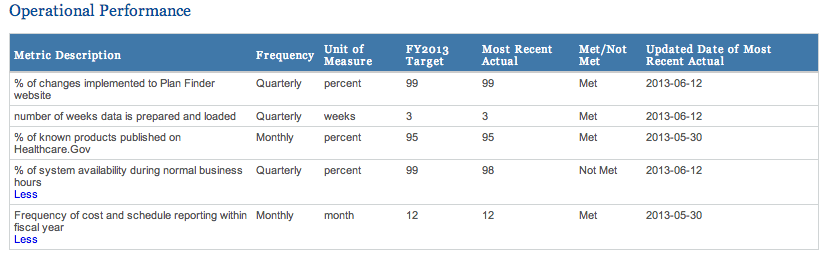
According to the IT Dashboard, "CMS updated the outstanding issues with the Performance Metrics on August 29, 2013. The CIO Rating is currently at 5." That's the top performance rating a CIO can give a program. But here are the metrics that score is based on:
Enlarge / The metrics grid for HealthCare.gov's Plan Finder: easy to make before launch.
Many of these metrics might seem like pointless measurements for a greenfield project like HealthCare.gov. Since it’s a new system, achieving 99 percent of the changes to the website is not exactly a banner note. And the one metric not met is "percent of system availability during normal business hours," measured per quarter—before the site was even online to the public.
The bottom line is that federal IT programs' success is measured by things that have nothing to do with how successful they are or by the metrics most of the world uses. While the business world (and Web companies in particular) now monitor user experience and productivity as a metric for IT success, the government keeps throwing out numbers that mask the truth: the only people who would use their systems are the ones that are forced to.
Like people who need health insurance.
 OfficePants
El Argentino
 Russell Street

No, income inequality is not a problem...
The Bottom 50% of People on Earth Have Only 1% of the Wealth
The gross economic inequality in America gets quite a bit of attention, at least from the non-rich. But when you look at the distribution of wealth in the entire world, the picture gets even more shocking.
Credit Suisse's annual Global Wealth Report breaks down the distribution of wealth around the world in several interesting ways. Some key figures:
-Average global wealth is $51,600 per adult (not per person).
-In Africa, the poorest continent, average wealth is $4,929 per adult. In North America, the wealthiest continent, average wealth is $296,004 per adult.
-North America and Europe each have about 1/3 of the world's total wealth. The rest of the world combined has the remaining 1/3.
-Having just $4,000 in wealth places you in the top half of the world's wealthy. It takes $75,000 to be in the top 10%, and $753,000 to be in the top 1%.
-The top 10% of the world's wealthy people own 86% of the world's wealth.
-The entire bottom half of the world's population by wealth owns only 1% of total global wealth.
That is appalling.
(And no, this data should not be interpreted to mean that poor people in wealthy countries should "consider themselves lucky.")
McDonalds, Taco Bell as Welfare Queens: Over Half Their Workers Use Public Assistance
Like Walmart, the fast food industry has taxpayers as a silent partner. But sadly, we don’t get shares or dividends.
- by Yves Smith
- Oct. 17, 2013
- original
The National Employment Law Center has been publishing reports on how the rock-bottom wages paid to fast food workers force them to rely on public assistance. The NELC released two new documents yesterday that drill further into the issue. Here’s an overview from the Washington Post:
Taxpayers are spending nearly $7 billion a year to supplement the wages of fast-food workers, even as the leading fast-food companies earn billions of dollars in annual profits, according to a pair of reports released Tuesday.
More than half of the nation’s 1.8 million “core” fast-food workers rely on the federal safety net to make ends meet, the reports said. Together, they collect nearly $1.9 billion through the earned income tax credit, $1 billion in food stamps and $3.9 billion through Medicaid and the Children’s Health Insurance Program, according to a report by economists at the University of California at Berkeley’s Labor Center and the University of Illinois.
Overall, the “core” fast-food workers are twice as likely to rely on public assistance than workers in other fields, said one of the reports, which examined nonmanagerial fast-food employees who work at least 11 hours a week and 27 weeks a year.
Even among the 28 percent of fast-food workers who were on the job 40 hours a week, the report said, more than half relied on the federal safety net to get by.
The Post deserves credit for flagging at the top of the piece that the fast food industry is handsomely profitable as a result of this stealth subsidy. It’s not as if they can’t afford to pay better wages but it sure is more lucrative for them not to.
But many readers will have looked only at the headlines, and not delved into the stories proper. And the headlines don’t finger the employers as welfare queens. Some examples:
Half of fast food workers need public aid CNN
Majority of Texas fast-food workers on public assistance San Antonio News Express
Low fast-food wages supplemented by billions in govt welfare – report RT
Fast-Food Workers Are Costing the U.S. $7 Billion a Year in Public Aid Time
The Time article does a perversely masterful job of shielding the restaurants from blame. Here’s how it starts:
Those cheap fast-food prices conceal a huge hidden cost—even if you never pull into a drive-thru. New studies by the University of Illinois, University of California, Berkeley, and the National Employment Law Project find that taxpayer-funded safety net programs effectively subsidize fast food workers’ low wages.
In other words, the implication is that if there is any culprit, it’s American’s appetite for bargain fries and burgers. We only get an oblique reference in the sixth paragraph to the idea that the companies themselves might have something to do with this situation:
Of course, fast food companies aren’t the only ones that rely on minimum- and low-wage workers; big-box retailers like Wal-Mart have also come under fire for what they pay employees. But researchers found that 44 percent of restaurant and food service workers were enrolled in one or more assistance programs, the highest of any industry.
A July report by the NELC demonstrated how these badly-paid workers were the bulk of industry employees:
…how low the pay really is…
….and how, contrary to industry claims, the jobs aren’t a stepping stone to better things. Working for a McDonald’s is no longer mainly a part-time or summer job for high school and college students. Only 18% are below 18 and living with their parents; even if you include all minors (which also picks up ones living on their own) and college students living at home, you reach only 1/3 of total employees.
And the claims that front line workers can become managers and owners? Complete hogwash. Most fast food stores are franchises, and they don’t go for sweat equity:
This Real News Network interview with Jack Temple of NELC not only debunks the industry’s efforts to defend its practices, but also describes how it is playing a central role in driving down wages:
October 18, 2013, 9:00 am
Electrical Grid Is Called Vulnerable to Power Shutdown
By NICOLE PERLROTH
Over the past few months, the discoveries of two engineers have led to a steady trickle of alarms from the Department of Homeland Security concerning a threat to the nation’s power grid. Yet hardly anyone has noticed.
The advisories concern vulnerabilities in the communication protocol used by power and water utilities to remotely monitor control stations around the country. Using those vulnerabilities, an attacker at a single, unmanned power substation could inflict a widespread power outage.
Still, the two engineers who discovered the vulnerability say little is being done.
Adam Crain and Chris Sistrunk do not specialize in security. The engineers say they hardly qualify as security researchers. But seven months ago, Mr. Crain wrote software to look for defects in an open-source software program. The program targeted a very specific communications protocol called DNP3, which is predominantly used by electric and water companies, and plays a crucial role in so-called S.C.A.D.A. (supervisory control and data acquisition) systems. Utility companies use S.C.A.D.A. systems to monitor far-flung power stations from a control center, in part because it allows them to remotely diagnose problems rather than wait for a technician to physically drive out to a station and fix it.
Mr. Crain ran his security test on his open-source DNP3 program and didn’t find anything wrong. Frustrated, he tested a third-party vendor’s program to make sure his software was working. The first program he targeted belonged to Triangle MicroWorks, a Raleigh, North Carolina based company that sells source code to large vendors of S.C.A.D.A. systems. It broke instantly.
Mr. Crain called Mr. Sistrunk, an electrical engineer, to see if he could help Mr. Crain test his program on other systems.
“When Adam told me he broke Triangle, I worried everything else was broken,” said Mr. Sistrunk.
Over the course of one week last April, the two tested Mr. Crain’s software across 16 vendors’ systems. They did not find a single system they couldn’t break.
By the end of the week, the two had compiled a 20-page report replete with vulnerabilities in 16 different system vendors for the Department of Homeland Security’s Industrial Control Systems Cyber Emergency Response Team, I.C.S.-C.E.R.T., which notifies vendors of vulnerabilities and issues public advisories.
And then, they waited. It would take I.C.S.-C.E.R.T. another four months to issue a public advisory for Triangle MicroWorks’ system.
Triangle MicroWorks’ engineering manager Greg Godlevski said that during those four months, the company developed a number of its own tests to look for defects in its software and fix them. Mr. Godlevski said the company waited for confirmation from Mr. Crain that the problem had been fixed, then met with I.C.S.-C.E.R.T. several times to review and comment on the government advisory.
“We take any reported problems discovered in our products very seriously,” Mr. Godlevski said. “We expend a lot of effort adding levels of security to our protocols and ensuring that they comply to the published specifications.”
D.H.S. did not return a request for comment.
Over the course of those four months, Mr. Crain and Mr. Sistrunk found vulnerabilities in an additional nine vendors’ systems.
Like most security alerts, there are some caveats to this concern for the safety of electric facilities: Mr. Peterson’s company, Digital Bond, sells consulting services to assess and improve the security of S.C.A.D.A. systems.
Mr. Crain also has an interest. In March, he plans to release a free version of his security test, but for now he is charging vendors to use his program. (Mr. Crain would not disclose pricing, since it differed for each vendor based on vendor size, saying only that he charged in the “thousands” though he said he charged far less than commercial services like WurldTech Security, which charges tens of thousands of dollars for similar programs.)
“We haven’t found anything we haven’t broken yet,” Mr. Crain said in an interview. At minimum, the two discovered that they could freeze, or crash, the software that monitors a substation, thereby blinding control center operators from the power grid. Mr. Crain likened that capability to “a bank robber being in a bank vault with the camera frozen.”
In the case of one vendor, Mr. Crain found that he could actually infiltrate a power station’s control center from afar. An attacker could use that capability to insert malware to take over the system, and like Stuxnet, the computer worm that took out 20 percent of Iran’s centrifuges, inflict actual physical harm.
“This is low-hanging fruit,” said Mr. Crain. “It doesn’t require some kind of hacker mastermind to understand the protocol and do this.”
What makes the vulnerabilities particularly troubling, experts say, is that traditional firewalls are ill-equipped to stop them. “When the master crashes it can no longer monitor or control any and all of the substations,” said Dale Peterson, a former N.S.A. employee who founded Digital Bond, a security firm that focuses on infrastructure. “There is no way to stop this with a firewall and other perimeter security device today. You have to let DNP3 responses through.”
Even more troubling, Mr. Peterson said, is that most DNP3 communications aren’t regulated. The original version of DNP3 worked on serial communications — a way of transmitting data usually found in things like coaxial cables — and is still widely deployed in large systems, particularly substations around the country. But current cybersecurity regulations, governed by the North American Electric Reliability Corporation’s (N.E.R.C.) Critical Infrastructure Protection Committee (C.I.P.C.) are focused on Internet Protocols, or I.P. protocols, and specifically exclude serial communications and the equipment that uses them from meeting any security requirements.
“Why isn’t D.H.S., N.E.R.C., and the DNP3 committee telling vendors they need to fix this now and utility owners they need to get this patched A.S.A.P.?” Mr. Peterson said.
To date, D.H.S. has posted nine advisories, several of them for software used by major players in the electric sector.
“This is a systemic problem,” Mr. Crain said. “Most of the top five utilities use this software and just because a patch is available, doesn’t necessarily mean that utilities are applying them.”
Families With Kids Go Homeless as U.S. Rents Exceed Pay: Economy
When Montoria Freeland separated from her husband of 15 years in 2008, she left a four-bedroom house and economic security. Before long, her pay and hours as a pharmacy technician were cut and she found herself and her son facing homelessness.
- by Jeanna Smialek
- Oct. 18, 2013
Freeland lived with family for a time, she said, and four months ago moved into transitional housing funded by the city government in Washington, D.C., while searching for work that pays more than her $8.25-an-hour retail job. Having lost her oldest son in a 2000 homicide, Freeland said she insists on looking for housing in a safe neighborhood for her surviving one, now 17. She found that’s available only at an increasingly steep price.
“You’re trying to pay car insurance, rent, electric, cable and if you’re using public transit, putting money on your card, groceries,” said Freeland, who was accepted into a program that provides temporary housing, financial planning and job-placement counseling. “It’s hard to survive out here.”
For households with children, rising housing costs, elevated unemployment and stagnant earnings are increasingly placing rent beyond reach. The housing slump made matters worse as former homeowners turned into renters, increasing competition for available apartments.
“There is just a mismatch between what people earn and what it takes to pay for housing,” said Sheila Crowley, chief executive officer of the Washington-based National Low Income Housing Coalition. “Unemployment continues to be persistently high, and wage stagnation at the low end seems to go out as far as the eye can see.”
Homeless Families
The number of homeless people who are part of a family climbed 1.4 percent in January 2012 from the prior year, even as total homeless numbers declined, based on a National Alliance to End Homelessness analysis of the most recent nationwide statistics available. The number of children without a home increased by an estimated 2 percent, according to NAEH, a Washington-based non-profit focused on policy and research on the needs of homeless people.
More recent local data from places such as Seattle and Portland, Oregon, suggest that in some markets where rent is rising, homelessness has followed suit. What’s more, federal budget cuts to government housing programs threaten to trim aid.
Nationally, the average hourly wage among renters is $14.32 this year compared with the $18.79 needed to afford an apartment at a fair-market rent, as defined by the U.S. Department of Housing and Urban Development, without spending more than 30 percent of income on housing, a National Low Income Housing Coalition report found in March. The $4.47 gap this year is wider than the $4.10 differential in 2012.
Not Affordable
The report found that extremely low-income households could afford to spend no more than $495 a month on an apartment this year, while the national two-bedroom fair-market rent was $977.
The number of full-time jobs at the prevailing state minimum wage that people in a household need in order to afford the average two-bedroom fair-market rent ranges from 1.4 jobs in Puerto Rico to 4.4 jobs in Hawaii, the report showed.
As incomes for the impoverished stagnate, rents rose 3.5 percent nationally through Aug. 31, from a year earlier, based on data from Trulia.com, a real-estate website.
“Units with more bedrooms are getting harder to find, and if you have kids, when you don’t have childcare, adequate employment is hard to find,” said Nan Roman, chief executive officer of the NAEH.
Seattle, Portland
Seattle and Portland are among the top 10 metropolitan areas with the biggest rent gains in 2012, according to a Trulia analysis of the 25 largest rental markets. At the same time, homelessness is on the rise.
A one-night tally taken in January of unsheltered homeless people in parts of King County, which includes Seattle, found a 2 percent increase compared to the same areas a year earlier. In the Portland region, 5 percent more people were living on the streets or in shelters on a night in January 2013 than in 2011.
The nationwide increase in homeless family members in 2012 contrasted with other populations: about 1.4 percent fewer single people were homeless that year compared with 2011, the NAEH report shows.
That’s partly because the government has focused programs on veterans and chronically homeless populations, Crowley said. Also, homelessness among families has failed to abate because it is tied more closely to the economy, said Douglas Rice, who works on housing issues at the Washington-based Center on Budget and Policy Priorities, which focuses on public programs for low-to moderate-income Americans. Homelessness among single people is more likely to be related to substance abuse and mental health issues, he said.
Doubling Up
Also, “single people maybe can double up more, they can find smaller places,” Roman said.
Median household income has fallen every year for the past five after adjusting for inflation, with Americans earning no more than they did in 1996, according to data from the Census Bureau. The share of people making less than $15,000 climbed to 13 percent of the population in 2012, from 10.9 percent in 2000, and the share making less than $35,000 expanded to 35.4 percent from 31.4 percent.
The share of Americans experiencing “deep poverty,” living at less than 50 percent of the $23,492 poverty line for a family of four, climbed to 6.6 percent in 2012 from 4.5 percent in 2000, based on Census Bureau data released last month.
In Pipeline
That may increase the pipeline of Americans heading toward homelessness. There was a 9.4 percent increase in the number of poor people “doubled up,” or living with friends or family due to economic need, between 2010 and 2011, based on the NAEH 2013 report. Crowley said 2011 is the latest year for which usable data on doubling up is available.
“If we see an increase in doubling up, that means there are people who cannot find affordable housing” and it indicates those people are at increased risk for homelessness, Crowley said.
According to the NAEH report, living doubled up is the most frequently cited previous living situation for people who enter the homeless system.
The across-the-board federal budget cuts, known as sequestration, that began in March could worsen the situation, particularly if Congress leaves them in place. Lawmakers this week passed legislation extending current funding levels through Jan. 15, entrenching sequestration at least until a new budget agreement is reached.
Budget Cuts
The cuts resulted in reductions to many programs within the Department of Housing and Urban Development, including Section 8 Housing Choice vouchers.
The vouchers are the federal government’s main program for helping very low-income families, seniors and the disabled afford private housing and are administered by local agencies. They subsidize rents, and can reduce payments to 30 percent of earned income.
The number of households receiving the subsidies will drop by an estimated 125,000 to 155,000 by mid-2014, between 6 and 7 percent below pre-sequestration levels, said Rice from the Center on Budget and Policy Priorities.
The rise in family homelessness is a function of a weak job market, and thus isn’t something government programs can fix, said Mark Calabria, director of financial-regulation studies at the Washington-based Cato Institute, which supports limited government.
Labor Market
“The biggest driver now of increase in family homelessness is the labor market,” Calabria said in an e-mail. “The most effective thing we can do is create jobs, which federal programs don’t have a good record at.”
Regaining independence can be difficult, said Freeland, who has found her lack of a higher education poses a barrier.
“The higher-paying jobs are sometimes unattainable” without a college degree, said Freeland.
She said she’s lucky to have help in the meantime, something she remembers each time she sees homeless people standing outside a shelter.
“Thank God that’s not my situation,” she said. “It very well could have been.”
Why Government Tech Is So Poor
Fixing Procurement Process Is Key to Preventing Blunders Like Healthcare.gov
By
Farhad Manjoo
Oct. 16, 2013 6:16 p.m. ET
Just before Healthcare.gov hobbled online, Kathleen Sebelius, secretary of health and human services, compared the federal health-care exchange to her iPad's new operating system.
If users found a few bugs in their iPads, she argued, most wouldn't consider them a complete disaster. Instead, they would recognize that technology is complicated, that errors are common, and they would wait for an update. Apple Inc., AAPL +0.87% she added, has "a few more resources" than her department, so "hopefully [citizens will] give us the same slack they give Apple."
That argument is as clueless as it is misleading. While it's true that Apple is fantastically wealthy, its product-development costs aren't necessarily greater than those of the federal government. As Fred Vogelstein reports in his coming book, Apple spent about $150 million developing the iPhone. The health-insurance exchange—which, let's remember, is merely a website meant to connect citizens to insurance companies, something quite a bit less complex than Apple's groundbreaking miniature computer—so far has cost at least $360 million, and possibly as much as $600 million.
So how can the government spend so much more on technology and not get anywhere near equal results? That gets to the larger problem with Ms. Sebelius's iPad argument: When Apple royally screws up, the world doesn't cut it any "slack," and that's a good thing. Note what happened last fall, when Apple replaced Google Inc. GOOG +13.80% 's maps app with its own half-baked version: iPhone users rebelled, the tech press went ape and, within a few days, Chief Executive Tim Cook apologized and eventually fired the company's mobile-software chief.
In consumer tech, performance matters. When things go wrong, customers balk, investors flee, and heads roll. In the government, despite several attempts at reform, few of these consequences seem to apply.
Isn't it time that changed? Healthcare.gov—which has been described as a failure by many experts, including supporters of the health law—is only the latest in a series of faulty, overpriced governmental tech launches during administrations of both parties.
It doesn't have to be this way. There's nothing inherent about the phrase "government technology" that should inspire a parade of incompetence; the tech needs of the feds don't have to be vastly more complicated, expensive or legally daunting than the rest of the world's. Instead, the problem is a lack of accountability. As Ms. Sebelius's comments underscore, there's an expectation, bolstered by the historical record, that the government can't do tech well, so we're all expected to forgive its glaring shortcomings.
The truth is that the government could revamp its tech house. For less money than we currently spend on IT, and with a smidgen of political will, we could remake the nation's IT infrastructure using off-the-shelf hardware and software and the best tech practices employed by the world's most admired tech companies. If we do so, dealing with the government—whether for health care, contracting, taxes, or for anything else—could really be as painless as buying a book from Amazon.
Though everything in Washington is partisan these days, this thing doesn't have to be. Both Democrats and Republicans ought to be able to get on board with tech reform; it would improve how we all interact with the government and make the whole system more efficient and affordable.
Tech companies, too, should fight for a new way. Today a small number of insiders are awarded the bulk of federal IT contracts. Reforming the way the government buys and uses tech would open up a vast market to companies such as Apple, Google, Amazon.com Inc., AMZN +5.84% a host of upstarts that are currently revolutionizing every other corner of economic life.
When you examine the follies at the heart of Healthcare.gov, two important factors stand out, experts say. The first is personnel—like many government IT projects, this was implemented by people who don't understand IT. "There's a lack of technology leadership at the agency level, leading to an inability to execute," said Vivek Kundra, who was appointed the nation's first chief information officer by President Barack Obama in 2009 and who is now an executive at the cloud-services company Salesforce.com Inc. CRM +2.06%
Mr. Kundra said that when he was the nation's CIO, the White House pushed a "cloud-first policy" that encouraged government agencies to avoid creating new server farms every time they had to build new websites, which is how the rest of the world works with tech. "It seems like with Healthcare.gov, a set of decisions were made at the agency level that aren't in line with how modern technology is deployed," Mr. Kundra said.
Why would the government implement the sort of tech infrastructure that no one else would consider? The answer is the mother all problems in government tech: "procurement." That's jargon for the broken process by which the government buys things.
Today, any company looking to work with the government must navigate an obstacle course of niggling, outdated regulations and arbitrary-seeming requirements. For instance, your technology must be Y2K-compliant just to get in the door. The process locks out all but a tiny handful of full-time contractors—companies who also happen to be big federal lobbyists. (Note how CGI Group Inc., GIB -0.44% which won the largest contract to build Healthcare.gov, lobbied on behalf of the health-care law.)
Clay Johnson, a former Presidential Innovation Scholar and the CEO of a reform-minded software company called Department of Better Technology, has written a seven-part manifesto on how to fix procurement, a prescription he says would go far in resolving most of the government's tech issues. His upshot: The government should strive to buy tech like the rest of the world does, opening itself up to vastly more vendors, and aligning price with performance. Logistically, none of the steps he outlines would be very difficult to accomplish. It would just require a full-court press from political leaders to make it happen.
These days, that sounds like reason enough for pessimism, though Mr. Johnson argues that government's tech issues are on the verge of reaching a tipping point that will force action.
"Long term, the government is not able to survive if it keeps using outdated technology, because the gap between last year's technology and this year's technology is always exponentially growing," he said. "You walk into the DMV and the person behind the desk has a CRT monitor and you have an iPhone—that leads to a gap to the perception of confidence. We need to fix that if we want the government to maintain some semblance of confidence, and competence."
Meet the Google executive who plans to cheat death: Ray Kurzweil takes 150 vitamins a day so he can 'hold out long enough for invention of robots that will keep humans alive'
By Daily Mail Reporter
- Futurist Ray Kurzweil explains the biology of the body is like computer software that needs upgrading
- Key is a 'bridge to bridge' system where you maximize current methods in order to live until life-lengthening technology is at its greatest
- Kurzweil is currently taking 150 vitamin supplements per day
- We will eventually hit a stage where robots will subsidize our immune system
PUBLISHED: 11:57 EST, 19 October 2013 | UPDATED: 16:54 EST, 19 October 2013
...
'That was a very good idea 10,000 years ago, when you worked all day to get a few calories; there were no refrigerators, so you stored them in your fat cells.
'I would like to tell my fat insulin receptor gene, “You don’t need to do that anymore,”.'
Kurzweil referenced a lab mice experiment at the Joslin Diabetes Center, which managed to turn off the mice's fat insulin receptor gene.
The mice continued to eat, remained slim, did not get diabetes or heart disease and lived 20 per cent longer.
Google is hoping to help expand the human lifespan with its new company Calico, which aims to make improvements in human health and well-being.
Kurzweil has previously predicted that by the late 2020s humans will be able to eat as much junk food as they want because everyone will have a nanobot injected into their bodies that will provide all the necessary nutrients while simultaneously eliminating fat.
Our resident transhumanist is probably already aware of this one, but even if you're not into all that, take a look at the pattern on his suit. Also, end of article informs us that Google companies are working on curing fatness.
http://www.dailymail.co.uk/news/article-2467514/Ray-Kurzweil-shares-plans-immortality.html
You know, we actually HAVE a feature that will literally call him, right?Calling Harvey.
Reports: U.S. drone strikes in Yemen, Pakistan killed civilians
By Ken Dilanian
October 21, 2013, 9:05 p.m.
WASHINGTON — U.S. drone strikes in Yemen and Pakistan are not as precise as American officials have suggested, and some appear to have violated international law, according to a pair of reports by human rights organizations based on interviews with survivors and witnesses.
The reports by Amnesty International, which looked into drone strikes in Pakistan, and Human Rights Watch, which examined attacks in Yemen, also assert that the U.S. has killed militants when capture was a feasible option and has targeted people rushing to rescue those injured in an initial barrage.
The reports, which were distributed in advance to the Los Angeles Times and other news organizations, are scheduled to be released at a news conference Tuesday in Washington.
Photos: U.S. drone strikes in Yemen and Pakistan
Amnesty examined nine attacks in Pakistan this year and in 2012 and concluded that 29 noncombatants were killed. Human Rights Watch counted 57 civilians killed in six attacks in Yemen from 2009 to 2013, including 41 in a December 2009 cruise missile attack based on faulty intelligence from the Yemeni government. Most of the strikes involved missiles fired from remotely piloted drone aircraft.
The authors of the reports acknowledge that in many cases it is difficult to say with certainty whether military-aged males killed in a particular strike were members of Al Qaeda or associated forces who had participated in or were planning attacks on U.S. interests.
Relatives often insist their dead loved ones had no connection to extremists. American intelligence officials and their congressional overseers argue that in almost all cases the strikes have hit legitimate targets. Sorting out the truth in individual cases is often impossible.
However, the human rights activists argue that mere membership in an organization or past participation in hostilities against the U.S. don't make a person a legitimate target for a drone strike under international law. And they say that despite President Obama’s pledge this year to be more transparent about the lethal operations, the U.S. is still releasing almost no information about who it is killing and why, making it impossible to definitively evaluate the legality of the strikes.
“We think these people were civilians, and the onus is on the U.S. government to prove otherwise,” said Naureen Shah of Amnesty International, who helped write that group’s report. “The U.S. government has this information and is withholding it.”
White House officials declined to respond in detail to the allegations. They pointed to Obama’s speech in May, in which he announced tighter standards for targeted strikes, including “a near-certainty that no civilians will be killed or injured.”
But he did not know why until after the Capitol Police had hustled her from the podium at the House of Representatives to a hospital for psychiatric observation.
repeatedly awakened by the Holy Spirit and urged to deliver a message on the House floor, where she has worked for the past eight years.