- Messages
- 9,933
http://www.bbc.co.uk/news/science-environment-23447600
Scientists can implant false memories into mice
Scientists can implant false memories into mice
Follow along with the video below to see how to install our site as a web app on your home screen.
Note: This feature may not be available in some browsers.


"close to meat"?
Sea level and temperatures hit record highs last year, report says
By Nathan Olivarez-Giles on August 6, 2013 04:17 pm
The US had its warmest year on record in 2012 as carbon levels grew and Arctic sea ice melted. Another downer: the global sea level hit an all-time high last year as well. These and other troubling environmental records were published Tuesday in the 32nd edition of the American Meteorological Society's State of the Climate report. This year, the annual AMS-written report was compiled with contributions from the National Oceanic and Atmospheric Administration (NOAA) and more than 380 scientists from 52 countries. The overall message of the 258-page document? Global warming is taking its toll and there is evidence of problematic, long-term trends all over the planet.
Last year, Earth was hot enough to break into the top 10 warmest years on record — either the eigth or ninth warmest depending on what dataset is used, the AMS report says. Meanwhile, both the US and Argentina had their warmest years on record. And the Arctic ocean also continued to warm, which caused sea ice to shrink yet again. In 2012, the Arctic warmed at a rate of about double the levels seen in lower latitudes, the report says. Arctic sea ice shrunk to a record low, at one point receding to 1.32 million square miles — 18 percent lower than the previous record low of 1.61 million square miles set back in 2007. NOAA has previously projected that the Arctic ocean could be essentially ice-free by 2050.
Temperatures, sea level, greenhouse gases — they're all up
On a worldwide scale, the sea saw record-setting temperatures last year as well. The AMS says that four independent datasets found 2012 to be among the 11 warmest years on record when it comes to average sea surface temperature. The Earth's average sea level also rose last year, after falling a bit in 2011 due to La Niña. "Global average sea level in 2012 was 1.4 inches above the 1993-2010 average," the report says. The increased sea surface temperatures and sea level go hand in hand: the warmer the water, the greater its volume.
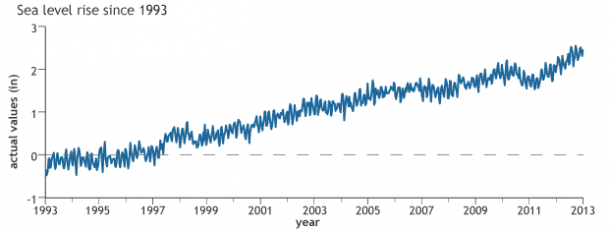
Among the major contributing factors to our continually warming planet are, of course, greenhouse gasses. In 2012 the levels of carbon dioxide, methane, and nitrous oxide in our atmosphere each rose. The AMS says that global carbon dioxide emissions, from the burning of fuel and the production of cement, hit a record high last year — up to 2.1 parts-per-million to a global average of 396.2 parts-per-million on a worldwide average. Another record from the report: for the first time, carbon dioxide levels hit 400 parts-per-million at several Arctic observational sites — locations far from cement factories, car-filled cities, or major manufacturing plants where massive amounts of fossil fuels would be burned.


New Study Finds High Levels of Arsenic in Groundwater Near Fracking Sites
by Theodoric Meyer
ProPublica, Aug. 8, 2013, 10:45 a.m.
A recently published study by researchers at the University of Texas at Arlington found elevated levels of arsenic and other heavy metals in groundwater near natural gas fracking sites in Texas’ Barnett Shale.
While the findings are far from conclusive, the study provides further evidence tying fracking to arsenic contamination. An internal Environmental Protection Agency PowerPoint presentation recently obtained by the Los Angeles Times warned that wells near Dimock, Pa., showed elevated levels of arsenic in the groundwater. The EPA also found arsenic in groundwater near fracking sites in Pavillion, Wyo., in 2009 — a study the agency later abandoned.
ProPublica talked with Brian Fontenot, the paper’s lead author, about how his team carried out the study and why it matters. (Fontenot and another author, Laura Hunt, work for the EPA in Dallas, but they conducted the study on their own time in collaboration with several UT Arlington researchers.) Here’s an edited version of our interview:
What led you guys to do the study?
We were sort of talking around lunch one day, and came up with the idea of actually going out and testing water in the Barnett Shale. We’d heard all the things that you see in the media, all the sort of really left-wing stuff and right-wing stuff, but there weren’t a whole lot of answers out there in terms of an actual scientific study of water in the Barnett Shale. Our main intent was to bring an unbiased viewpoint here — to just look at the water, see if we could find anything, and report what we found.
What kind of previous studies had been done in this vein?
The closest analog that I could find to our type of study are the things that have been done in the Marcellus Shale, with Rob Jackson’s group out at Duke University. Ours is set up very similarly to theirs in that we went out to private landowners’ wells and sampled their water wells and assayed them for various things. We decided to go with a list of chemicals thought to be included in hydraulic fracturing that was actually released in a congressional report. Our plan was to sample everyone’s water that we could, and then go through that list of these potential chemical compounds within the congressional list.
How did you do it?
We were able to get a press release put out from UT Arlington that went into the local newspapers that essentially called for volunteers to be participants in the study. For being a participant, you would get free water testing, and we would tell them our results. We were upfront with everyone about, you know, we don’t have a bias, we’re not anti-industry, we’re not pro-industry. We’re just here to finally get some scientific data on this subject. And we had a pretty overwhelming response.
From there we chose folks that we would be able to get to. We had to work on nights and weekends, because we had an agreement with EPA to work on this study outside of work hours. So we spent quite a few weekend days going out to folks who had responded to our call and sampling their water. But that wasn’t quite enough. We also had to get samples from within the Barnett Shale in areas where fracking was not going on, and samples from outside the Barnett Shale where there’s no fracking going on, because we wanted to have those for reference samples. For those samples we went door to door and explained to folks what our study was about.
We have people that were pro-industry that wanted to participate in this study to help out — saying, you know, ‘You’re not going to find anything and I’m going to help you prove it.’ And we also had folks that were determined to find problems. We have the whole gamut of folks represented in our study.
We would take a water well, and we would go directly to the head, the closest we could get to the actual water source coming out of the ground, and we would purge that well for about 20 minutes. That ensures that you’re getting fresh water from within the aquifer. So we didn’t take anything from the tap, and nothing that had been through any kind of filtration system. This was as close to the actual groundwater as we could get. We took some measurements, and then we took several samples back to UT Arlington for a battery of chemistry analyses. That’s where we went through and looked for the various volatile organic compounds and heavy metals and methanols and alcohols and things like that.
What did you find?
We found that there were actually quite a few examples of elevated constituents, such as heavy metals, the main players being arsenic, selenium and strontium. And we found each of those metals at levels that are above EPA’s maximum contaminate limit for drinking water.
These heavy metals do naturally occur in the groundwater in this region. But we have a historical dataset that points to the fact that the levels we found are sort of unusual and not natural. These really high levels differ from what the groundwater used to be like before fracking came in. And when you look at the location of the natural gas wells, you find that any time you have water wells that exceed the maximum contaminate limit for any of these heavy metals, they are within about three kilometers of a natural gas well. Once you get a private water well that’s not very close to a natural gas well, all of these heavy metals come down. But just because you’re close to a natural gas well does not mean you’re guaranteed to have elevated contaminate levels. We had quite a few samples that were very close to natural gas wells that had no problems with their water at all.
We also found a few samples that had measureable levels of methanol and ethanol, and these are two substances that don’t naturally occur in groundwater. They can actually be created by bacterial interactions underwater, but whenever methanol or ethanol occur in the environment, they’re very fleeting and transient. So for us to be able to actually randomly take a grab sample and detect detectable methanol and ethanol — that implies that there may be a continuous source of this.
You found levels of arsenic in areas with fracking that were almost 18 times higher than in areas without fracking or in the historical data. What would happen to someone who drank that water?
Arsenic is a pretty well-known poison. If you experience a lot of long-term exposure to arsenic, you get a lot of different risks, like skin damage, problems with the circulatory system or even an increased risk of cancer. The levels that we found would not be a lethal dose, but they’re certainly levels that you would not want to be exposed to for any extended period of time.
What about the other stuff you found?
The heavy metals are a little bit different because they are known to be included in some fracking recipes. But they’re also naturally occurring compounds. We think the problem is that they’re becoming concentrated at levels that aren’t normal as a result of some aspect of natural gas extraction.
It’s not necessarily that we’re saying fracking fluid getting out. We don’t have any evidence of that. But there are many other steps involved, from drilling the hole to getting the water back out. A lot of these can actually cause different scenarios whereby the naturally occurring heavy metals will become concentrated in ways they normally wouldn’t. For example, if you have a private water well that’s not kept up well, you’ll have a scale of rust on the inside. And if someone were to do a lot of drilling nearby, you may find some pressure waves or vibrations that would cause those rust particles to flake out into the water. Arsenic is bound up inside that rust, and that can actually mobilize arsenic that would never be in the water otherwise.
Methanol and ethanol are substances that should not be very easy to find in the groundwater naturally. We definitely know that those are on the list of things that are known to be in hydraulic fracturing fluid. But we were unable to actually sample any hydraulic fracturing fluid, so we can’t make any claims that we have evidence fluids got into the water.
Have you talked with the homeowners whose wells you sampled?
We have shown those homeowners the results. I think most of the folks that had high levels of heavy metals were not necessarily surprised. You hear so much I think maybe they were expecting it to come back with something even more extreme than that. I don’t want to say they were relieved, but I think they all sort of took the news in stride and realized, OK, well, as a private well owner there’s no state or federal agency that provides any kind of oversight or regulation, so it’s incumbent on that well owner to get testing done and get any kind of remediation.
Do you think fracking is responsible for what you found?
Well, I can’t say we have a smoking gun. We don’t want the public to take away from this that we have pegged fracking as the cause of these issues. But we have shown that these issues do occur in close relation, geographically, to natural gas extraction. And we have this historical database from pretty much the same exact areas that we sampled that never had these issues until the onset of all the fracking. We have about 16,000 active wells here in the Barnett Shale, and that’s all popped up in about the last decade, so it’s been a pretty dramatic increase.
We noticed that when you’re closer to a well, you’re more likely to have a problem, and that today’s samples have problems, while yesterday’s samples before the fracking showed up did not. So we think that the strongest argument we can say is that this needs more research.
How Upvote/Downvote Sites like Reddit Breed Irrational Herd Behavior
Are you a think-for-yourselfer? Do you weigh positive and negative Yelp reviews with a cold, dispassionate sagacity? Do you fancy yourself immune to the influence of others when you browse Reddit? That's cute. Newly published research says you're wrong.
A study that appears in the latest issue of Science reveals that users on social news aggregator sites like Digg, Reddit and Hacker News are heavily influenced by the opinions of other users, viewing comments differently depending on how they're rated previously. Sound obvious? It's not. Here's some background.
Who knows — maybe you have a Vulcan-like capacity for reason, and you really can resist the powerful effect of others' opinions (what is sometimes referred to as social influence bias). But even if you can, can we at least agree that you're kind of swimming upstream?
The last decade or more has been marked by an explosion of interest in aggregated opinion, and how we can use it to inform our own beliefs, ideas, and decisions. Need a new Blu-ray Player? Search for it on Amazon and sort your results by average customer review. Not sure whether you should be offended by "Blurred Lines" (is it the catchiest song you've heard in months, deplorably sexist, or just "subtly ridiculing?")? Here's a Reddit thread full of ready-made opinions (rated by popularity) primed to create, inform, or supplant your own.
When you're through reading this post (yes, this one), scroll to the bottom of the page and eat your fill of insights, ideas, suggestions, criticisms and other twopennies. Hell, maybe just stop reading right here and scroll to the comments right now for the quick rehash and some witty banter. We've all done it. That's half the reason we read things online anyway, right? For the comments?
We're all highly suggestible sheep. Photo by Bertoz, via Flickr.
Here's the thing. In an ideal world, the online rating systems we use to score Blu-ray players, music, restaurants, and even opinions would give rise to massive quantities of useful information that ultimately tell us something about the quality of whatever is being rated. (Call it the wisdom of the massively connected crowd.)
Only it doesn't always work that way. Sometimes a famous sushi bar is famous because people have parroted for years that its fish is the freshest in town, even though it's really only the eighth- or maybe ninth-freshest, and its preparation isn't even overseen by a trained itamae. Sometimes a popular movie is beloved not because it's a good movie, but because everyone says it's a good movie.
Researchers describe the tendency to make decisions based on prior ratings "irrational herding." There's evidence that suggests this herd-like behavior could be partly responsible for everything from terrible music on America's Top 40 to the rich-get-richer dynamics of economic inequality.
And yet, our understanding of how social influence affects collective judgement is restricted, because it's basically impossible to distinguish irrational herding from unified agreement on true quality — are "Blurred Lines" and "Get Lucky" the songs of the summer because they're good songs, or because Stephen Colbert says they are? It's probably some mix of both – but to really find out, we need a way to measure the extent to which social influence begets irrational herding.
To that end, Lev Muchnik of the Hebrew University of Jerusalem, Sinan Aral of MIT and Sean J. Taylor of NYU collaborated with a major social news site to conduct a massive randomized control experiment – one that would examine how a comment's "upvotes" or "downvotes" distorts its public reception. Their observations, which are published in the latest issue of Science, demonstrate that, regardless of its quality, a comment's very first vote had a huge impact on individual rating behavior and gave rise to herding effects.
Here's how it went down. On an unnamed social news aggregator described by the researchers as "similar to Digg.com and Reddit.com," the researchers monitored the status of 101,281 comments made by users in comment-threads like this one, this one, and this one. The comments were made over the course of five months, in which time they were viewed more than 10 million times and rated again by other users a total of 308,515 times.
But here's where things get interesting: the site was rigged such that every time a user left a comment, it was automatically administered an upvote (positive), a downvote (negative) or no vote at all (control). At the end of the experiment, the researchers found that comments that automatically received an upvote – just one upvote – were 32% more likely to receive another upvote by the first user to see them, relative to the control group. Those comments were also more likely to snowball in popularity; by the end of the study, the upvote group had received, on average, a 25% higher rating than the control group. Interestingly, comments that automatically received a downvote were actually more likely than the control group to receive an upvote from the second voter, reflecting what the researchers call a "correction effect."
"People are more skeptical of negative social influence," said Aral in a statement. "They're more likely to 'correct' a negative vote and give it a positive vote." The teams results suggest that positive social influences tend to accumulate, giving rise to herding effects, while negative social influences wind up being neutralized.
Another interesting observation: comments that appeared in threads relating to business, culture and society, and politics exhibited far greater herding effects than those pertaining to economics, general news, and IT.
"If perceptions of quality are biased by social influence," the authors write, "attempts to aggregate collective judgment and socialize choice could be easily manipulated, with dramatic consequences for our markets, our politics, and our health."
This study obviously lends itself to some pretty cynical conclusions (although the observed "correction effect" suggests we internet voters may be at least halfway decent people), but the authors stress it's important to remember that the better we understand how social biases color public opinion, the more we can do to keep them from being used inappropriately.
"Our message is not that we should do away with crowd-based opinion aggregation," Aral says. "Our point is that you need solid science under the hood trying to understand exactly how these mechanisms work in a broad population, what that means for the diffusion of opinion, and how can we design the systems to be fair, to have less incentives for manipulation and fraud, and be safe in aggregating opinions."
The researchers' findings are published in the latest issue of Science.
Where are we, Norway?Maybe if women paid for their own drinks they wouldn't have to worry about this kind of thing.
In regenerative medicine breakthrough, lab-grown human heart tissue beats on its own
By Katie Drummond on August 13, 2013 01:20

Progress in regenerative medicine has been coming fast and furious in recent months: scientists are now using far-out tissue engineering techniques to restore liver function in mice, regrow human muscle, and even implant bioengineered blood vessels into ailing patients. Now, a team at the University of Pittsburgh has managed to grow human heart tissue that can beat autonomously in a petri dish — an exciting step towards devising transplantable replacement organs.
The group, who reported their progress in the journal Nature Communications, used induced pluripotent stem cells (iPS cells) to accomplish the feat. These mature human cells are first "reprogrammed" to an embryonic state, before being spurred to develop into a specialized type of cell. In this instance, iPS cells derived from human skin were induced to become multipotential cardiovascular progenitor (MCP) cells — basically heart cells that can further differentiate into three varieties of highly specialized cells required for cardiovascular function.
A functional organ capable of beating on its own
From there, scientists transplanted the cells onto a mouse heart that had been completely stripped — turning the organ into what's known as a "scaffold." Over a period of weeks, the transplanted human cells proliferated and differentiated, rebuilding the scaffold into a functional organ capable of beating on its own. Right now, the heart tissue contracts at a rate of 40 to 50 beats per minute (on-par with a human's resting heart rate) but needs to be further refined before it's capable of beating strongly enough to distribute blood, or speeding up and slowing down when necessary.
This isn't the first time that scientists have managed to engineer heart tissue — in recent years, other teams have created lab-grown beating rat hearts and even human heart tissue. The latter breakthrough, however, relied on embryonic stem cells, which can't be derived from a specific patient for subsequent, personalized transplant the way this new technique allows.
A full-sized, fully functional replacement human heart is, of course, several years off. But in the near future, scientists hope to develop personalized "patches" of human heart muscle to repair damaged organs, and hope to see their technique used to more accurately study the effects of new pharmaceuticals to treat cardiovascular ailments.
Breakthrough: Scientists have built a fully-functional mouse heart
In a major scientific first, a team of developmental biologists has built a functional mouse heart from human tissues. The results herald a future where specific patches of heart muscle – or even the whole organ – could be grown for transplantation.
The work, which was led by University of Pittsburgh's Lei Yang and is recounted in the latest issue of Nature Communications, hinges on the combination of two major regenerative medicine techniques. The first is the use of human induced pluripotent stem cells (iPS cells). iPS cells are mature, differentiated cells (liver cells, for instance, or skin cells) that have been reprogrammed into an undifferentiated state.
Like embryonic stem cells, iPS cells can be stimulated by growth factors to give rise to a wide range of different cell types; just because an iPS cell started out as, say, a renal cell expelled in the urine, doesn't mean it can't be coaxed into becoming dental tissue (fun fact: a team of researchers recently did exactly that) – it just needs the right set of instructions. Yang and his colleagues took cells from a small biopsy of human skin, reverse-engineered them into iPS cells, then instructed them to produce what are called multipotential cardiovascular progenitor cells. These "MCP cells," as they're called, are the precursors to three very important types of heart cell: cardiomyocytes, endothelial cells, and smooth muscle cells.
The second technique is a tissue-preparation process known as decellularization, which Yang and his colleagues used to strip a mouse heart of its cells. What remained of the organ was a framework rich in non-living, but structurally and developmentally important, tissue known as extracellular matrix (ECM). The researchers repopulated this ECM-laden heart-scaffold with their MCP cells.
Within three weeks, the mouse heart had been reconstituted with cardiomyocytes, endothelial cells and smooth muscle cells. The heart was pulsing on its own (to the rhythm of roughly 45 beats per minute), generating mechanical force and even responding to drugs.
"Nobody has tried using these MCPs for heart regeneration before," explained Yang in a statement. A similar procedure, which saw decellularized rat hearts repopulated with the heart cells of newborn rats, was successfully performed back in 2007; what makes this big news is the implementation of human iPS cells and the effects of ECM on MCP cells. "It turns out that the heart's extracellular matrix can send signals to guide the MCPs into becoming the specialized cells that are needed for proper heart function," explains Yang.
The study also demonstrates that the ECM's intricate weave of fibrous proteins and carbohydrates not only promotes differentiation but proliferation of human heart tissue.
The million-dollar question, of course, is whether the technique can be used to create biomechanically viable tissue on the scale needed to perform patch-jobs on, say, the weak portion of a diseased heart, or even – dare we say it? – a whole, fully transplantable heart. "One of our next goals is to see if it's feasible to make a patch of human heart muscle," said Yang. "We could use patches to replace a region damaged by a heart attack. That might be easier to achieve because it won't require as many cells as a whole human-sized organ would."
In the meantime, however, Yang and his colleagues expect their strategy will be more immediately useful in the study of early heart formation, or the preclinical testing of new therapeutic agents.
The researchers' findings are published in the latest issue of Nature Communications.
New form of carbon said to be strongest material ever found
By Jacob Kastrenakes on August 15, 2013
The strongest known material in the world may have just been dethroned. Researchers from Rice University have calculated the properties of a little-studied form of carbon known as carbyne, and they've determined that it should have a "specific strength surpassing that of any other known material." That includes graphene — the longstanding titleholder for strongest material — which the researchers say is only half as stiff as carbyne. Carbyne and graphene are actually alike in several ways: both come from carbon, and both are only a single atom thick.
Carbyne has previously been detected in interstellar dust and meteorites. And obtaining it on Earth hasn't been easy: researchers have figured out how to chemically synthesize it, but only recently have they been able to create strands of the material that reach up to just 44 atoms long. Even so, now that carbyne's strength has been revealed, Rice's researchers suggest that it'll be of "great interest" to many who are looking into future possibilities for nanotechnology.
Nasa's Curiosity rover finds water in Martian soil
Dirt sample reveals two pints of liquid water per cubic feet, not freely accessible but bound to other minerals in the soil
Water has been discovered in the fine-grained soil on the surface of Mars, which could be a useful resource for future human missions to the red planet, according to measurements made by Nasa's Curiosity rover.
Each cubic foot of Martian soil contains around two pints of liquid water, though the molecules are not freely accessible, but rather bound to other minerals in the soil.
The Curiosity rover has been on Mars since August 2012, landing in an area near the equator of the planet known as Gale Crater. Its target is to circle and climb Mount Sharp, which lies at the centre of the crater, a five-kilometre-high mountain of layered rock that will help scientists unravel the history of the planet.
On Thursday Nasa scientists published a series of five papers in the journal Science, which detail the experiments carried out by the various scientific instruments aboard Curiosity in its first four months on the martian surface. Though highlights from the year-long mission have been released at conferences and Nasa press conferences, these are the first set of formal, peer-reviewed results from the Curiosity mission.
"We tend to think of Mars as this dry place – to find water fairly easy to get out of the soil at the surface was exciting to me," said Laurie Leshin, dean of science at Rensselaer Polytechnic Institute and lead author on the Science paper which confirmed the existence of water in the soil. "If you took about a cubic foot of the dirt and heated it up, you'd get a couple of pints of water out of that – a couple of water bottles' worth that you would take to the gym."
About 2% of the soil, by weight, was water. Curiosity made the measurement by scooping up a sample of the Martian dirt under its wheels, sieving it and dropping tiny samples into an oven in its belly, an instrument called Sample Analysis at Mars. "We heat [the soil] up to 835C and drive off all the volatiles and measure them," said Leshin. "We have a very sensitive way to sniff those and we can detect the water and other things that are released."
Aside from water, the heated soil released sulphur dioxide, carbon dioxide and oxygen as the various minerals within it were decomposed as they warmed up.
One of Curiosity's main missions is to look for signs of habitability on Mars, places where life might once have existed. "The rocks and minerals are a record of the processes that have occurred and [Curiosity is] trying to figure out those environments that were around and to see if they were habitable," said Peter Grindrod, a planetary scientist at University College London who was not involved in the analyses of Curiosity data.
Flowing water is once thought to have been abundant on the surface of Mars, but it has now all but disappeared. The only direct sources of water found so far have been as ice at the poles of the planet.
The other papers included x-ray diffraction images of the soil in order to work out the crystalline structure of the minerals on the Martian surface and analysis of a volcanic rock called "Jake_M", which is named after a Nasa engineer. The analysis showed that the rock was similar to a type on Earth known as a mugearite, which is typically found on ocean islands and in rift zones.
Grindrod said that the latest results published by the Nasa team were just the start of the scientific insights that would come from Mars in the next few years. "It's the first flexing of Curiosity's analytical muscles," he said. "Curiosity spent a long time checking out the engineering, instruments and procedures it was going to use – these papers cover just that engineering period. The targets here weren't chosen because of their science goals as such but as good targets to test out the instruments."
Leshin said that, as well as the excitement of exploring a new world for the first time, the increasingly detailed analysis of the Martian surface would be critical information for planning human missions. As well as the water discovery, analysis of the soil has also shown, for example, the presence of a type of chemical called a perchlorate, which is can be toxic to people. "It's only there at a 0.5% level in the soil but it impedes thyroid function," she said. "If humans are there and are coming into contact with fine-grained dust, we have to think about how we live with that hazard. To me it's a good connection between the science we do and the future human exploration of Mars."
She added: "I do think it's inevitable that we'll send people there and so let's do its as smartly as we can. Let's get as smart as we can before we go."
Sponges help coral reefs thrive in ocean deserts
By James Morgan Science reporter, BBC News
The mystery of how coral reefs thrive in "ocean deserts" has been solved, scientists say.
Reefs are among Earth's most vibrant ecosystems, yet they flourish in waters lacking nutrients - a phenomenon known as Darwin's Paradox.
A team found that sponges keep the reef alive - by recycling vast amounts of organic matter to feed snails, crabs and other creatures.
Sponges recycle nearly ten times as much matter as bacteria, and produce as much nutrition as all the corals and algae in a reef combined, the scientists calculate.
They are the "unsung heroes" of the reef community, said lead author Jasper de Goeij, an aquatic ecologist at the University of Amsterdam.
"Up until now no-one has really paid sponges much attention. They look nice, but everybody was more interested in corals and fish," he told BBC News.
"If you want a reef which is colourful and biodiverse, you need a 'sponge loop' to maintain it."
It was during his voyage on the Beagle that Charles Darwin famously observed that tropical reefs are like oases in a desert.
They are surrounded by waters lacking nitrogen and phosphorus - the building blocks of life - which ought to prohibit their growth.
And since corals release up to half their organic matter into seawater, reefs need a system to recover these nutrients and recycle them into the ecosystem.
Bacteria do part of the job, but are not abundant enough to service the chemical dependencies of a whole teeming reef community.
Sugar daddies
Sponges (poriferans) are filter feeders which live in rock crevices, sucking up plankton and organic matter released into the sea by corals.
The idea that they could be a missing link in the reef food cycle has been proposed before.
But it was not clear how much nutrition they could supply, nor how exactly they feed their reef neighbours - worms, crustaceans and other sea floor foragers.
On the Caribbean island of Curacao, de Goeij and his team studied four common species of sponges - first in laboratory aquariums, then in a natural reef where the scientists sealed off a cavity.
They fed the poriferans with labelled sugars - and traced these molecules on their journey.
First the sugars were absorbed from the water by the sponges, then quickly shed in dead filter cells (choanocytes) - detritus which fell to the seabed.
Within two days, the same molecules were present in snails and other creatures feeding on the sediment containing sponge waste.
These snails are in turn eaten by larger animals, and so the cycle continues.
It was not only the speed, but the sheer volume of food turnover which took the authors by surprise - about 10 times more than bacteria recycle.
The sponge Halisarca caerulea for example takes up two-thirds of its body weight in dissolved carbon each day, but it barely grows in size - because old cells are shed to the seabed.
In total, the Dutch team estimated this "sponge loop" produced nearly as many nutrients as all the primary producers (corals and algae) in an entire tropical reef.
And other marine deserts, like deep-sea cold-water coral reefs or temperate Mediterranean reefs, may also rely on poriferans to recycle their nutrients.
By recognising sponges as lynchpins - the unheralded heroes of the reef - they hope to aid conservation efforts in these fragile havens.
Scientists reveal chicken nuggets are less than 50% chicken meat
A recently published study reveals that striated muscle is "not the predominate component" in the nuggets from two national fast food chains. In other words: chicken nuggets are less than 50% chicken meat. But... then... what "components" make up the other 50+ percent?
The nuggets came from two national fast food chains in Jackson. The three researchers selected one nugget from each box, preserved, dissected and stained the nuggets, then looked at them under a microscope.
The first nugget was about half muscle, with the rest a mix of fat, blood vessels and nerves. Close inspection revealed cells that line the skin and internal organs of the bird... The second nugget was only 40 percent muscle, and the remainder was fat, cartilage and pieces of bone.
"We all know white chicken meat to be one of the best sources of lean protein available and encourage our patients to eat it," lead author Dr. Richard D. deShazo of the University of Mississippi Medical Center in Jackson, said. "What has happened is that some companies have chosen to use an artificial mixture of chicken parts rather than low-fat chicken white meat, batter it up and fry it and still call it chicken."
"Chicken nuggets are an excellent source of protein, especially for kids who might be picky eaters," said Ashley Peterson, vice president of scientific and regulatory affairs for the National Chicken Council (NCC), a real-life, not-at-all made-up non-profit trade group, representing the U.S. chicken industry, that actually exists.
"It is really a chicken by-product high in calories, salt, sugar and fat that is a very unhealthy choice," deShazo fired back. "Even worse, it tastes great and kids love it and it is marketed to them."
"This study evaluates only two chicken nugget samples out of the billions of chicken nuggets that are made every year," Peterson told Reuters, leveling a completely valid criticism at the study's sample size while simultaneously conjuring the horrifying mental image of BILLIONS OF CHICKEN FAT NUGGETS.
The researchers, tragically (or perhaps mercifully?) chose not to disclose which chain restaurants they visited.
Nuclear fusion milestone passed at US lab
By Paul Rincon Science Editor, BBC News website
Researchers at a US lab have passed a crucial milestone on the way to their ultimate goal of achieving self-sustaining nuclear fusion.
Harnessing fusion - the process that powers the Sun - could provide an unlimited and cheap source of energy.
But to be viable, fusion power plants would have to produce more energy than they consume, which has proven elusive.
Now, a breakthrough by scientists at the National Ignition Facility (NIF) could boost hopes of scaling up fusion.
NIF, based at Livermore in California, uses 192 beams from the world's most powerful laser to heat and compress a small pellet of hydrogen fuel to the point where nuclear fusion reactions take place.
The BBC understands that during an experiment in late September, the amount of energy released through the fusion reaction exceeded the amount of energy being absorbed by the fuel - the first time this had been achieved at any fusion facility in the world.
This is a step short of the lab's stated goal of "ignition", where nuclear fusion generates as much energy as the lasers supply. This is because known "inefficiencies" in different parts of the system mean not all the energy supplied through the laser is delivered to the fuel.
But the latest achievement has been described as the single most meaningful step for fusion in recent years, and demonstrates NIF is well on its way towards the coveted target of ignition and self-sustaining fusion.
- 192 laser beams are focused through holes in a target container called a hohlraum
- Inside the hohlraum is a tiny pellet containing an extremely cold, solid mixture of hydrogen isotopes
- Lasers strike the hohlraum's walls, which in turn radiate X-rays
- X-rays strip material from the outer shell of the fuel pellet, heating it up to millions of degrees
- If the compression of the fuel is high enough and uniform enough, nuclear fusion can result
For half a century, researchers have strived for controlled nuclear fusion and been disappointed. It was hoped that NIF would provide the breakthrough fusion research needed.
In 2009, NIF officials announced an aim to demonstrate nuclear fusion producing net energy by 30 September 2012. But unexpected technical problems ensured the deadline came and went; the fusion output was less than had originally been predicted by mathematical models.
Soon after, the $3.5bn facility shifted focus, cutting the amount of time spent on fusion versus nuclear weapons research - which was part of the lab's original mission.
However, the latest experiments agree well with predictions of energy output, which will provide a welcome boost to ignition research at NIF, as well as encouragement to advocates of fusion energy in general.
It is markedly different from current nuclear power, which operates through splitting atoms - fission - rather than squashing them together in fusion.
NIF, based at the Lawrence Livermore National Laboratory, is one of several projects around the world aimed at harnessing fusion. They include the multi-billion-euro ITER facility, currently under construction in Cadarache, France.
However, ITER will take a different approach to the laser-driven fusion at NIF; the Cadarache facility will use magnetic fields to contain the hot fusion fuel - a concept known as magnetic confinement.
Alzheimer's breakthrough hailed as 'turning point'
The discovery of the first chemical to prevent the death of brain tissue in a neurodegenerative disease has been hailed as the "turning point" in the fight against Alzheimer's disease.
More work is needed to develop a drug that could be taken by patients.
But scientists say a resulting medicine could treat Alzheimer's, Parkinson's, Huntington's and other diseases.
In tests on mice, the Medical Research Council showed all brain cell death from prion disease could be prevented.
Prof Roger Morris, from King's College London, said: "This finding, I suspect, will be judged by history as a turning point in the search for medicines to control and prevent Alzheimer's disease."
He told the BBC a cure for Alzheimer's was not imminent but: "I'm very excited, it's the first proof in any living animal that you can delay neurodegeneration.
"The world won't change tomorrow, but this is a landmark study."
Cells starve
The research team at the Medical Research Council Toxicology Unit, based at the University of Leicester, focused on the natural defence mechanisms built into brain cells.
When a virus hijacks a brain cell it leads to a build-up of viral proteins. Cells respond by shutting down nearly all protein production in order to halt the virus's spread.
However, many neurodegenerative diseases involve the production of faulty or "misfolded" proteins. These activate the same defences, but with more severe consequences.
The misfolded proteins linger and the brain cells shut down protein production for so long that they eventually starve themselves to death.
This process, repeated in neurons throughout the brain, can destroy movement or memory or even kill, depending on the disease.
This process is thought to take place in many forms of neurodegeneration, so safely disrupting it could treat a wide range of diseases.
The researchers used a compound which prevented those defence mechanisms kicking in and in turn halted neurodegeneration.
It is early science, a lot can go wrong between a drug for mice and a drug for humans and the only published data is for prion disease, not even Alzheimer's.
So why the excitement?
It is the first time that any form of neurodegeneration has been completely halted, so it is a significant landmark. It shows that the process being targeted has serious potential.
If this can be successfully developed, which is not guaranteed, the prize would be huge.
In Parkinson's the alpha-synuclein protein goes wrong, in Alzheimer's it's amyloid and tau, in Huntington's it's the Huntingtin protein.
But the errant protein is irrelevant here as the researchers are targeting the way a cell deals with any misfolded protein.
It means one drug could cure many diseases and that really would be something to get excited about.
The study, published in Science Translational Medicine, showed mice with prion disease developed severe memory and movement problems. They died within 12 weeks.
However, those given the compound showed no sign of brain tissue wasting away.
Lead researcher Prof Giovanna Mallucci told the BBC news website: "They were absolutely fine, it was extraordinary.
"What's really exciting is a compound has completely prevented neurodegeneration and that's a first.
"This isn't the compound you would use in people, but it means we can do it and it's a start."
She said the compound offered a "new pathway that may well give protective drugs" and the next step was for drug companies to develop a medicine for use in humans.
'Very dramatic'
Prof Mallucci's lab is also testing the compound on other forms of neurodegeneration in mice but the results have not yet been published.
Side effects are an issue. The compound also acted on the pancreas, meaning the mice developed a mild form of diabetes and lost weight.
Any human drug would need to act only on the brain. However, this gives scientists and drug companies a starting point.
David Allsop, professor of neuroscience at Lancaster University described the results as "very dramatic and highly encouraging" but cautioned that more research was needed to see how the findings would apply to diseases such as Alzheimer's and Parkinson's.
Dr Eric Karran, the director of research at the charity Alzheimer's Research UK, said: "Targeting a mechanism relevant to a number of neurodegenerative diseases could yield a single drug with wide-reaching benefits, but this compound is still at an early stage.
"It will be important for these findings to be repeated and tested in models of other neurodegenerative diseases, including Alzheimer's disease."
Study links warmer water temperatures to greater levels of mercury in fish
By Darryl Fears, Published: October 13 E-mail the writer
Under the watchful eyes of scientists, a little forage fish that lives off the southern coast of Maine developed a strangely large appetite.
Killifish are not usually big eaters. But in warmer waters, at temperatures projected for the future by climate scientists, their metabolism — and their appetites — go up, which is not a good thing if there are toxins in their food.
In a lab experiment, researchers adjusted temperatures in tanks, tainted the killifish’s food with traces of methylmercury and watched as the fish stored high concentrations of the metal in their tissue.
In a field experiment in nearby salt pools, they observed as killifish in warmer pools ate their natural food and stored metal in even higher concentrations, like some toxic condiment for larger fish that would later prey on them.
The observation was part of a study showing how killifish at the bottom of the food chain will probably absorb higher levels of methylmercury in an era of global warming and pass it on to larger predator fish, such as the tuna stacked in shiny little cans in the cupboards of Americans and other people the world over.
“The implication is this could play out in larger fish . . . because their metabolic rate is also increasing,” said Celia Chen, a professor at Dartmouth College in New Hampshire and one of six authors of the study. “Methylmercury isn’t easily excreted, so it stays. It suggests that there will be higher methylmercury concentrations in the fish humans eat as well.”
Methylmercury is linked to high blood pressure, kidney disease and heart attacks in adults and slow neuro-behavioral development in children. A thousand tons of the contaminant drops onto oceans every year from power plant emissions, and more than 250 tons pour from the land into various waters as a result of deforestation.
Top predators on land and sea have higher levels of mercury because of their prey. It is hard for any organism to release the metal, causing it to accumulate, or biomagnify, as scientists say.
The study, “Experimental and Natural Warming Elevates Mercury Concentrations in Estuarine Fish,” was published in the journal PLOS One in April, and officials at Dartmouth called attention to it ahead of last week’s Minamata Convention on Mercury in Japan.
Delegates from 130 nations at the three-day convention that ended Friday met to sign a treaty that seeks to greatly limit emissions from coal-fired power plants from industrial nations, mining operations in Africa and other sources that pollute oceans.
Every U.S. state has issued fish consumption advisories for mercury, and there is a particular concern among states bordering the Gulf of Mexico over health risks related to eating seafood containing mercury.
In spite of these concerns, there was no U.S. delegation in Japan. A small U.S. contingent rushed there before the convention but was recalled to the United States when the federal government shut down, according to a report by Scientific American.
“No one from the U.S. is here and no one from the U.S. government will walk to the front of the room and sign the treaty in front of the global community,” Joseph DiGangi, an adviser at the International POPs Elimination Network, a group devoted to reducing toxic chemicals, or “persistent organic pollutants,” was quoted as saying.
A 2007 World Health Organization report warned that “eating contaminated fish and shellfish is the main source of methylmercury exposure” and that the metal cannot be cooked out. The WHO recommended that mercury should be “eliminated wherever possible” and that exposure should be reduced.
But the killifish study suggested a future of fish with higher levels of mercury in a warming world, not less.
More health and science news
Obamacare: Understanding the Affordable Care Act
Washington Post staff SEP 27
Everything you need to know about navigating Obamacare.
‘This Is Mars’ celebrates the art of exploration
May-Ying Lam 12:56 PM ET
A book of richly toned black-and-white photos offers a sympathetic portrayal of Mars.
A hungry little fish could mean big problems with mercury
Darryl Fears OCT 13
A study links warmer water temperatures to greater levels of the toxic substance in fish.
Study links gene variation to a darker view of life
Meeri Kim OCT 12
People with a gene in which certain amino acids are missing were more aware of negative stimuli.
The list of sources that place mercury in the air and water is long. In addition to power plants and deforestation, there are industrial boilers, tooth fillings, car batteries, cosmetics, medical tools, vaccines and even some soaps.
“The study is the first of its kind to demonstrate, in both field and laboratory conditions, that methylmercury concentrations in killifish increase with temperature,” said the study’s lead author, Jennifer A. Dijkstra, a University of New Hampshire professor who was a researcher for the Wells National Estuarine Research Reserve in Maine when the killifish were observed between July 2009 and September 2010.
“This increase can be propagated up through the food web to fish that are consumed by humans, resulting in greater human exposure to methylmercury,” she said.
The other authors of the study were Kate L. Buckman of Dartmouth; Michele Dionne of the Wells research reserve; David W. Evans, a researcher for the National Oceanic and Atmospheric Administration’s Center for Coastal Fisheries and Habitat Research in Beaufort, N.C.; and Darren Ward, a researcher for the Department of Fisheries Biology at Humboldt State University in Arcata, Calif.
The scientists decided to measure outdoor temperatures in the pristine salt pools where killifish dwell in Maine and set temperatures in lab tanks at the research reserve that matched air and marine warming projections by the world’s top climate scientists.
They found six salt pools of about the same size in wetlands of the Little River estuary along the Gulf of Maine that had higher temperatures at different elevations.
Killifish in the field ate what they normally eat. In the lab they ate feed tainted with methylmercury. In both cases, they fed greedily in warmer water. Because of their higher metabolism, killifish did not gain weight, but they gained more metal than usual.
To determine that, the scientists collected the fish from the wild and labs using nets, then severed their little spines to euthanize them for tests.
Methylmercury accumulation in killifish in a salt pool where the water temperature reached 71 degrees was 400 percent higher than killifish in a pool with cooler water, 64 degrees, over four months of study ending in October 2010.
In the lab, methylmercury accumulation in killifish in tanks with the water temperature set at 80 degrees was 30 percent higher than those in water set at 59 degrees. But that study was shorter, 30 days each in March and May 2011.
“What it suggests is with increased temperature the uptake of methylmercury is going to be higher. . . . You can have higher contamination of fish tissue,” Chen said. “One of the most important effects will be the temperature effect.”
A Major Breakthrough in Bringing the Sense of Touch to Prosthetic Limbs
1
Prosthetic limbs have gotten more lifelike — and also more useful — recently. But how do you let people feel what they're touching? Recently, scientists have developed a number of supersensitive artificial skins, but the goal of restoring sensation has remained elusive. That is, until now.
The sense of touch is incredibly important — not only does it allow us to manipulate objects, it's also a vital part of emotional communication and it gives us a sense of embodiment. Naturally, to restore the sense of touch to those who've lost it, you'd have to electrically stimulate specific portions of the primary somatosensory cortex, which is the main sensory area of the brain that deals with touch sensations.
"Over the last 15 or so years, the idea of doing this has been floating out there," said Sliman Bensmaia, who runs a somatosensory research lab at the University of Chicago.
However, there are two main hurdles to applying such a technique, Bensmaia tells io9. One challenge has to do with trying to understand the brain enough make it all work. Then there's the technological difficulty of developing electrode arrays that reliably and robustly interface with the brain. "And you have to think ahead," Bensmaia added. "For a human patient, you can't implant it and then explant it; it has to last a lifetime."
Previous animal studies have only been proofs-of-concept, which showed that restoring touch using so-called intracortical microstimulation (ICMS) is possible. But none have actually demonstrated how it can be done.
So Bensmaia was very skeptical when he was first approached to take part in the Defense Advanced Research Projects Agency's (DARPA) Revolutionizing Prosthetics project, which seeks to create an artificial upper limb to restore motor function and sensation in amputees. "But I thought it offered a lot of promise, and that we could use this as a tool to understand the brain better," Bensmaia said.
For their study, Bensmaia and his colleagues focused specifically on the sensory aspects of the limbs — they set out to identify brain patterns associated with touch, and then project sensations using ICMS. Of course, this raises the question: How does one target a specific area of the body and project sensations onto the hand, as opposed to, say, the foot?
Luckily, scientists had previously figured out that corresponding areas of the brain activate in response to touching specific body parts. In effect, the primary somatosensory cortex essentially contains a sensory map of the body. You may have even seen the image to the left (or similar images), which shows the positions of different body parts across the somatosensory cortex.
Simulating touch
Using this information, the researchers decided to investigate three major aspects of touch: Location, pressure and timing.
To start, they trained Rhesus macaques to discriminate between different indentations, or pokes, of the hand. The training involved poking two of the primate's fingers on a hand — so if the second poke occurred on a finger to the left of the first finger poked, the macaque had to quickly look to the left.
Training complete, they then simulated the poking by stimulating neurons corresponding to the different fingers. For example, they would physically poke the index finger on the left hand, and then electrically stimulate neurons associated with the pinky on the left hand. They found that the macaques responded as if they had been physically poked (so in this example, they looked left).
Next, the researchers probed the primates' ability to discriminate between different pressures on the hand using another setup that also involved quickly looking left or right. "What happens when you poke with different forces?" Bensmaia said. "You have a greater and greater number of neurons that become activated, so one way we can mimic that or reproduce that is simply by increasing the current applied to the neurons."
After testing the primates, the team was able to create an algorithm that specifies how much current they needed to elicit the sensation of specific pressures. Again, they found that the macaques responded to the different electrical stimulations as if they had really been poked with varying pressures. They even poked a sensor on a prosthetic hand with various pressures and converted the indentations to electrical stimulations — the macaques responded as if they're own hands were poked.
"This illustrates that we were successful in relating pokes to the hand to electrical stimuli that create the same sensation of pressure," Bensmaia explained.
Finally, Bensmaia and his colleagues studied contact event sensations. When you grab an object, knowing exactly when you first touch the object and when you stopped touching it is important. In fact, the somatosensory cortex shows a huge, transient burst of activity when you first touch and stop touching an object. The researchers found they could mimic these phasic bursts (and the events they correspond to) with electrical stimulation.
Engineers have recently made a lot of progress in creating mind-controlled robotic prosthetic limbs, but the viability of these devices is diminished if they don't include sensory capabilities. For example, how do you know if you are squeezing something too hard if you can't actually feel it? Incorporating these three aspects of sensory feedback — contact location, contact force and contact timing — could greatly enhance the functionality of prosthetic limbs.
But this work is just a start — there is a lot more to touch than what the researchers have investigated so far. "When you grasp an object, you also have information about shape, texture and whether there is movement along your skin," Bensmaia said. The team is now interested in doing more work along these lines.
Another important test will be to transplant the research to human subjects. The study shows that restoring touch is possible — at the very least — in Rhesus macaques (whose sensory systems are similar to humans'), but researchers now need to test it in humans.
If all goes well, the work could someday help both amputees and patients with spinal cord injuries. "Imagine you are tetraplegic and you have a child," Bensmaia said. "Can you image the importance of being able to touch your child for the first time?"
Check out the study in the journal PNAS.
Freeze-drying the dead could help save the planet
Technology
14 October 13 by Nicholas Tufnell

Susanne Wiigh-Mäsak
Anna-Lena Lundqvist

Susanne Wiigh-Mäsak
Niklas Johansson
"This is going to revolutionise the cremation industry," says Susanne Wiigh-Mäsak; biologist, former chemical plant process technician, wife of renowned Swedish clam breeder and the founder of Promessa, a new and controversial burial process whereby a corpse is placed into a vat of liquid nitrogen, before being broken down with intense vibrations into thousands of millimetre-sized pieces of matter, freeze-dried and buried in a shallow grave.
The process is simple. Within a week and a half after death, the corpse is frozen to minus 18 degrees Celsius and then submerged in liquid nitrogen. This makes the body very brittle and vibration of a specific amplitude transforms it into an organic powder that is then introduced into a vacuum chamber where the water is evaporated away
Promession is an ecological burial technique that hopes to solve environmental and ethical problems which the founders of Promessa claim are currently present in traditional forms of burial and cremation. Promessa is a private Swedish company worth £3.2 million and while we may only just be hearing about its potential benefits, Wiigh-Mäsak has been working on it for 15 years.
The process is simple. Within a week and a half after death, the corpse is frozen to minus 18 degrees Celsius and then submerged in liquid nitrogen. This makes the body very brittle and vibration of a specific amplitude transforms it into an organic powder that is then introduced into a vacuum chamber where the water is evaporated away.
The now dry powder passes through a metal separator where any surgical spare parts and mercury (from old tooth fillings) are removed. The remains are now ready to be laid in a coffin made of corn starch. The organic powder, which is hygienic and odourless, does not decompose when kept dry. The burial takes place in a shallow grave in living soil that turns the coffin and its contents into compost in about 6-12 months' time. In conjunction with the burial and in accordance with the wishes of the deceased or next of kin, a bush or tree can be planted above the coffin.
"It came from the passion of gardening." Said Wiigh-Mäsak, who spoke to Wired.co.uk last week, "I'm a biologist who loves gardening. I guess it all started around age 17 when I realised how much there was to do to improve how we behaved in connection to nature, so I went to university to study biology for three years and alongside that I went for a private class in organic farming. It was here that I learned how the soil needs us to behave in relation to life."
"First of all it's important to realise that a good soil is a living soil, which means there are a lot of creatures in there, big and small, bacteria, fungus -- a huge variety of organisms. If we as human beings are not interfering with nature, then the soil is always covered, there is no such thing as naked soil in nature. Over the last 100 years we've tried to keep the soil naked and for the last 80 years we also thought it was a good idea to use synthetic fertiliser to compensate the organic material that's removed. Today we can really feel the effect of that, the minerals in the soil are going down and the food is not keeping the content of nutrients that is needed. It's not because people are naughty or evil or anything like that, it's just that this type of knowledge has disappeared from our awareness in society and that's going to be one of our biggest problems."
Promessavegan4U
The chemical plant, the king and the boiled nun After completing her education, Wiigh-Mäsak explained how she worked at a chemical plant for 15 years after moving to the country with her husband, who started what was to become the biggest clam farm in Sweden. Wiigh-Mäsak is immediately likeable. She spoke with a remarkable alacrity and passion for her work for the duration of the two-hour interview. She has a temperament that is both authoritative yet inviting, which is why it wasn't surprising when she casually remarked that she was invited to the Swedish Royal Castle to meet the King after she founded her own shop to sell her organic produce.
"I got so many awards, even from the Swedish King. I don't know how the King came to hear about my shop -- I suspect it's because I applied for a grant from a governmental organisation and someone there knew him."
Wiigh-Mäsak's meeting with the King was significant -- it was the first time she spoke out publicly about her disapproval of non-organic farming methods. After a scientist attending the event stated organic farming was impractical, Wiigh-Mäsak challenged him on the spot and disproved many of his findings. I asked her what some of his research entailed that inspired her outburst: "He put a pile of cow manure on a table and a pile of synthetic fertiliser and tested which one smelled the most. I mean, that is more than stupid." As Wiigh-Mäsak carefully explained her theories of soil preservation to the ill-informed scientist, the King looked on and smiled at her approvingly, which was "better than the grant itself".
In 1998 it started to occur to Wiigh-Mäsak that all of the care and attention she gave to her gardens, plants and fruit, would not be reciprocated. Her body and her loved ones' bodies would be burned to dust, which is an excessive waste of fossil fuels, or buried deep underground, which would cause the body to rot and spoil the soil as there is not enough oxygen six feet underground. She looked for organisations or companies that had alternative burial methods -- there were none, so as with her organic shop, she decided to make her own.
Firstly Wiigh-Mäsak made a three-point plan detailing the best way to turn a body into compost. It was imperative to keep the body in an organic form and to make the corpse as small and as unrecognisable as possible. "All the carbon in us still needs to be there, we still need to be food for the soil, for the biodegraders. Secondly we need to be smaller -- how can it be that today we use two methods of burial that are so wrong and not what nature expected from us? There will always be a rotting process with our current mode of burial because of the lack of oxygen. A rotting process is a slow, disgusting, ugly, smelly and methane producing mess. While soil production [that is, composting], which nature always prefers, is well-smelling, quick and does not leave any dangerous gases in the environment."
Wiigh-Mäsak explains that some of the problems with our current forms of burial are due to a widespread but well-meaning societal immaturity surrounding the subject of death "When a child or an adult doesn't know what to do we always start this hiding thing. As if things disappear when we hide them. We laugh at a child who hides behind a cloth saying "you can't see me!" but as adults we're often just as childish."
This fetishistic disavowal is a profound and important point. Much of western society functions on the premise of ignoring and hiding elements within that society that are generally agreed to be unpleasant truths, even if everyone knows that everyone else knows this. It's a bizarre paradox that not even Wiigh-Mäsak can escape, despite her clear disdain for it -- her third point falls precisely into this trap, "We need the body to be unrecognisable so that we can feel more comfortable with it lying quite close to the surface. Being unrecognisable is important for our mental way of looking upon it." Of course many of us would prefer it this way too, but this also partially explains why other methods were almost immediately deemed unacceptable, despite being just as effective: "They claim that they boiled the holy Bridget nun [a 14th century mystic, saint, and founder of the Bridgettines nuns and monks]," she announces, "You don't do that to people, as I see it. It feels disgusting."
Was it effective?
"Yes. But it's not even to be mentioned really. It happened to her because she was a saint and they wanted to preserve her bones. They wanted to do it quickly so they just boiled her, took the flesh out and saved the rest. It's certainly a quick way of removing the water, but ethically speaking I find it totally unacceptable."

Some crematoriums are forced to rake out the bones after the 90 minute procedure is over, as the bodies often don't completely burn away
Shutterstock

Susanne Wiigh-Mäsak
Niklas Johansson
"There will always be a rotting process with our current mode of burial because of the lack of oxygen. A rotting process is a slow, disgusting, ugly, smelly and methane producing mess. While soil production, which nature always prefers, is well-smelling, quick and does not leave any dangerous gases in the environment"Crematoria and conspiracies One of the most important and symbolic gestures that would be lost if Promessa replaces cremation is the scattering of ashes. Wired.co.uk asked if there was any way her new technology could allow for this kind of scattering, but Wiigh-Mäsak was adamant that freeze-dried remains could not be scattered in quite the same way, "You cannot scatter the freeze-dried remains because you are still in an organic form, which means you are not broken down, you are still food for the soil and if you spread it around you will be food for birds, or fish, or whatever. People would stop eating fish if you start spreading that into the ocean."
We assumed it was because it could disrupt the eco-system -- instead it was back to that disavowal problem again, "people might think 'should I eat fish today? What about if I eat dead people?'" So if you eat a fish that's eaten organic human remains, you're effectively eating a human?
"Yes. I mean, nothing is broken down in the human remains after promession," she explains, adding that she didn't want to "close any doors" so people who wanted to have ashes to scatter could burn the metal-free freeze-dried remains.
One of the most startling things Wired.co.uk learnt about cremation was how the mercury in tooth fillings and the sodium chloride in our bodies can and does poison some members of staff responsible for the burning process in crematoria. They are also forced to rake out the bones after the 90 minute procedure is over, as the bodies often don't completely burn away in that short period of time. Once the bones have been raked, they are put into a machine called a cremulator and crushed into powder, "So what you get is not really ashes in your urn, it is ground bones." Suddenly Promessa is sounding far more appealing.
Wired.co.uk is told that another great advantage of Promessa is the sudden influx of top soil. Now graveyards that were previously full are suddenly empty again thanks to the very shallow graves required for the Promession technique. This is particularly advantageous for overcrowded areas like Mexico City, which are struggling to deal with the remains of their dead.
A business like this is not cheap to fund and in 12 years Promessa has amassed more than £3.2 million thanks to "Investments, corporations and licences", currently they have licensees in South Korea, South Africa and Europe.
All the tests have been completed thanks to a supply of dead pigs, which were placed in coffins, frozen, physically broken down, dried and buried in the earth with great success. Human testing is still illegal.
Despite spending a lifetime studying death, Wiigh-Mäsak says she's never once found the topic morbid or depressing, "We don't see the dead body as the final end. Well treated, the body will support something new, life will continue. And that is going to create a totally new relation to death and dying of the body. It also makes it possible to start talking about death."
Death is one of the last few remaining taboos in an increasingly uncensored age, but why this particular mood has always been regnant has never been clear. "I have my own theory," says Wiigh-Mäsak, "I think it's very convenient for the cremation industry to sustain the taboo because then they can work on their own without any questions. If you tell people for 150 years 'This is a very quiet and complicated area, you don't really want to talk about it do you?' then that's probably what people will end up thinking in the end. And everyone I've spoken to over the years said that personally this isn't a hard topic, it's just that someone told them it should be. Taking that burden away from people is a wonderful thing. I had one lady who called me after we spoke once, she was very excited and said "Do you know, everyone has this problem? It could be peace on earth!" There are very few topics where everyone has something in common, but everyone shares the fact that we're all dying."
It struck Wired.co.uk that the spirit of Promessa had many similarities to the Tibetan sky burial, a funerary practice wherein a human corpse is incised in certain locations and placed on a mountaintop, exposing the body to the elements and animals -- especially predatory birds. There is no need to preserve the body, as it is considered to be an empty vessel. Birds may eat it or it may decompose naturally over time. The function of the sky burial is simply to dispose of the remains in as generous a way as possible. Not only was Wiigh-Mäsak familiar with this, but she had received a letter from an "Indian priest" claiming that they were very interested in learning more about Promessa, as they are currently experiencing an inconvenient shortage of vultures.

Potential burial site after Promession has taken place
Peter Masak

The factory where Promessa's promators are prepared and designed
Peter Masak
Central heating is people For all their apparent faults, the crematoria in Sweden at least seem to be aware of their ecological carelessness and have devised a novel way to help offset their carbon footprint. The furnaces used to burn the corpses run for 90 minutes at a time and often reach temperatures as high as 800 degrees Celsius. One company intends to use this surplus energy to heat the homes of their neighbouring town. Lennart Andersson, the director of the cemetery in the town of Halmstad told the Telegraph "It was when we were discussing all these environmental issues that we started thinking about the energy that is used in the cremations and realised that instead of all that heat just going up into the air, we could make use of it somehow. It was just rising into the skies for nothing." They initially plan to heat the crematorium before attempting to heat the rest of the town with the smoke produced by the burning corpses… presumably of their former neighbours.
Closer to home, the Redditch Borough Council attempted to heat their municipal swimming pool using the same method in 2011. However, the funeral director claimed to find the idea "strange and eerie". If the proposal is cleared, the council could save £14,500 annually on its heating bill. Wired.co.uk tried to get in touch with someone from Redditch Council about this, but no one was able to confirm whether the plans went ahead.
Apart from gardening and a passion for ecological responsibility, Wired.co.uk wondered what else inspired Wiigh-Mäsak, "The problem with having a little shop on an island that only has 200 people there during the long winters is that it's totally silent. There weren't people running into the shop for hours sometimes. I thought, what if I'm a lonely lunatic? What if it's only me who sees this? So over two years I started to interview people on a daily basis for 15 minutes. I'd tell them I had an idea and wanted to hear their thoughts. It was amazing; everyone said it was a brilliant
So no backlash at all? "It's the strangest of things. Of all the thousands and thousands of people, I haven't got one email that was in any way negative."
As cremations are often linked with Christianity, it was surprising there wasn't any disapproval from the church, "The government and the church have always been together in Sweden, but one year before Promessa started, the church and state separated, which was not lucky for the church or for Promessa." Wiigh-Mäsak explains that without a clear leadership, the bishops didn't know how to properly manage the graveyards. The cremation industry, seeing the potential to bolster their business, swooped in and very quickly began unofficially managing the graveyards. "And do you think they wanted to have any new method? No. So they've been struggling, you could say, over the years -- trying to spread rumours about us, trying to take down the importance of creating this new method, they have huge problems with us that they can't solve now and not in the future. They are fighting an impossible war."
Curiouser and curiouser crematoria
An impossible war between two competing body disposal organisations was too intriguing to ignore. Wiigh-Mäsak informed me that there were Swedish "hubs of power" within various crematoria that have specifically targeted her company. I got in touch with The Cemeteries Administration in Stockholm. They responded swiftly: "The Cemeteries Administration in Stockholm is not interested to participate in this matter. Kindly regards." Kindly regards, indeed.
However, a quick phone call to the Swedish Embassy soon connected us with the Federation of Cemeteries and Crematoria of Sweden. Wired.co.uk spoke to two members of their staff, both with similar stories to tell.
"It doesn't work." What doesn't?
"Promessa. It's in all the newspapers, the idea does not work. People have been waiting 10 years now." People? You mean the government has been waiting 10 years?
"No, dead people. She [ Wiigh-Mäsak] has kept dead people in a freezer for 10 years. They have been waiting for it to start but the technology… it doesn't work. So now the government has said they can't wait any longer, they have to bury them." But if the technology doesn't work, why are there still people waiting to use Promessa?
"Because it's in their will and by law that has to be respected." That's a bit odd isn't it?
"Yeah, it's really odd. I know in the beginning we wanted to talk to her and maybe collaborate. But now she hasn't any… she can't do it. It's very, very strange that she can still sell what's just an idea, I don't think she's even done it on an animal. If you talk to her though she'll probably tell you something different."
This completely contradicts the facts Wiigh-Mäsak provided me, but could also confirm her warnings that the crematoria were out to ruin her. I ask them outright, even if they don't believe she can make it, if she DID, would they consider her a threat to their business
"No. I don't think so. 77 percent of all Swedes are cremated. I don't think she'll be a threat."
But what about the crematoria's detrimental effects on the environment? Are they not worried they're ecologically immoral, as Wiigh-Mäsak suggests?
"I don't think I can answer that. I know we're definitely trying to be greener though and our newer equipment is certainly more efficient than our older ones." The phone cut off. When Wired.co.uk called back a different person answered, who had exactly the same story. Wiigh-Mäsak was in the papers. Her technology doesn't work. There are dead people in freezers.
An ecological (under)turf war Having heard both sides, it's difficult to know who to completely trust. This article seems to have inadvertently stumbled into a peculiar and entirely unexpected turf war between two distinctly different forms of burial with two distinctly different goals. With no intention of wanting to ruffle either side's feathers, or indeed of picking sides, this is probably the appropriate place to begin our coda.
Humankind has always been caught up in the world in which it finds itself. Lately that intrigue is often expressed in "ecological" terms, revealing an increasingly disproportionate fixation and burgeoning disquiet about the natural world (perhaps because we never quite forget that it is, ultimately, non-human), and an anxiety about what we're doing to it.
Hearing Wiigh-Mäsak speak, it's difficult not to be drawn to her emphasis on the science or biology of death, coupled with the admittedly pleasing notion that perhaps when we're all finally swept away, we can still contribute to a future we'll never know. It's reassuring there's (probably) some solid science behind that and that there may be hope yet for a world we've neglected and abused for far too long. If everything Wiigh-Mäsak said is true, there's at least one person at Wired.co.uk who will be looking to be buried the Promessa way.
OP's video isn't coming through for me on the iPhone. What's it of?
Those commercials were great.

Some vast hunk of carbon fiber for that. I read aboot it here: http://www.thetruthaboutcars.com/20...al-marts-many-contributions-to-american-life/Semis aren't exactly sexy but this one is pretty bad ass:
Some vast hunk of carbon fiber for that. I read aboot it here: http://www.thetruthaboutcars.com/20...al-marts-many-contributions-to-american-life/
 Betelgeuse
One more time
Why do we listen to our favourite music over and over again? Because repeated sounds work magic in our brains
by Elizabeth Hellmuth Margulis
Elizabeth Hellmuth Margulis is director of the music cognition lab at the University of Arkansas, a trained concert pianist, and the author of On Repeat: How Music Plays the Mind (2013).
What is music? There’s no end to the parade of philosophers who have wondered about this, but most of us feel confident saying: ‘I know it when I hear it.’ Still, judgments of musicality are notoriously malleable. That new club tune, obnoxious at first, might become toe-tappingly likeable after a few hearings. Put the most music-apathetic individual in a household where someone is rehearsing for a contemporary music recital and they will leave whistling Ligeti. The simple act of repetition can serve as a quasi-magical agent of musicalisation. Instead of asking: ‘What is music?’ we might have an easier time asking: ‘What do we hear as music?’ And a remarkably large part of the answer appears to be: ‘I know it when I hear it again.’
Psychologists have understood that people prefer things they’ve experienced before at least since Robert Zajonc first demonstrated the ‘mere exposure effect’ in the 1960s. It doesn’t matter whether those things are triangles or pictures or melodies; people report liking them more the second or third time around, even when they aren’t aware of any previous exposure. People seem to misattribute their increased perceptual fluency – their improved ability to process the triangle or the picture or the melody – not to the prior experience, but to some quality of the object itself. Instead of thinking: ‘I’ve seen that triangle before, that’s why I know it,’ they seem to think: ‘Gee, I like that triangle. It makes me feel clever.’ This effect extends to musical listening. But evidence has been accumulating that something more than the mere exposure effect governs the special role of repetition in music.
To begin with, there’s the sheer amount of it. Cultures all over the world make repetitive music. The ethnomusicologist Bruno Nettl at the University of Illinois counts repetitiveness among the few musical universals known to characterise music the world over. Hit songs on American radio often feature a chorus that plays several times, and people listen to these already repetitive songs many times. The musicologist David Huron at Ohio State University estimates that, during more than 90 per cent of the time spent listening to music, people are actually hearing passages that they’ve listened to before. The play counter in iTunes reveals just how frequently we listen to our favourite tracks. And if that’s not enough, tunes that get stuck in our heads seem to loop again and again. In short, repetition is a startlingly prevalent feature of music, real and imagined.
In fact, repetition is so powerfully linked with musicality that its application can dramatically transform apparently non-musical materials into song. The psychologist Diana Deutsch, at the University of California, San Diego, discovered a particularly powerful example – the speech-to-song illusion. The illusion begins with an ordinary spoken utterance, the sentence ‘The sounds as they appear to you are not only different from those that are really present, but they sometimes behave so strangely as to seem quite impossible.’ Next, one part of this utterance – just a few words – is looped several times. Finally, the original recording is represented in its entirety, as a spoken utterance. When the listener reaches the phrase that was looped, it seems as if the speaker has broken into song, Disney-style.
The speech-to-sound illusion, discovered by Diana Deutsch, UC San Diego. To experience the illusion, play the two recordings in sequence. Credit: Diana Deutsch
The transformation is truly bizarre. You’d think that listening to someone speak and listening to someone sing were separate things, distinguished by the objective characteristics of the sound itself. It seems obvious: I hear someone speak when she’s speaking, and sing when she’s singing. But the speech-to-song illusion reveals that the exact same sequence of sounds can seem either like speech or like music, depending only on whether it has been repeated. Repetition can actually shift your perceptual circuitry such that the segment of sound is heard as music: not thought about as similar to music, or contemplated in reference to music, but actually experienced as if the words were being sung.
This illusion demonstrates what it means to hear something musically. The ‘musicalisation’ shifts your attention from the meaning of the words to the contour of the passage (the patterns of high and low pitches) and its rhythms (the patterns of short and long durations), and even invites you to hum or tap along with it. In fact, part of what it means to listen to something musically is to participate imaginatively.
When they’re being heard as music, the two words – ‘sometimes behave’ – in Deutsch’s recording contain the next two words – ‘so strangely’ – almost inevitably within them. Try listening to the original utterance again and pausing it after the words ‘sometimes behave’: unable to resist completing the pattern, your mind automatically offers the continuation ‘so strangely’. When you hear something as music, you aren’t so much listening to as listening along with.
Repetition is the key to this participatory aspect of music. My own lab at the University of Arkansas did some research using rondos, a repetitive kind of musical composition that was particularly popular in the late 18th century. In our study, people who had heard classical rondos featuring exact repetition reported more of a tendency to tap or sing along than those who had heard rondos that varied the refrain a little. Then again, classical rondos provide very little opportunity for audience participation, and it’s notable that musical situations that expressly call for broad involvement generally feature even more repetition – think of the number of times a church responsorial calls on the congregation to sing a single phrase back. Even in the many ordinary musical situations that don’t expressly call for participation (listening to the radio while driving along, for instance), people still get involved in ways that range from subtle swaying to air guitar to full-voiced singing along.
Can music exist without repetition? Well, music is not a natural object and composers are free to flout any tendency that it seems to exhibit. Indeed, over the past century, a number of composers expressly began to avoid repetitiveness in their work. In a recent study at the Music Cognition lab, we played people samples of this sort of music, written by such renowned 20th-century composers as Luciano Berio and Elliott Carter. Unbeknownst to the participants, some of these samples had been digitally altered. Segments of these excerpts, chosen only for convenience and not for aesthetic effect, had been extracted and reinserted. These altered excerpts differed from the original excerpts only in that they featured repetition.
The altered excerpts should have been fairly cringeworthy; after all, the originals were written by some of the most celebrated composers of recent times, and the altered versions were spliced together without regard to aesthetic effect. But listeners in the study consistently rated the altered excerpts as more enjoyable, more interesting, and – most tellingly – more likely to have been composed by a human artist rather than randomly generated by a computer. The listeners in the study were college undergraduates with no special training or experience in contemporary art music.
A phrase that sounded arbitrary the first time might come to sound purposefully shaped and communicative the second
Even so, when I presented these findings at the annual meeting of the Society for Music Theory in 2011, to an audience that was uncommonly well-versed in these repertoires, some people were surprised to find that the doctored versions possessed an elevated degree of persuasiveness, even to them, and even when they knew what they were hearing. Admittedly, this study does not address the specially cultivated listening habits of the cognoscenti, but it does reveal something about the way listeners make sense of music that is new to them. Repetition serves as a handprint of human intent. A phrase that might have sounded arbitrary the first time might come to sound purposefully shaped and communicative the second.
A separate study in my lab tested whether repetition could also make snippets of music sound more musical. We generated random sequences of notes and presented them to listeners in one of two conditions: original or looped. In the looped condition, the random sequence played not once but six times in a row. At the start of the study, people listened to the sequences, which played automatically, one after the other. Some were in their original form and some were looped (it varied from participant to participant which sequence was heard in what form). Later, the test subjects heard each random sequence individually – once only, without repeats – and then rated how musical it sounded.
They had heard enough sequences that they all tended to blend together; they didn’t explicitly remember which segments they’d heard as loops, or even whether they’d previously heard the sequence at all. Nevertheless, they consistently found the sequences to be more musical when they’d heard them in looped form. Even without the aid of explicit memory, the repetitions of the random sequences had imbued them with a sense of musicality. No matter the constituent material, whether it’s strings of syllables or strings of pitches, it seems that the brute force of repetition can work to musicalise sequences of sounds, triggering a profound shift in the way we hear them.
To get a sense of how the process works, there’s a very simple trick you can try. Ask an indulgent friend to pick a word – lollipop, for example – and keep saying it to you for a couple minutes. You will gradually experience a curious detachment between the sounds and their meaning. This is the semantic satiation effect, documented more than 100 years ago. As the word’s meaning becomes less and less accessible, aspects of the sound become oddly salient – idiosyncrasies of pronunciation, the repetition of the letter l, the abrupt end of the last syllable, for example. The simple act of repetition makes a new way of listening possible, a more direct confrontation with the sensory attributes of the word itself.
Anthropologists might feel that they are on familiar ground here, because it is now understood that rituals – by which I mean stereotyped sequences of actions, such as the ceremonial washing of a bowl – also harness the power of repetition to concentrate the mind on immediate sensory details rather than broader practicalities. In the case of the bowl-washing, for example, the repetition makes it clear that the washing gestures aren’t meant merely to serve a practical end, such as making the bowl clean, but should rather serve as a locus of attention in themselves.
In 2008, the psychologists Pascal Boyer and Pierre Liénard at Washington University in St Louis went so far as to claim that ritual creates a distinct attentional state in which we consider actions on a much more basic level than usual. Outside of ritual, individual gestures aren’t usually interpreted on their own terms; they are absorbed into our understanding of the larger flow of events. Ritual shifts attention from the overall pattern of events toward their component gestures. Instead of noting only that a bowl is being cleaned, the witness to a ritual might notice the acceleration of the hand across the bowl’s edge during each wiping gesture, or the way the cloth bunches and then opens as it is dragged forward and back across the surface. What’s more, the repetition of gestures makes it harder and harder to resist imaginatively modelling them, feeling how it might be to move your own hand in the same way. This is precisely the way that repetition in music works to make the nuanced, expressive elements of the sound increasingly available, and to make a participatory tendency – a tendency to move or sing along – more irresistible.
our brains show more activity in their emotional regions when the music we are listening to is familiar, regardless of whether or not we actually like it
Given these similarities, it should be no surprise that many rituals actually depend on music. And music does seem to be a potently mind-expanding tool in its own right. The Swedish psychologist Alf Gabrielsson asked thousands of people to describe their most powerful experiences with music, then searched their responses for common themes. Many people reported that their peak musical experiences involved a sense of transcendence, of dissolved boundaries where they seemed to escape the limitations of their bodies and become one with the sounds they were hearing. These very deep and moving experiences can be partially explained by the shift in attention and the heightened sense of involvement brought about by repetition. Indeed, the psychologist Carlos Pereira and his colleagues at the University of Helsinki demonstrated that our brains show more activity in their emotional regions when the music we are listening to is familiar, regardless of whether or not we actually like it.
Even involuntary repetition, quite against our own musical preferences, is powerful. This is why music that we hate but that we’ve heard again and again can sometimes engage us unwillingly; why we can find ourselves on the bus enthusiastically grooving along until we realise that we’re actually listening to We Built This City by Starship. Repeated exposure makes one sound seem to connect almost inevitably to the next, so that when we hear ‘What is love?’, ‘Baby, don’t hurt me’ immediately plays through our minds. Few spoken utterances contain this irresistible connection between one part and the next. And when we do want bits of speech to be tightly bound in this way – if we’re memorising a list of the presidents of the United States, for example – we might set it to music, and we might repeat it. Listening seems musical when the current bit of sound feels like it’s inextricably pulled to the next bit of sound. Repetition intensifies this effect.
Can you make anything into music just by repeating it? No, there seems to be something special about sound. The few studies that have transferred musical devices, such as rhythm, repetition, and periodicity, to non-auditory domains – flashing lights, for example – suggest that the distinctive kinds of mental processing associated with music are harder to elicit when the basic material isn’t sonic.
It’s also worth pointing out that there are many aspects of music not illuminated by repetition. It might be possible to transform speech into song, but a single bowed note on a violin can also sound unambiguously musical without any special assistance. Repetition can’t explain why a minor chord sounds dark or a diminished chord sounds sinister. Still, it might be able to explain why a series of these chords can come to sound rousing and inevitable.
By tracing and retracing a path through musical space, repetition makes a sequence of sounds seem less like an objective presentation of content and more like a kind of tug that’s pulling you along. It captures sequencing circuitry that makes music feel like something you do rather than something you perceive. This sense of identification we have with music, of listening with it rather than to it, so definitional to what we think about as music, also owes a lot to repeated exposure.
The stunning prevalence of repetition in music all over the world is no accident. Music didn’t acquire the property of repetitiveness because it’s less sophisticated than speech, and the 347 times that iTunes says you have listened to your favourite album isn’t evidence of some pathological compulsion – it’s just a crucial part of how music works its magic. Repetitiveness actually gives rise to the kind of listening that we think of as musical. It carves out a familiar, rewarding path in our minds, allowing us at once to anticipate and participate in each phrase as we listen. That experience of being played by the music is what creates a sense of shared subjectivity with the sound, and – when we unplug our earbuds, anyway – with each other, a transcendent connection that lasts at least as long as a favourite song.
 Grand Potentate
. I saw once a study that music that one like can produce the same pleasuring effect as eating a meal you love or even sex. That was a nice one. But there is some music, especially that reagetton on that shit that is just repetition, rhythm, harmony and everything is just that.
Grand Potentate
. I saw once a study that music that one like can produce the same pleasuring effect as eating a meal you love or even sex. That was a nice one. But there is some music, especially that reagetton on that shit that is just repetition, rhythm, harmony and everything is just that.
Big Bang's Smoking Gun Found
Mar 17, 2014 11:10 AM ET // by Irene Klotz
For the first time, scientists have found direct evidence of the expansion of the universe, a previously theoretical event that took place a fraction of a second after the Big Bang explosion nearly 14 billion years ago.
We all know that the universe is big. Really big. But just how large is it?
The clue is encoded in the primordial cosmic microwave background radiation that continues to spread through space to this day.
Scientists found and measured a key polarization, or orientation, of the microwaves caused by gravitational waves, which are miniature ripples in the fabric of space.
Gravitational waves, proposed by Albert Einstein’s General Theory of Relativity nearly 100 years ago but never before proven, are believed to have originated in the Big Bang explosion and then been amplified by the universe’s inflation.
“This detection is cosmology’s missing link,” physicist Marc Kamionkowski, at Johns Hopkins University, told reporters during a webcast press conference on Monday.
“It’s something that we thought should be there, but we weren’t really sure. It has been eagerly sought now for close to two decades,” he said.
Because gravitational waves squeeze space as they travel, they imprint a specific pattern in the cosmic microwave background. Like light waves, gravitational waves have “handedness” that correlates to left- and right-skewed polarizations.
ANALYSIS: Big Bang, Inflation, Gravitational Waves: What It Means
Using a special telescope located at the South Pole, scientists not only detected gravitational waves in the universe’s fossil radiation; they also found that the telltale polarization signals are much stronger than expected.
“This has been like looking for a needle in a haystack, but instead we found a crowbar,” team co-leader Clem Pryke, with the University of Minnesota, said in a press release.
In addition to providing the first direct evidence of the universe’s inflation, the measurements can be used to date the process and determine how much energy it took.
“This is not something that’s just a home run, but a grand slam. It’s the smoking gun for inflation. It hints at unification of the fundamental forces at energies 10 trillions of times higher than those accessible at the Large Hadron Collider at CERN,” Kamionkowski said.
ANALYSIS: Cosmic Rebirth Encoded in Background Radiation?
Computer models indicate that the universe expanded by 100 trillion trillion times in .0000000000000000000000000000000001 (10 to the minus-34) seconds after the Big Bang explosion 13.8 billion years ago.
The telescope used to detect the gravitational waves is called Bicep, short for Background Imaging of Cosmic Extragalactic Polarization.
“These results are as extraordinary as they get, and they will require the most extraordinary scrutiny,” Kamionkowski said.
“If these results hold up … then we’ve learned only that inflation has sent us a telegram, encoded on gravitational waves and transcribed on the cosmic microwave background sky. It will be essential in the years to come to follow through with more detailed and precise measurements to infer fully what this telegram is telling us,” he added.
Voracious Worm Evolves to Eat Biotech Corn Engineered to Kill It
- By Brandon Keim
- 03.17.14
- 3:41 PM
Corn rootworm on the roots of a corn plant. Image: Sarah Zukoff/Flickr
One of agricultural biotechnology’s great success stories may become a cautionary tale of how short-sighted mismanagement can squander the benefits of genetic modification.
After years of predicting it would happen — and after years of having their suggestions largely ignored by companies, farmers and regulators — scientists have documented the rapid evolution of corn rootworms that are resistant to Bt corn.
Until Bt corn was genetically altered to be poisonous to the pests, rootworms used to cause billions of dollars in damage to U.S. crops. Named for the pesticidal toxin-producing Bacillus thuringiensis gene it contains, Bt corn now accounts for three-quarters of the U.S. corn crop. The vulnerability of this corn could be disastrous for farmers and the environment.
“Unless management practices change, it’s only going to get worse,” said Aaron Gassmann, an Iowa State University entomologist and co-author of a March 17 Proceedings of the National Academy of Sciences study describing rootworm resistance. “There needs to be a fundamental change in how the technology is used.”
First planted in 1996, Bt corn quickly became hugely popular among U.S. farmers. Within a few years, populations of rootworms and corn borers, another common corn pest, had plummeted across the midwest. Yields rose and farmers reduced their use of conventional insecticides that cause more ecological damage than the Bt toxin.
By the turn of the millennium, however, scientists who study the evolution of insecticide resistance were warning of imminent problems. Any rootworm that could survive Bt exposures would have a wide-open field in which to reproduce; unless the crop was carefully managed, resistance would quickly emerge.
Key to effective management, said the scientists, were refuges set aside and planted with non-Bt corn. Within these fields, rootworms would remain susceptible to the Bt toxin. By mating with any Bt-resistant worms that chanced to evolve in neighboring fields, they’d prevent resistance from building up in the gene pool.
But the scientists’ own recommendations — an advisory panel convened in 2002 by the EPA suggested that a full 50 percent of each corn farmer’s fields be devoted to these non-Bt refuges — were resisted by seed companies and eventually the EPA itself, which set voluntary refuge guidelines at between 5 and 20 percent. Many farmers didn’t even follow those recommendations.
Fast forward to 2009, when Gassmann responded to reports of extensive rootworm damage in Bt cornfields in northeast Iowa. Populations there had become resistant to one of the three Bt corn varieties. (Each variety produces a different type of Bt toxin.) He described that resistance in a 2011 study; around the same time, reports of rootworm-damaged Bt corn came in from parts of Illinois, Minnesota, Nebraska and South Dakota. These didn’t represent a single outbreak, but rather the emergence, again and again, of resistance.
'A widespread increase in trait failure maybe just around the corner.'
In the new paper, Gassmann describes further incidents of Bt resistance in other parts of Iowa. He also found rootworms resistant to a second variety of Bt corn. Moreover, being resistant to one variety heightened the chances of resistance to another. That means corn engineered to produce multiple Bt toxins — so-called stacked varieties — won’t do much to slow the evolution of rootworm resistance, as was originally hoped.
Farmers likely won’t stop using Bt corn, as it’s still effective against other pests — but as rootworms become more resistant, said Gassmann, farmers will turn to insecticides, thus increasing their costs and losing the ecological benefits originally gained by using Bt corn. As entomologists concerned by rootworm resistance wrote to the EPA in 2012, “When insecticides overlay transgenic technology, the economic and environmental advantages of rootworm-protected corn quickly disappear.”
Entomologist Bruce Tabashnik of the University of Arizona called Bt resistance “an increasingly serious problem,” and said that refuge sizes need to be increased dramatically and immediately. He and other scientists have pushed the EPA to double current refuge requirements, but so far without success.
“Biotech companies have successfully lobbied EPA for major reductions in refuge requirements,” said Tabashnik.
Entomologist Elson Shields of Cornell University agrees. “Resistance was caused because the farmers did not plant the required refuges and the companies did not enforce the planting of refuges,” said Shields, who has written that “a widespread increase in trait failure may be just around the corner.”
In addition to increasing refuge sizes, farmers also need to vary the crops planted on their fields, rather than planting corn season after season, said Gassmann. Breaks in the corn cycle naturally disrupt rootworm populations, but the approach fell from favor as the high price of corn made continuous planting appealing. “Continuous corn is the perfect habitat for rootworm,” said Gassmann.
Shields also lamented the difficulty he and other academic scientists long experienced when trying to study Bt corn. Until 2010, after organized objections by entomologists at major agricultural universities forced seed companies to allow outside researchers to study Bt corn, the crop was largely off-limits. Had that not been the case, said Shields, resistance could have been detected even earlier, and perhaps stalled before it threatened to become such a problem.
“Once we had legal access, resistance was documented in a year,” Shields said. “We were seeing failures earlier but were not allowed to test for resistance.”
There’s a lesson to be learned for future crop traits, Shields said. Rootworm resistance was expected from the outset, but the Bt seed industry, seeking to maximize short-term profits, ignored outside scientists. The next pest-fighting trait “will fall under the same pressure,” said Shields, “and the insect will win. Always bet on the insect if there is not a smart deployment of the trait.”