Automotive Discussion

If this the case I should get a fiat 500 then
I really want a sedan, but I always have relatives visiting, so 7 seats are better than 5
Fiat-500-XXL-1.jpg


maxresdefault.jpg
 
Am driving a Tesla S at the moment as a company car. I have to say I'm pleasantly surprised, a least with the performance and fit and finish (especially for an Emereken car).

Accelerates like the Hadron Collider and in almost total silence. Peak torque at 0 revs gotta love that. Smokes just about anything off the line with that instant power delivery.

It is however like driving a 2 tonne iPad, if you could call what you do "driving". More like being a passenger that steers. Generally I am ok with that in the city, though it's not much fun on a winding road.

It is a nice new car overall but don't ask me what the performance and range will be like in 10 years when the battery is degraded.
 
Am driving a Tesla S at the moment as a company car. I have to say I'm pleasantly surprised, a least with the performance and fit and finish (especially for an Emereken car).

Accelerates like the Hadron Collider and in almost total silence. Peak torque at 0 revs gotta love that. Smokes just about anything off the line with that instant power delivery.

It is however like driving a 2 tonne iPad, if you could call what you do "driving". More like being a passenger that steers. Generally I am ok with that in the city, though it's not much fun on a winding road.

It is a nice new car overall but don't ask me what the performance and range will be like in 10 years when the battery is degraded.

Did you choose it or did the company provide it?
 
Well our company fleet is moving to EVs, hybrids etc. and I preferred this over a Prius or a BMW i3. Most of the guys I work with prefer the Beemer as the Tesla is wide with a long wheelbase and that scares some people used to driving small cars.
 
The Tesla comes with a hefty price tag compared to a Mustang or Corvette or a Prius.
Is this part of a "green" image campaign? Do they cover their roofs with large solar panels to create energy?
 
Partly - they're also being used to test some EV charging and modelling technology were working on.
 
That's the Fiskar Karma, which I do not drive.

Sorry, I should have been more specific. I meant the roof tops of the company building(s).
I don't quite get this heavy, huge electrical powered car trend, though.
No advantage in the city (where you need a light, small and agile vehicle), and over long distances they don't last that long, especially when you go at a higher speed.
I wish that car manufacturers would stop making heavy luxury cars that need big engines. Just use the plastic floating in the oceans to make the components for small vehicles. The majority of cars used for commuting have only one person in them.
 
Sausagesandwhich - I kind of agree with you.

Really there are two philosophies when it comes to EVs. One is to make a 'no compromise' car that happens to be electric. This is the Tesla approach. Sure it's as heavy as a Hummer, but aside from that it's pretty much as good as any luxury car out there, has decent range (reality is not the same as the rated range, but it's still about 380km in my experience) though not perhaps as well finished as an Audi or Merc. Comparing the Model S to a Corvette or a Mustang isn't fair - it's a cruiser with sportscar acceleration, not a sportscar. Hand in hand with this model is the supposed need for a network of superchargers to boost trip range from major centres. I.e. the "charge while you stop and have a scone on your way interstate" scenario. Of course this is about 1% of total driving. It also degrades the battery faster. Really you can get by with home charging during the non-peak period, and charging at your home or work (eventually) during the day (when your solar panels are producing juice).

The other philosophy is to make shorter range, smaller EVs like the Nissan Leaf. About 100-150km range, shorter charge times, crap performance, but it will get you from A to B and cost fuck all to run, especially if you charge off solar panels. Sure it will take you 50 years to pay back the price premium in petrol savings but hey... They are also still heavy because, at the moment, batteries are heavy. You can do things like put them under the floor to reduce the centre of gravity but the weight is still there. Until new battery tech develops all EVs will be heavier (and more expensive) than their ICE counterparts, but the gap is narrowing. When you consider though that GM makes about $60 gross profit on a Chevvy, it just doesn't make commercial sense to go selling an EV version of a $20,000 car for $60,000... like the Volt. At least the Tesla competes with cars more or less in its price bracket, and the target market is more inclined to pay a bit extra for something 'different'.

So which is the best approach? But as for whether there is a market for a really expensive, heavy, slower Micra versus a pretty-much no compromise luxury car with some cool features you won't find on a Merc or Audi... I know where my money would be.

To answer your other question, yes we do have solar panels on our roof. And a really big battery that we're planning to integrate with vehivle charging among other things. It's mostly for research/green image purposes to be sure, and there is no way it's commercially viable for most places to do this now, but that's what they said about residential solar 10 years ago. As technology improves, scale increases and prices decrease you will slowly see more of this stuff in the mainstream. Of course, we own our building so that helps - where you have a commercial landlord they are not going to invest in energy efficiency or solar panels as its only the tenant who gets the benefit by way of reduced power costs.
 
In some German cities you can charge your e-bike or -car at solar (panel) power stations and here in the UK the service stations offer a similar service. But I guess that is just along the big motorways.
EVs make sense in highly populated areas to reduce air pollution, but the main problem with any car today is the basic weight.
People want AC in their cars and tiny little helpers so they don't have to move their seats by hand or manually wind down their windows.
When the Golf I came out it was light weight, just like so many other cars in that time. It was less than 1000 kg, that's why the first GTI was relatively fast and agile, despite having only 110 hp and an old fashioned engine.
Today's Golf weighs more than my Audi C4, and by comparison the overall fuel efficiency, despite modern engine technology, hasn't improved because of the weight. The "luxury" segment has gone insane, big engines with lots of power that make no sense, because you can hardly use it, not even on German Autobahn, because the sections with speed limits outnumber those without one.
 
I truly miss round headlights. They had a businesslike look that had some character. These overwrought slitty ones, especially with the kitschy neon/led outlines, are really starting to all look tawdry and more uniform than the old circular ones.
 
My guess, RS, is it's all thanks to CAD - or more accurately, design by computers. There are no geniuses like Malcolm Sayer or Flaminio Bertoni left to their own devices anymore - just a bunch of coders who pump design algorithms into a computer to maximise the Cd, minimise part complexity etc. with emphasis on one or the other depending on the price and class of the car. No surprise the results are all the same so the "designers" then fiddle around the edges so all cars don't look identical. I suppose it's kind of like a true bespoke suit versus a factory made one cut by lasers that's then "hand finished". Sure it will be "your" suit, but also pretty similar to the last one that left the assembly line.

In that context round headlights just don't make sense anymore; neither do fins, visible spare wheels or other automotive design cues from the past. Having said that there have been some clumsy attempts to reintroduce them on modern cars, the results being almost always categorically ugly.
 
I truly miss round headlights. They had a businesslike look that had some character. These overwrought slitty ones, especially with the kitschy neon/led outlines, are really starting to all look tawdry and more uniform than the old circular ones.

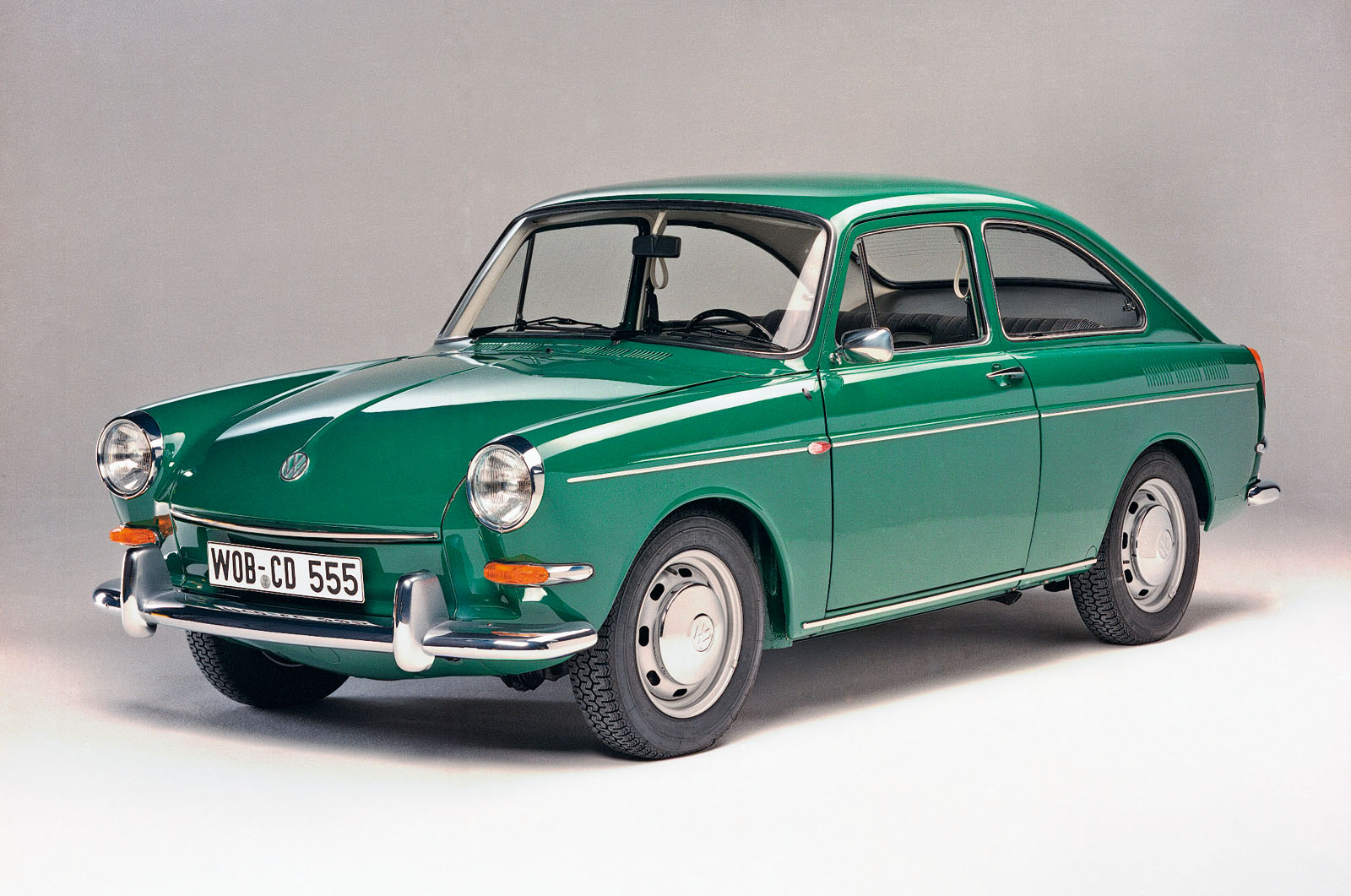
Meet the most friendly looking car ever:

VW-1600-729x486-fe5a6bd05898f619.jpg


Kopie_von_VW1600TL_stor.jpg


Hard to believe that this is a Volkswagen:

volkswagen-karmann-ghia-typ-34-1600-tl-02.jpg


Beats the new Alfa any time when it comes to style.
 
This is one of thhe things i love about driving my aryan car;

image.webp
 
So you were doing 80 miles per hour and your car uses roughly 1 litre per 10 kilometres.
Is that with your family in the car while towing a caravan? It's way too much fuel for a modern car.
 
So you were doing 80 miles per hour and your car uses roughly 1 litre per 10 kilometres.
Is that with your family in the car while towing a caravan? It's way too much fuel for a modern car.

I was doing 135 before that until my radar went apeshit with the cops. Probably in the photo cant be seen it actually says 29mpg.
 
In some German cities you can charge your e-bike or -car at solar (panel) power stations and here in the UK the service stations offer a similar service. But I guess that is just along the big motorways.
EVs make sense in highly populated areas to reduce air pollution, but the main problem with any car today is the basic weight.
People want AC in their cars and tiny little helpers so they don't have to move their seats by hand or manually wind down their windows.
When the Golf I came out it was light weight, just like so many other cars in that time. It was less than 1000 kg, that's why the first GTI was relatively fast and agile, despite having only 110 hp and an old fashioned engine.
Today's Golf weighs more than my Audi C4, and by comparison the overall fuel efficiency, despite modern engine technology, hasn't improved because of the weight. The "luxury" segment has gone insane, big engines with lots of power that make no sense, because you can hardly use it, not even on German Autobahn, because the sections with speed limits outnumber those without one.

Very true. There was a big jump in weight between the MKII Golf and the MKIII due in part to safety legislation.
 
I saw the 29, hence the result.
135 miles is bold.
Sadly, at that speed my fuel gauge is moving visibly to the left. Luckily in the UK the max speed is 70 miles per hour. And they are very strict about it.
 
Very true. There was a big jump in weight between the MKII Golf and the MKIII due in part to safety legislation.

Safety legislation sucks. Keep the cars light weight and make it more dangerous to drive at high speeds.
Let inertia and stupidity sort out the idiots.
 
I saw the 29, hence the result.
135 miles is bold.
Sadly, at that speed my fuel gauge is moving visibly to the left. Luckily in the UK the max speed is 70 miles per hour. And they are very strict about it.
Oh it does move pretty quickly, but here gas is cheap so who cares. I have been caught speeding several times, luckily cops never give me tickets. i always thought you were german, not english.
 
My guess, RS, is it's all thanks to CAD - or more accurately, design by computers. There are no geniuses like Malcolm Sayer or Flaminio Bertoni left to their own devices anymore - just a bunch of coders who pump design algorithms into a computer to maximise the Cd, minimise part complexity etc. with emphasis on one or the other depending on the price and class of the car. No surprise the results are all the same so the "designers" then fiddle around the edges so all cars don't look identical. I suppose it's kind of like a true bespoke suit versus a factory made one cut by lasers that's then "hand finished". Sure it will be "your" suit, but also pretty similar to the last one that left the assembly line.

In that context round headlights just don't make sense anymore; neither do fins, visible spare wheels or other automotive design cues from the past. Having said that there have been some clumsy attempts to reintroduce them on modern cars, the results being almost always categorically ugly.

Mmmm.

If Sayer were alive he would jump at the chance of using a computer to aid design. Sayer used mathematically derived curves to increase aerodynamic performance. He learned these off a German professor.

Car styling is pretty much done the same way it always has been. Sketches, clay models, tapes &c. Digitisation into a computer and optimisation comes later.

Some modern cars are beautiful, and have a level of fit and finish that would not be possible without the aid of the computer. A computer is merely a tool.
 
Safety legislation sucks. Keep the cars light weight and make it more dangerous to drive at high speeds.
Let inertia and stupidity sort out the idiots.

They seem to have been dropping in weight a bit of late but they are still far heavier than they were in the days of the MkI & II Golfs.

I was talking to an automotive safety engineer years ago and one of the problems he said with safety features on cars is that drivers often see them as performance enhancing features rather than safety ones. So, ABS means you can drive into the corner a little faster and so on. He half jokingly said, that people would drive much more safely if you removed the airbag from the steering wheel and replaced it with a spike. As I said, he was only half joking. ;)
 
Mmmm.

If Sayer were alive he would jump at the chance of using a computer to aid design. Sayer used mathematically derived curves to increase aerodynamic performance. He learned these off a German professor.

Car styling is pretty much done the same way it always has been. Sketches, clay models, tapes &c. Digitisation into a computer and optimisation comes later.

Some modern cars are beautiful, and have a level of fit and finish that would not be possible without the aid of the computer. A computer is merely a tool.

I don't disagree with you but I think there is a distinction between computer aided design and "computer designed" - the latter being more common these days particularly among the lower cost vehicles. And sure there are still beautiful modern cars. But examples like the Veyron (maybe not beautiful - more brute-iful) are styled before they are built. Peich basically said "make a car that looks like this and has 1000HP". There is no doubt it would only be half as interesting if it was styled by the computer boys to meet the performance specs in the most efficient way, rather than the other way around.

And let's not forget that is rarified air. The mass market stuff is almost singularly uninspiring IMO. Compare a Buick from the 1950s to a modern one. It's like comparing a Lalique vase to an electric razor.
 
I don't disagree with you but I think there is a distinction between computer aided design and "computer designed" - the latter being more common these days particularly among the lower cost vehicles. And sure there are still beautiful modern cars. But examples like the Veyron (maybe not beautiful - more brute-iful) are styled before they are built. Peich basically said "make a car that looks like this and has 1000HP". There is no doubt it would only be half as interesting if it was styled by the computer boys to meet the performance specs in the most efficient way, rather than the other way around.

And let's not forget that is rarified air. The mass market stuff is almost singularly uninspiring IMO. Compare a Buick from the 1950s to a modern one. It's like comparing a Lalique vase to an electric razor.

Well, I'm not sure what you mean by computer designed. I know of no circumstances where a bunch of parameters are entered into a computer and a complete design pops out. That is, the entire process is automated.

Car design is an iterative process, that's one of the reasons why it so blood expensive.
 
It seems to be more iterative for some than others. How else do you explain this?

all-cars-look-alike-nu.jpg

Here is the outline of these 8 cars overlaid:
car-silhouettes.jpg
 
The trouble these days is that nobody wants to take a risk any more and the automotive industry is a tough business.
That's why you find so many copies of successful cars from other makers.
If they come up with an original idea and turn it into an exiting prototype, it gets watered down later to a point where it's the same as all the other cars of that maker.

The most significant safety feature on my car are the brakes and the tires and the way I drive. Never used my ABS (except once on a gravel covered tarmac road. That was one quality road repair) and it has no airbag whatsoever. Same with ASR, ESP, brake assyst and so on.
There are quite a few cars around where the brake disks look ridiculously small. They still have to stop the same weight. Just because the engine is smaller and it takes longer to reach travelling speed it doesn't mean that the brakes need to be smaller.
70 miles per hour is a ridiculous top speed, especially on a motorway. You are hardly faster than the lorries/ trucks and there are, of course, those drivers who block the lane going much slower.
The German Autobahn™ on the other hand can get totally crazy. Since it seems that every truck in Europe is on it, you are basically constantly overtaking them and not every strip of Autobahn™ has three or more lanes. So if one is taken by trucks you get all sorts of road rage on the remaining one.
What strikes me most in the UK is the number of seriously senior citizens still driving. If you can hardly see, hear and/ or walk you should not be allowed to drive a car.
 
It seems to be more iterative for some than others. How else do you explain this?

all-cars-look-alike-nu.jpg

Here is the outline of these 8 cars overlaid:
car-silhouettes.jpg
Styling is only one aspect of car design. Other things occupant space, luggage space, aerodynamics, packaging &c play a very important part too. It does not surprise me that if you overlay the outlines over one another that they are close for a particular car segment.There's only so much scope.

However, cars are 3 dimensional objects so you have to view them that way.

Its also true that certain styling cues can be 'borrowed' by individual manufacturers. The best example I can think of at the moment is Ford's blatant rip off of Aston Martin's front grill. Aston's and Jaguars rear lights look very similar too. Automotive stylists are not immune to fashion and the prevailing taste amongst customers, they both lead and follow.

A
 
I've read that shorter model life cycles, are what is stifling innovation. If the amount of time you've got to design and develop an increasingly complex item is greatly shortened, you get a much more uninspired and derivative design than back when a totally new generation took ten or more years.
Also, it's like blockbuster movies. The more money you've sunk into one thing, the more risk-averse you become. Throw platform-sharing in for increased uniformity...
Anyway, have I griped about rollover protection and how it led to these cumbersome wide pillars that one can't see around? Who the eff rolls over a car?
 
In October my old man is inheriting this from family in the Netherlands
11885651_508367529326332_6623984391308070635_o.webp
 

Users who are viewing this thread

Back
Top Bottom