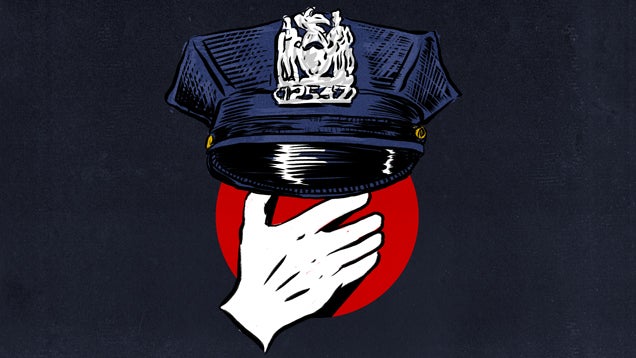
Cop Tyranny Thread

When kids are constantly listening to songs that blatantly state "fuck the police" and watching racism fueled by the media, the consequence is more racial targeting by the police with an increase of black incarceration and deaths.

The only way to change the perception is from within, not from blaming whites or blindly follow Sharpton/Jackson/Holder.

Let's not exaggerate. There are many anti-cop songs out there. But "fuck the police"? Name 5(outside of NWA & Ice T which were albums/songs from 20+ years ago.)
 
rally.jpg


:thelongpause:
 
http://www.reuters.com/article/2014/12/23/us-usa-police-nypd-race-insight-idUSKBN0K11EV20141223

Off duty, black cops in New York feel threat from fellow police
By Michelle Conlin

NEW YORK Tue Dec 23, 2014 5:14pm EST


1 of 4. Retired NYPD detective Harold Thomas poses with his retired NYPD identification card in West Hempstead, New York December 17, 2014. Reuters interviewed 25 African American male officers on the NYPD, 15 of whom are retired and 10 of whom are still serving. All but one said that, when off duty and out of uniform, they had been victims of racial profiling, which refers to using race or ethnicity as grounds for suspecting someone of having committed a crime.


(Reuters) - From the dingy donut shops of Manhattan to the cloistered police watering holes in Brooklyn, a number of black NYPD officers say they have experienced the same racial profiling that cost Eric Garner his life.

Garner, a 43-year-old black man suspected of illegally peddling loose cigarettes, died in July after a white officer put him in a chokehold. His death, and that of an unarmed black teenager in Ferguson, Missouri, has sparked a slew of nationwide protests against police tactics. On Saturday, those tensions escalated after a black gunman, who wrote of avenging the black deaths on social media, shot dead two New York policemen.

The protests and the ambush of the uniformed officers pose a major challenge for New York Mayor Bill De Blasio. The mayor must try to ease damaged relations with a police force that feels he hasn’t fully supported them, while at the same time bridging a chasm with communities who say the police unfairly target them.

What’s emerging now is that, within the thin blue line of the NYPD, there is another divide - between black and white officers.

Reuters interviewed 25 African American male officers on the NYPD, 15 of whom are retired and 10 of whom are still serving. All but one said that, when off duty and out of uniform, they had been victims of racial profiling, which refers to using race or ethnicity as grounds for suspecting someone of having committed a crime.

The officers said this included being pulled over for no reason, having their heads slammed against their cars, getting guns brandished in their faces, being thrown into prison vans and experiencing stop and frisks while shopping. The majority of the officers said they had been pulled over multiple times while driving. Five had had guns pulled on them.

Desmond Blaize, who retired two years ago as a sergeant in the 41st Precinct in the Bronx, said he once got stopped while taking a jog through Brooklyn’s upmarket Prospect Park. "I had my ID on me so it didn’t escalate," said Blaize, who has sued the department alleging he was racially harassed on the job. "But what’s suspicious about a jogger? In jogging clothes?"

The NYPD and the Patrolmen's Benevolent Association, the police officers’ union, declined requests for comment. However, defenders of the NYPD credit its policing methods with transforming New York from the former murder capital of the world into the safest big city in the United States.


EX-POLICE CHIEF SKEPTICAL

"It makes good headlines to say this is occurring, but I don’t think you can validate it until you look into the circumstances they were stopped in," said Bernard Parks, the former chief of the Los Angeles Police Department, who is African American.

"Now if you want to get into the essence of why certain groups are stopped more than others, then you only need to go to the crime reports and see which ethnic groups are listed more as suspects. That’s the crime data the officers are living with."

Blacks made up 73 percent of the shooting perpetrators in New York in 2011 and were 23 percent of the population.

A number of academics believe those statistics are potentially skewed because police over-focus on black communities, while ignoring crime in other areas. They also note that being stopped as a suspect does not automatically equate to criminality. Nearly 90 percent of blacks stopped by the NYPD, for example, are found not to be engaged in any crime.

The black officers interviewed said they had been racially profiled by white officers exclusively, and about one third said they made some form of complaint to a supervisor.

All but one said their supervisors either dismissed the complaints or retaliated against them by denying them overtime, choice assignments, or promotions. The remaining officers who made no complaints said they refrained from doing so either because they feared retribution or because they saw racial profiling as part of the system.

In declining to comment to Reuters, the NYPD did not respond to a specific request for data showing the racial breakdown of officers who made complaints and how such cases were handled.

White officers were not the only ones accused of wrongdoing. Civilian complaints against police officers are in direct proportion to their demographic makeup on the force, according to the NYPD’s Civilian Complaint Review Board.

Indeed, some of the officers Reuters interviewed acknowledged that they themselves had been defendants in lawsuits, with allegations ranging from making a false arrest to use of excessive force. Such claims against police are not uncommon in New York, say veterans.

STUDIES FIND INHERENT BIAS

Still, social psychologists from Stanford and Yale universities and John Jay College of Criminal Justice have conducted research – including the 2004 study "Seeing Black: Race, Crime and Visual Processing" - showing there is an implicit racial bias in the American psyche that correlates black maleness with crime.

John Jay professor Delores Jones-Brown cited a 2010 New York State Task Force report on police-on-police shootings - the first such inquiry of its kind - that found that in the previous 15 years, officers of color had suffered the highest fatalities in encounters with police officers who mistook them for criminals.

There’s evidence that aggressive policing in the NYPD is intensifying, according to data from the New York City Comptroller.

Police misconduct claims - including lawsuits against police for using the kind of excessive force that killed Garner - have risen 214 percent since 2000, while the amount the city paid out has risen 75 percent in the same period, to $64.4 million in fiscal year 2012, the last year for which data is available.


REPORTING ABUSE

People who have taken part in the marches against Garner's death - and that of Ferguson teenager Michael Brown - say they are protesting against the indignity of being stopped by police for little or no reason as much as for the deaths themselves.

“There’s no real outlet to report the abuse,” said Brooklyn Borough President Eric Adams, a former NYPD captain who said he was stigmatized and retaliated against throughout his 22-year career for speaking out against racial profiling and police brutality.

Officers make complaints to the NYPD’s investigative arm, the Internal Affairs Bureau, only to later have their identities leaked, said Adams.

One of the better-known cases of alleged racial profiling of a black policeman concerns Harold Thomas, a decorated detective who retired this year after 30 years of service, including in New York's elite Joint Terrorism Task Force.

Shortly before 1 a.m. one night in August 2012, Thomas was leaving a birthday party at a trendy New York nightclub.

Wearing flashy jewelry, green sweatpants and a white t-shirt, Thomas walked toward his brand-new white Escalade when two white police officers approached him. What happened next is in dispute, but an altercation ensued, culminating in Thomas getting his head smashed against the hood of his car and then spun to the ground and put in handcuffs.

“If I was white, it wouldn’t have happened,” said Thomas, who has filed a lawsuit against the city over the incident. The New York City Corporation Counsel said it could not comment on pending litigation.

At an ale house in Williamsburg, Brooklyn last week, a group of black police officers from across the city gathered for the beer and chicken wing special. They discussed how the officers involved in the Garner incident could have tried harder to talk down an upset Garner, or sprayed mace in his face, or forced him to the ground without using a chokehold. They all agreed his death was avoidable.

Said one officer from the 106th Precinct in Queens, “That could have been any one of us.”
 
Why does their race matter?

Since he targeted only black women to rape, then it's certain he arrested black women who refused rape. In a society where the judicial system's not entirely corrupt, this would suffice reason to look into his history of unlawful arrests.

I'm cool with this. Were it not for the lying racist agitators, the world would be better off with Michael Brown at room temperature. Eric Garner is a different story.

Not even a black idiot would make a move at an officer, unless he wanted to get killed. And the police coerced false testimony that Brown tried to assault the cop. He probably wasn't compliant but that's in itself doesn't warrant murder.

Fool you once, fool you thousands of times?
 
"But what’s suspicious about a jogger? In jogging clothes?"
Lots, but I'll be charitable and merely state that crazy people in athletic clothing running outdoors are IME white as can be.
Blacks made up 73 percent of the shooting perpetrators in New York in 2011 and were 23 percent of the population.
Good, they didn't try to hide the brutal facts.
Not even a black idiot would make a move at an officer, unless he wanted to get killed.
Wrong. When you're drugged up and a burglary suspect, you're assessing risks quite differently. Need I reference another unarmed pedestrian druggie that circled back to confront an armed man in an SUV?
Garner, petty criminal guilty of evading cigarette taxes and being a blowhard. Brown, a violent criminal brazenly walking down the street and resisting arrest and how did Darren Wilson get bruises warranting an ER visit? It offends me to no end that these two are lumped together. Totally different.
 
An individual case like this isn't worth my time to research the details although I saw local news clips with witnesses giving account of the cop shooting Brown after he was already shot and running away.

I do know it's common practice for police to lie as often as necessary to justify their murders, beatings, unlawful searches, seizures, arrests, etc and as we saw in my last youtube clip, police officers who want to do the right thing can and most likely lose their jobs/pensions for doing so. A 'good' cop has to lie to protect one's own livelihood.
 
http://gawker.com/the-nypd-is-an-embarrassment-to-the-city-of-new-york-1676173181

The NYPD Is an Embarrassment to the City of New York

qefnegczxphpkp24yg2z.jpg


A ceremony at Madison Square Garden yesterday morning marked the graduation of 884 new officers into the New York Police Department. When Mayor Bill de Blasio took the podium to address the graduating class, praising them for their courage and determination, he was greeted like an unpopular high school principal: with boos, jeers, and the turning of backs. When he talked about the officers facing "problems [they] don't create," someone in the audience called back: "You created them!"

Don't blame any incoming officers for the outbreak, however—they were only mimicking the hysterical fits their elders have been throwing in public for the past month. Two days earlier, at the funeral of officer Rafael Ramos, uniformed members of the force turned around en masse when de Blasio began to deliver his eulogy. (What other group comes to mind when you think about protests at funerals?) A week before, officers had turned their backs when de Blasio entered One Police Plaza after the shocking and senseless killing of Ramos and his partner, Wenjian Liu.

Those symbolic displays of contempt were intended to demonstrate the department's lack of faith in its democratically elected leader. What they have communicated instead is that the New York Police Department is too childish and entitled to deserve its privileged status, and too aggrieved and resentful to be called "New York's Finest." The New York Police Department is an embarrassment to the city of New York.

After the non-indictment of Daniel Pantaleo, the officer who killed unarmed Staten Island man Eric Garner, the department has embarked on an apparent mission to make itself look as juvenile as possible. In addition to the turned backs, the union representing NYPD officers recently pushed a petition to bar the mayor from attending cops' funerals, then all but instructed officers to participate in a work stoppage.

Why? Because de Blasio had the temerity to admit in public that his son is at a higher risk of being killed by the NYPD because his son is black. Because de Blasio said out loud, as mayor of New York city, what American parents of black and Latino children have said in private for decades. (There was also an incomprehensible dustup about de Blasio's use of the word "allegedly.")

Four days before Christmas, a Baltimore man named Ismaayil Brinsley grabbed a handgun, shot his girlfriend, took a bus to New York City, and murdered Wenjian Liu and Rafael Ramos while they were sitting in their car on a corner in Bed Stuy. Shortly thereafter, Brinsley fled into the Myrtle-Willoughby G Train station and committed suicide. Brinsley had made his intentions clear in an Instagram post earlier that day: He was going to kill some New York City cops, and he was going to do so because of the police killings of Eric Garner and Michael Brown.

It's hard to imagine something that could have changed the dynamic of the ongoing popular protests against police brutality more: Two men lost their lives. Two families had their husbands, fathers, and sons torn from them. Thousands of NYPD cops lost their colleagues. The tragedy was an immediate and clarifying humanization of a profession whose incompetents and villains had dominated the news.

But if the deaths of Liu and Ramos gave the police department a moment to solemnly reflect and an opportunity to reconnect with a citizenry it had alienated with abuse and violence, they were squandered within only a few hours, when Patrick Lynch, the head of the police department's largest union, told reporters that there was "blood on the hands" of the mayor and protesters. The willfully ignorant dolchstosslegende of de Blasio's culpability in the murders was ridiculous to anyone with even passing understanding of the story: Ismaayil Brinsley allegedly shot and wounded his girlfriend before the murder-suicide; he'd had a long list of past weapons and robbery charges; he was obviously sick and hurting.

And so while Lynch brayed, the rest of the city kept moving. De Blasio, recognizing the gravity of the moment, called for a temporary halt to the public protests that have filled streets around the city all month. Protesters declined to heed de Blasio's call, and returned to the streets a few nights later, some singing "This Little Light of Mine" and paying their respects at an impromptu memorial for officers Liu and Ramos. In a tremendous showing of grace, Eric Garner's daughter Emerald visited the memorial, telling reporters, "I just had to come out and let their family know that we stand with them, and I'm going to send my prayers and condolences to all the families who are suffering."

Not moving: The cops. Days before the murders, Lynch proudly said at a police union meeting that officers should respond to gentle criticism from the mayor and demonstrators by deliberately slowing down their patrols: "We're going to take that book, their rules and we're going to protect ourselves because they won't. We will do it the way they want us to do it. We will do it with their stupid rules, even the ones that don't work." Another PBA spokesman denied that Lynch was calling for a slowdown, but the union chief's language is clear enough.

That apparent slippage in enforcement is addressed in a pair of New York Post articles published this week. According to the emphatically pro-cop tabloid, since December 22, tickets and minor summonses are down 94 percent and overall arrests down 66 percent compared to the same period last year. But instead of framing the lack of action in terms of Lynch's raging ego, the Post and its sources posit that the recent unrest and the Liu-Ramos murder have left cops feeling afraid of being hurt on the job.

In truth, it's probably a little bit of both. Whether you're a good cop or a bad cop, waking up and starting your patrol in a city where two of your colleagues were killed on the job and where throngs of people express their displeasure with you every single night is surely a source of enormous anxiety and discomfort, and rightfully so.

But fearful as it may be, this is the job the cops signed up for: to protect and serve, as the motto on the side of every squad car in New York says, with courtesy, professionalism, and respect. This is why the angle that Lynch's vituperative rhetoric is really about a union contract dispute is so unconvincing. Despite what the NYPD would have you believe, a police officer is not an oppressed minority, but a special, protected class of person—just look at what happened to Daniel Pantaleo after he killed a man on video for clear evidence of that. And if the pressures of being a police officer ever become too great, cops are welcome to avail themselves of that special status by turning in their guns and badges and quitting the force.

Eric Garner wasn't so privileged. When the pressures of being a black man in a racist police state became too great for him to bear, he didn't have the luxury of quitting. The greatest tool at his disposal in the moments before his death was his voice, and he used it. "I'm tired of it! This stops today," he pled with officers as they questioned him about allegedly selling a single loose cigarette. "Please, just leave me alone." For that simple request, he was executed in public without a trial.

This is the truth that black and Latino and queer and otherwise disenfranchised New Yorkers have known for decades, if not centuries: The NYPD has never been "New York's Finest." The life-threatening danger that New York's police department poses to its citizens of color is so clear, so well-tread, that discussing it here would be tiresome if it wasn't so necessary and so agonizing. This year, there was Eric Garner, the unarmed father of six who was choked to death by a cop with an alleged history of aggressive misconduct toward black men, and whose death went completely unprosecuted. There was also Akai Gurley, declared "a total innocent" by NYPD Commissioner Bill Bratton, but only after he was shot and killed by a rookie cop in the hallway of his own apartment building; Denise Stewart, dragged nearly naked from her home by a dozen cops who mistakenly knocked on her door after receiving a 911 call from another unit; Rosan Miller, given a mercifully nonfatal chokehold for grilling up food on the sidewalk in front of her house (this is what mercy toward black people looks like from the NYPD: a chokehold that doesn't kill you). Last year, there was Kimani Gray, shot dead in the street at 16 years old, and before that, Tamon Robinson, Shereese Francis, Ramarley Graham, Alberta Spruill, Amadou Diallo. The list goes on and horribly on.

But the world is changing. Stop-and-frisk has slowed, if not entirely ended. Thanks to collective action in the wake of Garner's death, outcry over the NYPD's brutality and recklessness became too loud for the department or the city or its white establishment to ignore this year. Mayor de Blasio's experience raising a son at high risk of NYPD killing makes him a compassionate and impassioned, if not always effective, advocate for change. His administration, the incisive editorials in the New York Times and the New York Daily News, and, most of all, the thrilling sight of people taking to the streets to demand justice have made New York feel like the city it wants to be—the greatest city in the world.

The infantile response from the NYPD and the unions that represent it is not worthy of it. It is hardly worthy of a schoolyard bully who can't believe he's finally been called on his bullshit.
 
Good article, but this bullshit about angling this all towards racism deflects from the bigger more pressing problem: cops are out of control and part of a system of apologists that defend their every move.
 
http://lawcha.org/wordpress/2014/12...ce-created-control-working-class-poor-people/

Stop Kidding Yourself: The Police Were Created to Control Working Class and Poor People
December 29, 2014
Sam Mitrani
« Back to LaborOnline

Sam Mitrani
Sam Mitrani is an Associate Professor of History at the College of DuPage. He earned his PhD from the University of Illinois at Chicago in 2009 and his book The Rise of the Chicago Police Department: Class and Conflict, 1850-1894 is available from the University of Illinois Press. View all posts by Sam Mitrani »
In most of the liberal discussions of the recent police killings of unarmed black men, there is an underlying assumption that the police are supposed to protect and serve the population. That is, after all, what they were created to do. If only the normal, decent relations between the police and the community could be re-established, this problem could be resolved. Poor people in general are more likely to be the victims of crime than anyone else, this reasoning goes, and in that way, they are in more need than anyone else of police protection. Maybe there are a few bad apples, but if only the police weren’t so racist, or didn’t carry out policies like stop-and-frisk, or weren’t so afraid of black people, or shot fewer unarmed men, they could function as a useful service that we all need.

This liberal way of viewing the problem rests on a misunderstanding of the origins of the police and what they were created to do. The police were not created to protect and serve the population. They were not created to stop crime, at least not as most people understand it. And they were certainly not created to promote justice. They were created to protect the new form of wage-labor capitalism that emerged in the mid to late nineteenth century from the threat posed by that system’s offspring, the working class.

This is a blunt way of stating a nuanced truth, but sometimes nuance just serves to obfuscate.


Slave patrol badge, 1858. Slave patrols to hunt down escaped slaves were the original police in the South.

Before the nineteenth century, there were no police forces that we would recognize as such anywhere in the world. In the Northern United States, there was a system of elected constables and sheriffs, much more responsible to the population in a very direct way than the police are today. In the South, the closest thing to a police force was the slave patrols. Then, as Northern cities grew and filled with mostly immigrant wage workers who were physically and socially separated from the ruling class, the wealthy elite who ran the various municipal governments hired hundreds and then thousands of armed men to impose order on the new working class neighborhoods.

Class conflict roiled late nineteenth century American cities like Chicago, which experienced major strikes and riots in 1867, 1877, 1886, and 1894. In each of these upheavals, the police attacked strikers with extreme violence, even if in 1877 and 1894 the U.S. Army played a bigger role in ultimately repressing the working class. In the aftermath of these movements, the police increasingly presented themselves as a thin blue line protecting civilization, by which they meant bourgeois civilization, from the disorder of the working class. This ideology of order that developed in the late nineteenth century echoes down to today – except that today, poor black and Latino people are the main threat, rather than immigrant workers.


Chicago police cast themselves as the defenders of civilization for a society ordered by capitalist premises. After Haymarket in 1886, they contended that they stood between civilization and anarchy.

Of course, the ruling class did not get everything it wanted, and had to yield on many points to the immigrant workers it sought to control. This is why, for instance, municipal governments backed away from trying to stop Sunday drinking, and why they hired so many immigrant police officers, especially the Irish. But despite these concessions, businessmen organized themselves to make sure the police were increasingly isolated from democratic control, and established their own hierarchies, systems of governance, and rules of behavior. The police increasingly set themselves off from the population by donning uniforms, establishing their own rules for hiring, promotion, and firing, working to build a unique esprit des corps, and identifying themselves with order. And despite complaints about corruption and inefficiency, they gained more and more support from the ruling class, to the extent that in Chicago, for instance, businessmen donated money to buy the police rifles, artillery, Gatling guns, buildings, and money to establish a police pension out of their own pockets.

There was a never a time when the big city police neutrally enforced “the law,” or came anywhere close to that ideal (for that matter, the law itself has never been neutral). In the North, they mostly arrested people for the vaguely defined “crimes” of disorderly conduct and vagrancy throughout the nineteenth century. This meant that the police could arrest anyone they saw as a threat to “order.” In the post-bellum South, they enforced white supremacy and largely arrested black people on trumped-up charges in order to feed them into convict labor systems.

The violence the police carried out and their moral separation from those they patrolled were not the consequences of the brutality of individual officers, but were the consequences of careful policies designed to mold the police into a force that could use violence to deal with the social problems that accompanied the development of a wage-labor economy. For instance, in the short, sharp depression of the mid 1880s, Chicago was filled with prostitutes who worked the streets. Many policemen recognized that these prostitutes were generally impoverished women seeking a way to survive, and initially tolerated their behavior. But the police hierarchy insisted that the patrolmen do their duty whatever their feelings, and arrest these women, impose fines, and drive them off the streets and into brothels, where they could be ignored by some members of the elite and controlled by others. Similarly, in 1885, when Chicago began to experience a wave of strikes, some policemen sympathized with strikers. But once the police hierarchy and the mayor decided to break the strikes, policemen who refused to comply were fired. In these and a thousand similar ways, the police were molded into a force that would impose order on working class and poor people, whatever the individual feelings of the officers involved.

Though some patrolmen tried to be kind and others were openly brutal, police violence in the 1880s was not a case of a few bad apples – and neither is it today.


Graffiti, location unknown.

Much has changed since the creation of the police – most importantly the influx of black people into the Northern cities, the mid-twentieth century black movement, and the creation of the current system of mass incarceration in part as a response to that movement. But these changes did not lead to a fundamental shift in policing. They led to new policies designed to preserve fundamental continuities. The police were created to use violence to reconcile electoral democracy with industrial capitalism. Today, they are just one part of the “criminal justice” system which continues to play the same role. Their basic job is to enforce order among those with the most reason to resent the system – who in our society today are disproportionately poor black people.

A democratic police system is imaginable – one in which police are elected by and accountable to the people they patrol. But that is not what we have. And it’s not what the current system of policing was created to be.


Sam Mitrani, The Rise of the Chicago Police Department: Class and Conflict, 1850-1894, available from University of Illinois Press

If there is one positive lesson from the history of policing’s origins, it is that when workers organized, refused to submit or cooperate, and caused problems for the city governments, they could back the police off from the most galling of their activities. Murdering individual police officers, as happened in in Chicago on May 3rd 1886 and more recently in New York on December 20th, 2014, only reinforced those calling for harsh repression – a reaction we are beginning to see already. But resistance on a mass scale could force the police to hesitate. This happened in Chicago during the early 1880s, when the police pulled back from breaking strikes, hired immigrant officers, and tried to re-establish some credibility among the working class after their role in brutally crushing the 1877 upheaval.

The police might be backed off again if the reaction against the killings of Eric Garner, Michael Brown, Tamir Rice, and countless others continues. If they are, it will be a victory for those mobilizing today, and will save lives – though as long as this system that requires police violence to control a big share of its population survives, any change in police policy will be aimed at keeping the poor in line more effectively.

We shouldn’t expect the police to be something they’re not. As historians, we ought to know that origins matter, and the police were created by the ruling class to control working class and poor people, not help them. They’ve continued to play that role ever since.
 
I never considered the origins of police, it's an institute you always thought was just there, like fireman. The history of fireman is pretty fucking seedy as well.
 
Here's one for you OfficePants OfficePants JimmyRustler

http://www.policechiefmagazine.org/...al&utm_source=twitter.com&utm_campaign=buffer

Generating New Revenue Streams

Paul LaCommare, Commander, West Covina Police Department, West Covina, California

a.jpg

downward spiral in California city governments’ revenue streams has occurred for the last five years starting with the housing bubble that burst property tax returns by 40 percent. Warnings contained in the California Department of Finance’s Economic Indicators, January–February 2008 report state that

the current economic slowdown afflicting California and the nation is the result of a one-two punch. The first blow fell in 2005 and 2006 when real estate markets peaked and began a gradual slowdown. Late in 2006, it appeared that despite some losses, home sales and prices had stabilized. The second blow, though, fell in 2007 when the subprime lending meltdown and rising foreclosures led to the implosion of real estate mortgage markets. Residential real estate markets were jolted by rising inventories as too many homes were on the market and the number of qualified buyers, particularly those looking to move up, dwindled. Ominously, as 2007 progressed, the likelihood steadily increased that rather than just suffering through severe corrections in breal estate and home construction markets, the economy might run into a full-fledged economic slowdown.1
The common reaction to a budget crisis is reducing personnel and cutting services. The focus of this article is to provide police agencies with an alternative to personnel and service reductions. This alternative could help the survival of a city and maintain or expand police service through generating new revenue streams as a proactive approach to meet the fiscal crisis of today and the uncertain future of tomorrow.

While generating revenue streams is not new to most agencies, the focus and resources necessary to meet current and emerging public safety needs are unprecedented in law enforcement’s history. Law enforcement executives are accustomed to the ebb and flow of fiscal budgets. The current trend, however, is much more far reaching and will impact almost all cities in California and most likely all communities in the United States.

Five years ago, the current state of the economy facing cities and counties was not even a concern. Now, however, many law enforcement agencies are facing the reality of severe budget cuts, reduced workforce, and the elimination or reduction of many law enforcement programs. Today, police chiefs are being asked to look for ways of economizing, increasing efficiency, eliminating redundancies, and finding revenue sources.

This trend will be prompted in two possible ways. First, increasing financial pressure will require more severe budget cuts to the point that many agencies will be able to provide only basic services. Second, cities will begin to see successes at nearby agencies and look to new revenue streams as a panacea to forestall reduced services or even bankruptcy. Based on the research for this article, there is a clear presumption of need for law enforcement to generate new income streams. A first necessary step in that process is to examine possible revenue-generating ideas.


Possible New Revenue Streams

A group of experts in the fields of city government, business, real estate, and entrepreneurship assembled in April 2008 to identify possible new income streams that could be initiated by law enforcement.2 Their suggested new revenue streams serve as an example of ideas that can be generated in a short period of time. Each idea must be weighed against the feasibility of implementation, profit potential, and appropriateness for law enforcement involvement. Their most prominent recommendations were

  • fees for sex offenders registering in a given jurisdiction,
  • city tow companies,
  • fine increases by 50 percent,
  • pay-per-call policing,
  • vacation house check fees,
  • public hours at police firing range for a fee,
  • police department-run online traffic school for minor traffic infractions,
  • department-based security service including home checks and monitoring of security cameras by police department,
  • a designated business to clean biological crime scenes,
  • state and court fees for all convicted felons returning to the community,
  • allowing agency name to be used for advertisement and branding,
  • triple driving-under-the-influence fines by the court,
  • resident fee similar to a utility tax,
  • tax or fee on all alcohol sold in the city,
  • tax or fee on all ammunition sold in, the city,
  • public safety fees on all new development in the city,
  • 9-1-1 fee per use,
  • police department website with business advertisement for support,
  • selling ride-a-longs to the public, and
  • police department–run firearm safety classes.
In addition to concepts that may lie ahead, there are also many examples of revenue-generating ideas that have been tried and proven in actual use.


West Covina’s Revenue Service Model

The West Covina, California, Police Department is a midsized municipal police agency in Southern California. The concept of developing a police revenue service in West Covina began in the 1980s. In 1984, the department was searching for a new computer software system to manage its computer-aided dispatch and records management system (CAD/RMS). Dissatisfied with the current offerings on the market, the department decided to develop its own CAD/RMS system. The department provided training to employees who later wrote and developed a complex software system to run CAD/RMS. The system was implemented at West Covina and was successful. By the late 1980s, the city leased the program to another agency and began marketing in earnest.

In 1995, the West Covina Service Group was formed as an enterprise and has been in operation ever since. Currently, the West Covina Service Group’s CAD/RMS system is running in 21 police agencies throughout the United States. On top of the more traditional methods of revenue generation, which include impound fees, booking fees, and driving-under-the-influence investigation fees, the West Covina Service Group generates about $1.75 million annually through its software system for the city’s use. The West Covina Service Group also provides all CAD/RMS services for West Covina, resulting in a more than $500,000 annual savings for a total ancillary benefit of $2.25 million dollars per year.

Historically, the West Covina Police Department has spent a great deal of time and energy in the field of forensics as a method of crime solving. This has led to the development of a forensic lab and expert personnel. The department recognized that many small agencies in the area did not have the resources to process their own latent prints and were frustrated with the extended lag time associated with current services. After recognizing this niche market in 2006, the department elected to offer contracted forensic services to other agencies. This also has become a successful business venture, netting more than $42,000 since inception. Beyond monetary issues, the service also has benefitted crime reduction programs through the timely identification of latent prints. A selling point is the Forensic Investigative Unit’s ability to meet a five-day turnaround time on submitted prints or articles as opposed to six months to a year through traditional county or state services.

During 2008 and 2009, the West Covina department also implemented other ordinances and programs that increase effectiveness, generate revenue, and mitigate the cost of personnel management. Two of them follow:

  • An administrative citation process for party noise. Modeled after other California agencies, the party ordinance allows an administrative citation to be issued at loud parties where the music is plainly audible 50 feet from the property line. The first citation is $100, a second $200, and a third or subsequent citation within 12 consecutive months is $500. The goal of the ordinance is to reduce repeat party calls, improve the quality of life for surrounding residents, and generate a revenue stream to offset the cost of response and enforcement.
  • An ordinance fining parents for child’s graffiti. The graffiti ordinance imposes a $1,000 administrative fine to the parents of juveniles arrested for graffiti crimes. The juvenile is still processed independently through the criminal justice system. The goal of this new ordinance is to promote greater responsibility from parents, reduce the number of repeat offenders, and generate a revenue stream to compensate the city for enforcement efforts.
Both of these administrative citations are too new to provide statistical results, however they show promise in the areas of crime reduction and revenue generation.

One tried and successful idea that has greatly enhanced the West Covina Police Department’s ability to maintain services while decreasing costs is the 960 program. Under the Public Employee Retirement System (PERS), retired employees can work up to 960 hours per fiscal year at a PERS agency with no penalty to their non-medical retirement. The West Covina Police Department has retained some personnel immediately after retirement on a contract in their same role. They are paid their previous hourly rate without benefits. This saves the city approximately 40 percent to 50 percent per employee, while maintaining needed coverage. On average, the department can save the equivalent of one full-time position for every two to three 960 positions filled. This is a tremendous cost savings and has the real benefit of maintaining services at existing levels.

West Covina has focused on revenue-generating programs that offer side benefits to the department such as CAD/RMS technology, crime reduction, and improved quality of life for residents. Future revenue-generating programs may be focused more on profitability and be increasingly varied from the general law enforcement mission. Current trends affecting the economy, criminal justice, and the future must be considered as others scramble to fill gaping holes in their fiscal projections.


Act Now

The future of policing is in jeopardy based on the current and predicted financial futures of cities. Law enforcement will not cease to exist, but services will be reduced and personnel lost if action is not taken. Cities have few options in this matter. Cities can attempt to raise taxes; however, the public is already feeling the detrimental financial effects of the economy and may be reticent to acquire more financial liability. Cities can reduce the costs associated with law enforcement through budget cuts. This option has already been exercised by most cities and in many cases, further budget cuts can only be accomplished through the loss of personnel. Table 1 shows the most common actions initiated to lessen the impact of economic changes from agencies across the United States.

Actions Initiated to Cope with Economic Changes % of Agencies
Eliminate/change take-home car policy 27%
Initiate/increase use of bicycles 23%
Initiate/increase use of hybrid vehicles 18%
Initiate/expand use of foot patrols 17%
Implement facility energy savings programs 17%
Initiate/increase use of two-person cars 15%
Initiate/increase use of Segways 13%
Adjust work hours of staff 12%
Initiate/expand use of telephone report units 10%
Source: PERF 2008 Violence Crime Survey

Some law enforcement professionals will balk at the strain of generating new revenue sources. Agencies must be extremely careful during the selection process when they are choosing a type of revenue-generating program to implement. Each program must be evaluated against the strengths and weaknesses of the organization. Just as important, each revenue-generating idea must be evaluated to determine if it is within the highest standards of law enforcement. Many ideas, although legal and possible, will not meet this standard.
The level of importance given to generating new revenue streams by agencies will be based upon the agencies’ individual needs and the resources available to them. In some cases, this alternative could forestall or prevent city bankruptcy. In the majority of circumstances, generating new income streams could provide the resources necessary to relieve part of the financial burden on cities and allow police departments to maintain current services and personnel levels. In the best-case scenario, new revenue streams would be sufficient to expand police services to the public. In all cases, the management of law enforcement agencies has the responsibility of examining how it can reduce public effects of a poor financial climate.


Recommended Steps

To fulfill responsibilities to the public, law enforcement must prepare for the worst while hoping for the best. These recommended steps concentrate on the most likely trend of increased financial strain:

  • Law enforcement executives must evaluate their agencies’ financial situation to determine the necessity of developing new revenue streams. While all cities will have certain factors in common, many characteristics will be different and call for a different level of need for new revenue sources. This evaluation should be ongoing as most financial situations develop rapidly. Executives should seek to identify the overall economic trend and its projected impact on the department. This assessment will determine the extent of resources and the need for the development of new revenue streams.
  • Once the executive staff of an agency has determined that new revenue streams are necessary, they must commit and communicate. Much of this responsibility rests with the chief of the agency. Because this project is outside of the mainstream duties of law enforcement, the chief must communicate the vision and the necessity of success in this endeavor. The level of commitment displayed by command staff will in great part determine the success of the new endeavor.
  • Agencies should involve many people in the process of generating ideas for new revenue streams. This recommendation is very important because the more people who are involved, the more likely an agency is to find the ideas that will work best in its jurisdiction. The solicitation of ideas should extend past department personnel and include the remainder of the city and community members.
  • Agencies should establish a broad-based committee to evaluate new revenue stream ideas. This committee should be charged with evaluating each idea’s profit potential and determining if the strengths and weaknesses of the department could support a successful implementation. Most importantly, the committee must assess if the idea falls within the standards of the department, the city, and the general law enforcement community.
  • Once one or more revenue-generating ideas are chosen, the agency must spend the time and resources necessary to develop strategic implementation plans. This background work will greatly increase the agency’s chance of success. The department also should focus on goal establishment and evaluation methodology.
  • A critical part of implementation is the development of project support. Determine the stakeholders and actively build their commitment level. Lack of political support can sabotage even the most viable project.

The Future

To be successful and meet law enforcement’s responsibilities to the public, several factors must be achieved. Police executives must be willing to adapt to the demands of the external environment in their respective cities, which likely are navigating their own financial crises. Law enforcement has a clear responsibility to meet financial challenges to provide for the safety and security of communities. Executives must be knowledgeable about the rapidly changing environment and adapt their organizations to meet these challenges. The alternative of generating new revenue streams is a viable, responsible option that will allow law enforcement to continue to provide excellent service to the public. This fiduciary responsibility and response to the financial crisis may be the most significant challenge law enforcement has faced in recent history. Each agency possesses talented personnel whose abilities exceed the daily requirement of police work. In working with leadership, employees may uncover and develop new revenue streams that could greatly assist their cities. This is the time to broaden the traditional definition of police responsibilities and include a proactive approach to developing new revenue streams in the current economy. Those agencies that are willing to envision the future and then plan and act to provide future financial resources will be in the best position to provide public safety. ■
 
Excellent piece from ProPublica. Highly recommended reading:

https://www.propublica.org/article/flashbangs

Hotter Than Lava
Every day, cops toss dangerous military-style grenades during raids, with little oversight and horrifying results.
by Julia Angwin and Abbie Nehring, ProPublica January 12, 2015
It was just before dawn when 18 police officers poured out of an armored truck and an unmarked white van at the Laurel Park apartment complex on the outskirts of Atlanta. A few days earlier, a confidential informant reported seeing “a brown skinned black male” with “a small quantity of a green leafy substance.” The 22-year-old suspect, paroled for forging a check, lived in a small ground floor apartment with easy access. But the police didn’t plan on taking any chances.

dukes-burns-2-856*978-181227.jpg

Treneshia Dukes suffered second-degree burns from a flashbang grenade. Her sister took these cellphone photos shortly after she got out of the hospital.
Jason Ward and his high-school sweetheart Treneshia Dukes were asleep, naked, in the apartment when an explosion went off and their bedroom window shattered. Ward leapt up toward the broken glass. Dukes started running. In the dark, she crashed into a closet door before stumbling into the bathroom and balling up in the tub. “I just started crying and I’m praying like, ‘I’m not going to die like this, this is not how I want to die,’” she later testified. Seconds later, a man wearing a mask stormed the bathroom and held a gun to her face, instructing her to lie on the floor. “If you move I’m going to blow your fucking brains out,’” Dukes recalled him saying. It was then she noticed skin hanging off her arm and blistering patches of pink flesh on her brown legs.

The masked man noticed her skin, too. He told Dukes to sit up and signaled to a man in plainclothes to inspect her. “The guy came in there,” recalled Dukes, just starting to realize she was dealing with the police, not armed assailants, “and he looked at me and he looked back at the other guy and was like, ‘Y’all done fucked up.’”

The Human Toll of Flashbangs
At least 50 Americans have been seriously injured, maimed or killed by flashbangs since 2000. Here are their stories.

Child
Aiyana Jones
May 16, 2010, Detroit,MI
It was just after midnight on May 16, 2011, and seven-year-old Aiyana Stanley-Jones was asleep on a couch in her house when officers with the Detroit Special Response Team burst in with a reality television crew for the true-crime show, The First 48. The officers threw a flashbang that lit the girl's blanket on fire. It was not the blaze that killed Aiyana, but a single shot from Officer Joseph Weekley's gun that struck her in the head a few seconds later. See more.

Explore the full graphic

(Credit: Abbie Nehring, Sisi Wei and Lena Groeger)
Dukes had been hit by a flashbang, a $50 device used by the police to disorient suspects, often during drug raids. First designed nearly 40 years ago to help military special forces rescue hostages, flashbangs create a stunningly bright burst of light and an ear-splitting boom that temporarily blind and deafen anyone standing within a few feet of them. Last week, French special forces used flashbangs as part of a dramatic operation to free hostages held at a kosher supermarket in Paris. But when these modified hand grenades explode on the human body, they can cause severe injury or death. The flash powder burns hotter than lava. Dukes suffered second-degree burns across her body. When later asked to describe the pain she felt that morning on a scale of one to 10, with 10 being the absolute greatest, Dukes said 100.

The military-style assault on the Laurel Park apartment the morning of July 21, 2010, did not uncover a violent criminal’s drug lair. Although Dukes’ boyfriend grabbed a handgun when the window shattered, he tossed it aside as soon as he realized that the intruders were police. He threw himself down on the ground and surrendered immediately. In the end, after storming the apartment and throwing three flashbangs, the police found about a tenth of an ounce of marijuana.

Such aggressive use of flashbangs has become common among today’s militarized police forces. The Clayton County police, who burned Dukes, deployed flashbangs on about 80 percent of their raids in the year prior to her injury, according to police records. Police argue that flashbangs save lives because they stun criminals who might otherwise shoot. But flashbangs have also severed hands and fingers, induced heart attacks, burned down homes and killed pets. A ProPublica investigation has found that at least 50 Americans, including police officers, have been seriously injured, maimed or killed by flashbangs since 2000. That is likely a fraction of the total since there are few records kept on flashbang deployment.

The U.S. Court of Appeals for the 7th Circuit wrote in 2000 that “police cannot automatically throw bombs into drug dealers’ houses, even if the bomb goes by the euphemism ‘flash-bang device.’” In practice, however, there are few checks on officers who want to use them. Once a police department registers its inventory with the Bureau of Alcohol, Tobacco, Firearms and Explosives, it is accountable only to itself for how it uses the stockpile. ProPublica’s review of flashbang injuries found no criminal convictions against police officers who injured citizens with the devices.

After storming the apartment, throwing three flashbangs and burning Treneshia Dukes, the police found a tenth of an ounce of marijuana. (Bryan Meltz for ProPublica)
After Dukes filed a formal complaint, a Clayton County Police Department internal investigators wrote in their report that officers had done “nothing wrong” the morning of her injury. In fact, the team commander was promoted. Outraged by the inaction, Dukes filed a civil lawsuit against the police in July 2012, alleging excessive use of force. “No one has ever apologized,” Dukes said in an interview. “It’s not right to feel like you can just hurt someone, and it’s OK.”

On a warm day this fall, we traveled to northeast Arkansas to throw flashbangs with one of the first Americans to make them, a ruddy-faced explosives manufacturer named Bill Nixon. He operates from two low-slung buildings off a rural highway not far from Memphis. “Cover your ears,” he said as we positioned ourselves behind earthen bunkers near the buildings. Nixon pulled the pin, and as he threw the grenade, a lever called the spoon released. A second later, the device deflagrated. Even at a distance of 30 feet, the bang was so loud that both of us involuntarily screamed when it went off.

The guy came in there and he looked at me and he looked back at the other guy and was like, ‘Y’all done fucked up.’

Nixon stumbled into the flashbang business. Trained as a mechanical engineer, he got an explosives license in the ‘80s and started selling blasting caps and other explosives to local police departments. In 1988, the head of the SWAT team at the Memphis Police Department told him he was having troubling finding flashbangs. Police departments across the nation were starting their own SWAT teams to rescue hostages and storm barricaded houses. But an industry had not yet arisen to provide military-style weapons for the police. Even the Los Angeles Police Department, which founded the nation’s first SWAT team in 1966, was building flashbangs for itself by modifying military hand-grenade simulators.

Sensing a need, Nixon decided to try his hand at building a flashbang. By 1990, he had patented a device that he called the Omni Blast. He marketed his device as having less smoke than its competitors and a more spherical explosion. Pretty soon, he had customers all across the nation.

But, as flashbangs became ubiquitous, Nixon worried that departments weren’t training officers to use them properly. Reports of accidents started to trickle in. A prison guard in Nevada lost her hand when a flashbang exploded during a training exercise. And then, in 2002, an officer closer to Nixon’s home in Arkansas was injured. An Omni Blast exploded in the hand of Brandt Carmical, a North Little Rock police officer, as he conducted a flashbang demonstration for a local Boy Scout troop. It pulverized his right hand, blew out his right eardrum and perforated his left eardrum. “I saw all this flesh,” Carmical recalled. “I couldn’t hear anything.” At the hospital, Carmical’s hand was amputated at the wrist. Later, he had to go back for further surgery because black powder from the flashbang was causing his skin to rot.

Explosives manufacturer Bill Nixon, one of the first Americans to sell flashbangs, believes police should not treat flashbangs like less-lethal weapons such as tear gas. “It boggles my mind,” he said. (Andrea Morales for ProPublica)
Carmical sued Nixon, arguing that the Omni Blast was defective and exploded too quickly. Nixon said that although it is possible that his device was faulty, he suspects that the accident occurred because the spoon was prematurely released. The dispute was settled out of court for an undisclosed amount (which Carmical said allows him to forgo a second job), and no judicial determination was made about the cause of the accident.

Nixon said he stopped selling flashbangs two years after Carmical’s accident, concerned that police officers are not sufficiently trained to use them. “I realized that, let’s say this is the perfect device,” Nixon said, “it’s still going to hurt people.” In Nixon’s opinion, the police are wrong to treat flashbangs like less destructive weapons such as tear gas and sound cannons. “It boggles my mind,” he said.

Carmical, a former Marine, returned to work wearing a prosthetic with a U.S. Marine Corps logo and rejoined the SWAT team. He said the North Little Rock police have become “more selective” about flashbang deployment since his injury. Often, he said, they will set off a flashbang outside a home as a distraction, allowing officers to enter from another side of the house. When flashbangs are needed, Carmical prefers to let his teammates throw them. Being near an exploding flashbang can cause Carmical to freeze up. “It’s almost like unplugging myself for just a second,” he recalled, grateful that his fellow officers “kind of pat me on the shoulder and plug me back in.”

A flashbang pulverized the right hand of North Little Rock police officer Brandt Carmical, who now wears a prosthetic. “I saw all this flesh,” Carmical recalled. (Andrea Morales for ProPublica)
Across the river, in Little Rock, Ark., the police department is still using flashbangs on nearly every raid, according to ProPublica’s analysis. Police department records obtained by the American Civil Liberties Union, as part of its nationwide survey of police militarization, showed that between 2011 and 2013, Little Rock police tossed flashbangs into homes on 112 occasions, or 84 percent of raids – nearly all of them in predominantly black neighborhoods.

Little Rock Police Department spokesman Sidney Allen defended the practice, saying, “You may see a large number of flashbang deployments, but what we see is a large service of warrants without gunfire.” But no weapons were found at three-quarters of the homes during this period, according to department records obtained by ProPublica. Most searches yielded drug paraphernalia such as small baggies of marijuana and glass pipes. Others just turned up bottles of beer.

One Sunday afternoon in 2012, Sharon Kay Harris, a diminutive 54-year-old grandmother, was still in her church clothes getting a soda out of the fridge when police officers threw a flashbang into her kitchen. “It was very scary,” Harris said. “It’s real loud, it sounds like a gun going off.” Other officers broke down her front door with a battering ram and threw a flashbang into the living room, igniting a pile of clothing. A few weeks earlier, Harris had sold a plate of food and six cans of beer without a license, a misdemeanor in Arkansas, to an undercover officer. The officer returned on a second occasion to catch Harris in another offense: selling liquor on a Sunday. During their raid on Harris’ house, the police confiscated several cases of beer, which she freely admitted to selling along with hot dogs, nachos and fajitas.

After police threw flashbangs into the home of Sharon Kay Harris, they confiscated several cases of beer, which she freely admitted to selling along with hot dogs, nachos and fajitas. (Andrea Morales for ProPublica)
Afterward, the city of Little Rock sued Harris, alleging that her property should be declared a nuisance and “abated” – or razed – since it was being used to facilitate criminal violations. The Pulaski County Circuit Court dismissed the city’s lawsuit, but Harris was still fined $950. She could not afford the bill, so she cut grass and picked up trash at the county jail instead.

Little Rock Police Department spokesman Allen said he does not consider the force used on Harris’ home to be excessive. “If she hadn’t been selling illegal items out of the home, no warrant would have been served,” he said. “What you call extreme, we call safe.”

If there was ever a flashbang injury that might have warranted criminal charges against an officer, it would be the case of Bou Bou Phonesavanh, a 19-month-old baby who last May was nearly killed by a flashbang during a drug raid in Georgia. The case garnered national attention.

Bou Bou was sleeping in a portable playpen at the foot of his parents’ bed when the Habersham County Special Response Team broke down the door to the room and threw a flashbang. The grenade landed on a pillow next to Bou Bou’s face. The blast blew a hole in his chest, severed his nose, and tore apart his lips and mouth. The SWAT team was looking for the boy’s cousin, Wanis Thonetheva, who a day earlier had allegedly sold a bag of methamphetamine to a confidential informant on the property. But Thonetheva wasn’t there, and no drugs or weapons were found. Hours later, Thonetheva surrendered peacefully when officers knocked on the door at a nearby house where he was staying.

At the hospital, Bou Bou was placed in a medically induced coma for almost a month. He has had eight reconstructive surgeries, including skin grafts, and racked up $1.6 million of medical bills that his family cannot afford to pay. In the next few months, he will need surgery to remove black flashbang powder that embedded in his face, arms and chest before it gets infected. And because his skin grafts won’t grow as he grows, Bou Bou will need reconstructive surgery every two years for the next 20 years. His mother, Alecia Phonesavanh, said that she and her husband plan to donate their own skin for the future grafts. Bou Bou often wakes up in the middle of the night screaming and shaking and holding his mouth. “It almost seems like he’s remembering what happened,” said Alecia Phonesavanh, who has been unable to hold down a job since the accident because of the demands of caring for her son.

First designed to help military special forces rescue hostages, flashbangs create a burst of light and an ear-splitting boom that temporarily blinds and deafens anyone standing within a few feet of them. (Andrea Morales for ProPublica)
In October, a Habersham County grand jury declined to indict the officers involved. “Some of what contributed to this tragedy can be attributed to well-intentioned people getting in too big a hurry,” the grand jury wrote in its findings. The grand jury instead recommended that officers receive better training and that policy makers consider restricting the use of “no-knock” warrants, which allow police to burst into homes unannounced, often using battering rams and flashbangs. The Phonesavanhs plan to file a civil lawsuit to recover their medical expenses, which the county has refused to pay, and are hoping federal prosecutors will bring charges against the officers involved. “For us, justice won’t mean money,” Alecia Phonesavanh said. “Justice means actual consequences for the officers who caused this nightmare for my family.”

Georgia State Sen. Vincent Fort hopes the case will renew momentum for a bill he’s been pushing since 2008 that would require a higher legal standard to issue no-knock search warrants. “The likelihood of something passing has increased,” he said, acknowledging that strengthening no-knock requirements would not necessarily prevent police from throwing flashbangs after a brief knock on the door. Fort said he is also considering adding requirements for flashbang training and restricting their use to daytime hours.

Currently, there are no binding national requirements for police to be trained in the use of flashbangs. The National Tactical Officers Association, the trade group for SWAT teams, strongly advises that untrained officers not be allowed to use flashbangs. The trade group conducts its own training sessions that officers can attend (if their department can afford to send them). Most flashbang manufacturers also offer instruction for a fee. David Pearson, who runs flashbang training sessions for the trade group, said in an interview that he urges caution. “Flashbangs do have their place,” he said, “but I don’t think it’s on every mission or in every room.”

The scope of police flashbang training is sharply contested in the Treneshia Dukes case. Clayton County Police Department records obtained by Dukes’ attorney Mario Williams indicate that the department hadn’t held flashbang training in the three years prior to her injury. The manufacturers’ training manual used by Clayton County police – which devotes an equal number of pages to deploying the devices as it does to deploying legal defenses – advises officers in no uncertain terms: “Sound policy, documented training, and looking before you throw a device are the best defenses against civil or criminal claims.” Department officers testified that their general SWAT training included work with flashbangs even though it wasn’t formally recorded in department training logs.

In a deposition, Williams asked Clayton County Sgt. Scott Malette, who deployed one of the flashbangs in the apartment where Dukes and her boyfriend slept, about a previous raid that resulted in a flashbang injury. In that 2009 raid, his team encountered a closed door. As a colleague kicked it open, Malette threw a flashbang into the room. “The room was dark, and I did not identify any room occupants,” Malette had written in the police report. The flashbang landed on the bed where a man and woman were sleeping, and it burned the man’s legs and feet.

“Everyone carries a flashbang,” Malette testified. “Any time we encounter locked doors, we have an unknown, we have to gain back that initiative.”

“Were you aiming the flashbang over the bed?” Williams asked.

“Yeah, on the other side of the bed,” Malette replied.

Flashbangs Thrown in Little Rock
It’s difficult to find police departments that keep records of flashbang use. But we found that Little Rock, Ark., did note the damage done by flashbangs in SWAT team records obtained by the ACLU. Between 2011 and 2013, Little Rock police tossed flashbangs into homes on 84 percent of raids — nearly all of them in predominantly black neighborhoods.

Black Population
0 – 20%
20 – 35%
35 – 60%
60 – 100%
Flashbang thrown
(Source: Census 2010. Does not include Hispanics.)
Aim is very important in flashbang legal cases. This standard was established in 1987 when the California Supreme Court ruled that throwing a flashbang could be considered a reasonable use of force when officers “have seen fully into a targeted room.” This legal precedent means that Dukes’ case will likely turn on a narrow thread of argument. Did the police wildly throw a flashbang into her bedroom without looking, or did Dukes unwittingly run into the path of a flashbang that they had carefully aimed?

Dukes testified she was lying in bed when a circular object flew in through the window, landed on her thigh and exploded. Her account is supported by her boyfriend’s brother, who visited shortly after the raid, and the maintenance man for the apartment complex. Both testified that they saw black flashbang residue on the wall above the bed. Also on her side is a powerful piece of physical evidence: a burned red-and-black comforter under which Dukes slept at the moment of the raid.

Flashbangs do have their place, but I don’t think it’s on every mission or in every room.

Clayton County officials admit that at least three flashbangs were deployed during the raid that injured Dukes. SWAT commander Stephen Branham, who is a defendant in the case, testified that he was standing within view of Dukes’ bedroom window and that his team indeed broke it in an operation known as a “break and rake.” Branham said that on a previous raid his team had thrown a flashbang through a window it had broken. But during the Laurel Park raid, he testified, “I was standing there the whole time. Nobody threw a bang through that window.” According to Branham, his team deployed two flashbangs outside the apartment, and Sergeant Malette threw a third one into the front hallway after the front door had been breached. Malette testified that Dukes must have run into his flashbang. “From where she ended up and where the flashbang was and the marks and stuff on the door, with the evidence, I surmised that it was – it was actually the bang that I deployed that would be responsible for burning her in that area,” Malette said.

However, Malette also testified that the description of Dukes’ burns likely fit a scenario in which a person was hit by a flashbang while lying down.

“I would have to assume that that person was prone,” Malette said under oath.

At the time she was burned, Dukes was pregnant but didn’t know it. Sometimes she worries that her son, now 3 years old, could have been affected by the painkillers she was prescribed in the hospital. (Bryan Meltz for ProPublica)
The U.S. District Court for the Northern District of Georgia will soon decide whether to allow Dukes’ case to proceed. Dukes, now 26, has had two children with Ward and works as a package handler at a warehouse. At the time she was burned, Dukes was pregnant but didn’t know it. When she found out, she immediately stopped taking the powerful painkillers she had been prescribed in the hospital. But sometimes she worries that her son, who turns 4 in March, could have been affected by the medicine she took. Today, it bothers her that her skin is darker in the patches where she was burned. “My skin is ugly, and I feel like I’m ugly,” she said in an interview. “When I talk about it, I just get angry.”

Sometimes loud noises trigger memories of the event. One summer night after the accident, Dukes woke up in a panic. A storm was raging outside and, in her sleepy state, she confused the thunder and lightning for flashbang explosions. She ran into the bathroom once again and curled up on the floor, rocking and saying, “They’re coming, they’re coming.” Her mother found her and asked who was coming. “I said, ‘Them. Please don’t burn me again.’”

This story was co-published with the Atlantic.
 
Last edited:
article said:
It’s difficult to find police departments that keep records of flashbang use
wtf? Shouldn't this be exactly like a firearm, where use in the field requires extensive documentation? It's a pyrotechnic device!

Anyway, some good news. Skip the grand jury and prosecute cops, yes two of them for killing a man.

This is the incident referenced in Rob Hustle's song, Call the Cops:
 
http://www.nbcmiami.com/news/local/...288739131.html?_osource=SocialFlowTwt_MIBrand

Family Outraged After North Miami Beach Police Use Mug Shots as Shooting Targets


A South Florida family is outraged at North Miami Beach Police after mug shots of criminals were being used at a shooting range for police training. Willard Shepard reports. (Published Thursday, Jan 15, 2015)

Thursday, Jan 15, 2015 • Updated at 9:06 PM EST
A South Florida family is outraged at North Miami Beach Police after mug shots were being used at a shooting range for police training.

It was an ordinary Saturday morning last month when Sgt. Valerie Deant arrived at the shooting range in Medley, or so she thought.

Deant, who plays clarinet with the Florida Army National Guard’s 13th Army Band, and her fellow soldiers were at the shooting range for their annual weapons qualifications training.

What the soldiers discovered when they entered the range made them angry: mug shots of African American men apparently used as targets by North Miami Beach Police snipers, who had used the range before the Guardsmen.

Even more startling for Deant, one of the images was her brother. It was Woody Deant’s mug shot that taken 15 years ago, after he was arrested in connection to a drag race in 2000 that left two people dead. His mug shot was among the pictures of five minorities used as targets by North Miami Beach police, all of them riddled by bullets.

“I was like why is my brother being used for target practice?” Deant asked.

Deant’s fellow guardsmen were angry too, but they tried to console Deant, who was devastated.

“There were like gunshots there,” Deant said. “And I cried a couple of times.”

She immediately called her brother, Woody Deant, who was 18-years old when the picture was taken.

“The picture actually has like bullet holes,” Woody Deant said. “One in my forehead and one in my eye. …I was speechless,” she added.

The City of Medley owns the Medley Firearms Training Center and it leases the facilities to law enforcement agencies in the area. The shooting range staff doesn’t select the targets use by law enforcement and the military.

North Miami Beach Police Chief J. Scott Dennis admitted that his officers could have used better judgment, but denies any racial profiling.

He noted that that the sniper team includes minority officers. Dennis defended the department’s use of actual photographs and says the technique is widely used and the pictures are vital for facial recognition drills. But the Deant family questions why officers were firing targets with images of real people, in this case African-Americans, especially at a time when relations between minority communities and law enforcement are so tense.

“Our policies were not violated,” Dennis said. “There is no discipline forthcoming from the individuals who were involved with this.”

NBC 6 Investigators spoke with sources at federal and state law enforcement agencies and five local police departments that have SWAT and sniper teams in an attempt to find out if this is a common practice. All law enforcement agencies said they only use commercially produced targets, not photos of human beings for target practice.

“The use of those targets doesn’t seem correct,” Alex Vasquez, a retired FBI agent, said. “The police have different options for targets. I think the police have to be extra careful and sensitive to some issues that might be raised.”

Dennis said the police department uses an array of pictures including that of whites, and Hispanic males. What concerns his police department, he said, is that the picture was from someone that happened to be arrested by his agency.

“That individual would be someone that was on the streets of North Miami Beach,” Dennis said.

The police chief said his department will resume use of human image targets after it expands the number of images in its inventory. His officers, Dennis said, will not use any booking photos from suspects they have arrested and he’ll direct his officers to remove the targets after they use the shooting range.

But Woody Deant, who did four years in prison after his 2000 arrest, expressed outrage.

“Now I’m being used as a target?” said Woody Deant. “I’m not even living that life according to how they portrayed me as. I’m a father. I’m a husband. I’m a career man. I work 9-to-5.”

The Deants contacted Attorney Andell Brown. He said he finds the use of human images for target practice extremely disturbing.

“This can create a very dangerous situation,” Brown said. “And it has been ingrained in your subconscious what does that mean when someone [police] comes across Woody or another person on the street and their decision-making process on using deadly force or not.”

The Deants agree.

“Automatically in his [police officer] mind he’s going to think target, target, target…,” Woody Deant said.
 
Be thankful that you guys have a working force. In Venezuela and many other countries cops are the ones that rob you and then do a criminal investigation of who did it. They also kill you, and then do the investigation to find out who killed you. Gotta love Latin America. The land of the eternal bloodshed.
 
Good news!

http://www.washingtonpost.com/inves...7ca058-99d4-11e4-bcfb-059ec7a93ddc_story.html

Holder limits seized-asset sharing process that split billions with local, state police
Holder limits police ability to seize assets(2:21)
Attorney General Eric Holder is barring local and state police from using federal law to seize cash, cars and other property without evidence that a crime occurred. The Post's Robert O'Harrow Jr. explains the most sweeping check on police power to confiscate personal property since the seizures began three decades ago.
By Robert O'Harrow Jr., Sari Horwitz and Steven Rich January 16 at 2:15 PM
Attorney General Eric H. Holder Jr. on Friday barred local and state police from using federal law to seize cash, cars and other property without evidence that a crime occurred.

Holder’s action represents the most sweeping check on police power to confiscate personal property since the seizures began three decades ago as part of the war on drugs.

Since 2008, thousands of local and state police agencies have made more than 55,000 seizures of cash and property worth $3 billion under a civil asset forfeiture program at the Justice Department called Equitable Sharing.

The program has enabled local and state police to make seizures and then have them “adopted” by federal agencies, which share in the proceeds. The program allowed police departments and drug task forces to keep up to 80 percent of the proceeds of the adopted seizures, with the rest going to federal agencies.

“With this new policy, effective immediately, the Justice Department is taking an important step to prohibit federal agency adoptions of state and local seizures, except for public safety reasons,” Holder said in a statement.

Holder’s decision allows some limited exceptions, including illegal firearms, ammunition, explosives and property associated with child pornography, a small fraction of the total. This would eliminate virtually all cash and vehicle seizures made by local and state police from the program.

While police can continue to make seizures under their own state laws, the federal program was easy to use and required most of the proceeds from the seizures to go to local and state police departments. Many states require seized proceeds to go into the general fund.

A Justice official, who spoke on the condition of anonymity in order to discuss the attorney general’s motivation, said Holder “also believes that the new policy will eliminate any possibility that the adoption process might unintentionally incentivize unnecessary stops and seizures.”

Holder’s decision follows a Washington Post investigation published in September that found that police have made cash seizures worth almost $2.5 billion from motorists and others without search warrants or indictments since the terrorist attacks of Sept. 11, 2001.

The Post found that local and state police routinely pulled over drivers for minor traffic infractions, pressed them to agree to warrantless searches and seized large amounts of cash without evidence of wrongdoing. The law allows such seizures and forces the owners to prove their property was legally acquired in order to get it back.

Police spent the seizure proceeds with little oversight, in some cases buying luxury cars, high-powered weapons and military-grade gear such as armored cars, according to an analysis of Justice Department data obtained through Freedom of Information Act requests.

News of Holder’s decision stunned advocates who have for a long time unsuccessfully sought to reverse civil asset forfeiture laws, arguing that they undermine core American values, such as property rights and due process.

‘Your property is guilty until you prove it innocent’(11:36)
In the wake of Sept. 11, 2001, an aggressive brand of policing called “highway interdiction,” which involves authorities seizing money and property during traffic stops, has grown in popularity. Thousands of people not charged with crimes are left fighting legal battles to regain their money.
“It’s high time we put an end to this damaging practice,” said David Harris, a constitutional law scholar at the University of Pittsburgh. “It has been a civil-liberties debacle and a stain on American criminal justice.”

Holder’s action comes as members of both parties in Congress are working together to craft legislation to overhaul civil asset forfeiture. Last Friday, Sens. Charles E. Grassley (R-Iowa) and Mike Lee (R-Utah), along with Reps. F. James Sensenbrenner Jr. (R-Wis.) and John Conyers Jr. (D-Mich.), signed a letter calling on Holder to end Equitable Sharing.

Grassley praised Holder’s decision on Friday.

“We’re going to have a fairer justice system because of it,” Grassley said. “The rule of law ought to protect innocent people, and civil asset forfeiture hurt a lot of people.”

He said he planned to continue pressing for legislative reforms.

“I commend the department for this step and look forward to working with them on comprehensive forfeiture reform that protects Americans’ property rights,” Sensenbrenner said. “Equitable sharing has become a tool too often used to bypass state law. Forfeitures should be targeted and must have appropriate procedural protections. ”

The new policy could become one of the more notable pieces of Holder’s legacy. Holder has already announced he is leaving the department, and it is clear that he is takings steps to burnish his place in history. On Thursday, he pushed in a speech for better tracking of police use-of-force incidents.

But Friday’s action is sure to engender its share of controversy.

The policy will touch policing and local budgets in every state. Since 2001, about 7,600 of the nation’s 18,000 police departments and task forces have participated in Equitable Sharing. For hundreds of police departments and sheriff’s offices, the seizure proceeds accounted for 20 percent or more of their annual budgets in recent years.

The action comes at a time when police are already angry about remarks that Holder and President Obama made after the controversial police killings of unarmed black men in Ferguson, Mo., and New York City. Some have accused them of being “anti-cop.”

“It seems like a continual barrage against police,” said John W. Thompson, interim executive director of the National Sheriffs’ Association. “I’m not saying there’s no wrongdoing, but there is wrongdoing in everything.”

Critics of the decision say that depriving departments of the proceeds from civil asset forfeitures will hurt legitimate efforts to fight crime, drug smuggling and terrorism.

Bill Johnson, executive director of the National Association of Police Organizations, said, “There is some grave concern about the possible loss of significant funding while local police and state police are being asked to do more and more each year.”

Over the past decade, thousands of people have had to fight the government to get their cash and property back, often hiring lawyers and spending more than a year in the process. Many of them were people of color and immigrants swept up in police dragnets on the nation’s highways aimed at stopping drug dealers, money launderers and terrorists.

That includes people such as Mandrel Stuart, who was stopped in 2012 by Fairfax County police, detained without charges, handcuffed and stripped of $17,550 in cash that was to be used for equipment and supplies for his barbecue restaurant in Staunton, Va. He eventually hired a lawyer, and a jury gave him his money back in 2013. But he lost his restaurant while fighting the government, because he had no working capital.

“A lot people won’t be harassed the way they are harassing them now,” Stuart said Friday after he heard about Holder’s action. “It’s some justice at last on our side.”

Civil asset forfeiture is one of the most powerful — and unusual — law enforcement tools. Police do not need evidence of a crime to use it, because it is a civil action against an object, such as currency or a car, rather than a person.

As a consequence, protections common in criminal law do not apply. In fact, the burden is on owners who want to recover their cash or property to prove it is not tied to crime.

Forfeiture has its basis in British admiralty law, but it became a part of the fight against drugs in the United States beginning in 1970, when Congress allowed police to seize aircraft, boats and other property used to transport narcotics or bought by drug lords with ill-gotten gains.

In the 1980s, the law was expanded to include cash. About the same time, the Justice Department created its Asset Forfeiture Program and began allowing federal agencies to adopt seizures made by state and local authorities. Those changes led to a massive increase in money deposited into the federal forfeitures fund as seizures by local and state police surged. Allegations of police abuses also increased.

Searing reports by the Orlando Sentinel and other newspapers about abuses spurred Congress to pass the Civil Asset Reform Act in 2000. But a key change — ending the sharing of seizure proceeds between local police and federal agencies — was cut from the bill after fierce opposition from police and prosecutors. Some lawmakers called the sharing of money a “perverse incentive” for overly aggressive police tactics.

After 9/11, the use of the asset forfeiture law and the Equitable Sharing program rose to new heights as federal authorities called on local, county and state police to help keep watch on the nation’s highways, not only for drug smugglers but also for terrorists.

The Departments of Justice and Homeland Security paid private firms millions to train local and state officers in the techniques of an aggressive brand of policing known as “highway interdiction.” That training, developed by the firms, included methods for ferreting out suspicious drivers and coaxing them into granting warrantless searches of vehicles, according to internal company training documents obtained by The Post. The documents emphasized the importance of targeting cash.

Departments that had once focused on seizing drugs changed their focus to money in recent years, some officers said. “Over a period of a single decade, the culture was now totally changed,” said Shawn Pardazi, a Mississippi police detective who teaches highway interdiction.

The federal government also encouraged police to collect and share intelligence about drivers, even those who had done nothing wrong. The training firm Desert Snow started a private intelligence system called Black Asphalt that enabled police to share tips about drivers across state lines and funnel raw reports about drivers to federal authorities, including those at the Drug Enforcement Administration and U.S. Immigration and Customs Enforcement.

Civil asset forfeiture has become one of the few public policy and social issues that united activists and lawmakers across the political spectrum, some of whom dubbed the system “policing for profit.”

After The Post series, John Yoder and Brad Cates, two directors of the Justice Department’s asset forfeiture office under President Ronald Reagan, said the program should end. In an opinion piece, they said the program began with good intentions to fight the “profit motive” that fueled drug cartels and other criminals. “Over time, however, the tactic has turned into an evil itself, with the corruption it engendered among government and law enforcement coming to clearly outweigh any benefits.”

The Institute for Justice and other libertarian-leaning groups teamed up with the American Civil Liberties Union and left-leaning groups to press for changes in the wake of the Post investigation.

“This is a profoundly important and path-breaking change in the ability of the government to take property of Americans,” said Scott Bullock, a senior attorney at the Institute for Justice, which produced a study about civil asset forfeiture five years ago called “Policing for Profit: The Abuse of Civil Asset Forfeiture.”

In recent months, Grassley, the new chairman of the Senate Judiciary Committee, and Sen. Patrick J. Leahy (Vt.), the panel’s ranking Democrat, joined the effort, along with Sensenbrenner and others.

“I am deeply troubled by the well-documented reports of innocent Americans swept up through the misuse of civil asset forfeiture laws,” Leahy said in a statement to The Post. “This program was designed to be a crime-fighting tool, not just a fundraising tool. I look forward to working with Senator Grassley to impose some much-needed oversight and accountability into this area.”

Holder said Equitable Sharing seizure adoptions will continue to be employed by local and federal authorities, but only in limited circumstances when public safety is at risk and where local and federal authorities are collaborating in cases clearly involving criminal activity.

The public safety exceptions include seizures of weapons and other dangerous items, and property related to child pornography, which have accounted for only a tenth of 1 percent of the total seizures since 2008, a Post analysis found.

Joint federal and local investigations accounted for just 9 percent of all seizures but 43 percent of the value of all seizures. Local and state seizures without federal participation amounted to 57 percent of the dollar value of the seized items under Equitable Sharing since 2008 — $3 billion out of $5.3 billon, according to Post research.

In announcing the new Justice Department policy Friday, Holder said there is also less need for the Equitable Sharing program. In the 1980s, when sharing policies took effect, few states gave police the authority to make civil seizures and forfeit the assets of criminals in the way that federal law allowed.

“Today, however, every state has either criminal or civil forfeiture laws, making the federal adoption process less necessary,” Holder’s statement said. “Indeed, adoptions currently constitute a very small slice of the federal asset forfeiture program. Over the last six years, adoptions accounted for roughly three percent of the value of forfeitures in the Department of Justice Asset Forfeiture Program.”

Some police departments have shown an apparent preference for federal law over state laws. Equitable Sharing required the seizure proceeds to go back to the departments, while state asset forfeiture programs can mandate that the money go into the state’s general fund.

The federal agencies that have historically adopted the seizures, such as the DEA and ICE, stand to lose a considerable amount from the change in policy. Federal agencies have taken in $800 million from the program in cash alone without warrants or arrests since 2001.

The Treasury Department is also changing its asset forfeiture program to follow the same guideline included in Holder’s order, the statement said.

Federal agencies make larger seizures of cash and property through avenues other than Equitable Sharing, typically in cases involving defendants ranging from drug cartel kingpins to Bernie Madoff, whose fraud case has resulted in more than $9 billion in forfeitures in recent years.

Those programs are not affected by the changes to Equitable Sharing, but Holder also said the new policy is the first step in a “comprehensive review” of civil forfeiture in general.

Justice Department officials noted that civil asset forfeiture has hurt criminals and their organizations. It also has enabled the government to refund money to crime victims — about $4 billion over the past 15 years.

“Asset forfeiture remains a critical law enforcement tool when used appropriately — providing unique means to go after criminal and even terrorist organizations,” Holder said. “This new policy will ensure that these authorities can continue to be used to take the profit out of crime and return assets to victims, while safeguarding civil liberties.”
 
Yeah, but unless you committed a crime at a stop, having cash is not a crime.

This is a step, but not as big of one as the author seems to believe. The states will end around it.
 

Users who are viewing this thread

Back
Top Bottom