Good Articles That Don't Deserve Their Own Threads

Could the dining car ever make a comeback?

http://www.bbc.com/news/magazine-3020779

It is somewhat sad to see even within the photographs of this article a steady decline in service, space and I am sure the quality of people. What happened in the past century? I would quite enjoy the after dinner (withdrawing?) car with a brandy, cigar and this forum's latest posts.
 
This is a very well done article on corporate tax reform, and really hits to the heart of the matter. Our government basically has been steering our economy to the final result of about ten mega corps by crushing small business. While talking about helping the middle class, main street and all that other bullshit, the administration enacts policy after policy that benefits huge companies while crushing small business. PepsiCo doesn't give a shit about regulation. They have a department of regulatory specialists that are 10 times the size of the average small business. Mom and Pop are the ones who are hurt, and concurrently, everyone looking for a job, especially the mythical middle class. 55% of all jobs are small business, and 66% of all jobs created since the 1970's are small business.

http://www.wsj.com/articles/brian-r...ht-down-main-street-1421712405?mod=hp_opinion
 
Small business is being crushed in favour of big business aided and abetted by banks.

I don't know how things work in the US but my Daughter and her husband just built a house. Their "build" mortgage is set up to only pay the builder at certain stages, which makes sense at first glance. However, the first payment is after the house is framed. Makes it difficult for the small builder - who might be far more skilled and conscientious - to carry those costs especially if just starting out. Skewed towards big builders who have the financial backup and crews to slap up shit. Not all big outfits are shite but just look at any new housing subdivision and you are appalled by the shoddy workmanship.

McMansions, McBungalows, and McTenaments are the future.

Construction loans are usually bulk payment in the US, but contractors are paid on percent completion which is proper. If a contractor doesn't have the stability to carry a months payment, then I'd be worries about them in general. I will say that working for general contractors is pretty fucked up though, as they make their money on the backs of their subs and don't give a shit about payment timeliness. It's a big problem.

I'm not sure there is a correlation between company size and quality, but national outfits do seem to have the monopoly on McTenaments though.

Full disclosure, construction is my business (not houses though).

Which is why i threw the response your way to get a better read on your thoughts as someone in the business.

You are right, there is not necessarily a correlation between size and quality. The small builder can throw up shit just as well as a big outfit.
 
Which is why i threw the response your way to get a better read on your thoughts as someone in the business.

You are right, there is not necessarily a correlation between size and quality. The small builder can throw up shit just as well as a big outfit.

In wildly (very wildly) general terms, I think mid sized builders are probably the most consistent quality wise. Most of your custom to semi custom builders are in the middle range.
 
This is a very well done article on corporate tax reform, and really hits to the heart of the matter. Our government basically has been steering our economy to the final result of about ten mega corps by crushing small business. While talking about helping the middle class, main street and all that other bullshit, the administration enacts policy after policy that benefits huge companies while crushing small business. PepsiCo doesn't give a shit about regulation. They have a department of regulatory specialists that are 10 times the size of the average small business. Mom and Pop are the ones who are hurt, and concurrently, everyone looking for a job, especially the mythical middle class. 55% of all jobs are small business, and 66% of all jobs created since the 1970's are small business.

http://www.wsj.com/articles/brian-r...ht-down-main-street-1421712405?mod=hp_opinion

Aren't you the guy that doesn't believe in the big club? Sounds kinda elite to me.
 
In wildly (very wildly) general terms, I think mid sized builders are probably the most consistent quality wise. Most of your custom to semi custom builders are in the middle range.

If I ever build a custom home, I am going to manage it myself.
 
http://www.nakedcapitalism.com/2015/01/how-wall-street-killed-entrepreneurs.html


How Wall Street Killed Entrepreneurs
Posted on January 28, 2015 by Yves Smith


Since it conflicts with Americans’ widely-held image of self-reliance, the fact that new business creation has fallen to the point that even Hungary has a higher rate of starting new ventures than the US hasn’t gotten the attention it warrants in the mainstream media.

Unfortunately, many of the explanations for why that happened are more than a bit off.

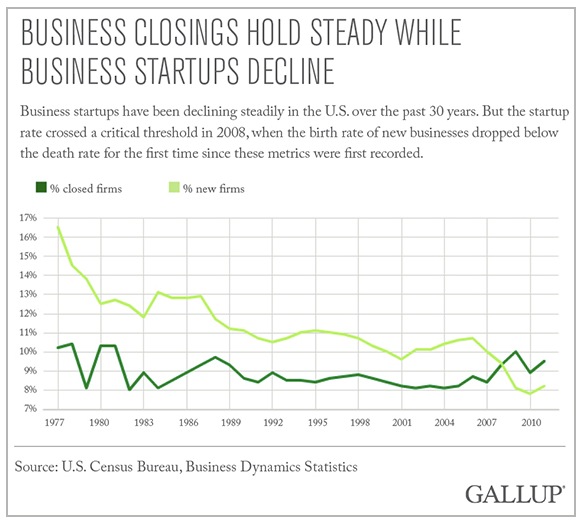
The original report came in Gallup last week. Key section:

The U.S. now ranks not first, not second, not third, but 12th among developed nations in terms of business startup activity. Countries such as Hungary, Denmark, Finland, New Zealand, Sweden, Israel and Italy all have higher startup rates than America does.

We are behind in starting new firms per capita, and this is our single most serious economic problem. Yet it seems like a secret. You never see it mentioned in the media, nor hear from a politician that, for the first time in 35 years, American business deaths now outnumber business births.

Screen-shot-2015-01-28-at-3.49.46-AM.jpg


[snip]

Business startups outpaced business failures by about 100,000 per year until 2008. But in the past six years, that number suddenly reversed, and the net number of U.S. startups versus closures is minus 70,000.

This change is critically important because small and medium sized businesses are the creators of new jobs. Large corporations have in aggregate been in liquidation mode for well over a decade, net saving and net shedding employees. You can see this behavior in the regularity with which the business press reports on headcount-cutting exercises, as if they are mere cost cutting exercises, as opposed to a sign of how deeply unwilling large corporations are to invest in their workers and their futures.

Notice how the change dates to the crisis? This is no accident. While correlation is no proof of causation in and of itself, it’s not hard to fill in causal drivers.

The Gallup article lays on thick the mythology of American entrepreneurship, as if its some sort of value or character attribute we are losing, like the old Roman virtue, and that it rests on “innovation”. The problem is that the cultural hype is based on high-flying, often venture-capital funded startups. Worse, not just journalists but also even academics have fixated on venture-capital backed young companies, even though they account for only 1% of total new ventures in most years and only 25% of the Inc. Magazine 500 roster of most successful high-growth companies.

So what about the understudied overwhelming majority of startups that are the real job engine of America? What are they like?

In his landmark study, The Origin and Evolution of New Ventures, Amar Bhide found that the most common path for successful entrepreneurs was that they had worked for large, established industry players and noticed a market niche that wasn’t served well. The most common way these new businesses were funded were savings, borrowing from friends and family, and credit cards.

Now if you think for a bit about what has been happening in our economy, and in the business world overall, you can see how the impact of the crisis and its aftermath would lead anyone with an operating brain cell to be cautious about hanging out their own shingle.

First, a classic balance sheet recession means a slow and weak recovery, as we have seen all to well. Coddling Wall Street has exacted a high toll on Main Street, and the players at risk like small business most of all. Only recently have small businessmen expressed a decent level of optimism about the economy and hiring. But even with that, there are a lot of headwinds, such as a questionable outlook for retail, which is one of the most popular targets for new ventures.

Second is that a lot of people had their savings depleted or wiped out during the crisis due to job losses or hours cutbacks. And older people who have some capital are still facing a low interest rate environment, and questionable prospects for capital gains. While that may make some more willing to take a flier, many people respond instead by working to save even more (if they are still working), trying to find not horribly risky income producing assets, and being careful about risk taking. In general, when times are robust, most investors have higher risk tolerances than when times are bad or uncertain. So the savings and friends and family route for getting funding also is not what it used to be.

Third is that credit card companies slashed credit lines during the crisis, felling a lot of ventures that relied on seasonal credit. And two important small business credit card lenders have exited the business or cut back on their offerings. Advanta failed, and American Express, which used to offer a suite of small business funding products, such as a capital lines, has eliminated some of its products and has become more stringent on how much credit it provides on its business card products.

There is an additional development which is longer term and was exacerbated by the crisis, which is short job tenures. It’s hard to get enough insight about customer behavior and what it might take to compete with or sidestep industry incumbents if you don’t spend enough time at a company to understand its operations and processes. Related to that is that many companies now make workers sign highly restrictive non-compete agreements as a condition of employment, making it hard for them not just to join other companies but go out on their own.

So while Wall Street isn’t the sole perp in the decline of American entrepreneurship, it is still a leading perp. And that’s why it is important not to give up on the effort to cut our hypertrophied finance sector down to size.
 
http://news.nationalpost.com/2015/0...-reno-story-you-will-ever-hear/#__federated=1

this is pretty extreme. dude must have had underlying issues, but sad nonetheless.

Home sweet homewreck: This is the worst reno story you will ever hear


Jim Pantaleo’s phone winked out sometime after 6:00 a.m. on Aug. 1, 2012. The last message he sent before it died was to his wife, Allison. “Love you forever,” it said. And then, nothing.

Jim had spent the day before writing and drinking, slowly. From his perch at the corner of an L-shaped bar at a pub in Toronto’s east end, he tapped away at his laptop. He sipped beer and he did shots of “liquid cocaine,” a mix of Jagermeister and Goldschlager schnapps.


When Jim and Allison Pantaleo first met — as coworkers at a pub called Gabby's on the Danforth — it was something close to love at first sight. Not long after that, they were married.
Jim had arrived at the pub, Rails and Ales, at about 3 p.m. “He seemed very normal,” says Len Grammenopoulos, the bar’s owner. He ate some food. He joked around. Sometime after midnight, he sent his mother an email with seven letters inside. At about 2:30 a.m., he paid his tab — maybe $60, $70. He high-fived Len and he walked out. “I remember him saying ‘I’m gone,’” Len says. “And that was it.”

Jim was gone.

Three years before he walked out of that bar, Jim was a different man. He was newly married. He owned a pub with Allison. The two had planned on starting a family soon. Then they bought a house, and everything fell apart.

Within weeks of moving in, they say, their new floors buckled. Their pipes froze. Their ceiling cracked. They also say that their foundation began to shift. One day, just months after signing their mortgage, they became so concerned with the condition of the house that they grabbed their cats, packed their car and fled — afraid their walls might collapse.

By the time Jim disappeared, the two had been out of their home for two and half years. They were separated, broke and stuck in a long and pricey lawsuit. In a letter addressed to his lawyer, Jim tried to sum up what it all had done to him. “I dont [sic] expect to survive to see the end of this,” he wrote.

But what happened to Jim and Allison — at least the version they told in interviews and court documents — represents something beyond the worst case scenario of a renovation gone wrong. Because, according to them, it wasn’t even their renovation that caused the problems — it was the one next door.

I remember Jimmy pulling me over one day and showing me cracks in the ceiling

Going by pictures alone, Jim and Allison don’t look like much of a match. She’s blond and sunny, and always smiling. He is none of those things. In fact, in a lot of photos, he’s giving the camera the finger. Still, when the two first met — as coworkers at a pub called Gabby’s on the Danforth — it was something close to love at first sight.

Within months of their first kiss, they were living together. Not long after that they married, in a small ceremony at City Hall. They had the party afterward in Gabby’s, which by that point Jim had bought and the two were managing together.

Allison knew then she wanted kids. Jim did, too. But before starting a family, he wanted to make sure they’d have a home to grow up in. “We spent over a year looking for a house,” Jim wrote in the letter to his lawyer. Jim’s mother, a real estate agent, helped them out. Together, they looked at more than 100 homes.


After Jim and Allison Pantaleo got married, they had their reception in Gabby's, which by that point Jim had bought and the two were managing together.
One property, in an up-and-coming neighbourhood a 15-minute walk north of the Danforth, looked promising. It wasn’t perfect. It was small and old and it needed work. It was semi-detached, too, linked by a common wall to the home next door. “I’d heard horror stories about that kind of thing,” says Allison. Still, the Pantaleos liked the neighbourhood and the local schools. So they decided to go for it.

They offered $340,000, a smidge above asking. “And we got it, and we were thrilled, I mean absolutely thrilled,” says Allison. “It really was one of the happiest moments of our marriage.”

The Pantaleos planned to move in to their new home, at 29 Dunkirk Rd., on Oct. 31, 2009. In the weeks before, they scheduled an aggressive list of renovations. They put in a new kitchen with granite counter tops and limestone floors. They laid down new cherry wood floors everywhere else, added pot lights and painted the interior. Jim especially loved the floors, says his friend Kris Edwards. “For whatever reason, that stood out.”

As all this was happening, renovations were also underway next door. The semi attached to the Pantaleos had been sold that summer. And the new owners, Jonathan Wood and his wife Gillian Irving, were gutting it. “I thought that would actually be good,” says Allison. “I’m like, if they upgrade their house, that’s in turn going to make the value of my house go up.”

It didn’t turn out that way.

jim-allison-house-1.jpg

Supplied Photo

The Pantaleos planned to move in to their new home, at 29 Dunkirk Rd. (right) on Oct. 31, 2009.
In August 2009, not long before the Pantaleos signed their mortgage, a city inspector showed up to examine 31 Dunkirk, the home next to theirs. According to City records, the inspector found a host of troubles on the building site. The inspector ordered the contractor on the job, Ironwood Construction Ltd., to “stop work immediately” and retain the services of a structural engineer to fix the issues.

That order was eventually lifted, though, and work on the house carried on in the fall. In early October, Allison says their own contractor called. He told them he was worried about the work going on next door. “The site’s not secure,” Allison remembers him saying. ” I don’t think this guy knows what he’s doing.” A few days later, he called again. You have to see the basement, he said. “Essentially they had removed part of the foundation wall,” Allison says. “I could see through to the neighbours. I could pass a coffee cup through for sure.”

From there, things snowballed, according to Allison. As she describes it, their foundation appeared to start shifting. She remembers their new French doors suddenly jamming — the top edges rubbing against the frame. There were other problems, too, she says. “I remember Jimmy pulling me over one day and showing me cracks in the ceiling and down the walls,” says Mr. Edwards.

On Oct. 22, 2009, the Pantaleos brought in a home inspector to assess the damage. In his report, he detailed some problems. But nothing that led Allison and Jim to believe they couldn’t live there safely. So they moved in on schedule.

allison-pantaleo-house.jpg

Alex Urosevic for National Post

One day, just months after signing their mortgage, Jim and Allison Pantaleo became so concerned with the condition of their house (right, pictured in 2015 after they sold it) that they grabbed their cats, packed their car and fled — afraid their walls might collapse.
But the problems at 31 Dunkirk continued, Allison says. In mid-November, Allison and Jim were sitting in their living room when she says they heard music suddenly piping in from next door. The workers had busted a hole “the size of a baseball” through the wall, Allison says.

Another night, they were in bed when they heard a loud “thunk, thunk, thunk” coming from the work site. When they went outside, they found the door to 31 Dunkirk flapping in the wind. Inside, there was little more than an unguarded pit. “They had done nothing to secure it,” Allison says.


CLICK TO ENLARGE
As November turned into December, the Pantaleos say things got worse: on several occasions, propane fumes from the worksite next door seeped into their home; the cracking in the floors progressed; the stairs started to separate from the walls. On Jan. 2, 2010, in the midst of the first cold snap of the season, the Pantaleos’ pipes froze, a direct result, Allison believes, of the digging next door.

But all of that was just a prelude. It was bad. But for Jim and Allison, it still felt more like a hassle than a life-changer. Then, on Jan. 15, 2010, things, they say, got much, much worse.

Allison was out of town, visiting her mother, when Jim called. “He’s like, ‘You’re not going to believe this, they tore down the house,’ ” she recalls. “And I thought to myself, ‘No, no, no. It can’t be that bad.” So she got in her car and she drove back to Toronto. “As I’m driving up the street, I guess my face just dropped,” she says. The top half of 31 Dunkirk had been completely torn away, she says, leaving their own home, from the second storey up, exposed to the elements.

It didn’t stop there. On Monday, Jan. 18, Jim and Allison were in bed when they heard a loud series of crashes coming from next door. The looked outside and say they saw the workers demolishing what was left of 31 Dunkirk. By that evening, it was finished. All that was left was a deep pit. Allison says there were no fences guarding it, and nothing in place to insulate or support the Pantaleos’ half of the structure.

During the demolition, the workers had torn a hole in the Pantaleos’ roof, Allison says, and without the support from 31 Dunkirk, their house started to shift east. Four days later, worried about the stability of their home, Allison and Jim called a structural engineer to do an inspection. He examined the house and left about 2 p.m. Fifteen minutes later, he called Allison from the road. His message, according to Allison, was this: “You guys have to get out. It’s not safe.” If the conditions were right and the wind picked up, Allison says he told her, their house could collapse.

(The engineer, Rob Stiemer, declined to comment for this article. But in a written report he confirmed that he advised the couple to “seek alternative living arrangements.”)

Allison and Jim were both supposed to work that night. Instead, they scrambled to cover their shifts. They snatched what they could from the house and they ran. “I have a Welsh bible that’s been in my family for 100 years, so I grab that. I grab some jewelry. We grab a couple of changes of clothes and a toothbrush and we get in the car,” Allison says.

With their three cats, they sat in their Honda Civic on the street. Jim lit a cigarette. “He looks at me and goes, ‘Well, that’s kind of f—ed,’” Allison says. Then he grabbed her hand and said, “We’ve got each other, that’s all we need.” And they left.

They didn’t know it at the time, but they would never live in their home together again.

Mr. Stiemer came back at least four times over the next two years to chart the progression of the damage he says occurred. In his preliminary report, issued Jan. 25, 2010, he laid out a catalogue of problems, backed up by photographic evidence. The floors and walls were cracking. Light was seeping in through the basement. And the house appeared, visually, to be leaning toward the open pit next door, according to his report.

The home, he wrote, was “unstable” due to the demolition work at 31 Dunkirk.

In a later report, Mr. Stiemer wrote that the owners of 31 Dunkirk did not have a permit to demolish their house when they did. What’s more, he wrote, they never performed a “precondition assessment or walkthrough” to find out what would happen to 29 Dunkirk when 31 Dunkirk came down.

jim-allison-house-hole.jpg

Supplied Photo

Jim and Allison Pantaleo say the work site at 31 Dunkirk was not secured.
But a city inspector, according to both Allison’s account and Mr. Stiemer’s report, told the Pantaleos’ the problem was effectively theirs. If their home wasn’t stable, it was up to them to fix the damage, he said, and if they didn’t do it promptly, he’d issue an order to make them comply. “He was just so awful and so cold and so callous,” Allison said. “And I’m like, ‘My house is falling over!’”

The City of Toronto wouldn’t comment on this story due to ongoing litigation. But in a statement of defence filed in Nov. 2010, the City said their inspector came out to 31 Dunkirk at least nine times between April 2009 and February 2010. The City claims he twice observed work being performed without a permit — including the demolition — and twice ordered the contractor to stop work.

Regardless, in early February, Allison and Jim felt they had to do something to secure their home. Their insurance company was threatening to pull their coverage if they couldn’t prove it was safe. And if that happened, Allison worried they’d lose their mortgage, too. So on Feb. 18, working off a design created by Mr. Stiemer, they had contractors install a series of massive wooden beams, mounted diagonally from floor to ceiling inside the house. Their insurance was set to lapse at 9 p.m. that night, according to Allison. “I’m on the phone with my adjustor,” she says. “I’m taking pictures saying, ‘Please, please, whatever you do, don’t kill my insurance.’”

It worked. The company didn’t cancel their policy; the bank kept their mortgage alive. But the Pantaleos were left with a home they felt they couldn’t live in.

jim-allison-house-hole-side.jpg

Supplied Photo

What happened to Jim and Allison Pantaleo — at least the version they told in interviews and court documents — represents something beyond the worst case scenario of a renovation gone wrong. Because, according to them, it wasn't even their renovation that caused the problems — it was the one next door.

When they first fled, Jim and Allison went to stay with Allison’s cousin, who lived nearby. They thought they’d be there for a few days, maybe a week or two at most. But the weeks soon became months. The cross-braces remained. And Jim and Allison were no closer to moving home.

And so, on Aug. 19, 2010, they filed a lawsuit in Ontario Superior Court against the owners of 31 Dunkirk, as well as Simon Maas, operating as Ironwood Construction, Stephen Hamann, the engineer Ironwood hired, and the City of Toronto. They asked for $2.8 million in damages.

That lawsuit is still dragging on today. None of the Pantaleos allegations have been proven and the other parties to the suit would not agree to speak for this piece. But they have all filed statements of defence. Effectively, they all deny any responsibility for damages the Pantaleos suffered, while at the same time expressly denying the Pantaleos suffered any damages in the first place.

One argument common to the defendants is that the Pantaleos didn’t have to move out when they did, and in any case, could have moved back in much sooner after the demolition. Allison denies that. They moved out, she says, because a professional engineer told them to, and stayed out because the damage to their home was so severe.

jim-allison-house-hole1.jpg

Supplied Photo

On Monday, Jan. 18, 2010 Jim and Allison were in bed when they heard a loud series of crashes coming from next door. The looked outside and say they saw the workers demolishing what was left of 31 Dunkirk.

The homeowners, Mr. Wood and Ms. Irving, also claimed the Pantaleos failed to properly assess the state of their home before buying it, and failed to properly maintain it once they did. Allison, however, says they had a home inspection performed before buying the house and that the inspector found no significant structural issues with the property.

Meanwhile, the defendants have also filed cross-claims against each other. The engineer, Mr. Hamann, for example, claims Ironwood failed to follow his advice with respect to “bracing and shoring” the home. He also writes that Ironwood tore down the roof and second floor of the home without his “knowledge” and “advice.” The homeowners also claim that Ironwood had complete control of all work performed on the site and that Ironwood alone was responsible for hiring and supervising subcontractors.

jim-allison-house-tear-down.jpg

Supplied Photo

On Jan. 15, 2010, Jim called Allison and said, “You’re not going to believe this, they tore down the house. ”
Mr. Maas, operating as Ironwood Construction and Ironwood Contracting and Construction, claims that at all times Ironwood’s work was inspected and reviewed by Mr. Hamann, Mr. Wood and Ms. Irving and the City of Toronto. He and the company also deny that the structural integrity of the Pantaleo’s home was damaged in any way by the work performed at 31 Dunkirk.

But the Pantaleos’ is not the only case involving Mr. Maas and Ironwood. According to court records, corporate papers and city documents, the company, or Mr. Maas operating as the company, has been or is currently involved in at least three other lawsuits related to its work, and has been the subject of multiple municipal investigations for, among other things, poor workmanship. According to internal City emails, meanwhile, in 2012, municipal inspectors were preparing charges against Ironwood, when they discovered the Province had already dissolved the company.

According to one lawsuit, in 2013, Mr. Maas was ordered to repay two former clients more than $160,000 after he failed to complete a major rebuild on their home. In another complaint, this one filed with the City, a Toronto couple described unfinished or badly done work that stretched months beyond the contracted completion date.

After Mr. Maas declined an interview at the advice of his lawyer, the National Post sent him a detailed email outlining these and other allegations. In response, his attorney, Julian Porter, said in a letter that, with regards to questions on Allison and Jim Pantaleo, the parties “are not entitled to make statements” because the “litigation has not concluded.” Neither Mr. Maas nor his attorney responded to questions about the municipal investigations or other lawsuits.

In his statements of defence for the various lawsuits, Mr. Maas has always maintained that he should never have been personally named. The work was always carried on by Ironwood, not him personally, he says. But in 2012, the provincial government cancelled Ironwood’s certificate of incorporation after the company failed to file what’s called a “notice of change” despite repeated warnings.

I can’t protect my home, my wife, my family. What am I supposed to do?

Back in 2010, when Allison and Jim were still living in her cousin’s house, still trying to run their restaurant, they knew nothing about any of this. They used their home “as a glorified storage unit,” Allison says. And both of them still went by every day to look at it.

But in time the stress and uncertainty got to them. One night that spring, Jim showed up on a neighbour’s doorstep in tears. There were animals in his home, he said, raccoons crawling in through the damaged basement and scurrying around. “You could see it was beating him down,” Kelly Entwistle says. “He said to me, ‘I can’t protect my home, my wife, my family. What am I supposed to do?’”

Jim was having other problems, too, problems not directly related to the house. He suffered from chronic pain, possibly linked to a bad car accident he’d been in years before. And he was taking pills for the pain — sometimes mixing them with alcohol. “But he had been doing that for his entire adult life,” says his friend Brad Burgess. “And he was functional. He ran a business, right? He got himself into a position where he could buy a house.” But after the house, Mr. Burgess says, “he became non-functional.”

jim-allison-house-rebuild.jpg

Supplied Photo

In March 2012, the new house at 31 Dunkirk (pictured while it's still under construction) sold for $519,000.
About six months after moving out, Allison and Jim split up. “The stress of everything, it just got to be too much,” she says.

They were never legally divorced and for a year after that, they kept working together at Gabby’s. But eventually, Allison left there too, and took a job at a restaurant down the street.

Back at their property, after a brief delay, construction started again on 31 Dunkirk. In March 2012, the new house — with hardwood floors and a bright white interior — sold for $519,000, more than double what Mr. Wood and Ms. Irving had paid for the property in 2009.

jim-allison-house-hole-side1.jpg

Supplied Photo

Allison Pantaleo says, without the support from 31 Dunkirk, their house started to shift east.

Two months later, the Pantaleo’s home — now supported by the new building next door — sold as well. It went for just under $358,000, or $32,000 less than what Jim and Allison had paid to buy and renovate it three years before.

Even before that point, Jim’s finances were a mess. He had been paying the mortgage at 29 Dunkirk, paying rent for separate apartments, trying to keep the restaurant afloat and dealing with lawyers’ bills, among others, for years. For a while Jim borrowed money from his family to keep up. But eventually it became too much for him to handle. “He was just hemorrhaging money,” says Mr. Edwards.

What he did, in the end, was sell his restaurant. In the letter to his lawyer, Jim said he had hoped to keep the house, “so that we could maybe escape with the smallest amount of dignity.” But it didn’t work. And without Gabby’s, Jim became even more untethered. “I knew losing the bar hurt him,” says Mr. Grammenopoulos. “That was his thing, man. He was good at it.”

By the spring of 2012, Jim was living with his parents in Markham. “He was just a shell of who he used to be,” says Mr. Burgess. “He looked horrible. He sounded horrible. He was literally doing nothing.”

But in the early summer that year, things were looking up. Jim was talking to Allison again. They’d even been on a couple of dates. One night in July, they went for dinner on the Danforth. They talked about the house – but for the first time in a while, they talked about other things too. Afterward, standing outside, they kissed. “It was a proper date,” Allison says. “A proper, amazing date.”

A few days later, Jim sent Allison an impact statement for the lawsuit they’d filed. It was a brutal read — laying out, in raw and painful detail, what the house had done to his life. But at the time, Allison took it as a good sign, proof maybe, that Jim was coming out of his haze.

It turned out to be the opposite. Jim wasn’t getting better. He was saying goodbye.

Just after 8 a.m. on Aug. 1, 2012, Allison’s phone rang. It was a weird time for her to get a call; everyone knew she worked nights. The name on the display, though, was even weirder: Kelly Pantaleo, Jim’s mom. “I hadn’t talked to her in two years,” Allison says. “She was in tears.”

Within months of their first kiss, Jim and Allison Pantaleo were living together. Not long after that they married, in a small ceremony at City Hall.
At about 12:30 the night before, Jim had sent his mother seven letters for her to distribute. They were, effectively, suicide notes. At that point, no one knew where Jim was. He hadn’t come home. He wasn’t answering his phone. “I just started saying, ‘We’ll find him. We’ll find him,’ ” Allison says.

When she hung up the phone, she saw the “love you forever” text from Jim. It had come in at exactly 6 a.m.

Allison spent that day and the next trying to track him down. She walked up and down the Danforth with photographs asking anyone she saw if they’d seen him. She even tried Jilly’s, a ratty old strip club nearby with a rooming house upstairs.

On Aug. 2, 2012, at 3:55 a.m., Allison sent Jim a text, “I am wearing your sweater to make me think you are safe.”
That night, Jim used his credit card at another bar on the Danforth. So the next day, Allison continued her search.

The whole time, along with Jim’s family, Allison kept sending him messages. “We sent him pictures of the cats saying ‘Daddy, please come home,’ ” she says. On August 2, at 3:55 a.m., she sent him a text, “I am wearing your sweater to make me think you are safe.”

Later that day, she was in Markham with Jim’s parents. But she says, “I just got that useless feeling.” So she got in her car to head back to Toronto. A few minutes later, Jim’s cousin called: “Alli, please turn around,” she said. “Please come back.”

A jogger had found Jim’s body in Riverdale Park, a long green strip that hugs either side of the Don River, in the middle of Toronto. He had a fatal bullet wound. He had left another note by his side. In his clothes, they found 10 cigarette butts and an empty pack of dunhills. “He was a chain smoker but he hated the idea of littering,” Allison says. “So even though he was about to do what he was about to do, he still butted them out and kept the garbage.”

Jim Pantaleo was 43 years old when he died. He was buried on Aug. 9, 2012, at the Holy Cross Cemetery, just north of Toronto.

In life, he had problems. Lots of them. He smoked too much. He drank too much. And he hurt, physically, a lot of the time. But he got by. That’s what his friends and family say. He got by, just fine, at least until the house.

Allison is now living in a small one-bedroom apartment a few subway stops away from the home she and Jim once owned. The lawsuit drags on.
Earlier this year, Allison tried to have her legal claim altered to include Jim’s death. She failed. It’s hard, after all, to say any one thing “caused” a man to kill himself.

But for Jim’s family and friends, at least, it’s clear the house played a role in Jim’s death. “I think that was the trigger,” says Mr. Burgess. It started a spiral that consumed his marriage and his business and ended with him, in a park, with a pistol, on Aug 2, 2012.

As for Allison, she’s now living in a small one-bedroom apartment a few subway stops away from the home she and Jim once owned. The lawsuit drags on. There was a delay when Jim died. They had to change all the paperwork.

Before this all started, before the wedding and the house and everything that came with it, she actually knew the couple that owned 31 Dunkirk. They used to come into Gabby’s every Wednesday night for dinner. A while back, she saw one of them in Starbucks with her daughter. Allison is 35 now. She doesn’t know when or if she’ll ever have kids.

“I didn’t say anything, because what are you going to say,” she says. “But just watching her with her daughter … It’s not fair. It’s just not fair.”
 
^Man, that's shocking.

Obviously, Jim should have sought treatment for what was obviously depression, but I agree that the whole issue surrounding the house would played an enormous part in his mental/emotional disintegration.

How the heck can some demolish half of a semi-detached house? The houses share a common wall - it just doesn't work and it's self-evident that it would cause massive damage.

I don't even understand why the owners of the neighbouring semi-detached demolished it - it doesn't look as nice as the original place.

it is beyond me how the demolition was allowed to happen and why the neighbours aren't on the hook for the problems caused.
 
The lawsuit is ongoing, those things take years. She'll get a nice settlement eventually.

Why anyone would buy an attached or "semi-"attached residence is beyond me.
Not all of us can afford to live in detached homes in the middle of fucking nowhere.
 
I don't know if anyone is paying attention to what is going on in the Eurozone, but the ECB just told Greece to go fuck themselves and that would live as slaves to the Euro forever. Will be interesting to see if Greece capitulates or tries to burn the whole fucking thing down:
http://www.nakedcapitalism.com/2015/02/ecb-greece-drop-dead.html
ECB to Greece: Drop Dead

Posted on February 5, 2015 by Yves Smith
Even by the standards of bank thuggishness, the move by the ECB against Greece last night was a stunner. Americans have become used to banks taking houses under dubious pretexts when both the investors and borrowers would do better with a writedown. But to see the ECB try take a country is another matter entirely. As one seasoned pro said, “If anyone had tried something like this against a country with a decent sized military, the tanks would be rolling.”

The ECB’s bombshell was to put Greece at risk of an intensification of its ongoing bank run in order to pressure it to agree to a deal with the Troika under an impossibly tight timetable, even shorter than the February 28 pre-existing deadline that Greece Finance Minister Yanis Varoufakis had planned to extend until June. As we’ve discussed at length previously, a longer negotiation timetable would be necessary to meet Greece’s objective of restructuring of the relationship with the Troika. Greece wanted that to be based on the recognition that Greece could never pay off its debts and that it was in both side’s interest to let Greece implement more growth-oriented policies. But the message from the enforcers at the ECB was unambiguous: Greece has no rights and needs to accept its debtcropper status.

The ECB has thus also effectively said that it would rather have fascists like Golden Dawn running Greece, which is what will eventually occur if it succeeds in breaking Syriza. It also just handed France’s Marine Le Pen, head of the nationalistic, anti-Eurozone Front National fantastic fodder for her campaign.

The February 28 date was the result of Greece presumably needing access to so-called bailout funds to pay off an IMF obligation coming due. Varoufakis said he would refuse those funds, and could get by until June, when more loans came due, by relying on existing tax receipts and getting what he regarded as minor waivers from the central bank. He also had some creative ideas for restructuring Greece’s debts and said that he wanted the OECD rather than the Troika to provide auditors on behalf of the lenders.

Even though we warned that the ECB was likely to use its control over liquidity facilities to stymie Syriza’s plans and force Greece to the negotiating table sooner rather than later, the smackdown was even more brutal than we imagined possible. The press release contains these main elements:

1. The central bank will not allow Greece to pledge Greek government debt as collateral for ECB loans after February 11. The mechanism was the lifting of a waiver that the ECB had in place. This in theory will not have an impact on the banks, since they hold little in the way of Greek sovereign debt* and in any event banks can still pledge Greek government debt for emergency lending purposes (note there has been misreporting on this issue). The immediate impact is to thwart Varoufakis’ plans to issue some additional short-term debt to carry Greece through June. Note that the ECB once briefly removed this waiver in 2012 when negotiations with Greece became fraught.

2. It stated that “it is currently not possible to assume a successful conclusion of the programme review.” This looks to be directed at Greece’s rejection of Troika bailout monitors.

3. It affirmed that Greek banks still have access to the emergency lending assistance, or ELA. But as we pointed out, that access is on a rolling two week basis. And now that Greece is officially on the ECB’s hit list, the renewal now becomes another choke point for Greece.

For the moment, the enforcers at the ECB seem to think they have enough of an upper hand via squeezing Greece via its access to funding markets. From the Wall Street Journal at the time of the ECB press release. Take particular notice of the final paragraph:

“Even with an extension of the current program, there will be challenging months ahead. But without such an extension the situation would become very tough,” one EU official said.

Another EU official confirmed that there was little willingness among eurozone governments and the ECB to allow Greece to issue more short-term debt, so-called Treasury bills, to plug funding holes in the coming days. An informal request to increase treasury-bill issuance to €25 billion from €15 billion currently—made by Mr. Varoufakis at meetings in Brussels earlier this week—is a no-go for Greece’s creditors…

Europe’s reluctance to let Athens borrow more short-term debt raises questions on how the government will meet debt repayments in coming months. In March and June, Greece has to pay almost €4 billion to the International Monetary Fund and smaller creditors. Bigger issues await in July and August, when some €7 billion in bonds held by the ECB mature.

But Greece’s financial situation could become dicey even before then. If the current bailout program expires as scheduled on Feb. 28, Greek banks won’t be able to get liquidity from the ECB anymore, due to the country’s bad credit rating. After that, they could still get funding from the Greek central bank, through so-called Emergency Liquidity Assistance or ELA, but this is also subject to ECB approval.

One of the EU officials said that ELA could continue “for some time,” without giving further details. The ECB has in the past threatened to cut off ELA funding to banks in Ireland and Cyprus to force national governments to agree on a new bailout program with the eurozone

And in an update in the European morning, the Journal describes, not surprisingly, that Greek markets are roiled. That was the point, after all. Key sections:

Athens’ main stock index plummeted 9% in early trade before recouping marginally, while the country’s two-year debt yield soared by more than three percentage points to around 19.30%.

Losses were particularly hefty in the banking sectors, where Piraeus Bank SA, National Bank of Greece SA, Alpha Bank AE and Eurobank Ergasias SA fell between 6% and 15% to the bottom of the Stoxx Europe 600 index, which was down 0.2%….

That heightened perceived risk of default was reflected in the Greek bond curve Thursday too. The yield on its five- and 10-year debt climbed sharply to trade around 14.9% and 10.7%, respectively. Yields rise as bond prices fall.

As we have said before, Greece is in a weak bargaining position. It may be able to go beyond February 28, but probably not very long. Some readers have suggested appealing to Russia, but not only would that unleash even more brutal treatment from the Troika, but the German press has also reported that Russia is not interested.

Varoufakis has ruled out a Grexit as ultimately hugely detrimental to Greece. Even if the Tsipras government were to decide to reverse course (likely leading Varoufakis to resign), he would probably want a referendum to make sure it had popular support. Most governments have procedures that don’t allow for them to be launched on short order. So even with this averse development, a Grexit seems unlikely.

The Greek government can implement emergency measures, like capital controls and restrictions on daily bank withdrawals, to reduce the bank run. Measures like nationalizing all domestic banks and implementing a plan to allow foreign banks to leave the country in an orderly manner works only if the Greek central bank can backstop the domestic banks, and that in turn works only in the event of a Grexit, since the central bank needs to be a currency issuer.

And of course, Greece can default.

In response to an e-mail tonight, Varoufakis wrote, “One thing we will not do is capitulate.” I hope readers will wish him and his fellow citizens good luck. But the Troika seems determined to destroy Greece if that is what it takes to show that their authority remains unchallenged. But the cost of discipling Greece is likely to be far greater than they imagine, not just in financial terms, but to the Eurozone project itself.

_____

* Details courtesy Bloomberg:

The Bank of Greece publishes a monthly balance sheet for Greek banks. Click on the liabilities tab: As of December 2014, the Greek banks owed €56 billion to the Eurosystem, via the Bank of Greece. What assets did they use as collateral to secure these loans? Click on the assets tab: The Greek banks only owned €12 billion in Greek government securities at the end of December, so these could only be securing a relatively small amount of the borrowing from the Eurosystem.

Taking a closer look, it becomes clear that Greek government securities are even less important as collateral than these figures make it seem. €7.4 billion of the Greek government securities owned by the banks were Treasury bills, so less than €5 billion were regular Greek government bonds. And other reporting (such as here and here) tells us the ECB has imposed a maximum limit of €3.5 billion on the use of Greek Treasury bills. (Another “rule” that’s basically just more ad hocery).

This means the Greek banks were using at most €8 billion in Greek government debt in December as collateral for loans from the Eurosystem. Set against the total loans of €56 billion owed to the Eurosystem this is fairly small beer. (Factoring in haircuts, its share in collateral would be even less than this comparison suggests).

So, on its own, the eligibility of Greek government bonds is just not that big a deal.
 
e-cigarettes with kill you

http://www.theverge.com/2015/2/5/7988047/ecig-vapor-damages-immune-system-mice

E-cigarette vapor damages the immune system of mice, study finds
  • By Jacob Kastrenakes
  • on February 5, 2015 03:21 pm
  • Email
  • @jake_k
    9

    (Lindsay Fox / Flickr)
    E-cigarettes are being pitched as potentially safer alternatives to traditional tobacco cigarettes, but it's starting to look like they may share some of the same deleterious effects. A new study out of Johns Hopkins University looks at e-cigarettes' effects on mice, and it finds that exposure to their vapor limited of the mice's immune systems and impaired their lungs' ability to fight off viral and bacterial infections. They also found that the vapor contained harmful molecules known as free radicals. The findings were published this week in the journal PLOS One.

    "They had more of the virus in their lungs."

    The research team exposed the mice to e-cigarette vapor, from the commercial brand Njoy, for two weeks. They attempted to simulate human conditions by measuring the level of nicotine in the mice's blood and matching it with the levels that occur in human smokers. After two weeks of vapor exposure, some mice were exposed to pneumonia, other mice were exposed to the flu, and others were left in fresh air. In both cases with disease exposure, the mice had more trouble fighting back: with pneumonia, the bacteria had an easier time multiplying; with the flu, the mice lost more weight — some even died.

    "We saw that they got sicker" after disease exposure, Thomas Sussan, the paper's lead author and an assistant scientist at the Bloomberg School of Public Health, tells The Verge. "They had more of the virus in their lungs, they had more inflammation in their lungs, [and] they were more susceptible to death."

    The results suggest something in e-cigarette vapor is inhibiting the immune system within the mice's lungs, the researchers say. Though it's not clear what the cause is, one candidate is the free radicals the researchers detected in the vapor. These molecules are capable of damaging cells and DNA, and they're present in high levels in tobacco smoke. The researchers didn't expect to find them in e-cig vapor because there's no combustion involved, but it appears that just heating up e-cig liquid may be enough. "We were actually surprised that we found quite a bit," Sussan says, "but the levels were considerably lower than what you'd see in cigarette smoke." Far lower — more than 100 times beneath cigarette levels.

    But what's impeding the mice's immune systems may not be. The researchers suggest that the culprit may be related to an additive in e-cig liquid called "propylene glycol," which is also found in fog machines and seems to cause similar lung problems in people who work with them. This study, however, didn't investigate that link. Njoy did not immediately respond to a request for comment.

    "They did work with one particular brand, one particular flavor, one particular level of nicotine," David Peyton, a chemist at Portland State University who was not involved with the study, tells The Verge. "Critically, I would like to see this group follow up with no-nicotine e-cigarette fluid, I would like to see no flavoring at all, I would like to see ... the glycerine alone, and see what effects those have." Though Peyton sees no problems with the study's protocols, its limited scope means that it's a starting point for a lot more research. "As a scientist there are a whole host of question that this study opens up."

    The study doesn't say if this is better or worse than cigarette smoke

    That type of uncertainty speaks to the general ambiguity in the current debate around e-cigarette safety and regulation. Though it's widely expected that they'll be less harmful than traditional cigarettes, it isn't clear what the risks will be — just because the technology is so new. That's led to much debate over how strictly e-cigarettes should be regulated: loose regulations could mean e-cigs being picked up by non-smokers, exposing them to harm, while strict restrictions could prevent smokers from switching to a less-harmful alternative.

    Sussan's team doesn't determine how the effects of e-cigarette vapor compare to the effects of traditional cigarette smoke, but their work does show that similar effects are present. "I can't say that it's better or worse," Sussan says, "but we see that same type of [immune] dysfunction." In particular, the researchers say this may be cause for concern should a smoker who's developed a lung disease attempt to switch to e-cigarettes for safety, as that safety may not actually be there.

    Sussan notes that vaping activists often — rightly or otherwise — find fault with research into the effects of e-cigs. He believes that his research group has found a way around this by developing a more-realistic animal model. In fact, Sussan says, their model appears to be the first of its kind, with an animal being exposed to vapor in a way that actually simulates smoking.

    "You can't really train mice to vape."

    "This type of exposure certainly has precedent in the tobacco research area, so it's got that kind of legitimacy around it," Peyton says. That said, "You can't really train mice to vape," so there are always going to be some differences between this model and a human study. And Peyton thinks that this study may well find itself facing criticism — "and perhaps unfairly so" — simply because it doesn't look at how the effects of e-cigarette vapor compare to the effects of cigarette smoke. "People will push back on it and say, 'you're saying that this is not supporting e-cigarettes as a cessation device,'" he says. "What they've done is compared e-cigarette vaping to non-vaping."

    Chances are, we're going to see more use of animal models in the future. The debate around e-cigarettes' health effects isn't going to subside any time soon, and any model that gets results people view as realistic is likely to see some traction. "Clearly this is the first study," Peyton says. "There are a lot more [e-cig] systems that this group can do exactly the same study on but with a whole different series of devices to work on.
 
Popular Health Supplements Actually Full of Asparagus and Lies

Major national retailers are selling bullshit herbal supplements that don't actually contain the ingredients they promise on the bottle, the New York State attorney general's office alleged on Monday. That "gingko biloba" is actually a unique blend of powdered asparagus and deception.

The AG's office ordered tests on supplements from GNC, Target, Walmart, and Walgreens, and the results were disheartening: "[R]oughly four out of five of the products contained none of the herbs listed on their labels," the New York Times reports.

The attorney general sent cease-and-desist letters to the four companies, ordering them to take the deceptive products—which contained mostly fillers like powdered rice, a houseplant called dracaena, and the aforementioned asparagus—off of New York shelves.

Walgreens has agreed to pull the allegedly deceptive supplements nationwide, and Walmart and GNC both said they would take "appropriate" action.

The NYT's Well blog has a full list of useless pills to look out for, but here's the short version: Nobody's gingko biloba, ginseng or St. John's Wort is any good, garlic is only 50/50 in garlic pills (but it shows up in plenty of unrelated supplements), and Target had the only echinacea that contained echinacea (but still not in every sample).

g1sfj3uijhv7l1vuupny.jpg


The Times' Anahad O'Connor also runs down how we got here

http://well.blogs.nytimes.com/2015/02/03/sidebar-whats-in-those-supplements/

Here are the products that were analyzed by the attorney general, along with the test results that were described in cease-and-desist letters that the agency sent to the four retailers.

From GNC, Herbal Plus brand:

Gingko Biloba:

  • No gingko biloba found
  • Did detect allium (garlic), rice, spruce and asparagus
St. John’s Wort

  • No St. John’s Wort found
  • Did detect allium (garlic), rice and dracaena (a tropical houseplant)
Ginseng

  • No ginseng found
  • Did detect rice, dracaena, pine, wheat/grass and citrus
Garlic

  • Contained garlic
Echinacea

  • No echinacea found
  • Did detect rice in some samples
Saw Palmetto

  • One sample contained the clear presence of palmetto
  • Other samples contained a variety of ingredients, including asparagus, rice and primrose
From Target, Up & Up brand

Gingko Biloba

  • No gingko biloba found
  • Found garlic, rice and mung/French bean
St. John’s Wort

  • No St. John’s Wort found
  • Found garlic, rice and dracaena (houseplant)
Garlic

  • Contained garlic
  • One test identified no DNA
Echinacea

  • Most but not all tests detected Echinacea
  • One test identified rice
Saw Palmetto

  • Most tests detected saw palmetto
  • Some tests found no plant DNA
Valerian Root

  • No valerian root found
  • Found allium, bean, asparagus, pea family, rice, wild carrot and saw palmetto
From Walgreens, Finest Nutrition brand

Gingko Biloba

  • No gingko biloba found
  • Did detect rice
St. John’s Wort

  • No St. John’s Wort found
  • Detected garlic, rice and dracaena
Ginseng

  • No ginseng found
  • Detected garlic and rice
Garlic

  • No garlic found
  • Detected palm, dracaena, wheat and rice
Echinacea

  • No echinacea found
  • Identified garlic, rice and daisy
Saw Palmetto

  • Contained saw palmetto
From Walmart, Spring Valley brand

Gingko Biloba

  • No gingko biloba found
  • Found rice, dracaena, mustard, wheat and radish
St. John’s Wort

  • No St. John’s Wort found
  • Detected garlic, rice and cassava
Ginseng

  • No ginseng found
  • Found rice, dracaena, pine, wheat/grass and citrus
Garlic

  • One sample showed small amounts of garlic
  • Found rice, pine, palm, dracaena and wheat
Echinacea

  • No echinacea or plant material found
Saw Palmetto

  • Some samples contained small amounts of saw palmetto
  • Also found garlic and rice
 
^ Wow. On the one hand, I knew that these herbal, naturopathic supplements were pretty much useless but that's even more of a naked rip-off than I expected. It's one thing to sell useless herbs to people at massive mark-ups, but it's another thing to sell them pills that don't even contain the useless herbs that they claim to contain!
 
^ Wow. On the one hand, I knew that these herbal, naturopathic supplements were pretty much useless but that's even more of a naked rip-off than I expected. It's one thing to sell useless herbs to people at massive mark-ups, but it's another thing to sell them pills that don't even contain the useless herbs that they claim to contain!
Talk to JimmyRustler. One of our many corrupt politicians exempted herbal supplements, and in fact ALL athletic supplements, from FDA regulation. So they basically run on the honor system. According to him that's supposed to be working itself out.
 
The placebo effect is a powerful thing. But this takes the quackery of herbal supplements to a new level.
 
Mebbe they were homeopathic.
Did the NYT's Well blog do a list of useless injections and include the flu shot?
One of our many corrupt politicians exempted herbal supplements, and in fact ALL athletic supplements, from FDA regulation.
Athletic supplements? That's the tradeoff for them not being allowed to list the actual proven benefits and efficacy. Big Pharma would rather sell flu shots than vitamins.
 
Mebbe they were homeopathic.
Did the NYT's Well blog do a list of useless injections and include the flu shot?
Athletic supplements? That's the tradeoff for them not being allowed to list the actual proven benefits and efficacy. Big Pharma would rather sell flu shots than vitamins.
Maybe who was homeopathic? And what the fuck does this have to do with injections?
 

Users who are viewing this thread

Back
Top Bottom