Macroeconomic Reality

The problem with all this tweed and cashmere, unless you have a stately home that you can't afford to heat, you're in real trouble when it comes to modern homes, offices and transport which are invariably over heated in winter.
 
The problem with all this tweed and cashmere, unless you have a stately home that you can't afford to heat, you're in real trouble when it comes to modern homes, offices and transport which are invariably over heated in winter.

Ah, but the true elite decides his own temperature
 
chart207jpg_Page1.jpg
chart213jpg_Page1.jpg


Getting very close!
 
Over The Last 10 Years The U.S. Economy Has Grown At EXACTLY The Same Rate As It Did During The 1930s

Even though I write about our ongoing long-term economic collapse every day, I didn’t realize that things were this bad. In this article, I am going to show you that the average rate of growth for the U.S. economy over the past 10 years is exactly equal to the average rate that the U.S. economy grew during the 1930s. Perhaps this fact shouldn’t be that surprising, because we already knew that Barack Obama was the only president in the entire history of the United States not to have a single year when the economy grew by at least 3 percent. Of course the mainstream media continues to push the perception that the U.S. economy is in “recovery mode”, but the truth is that this current era has far more in common with the Great Depression than it does with times of great economic prosperity.

Earlier today I came across an article about President Trump’s new budget from Fox News, and in this article the author makes a startling claim…

The hard fact is that the past decade’s $10 trillion in deficit spending has produced the worst economic growth as measured by Gross Domestic Product in our nation’s history. You read that right, in the past decade our nation’s economy grew slower than even during the Great Depression. This stagnant, new normal, low-growth economy is leaving millions of working age people behind who have given up even trying to participate, and has led to a malaise where many doubt that the American dream is attainable.


When I first read that, I thought that this claim could not possibly be true. But I was curious, and so I looked up the numbers for myself.

What I found was absolutely astounding.

The following are U.S. GDP growth rates for every year during the 1930s…

1930: -8.5%
1931: -6.4%
1932: -12.9%
1933: -1.3%
1934: 10.8%
1935: 8.9%
1936: 12.9%
1937: 5.1%
1938: -3.3%
1939: 8.0%

When you average all of those years together, you get an average rate of economic growth of 1.33 percent.

That is really bad, but it is the kind of number that one would expect from “the Great Depression”.

So then I looked up the numbers for the last ten years…

2007: 1.8%
2008: -0.3%
2009: -2.8%
2010: 2.5%
2011: 1.6%
2012: 2.2%
2013: 1.7%
2014: 2.4%
2015: 2.6%
2016: 1.6%

When you average these years together, you get an average rate of economic growth of 1.33 percent.

I thought that was a really strange coincidence, and so I pulled up my calculator and ran all of the numbers again and I got the exact same results.

The 1930s certainly had more big ups and downs, but the average rate of economic growth during that decade was exactly the same as we have seen over the past 10 years.

And of course the early 1940s turned out to be a boom time for the U.S. economy, while it appears that our rate of economic growth is actually slowing down. As I noted yesterday, U.S. GDP growth during the first quarter of 2017 was just 0.7 percent.

But you don’t hear any talk like this on the mainstream news, do you?

Instead, they tell us that everything is just peachy.

I often wonder what things would be like right now if Barack Obama and his minions in Congress had not added more than 9 trillion dollars to the national debt. By stealing all of that money from future generations of Americans and spending it now, Obama was able to artificially prop up the U.S. economy. If we were able to go back and remove 9 trillion dollars of government spending from the economy over the past 8 years, we would be in a rip-roaring economic depression right now. For an extended analysis of this, please see my previous article entitled “The Shocking Truth About How Barack Obama Was Able To Prop Up The U.S. Economy”…

But even though we have been adding more than a trillion dollars to the national debt each year, and even though the Federal Reserve pushed interest rates all the way to the floor during the Obama era, the U.S. economy has not grown by three percent or more on an annual basis since 2005.

When you take an honest look at the numbers, there is no way that anyone can possibly claim that the U.S. economy is doing well. The best that you can say is that we have been staving off a complete economic meltdown and another Great Depression, but of course the measures that our leaders have been taking to do this have just been making our long-term problems even worse.

I feel bad for President Trump, because he has inherited the biggest economic mess in U.S. history. When we finally reach the point when it is impossible to artificially prop up the U.S. economy any longer, he is going to get most of the blame, but he won’t deserve it.

It is not going to be possible for Trump or anyone else to fix our system, because it was fundamentally flawed from the very beginning. The Federal Reserve was designed to create an endless spiral of government debt, and since the day it was created the U.S. national debt has gotten more than 5000 times larger and the value of the U.S. dollar has declined by about 98 percent.

If we truly want to fix the economy, the Federal Reserve must be abolished. If I was President Trump, I would look to start issuing debt-free U.S. currency just like President Kennedy did in 1963 as soon as possible.

In addition, we need to push tax rates as low as possible. Personally, I would like to see the day when the personal income tax is completely eliminated and the IRS is shut down. The greatest period of economic growth in all of U.S. history was when there was no income tax and no Federal Reserve. America once thrived in such an environment, and I believe that we can do it again.

Of course we need to also dramatically reduce the size and scope of the federal government. Our founders intended to create a very limited federal government, but instead the left has just kept pushing to make it larger and larger.

Businesses all over America are being strangled to death by mountains of federal regulations, and if we could just get the government off of their backs the business community could start thriving again. There are quite a few government agencies that could be shut down entirely, and I think that the EPA would be a good place to start.

Once upon a time the United States showed the world the power of free markets and capitalism, and if we want to make America great again, we should go back and do the things that made America great in the first place.

But would the American people be willing to go down that path?
 
Does the World End in Fire or Ice? Thoughts on Japan and the Inflation/Deflation Debate

Posted on May 24, 2017 by Charles Hugh Smith
Do we implode in a deflationary death spiral (ice) or in an inflationary death spiral (fire)? Debating the question has been a popular parlor game for years, with Eric Janszen’s 1999 Ka-Poom Deflation/Inflation Theory often anchoring the discussion.

I invite everyone interested in the debate to read Janszen’s reasoning and prediction of a deflationary spiral that then triggers a monstrous inflationary response from central banks/states desperate to prop up their faltering status quo.

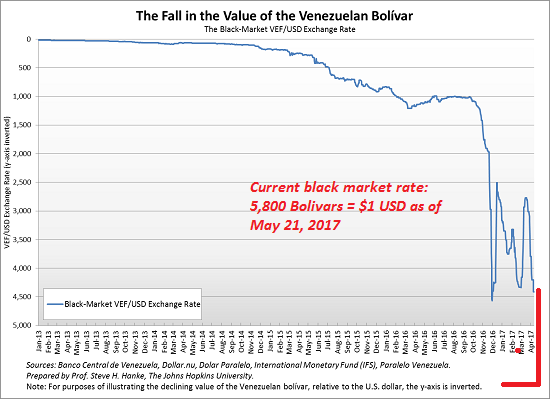
Alternatively, economies can skip the deflationary spiral and move directly to the collapse of their currency via hyper-inflation. This chart of the Venezuelan currency (Bolivar) illustrates the “skip deflation, go straight to hyper-inflation” pathway:

bolivar4-17.png

If we set aside the many financial rabbit holes of the inflation/deflation discussion, we find three dominant non-financial dynamics in play:demographics, technology and energy.

As populations age and retire, the resulting decline in incomes and spending are inherently deflationary: less money is earned, and less money is spent, reducing economic activity (gross domestic product).

The elderly also sell assets such as stocks, bonds and their primary house to fund their retirement, and if the elderly populace is a major cohort (due to low birth rates and increasing life spans, etc.), then this mass dumping of assets is also deflationary, as the increasing supply of sellers and the stagnating supply of buyers pushes prices lower.

Recession and stagnation are also deflationary. Shift 10 million workers from secure fulltime employment with full benefits to low-paid, insecure part-time jobs with few benefits, and you have a self-reinforcing deflationary spiral in action: a significant percentage of the workforce is now receiving far less income, which necessarily slashes their spending and just as importantly, their ability to borrow huge sums of money to buy vehicles, homes, overseas vacations, etc.

In consumer-dependent economies that are dependent on debt for much of the consumer spending, this decline in borrowing and spending power is extremely deflationary, as there is a lot less money available to chase the existing output of goods and services.

Japan is a case in point. A friend of ours who lived and worked in Japan for a decade (the 1990s) recently visited Japan again after 15 years working in Europe and the U.S., and he was surprised to find prices were the same or lower as when he was living in Japan.

This is the result of multiple sources of deflation operating in Japan.

A recent NHK TV program reported some young people in Japan are trickling back to rural villages and renting large traditional farm houses and the adjoining land for $200/month, a fraction of what they were paying for cramped studios in big cities. This is an example of deflation in action: people abandon costly housing, transportation, etc. and adopt lifestyles that generate far less income and far lower expenses–both are deflationary.

Given the structural rise of part-time employment, an aging populace and the deflationary impacts of technology and globalization, no wonder Japan is experiencing deflationary/stable prices.

Technology is relentlessly deflationary. Where consumers once spent small fortunes buying stereo equipment and music storage (LPs, cassettes, CDs, etc.), cameras, film, photo printing, etc., game consoles and equipment, small-screen TVs, and paying for telephony, now a single device–a smart phone–combines all these functions (with some obvious limitations) in one device.

Globalization and commoditization are also deflationary. Global wage arbitrage and automation lowers production costs, and the commoditization of labor and inputs (capital and materials) push prices lower.

Declining energy costs are also deflationary, as the cost of energy affects the pricing of almost every good and service.

We now discern the outlines of why money created out of thin air needn’t be as inflationary as expected. If economic activity declines by $1 trillion due to lower incomes, spending, etc., creating $1 trillion out of thin air and injecting it into the economy as monetary and fiscal stimulus is more or less simply replacing the $1 trillion of deflation.

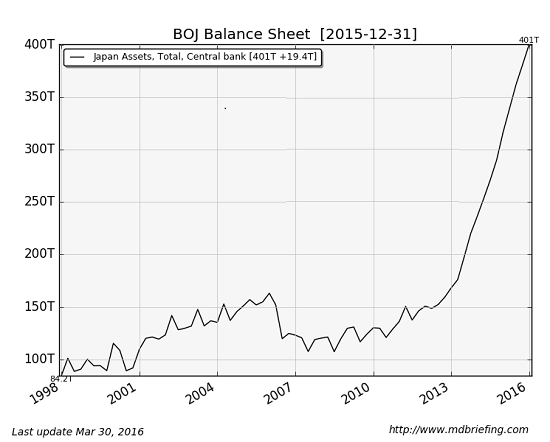
The Bank of Japan has tripled its asset purchases (monetary stimulus and support of the stock and bond markets) with little apparent effect on conventional measures of inflation.

BOJ-bs6-16.png

This print-to-offset deflationary declines may appear to be stable and sustainable, but the expansion of bonds (to fund fiscal stimulus) accrues interest, which even at low rates eventually starts burdening state spending.

All this new currency doesn’t necessarily lead to productive spending or investment; rather, it may increase mal-investment and systemic asymmetries that eventually destabilize the entire financial system.

Japan has managed to offset decades of deflationary dynamics, but at a cost that is hidden beneath the surface of apparent stability. Building bridges to nowhere and creating money from thin air to buy stocks and bonds only appears sustainable because the risks and imbalances are piling up out of sight. Eventually the “perfect balance” between deflation and inflation tips one way or the other, and a systemic crisis “nobody saw coming” unfolds.
 
Over The Last 10 Years The U.S. Economy Has Grown At EXACTLY The Same Rate As It Did During The 1930s

Even though I write about our ongoing long-term economic collapse every day, I didn’t realize that things were this bad. In this article, I am going to show you that the average rate of growth for the U.S. economy over the past 10 years is exactly equal to the average rate that the U.S. economy grew during the 1930s. Perhaps this fact shouldn’t be that surprising, because we already knew that Barack Obama was the only president in the entire history of the United States not to have a single year when the economy grew by at least 3 percent. Of course the mainstream media continues to push the perception that the U.S. economy is in “recovery mode”, but the truth is that this current era has far more in common with the Great Depression than it does with times of great economic prosperity.

Earlier today I came across an article about President Trump’s new budget from Fox News, and in this article the author makes a startling claim…

The hard fact is that the past decade’s $10 trillion in deficit spending has produced the worst economic growth as measured by Gross Domestic Product in our nation’s history. You read that right, in the past decade our nation’s economy grew slower than even during the Great Depression. This stagnant, new normal, low-growth economy is leaving millions of working age people behind who have given up even trying to participate, and has led to a malaise where many doubt that the American dream is attainable.


When I first read that, I thought that this claim could not possibly be true. But I was curious, and so I looked up the numbers for myself.

What I found was absolutely astounding.

The following are U.S. GDP growth rates for every year during the 1930s…

1930: -8.5%
1931: -6.4%
1932: -12.9%
1933: -1.3%
1934: 10.8%
1935: 8.9%
1936: 12.9%
1937: 5.1%
1938: -3.3%
1939: 8.0%

When you average all of those years together, you get an average rate of economic growth of 1.33 percent.

That is really bad, but it is the kind of number that one would expect from “the Great Depression”.

So then I looked up the numbers for the last ten years…

2007: 1.8%
2008: -0.3%
2009: -2.8%
2010: 2.5%
2011: 1.6%
2012: 2.2%
2013: 1.7%
2014: 2.4%
2015: 2.6%
2016: 1.6%

When you average these years together, you get an average rate of economic growth of 1.33 percent.

I thought that was a really strange coincidence, and so I pulled up my calculator and ran all of the numbers again and I got the exact same results.

The 1930s certainly had more big ups and downs, but the average rate of economic growth during that decade was exactly the same as we have seen over the past 10 years.

And of course the early 1940s turned out to be a boom time for the U.S. economy, while it appears that our rate of economic growth is actually slowing down. As I noted yesterday, U.S. GDP growth during the first quarter of 2017 was just 0.7 percent.

But you don’t hear any talk like this on the mainstream news, do you?

Instead, they tell us that everything is just peachy.

I often wonder what things would be like right now if Barack Obama and his minions in Congress had not added more than 9 trillion dollars to the national debt. By stealing all of that money from future generations of Americans and spending it now, Obama was able to artificially prop up the U.S. economy. If we were able to go back and remove 9 trillion dollars of government spending from the economy over the past 8 years, we would be in a rip-roaring economic depression right now. For an extended analysis of this, please see my previous article entitled “The Shocking Truth About How Barack Obama Was Able To Prop Up The U.S. Economy”…

But even though we have been adding more than a trillion dollars to the national debt each year, and even though the Federal Reserve pushed interest rates all the way to the floor during the Obama era, the U.S. economy has not grown by three percent or more on an annual basis since 2005.

When you take an honest look at the numbers, there is no way that anyone can possibly claim that the U.S. economy is doing well. The best that you can say is that we have been staving off a complete economic meltdown and another Great Depression, but of course the measures that our leaders have been taking to do this have just been making our long-term problems even worse.

I feel bad for President Trump, because he has inherited the biggest economic mess in U.S. history. When we finally reach the point when it is impossible to artificially prop up the U.S. economy any longer, he is going to get most of the blame, but he won’t deserve it.

It is not going to be possible for Trump or anyone else to fix our system, because it was fundamentally flawed from the very beginning. The Federal Reserve was designed to create an endless spiral of government debt, and since the day it was created the U.S. national debt has gotten more than 5000 times larger and the value of the U.S. dollar has declined by about 98 percent.

If we truly want to fix the economy, the Federal Reserve must be abolished. If I was President Trump, I would look to start issuing debt-free U.S. currency just like President Kennedy did in 1963 as soon as possible.

In addition, we need to push tax rates as low as possible. Personally, I would like to see the day when the personal income tax is completely eliminated and the IRS is shut down. The greatest period of economic growth in all of U.S. history was when there was no income tax and no Federal Reserve. America once thrived in such an environment, and I believe that we can do it again.

Of course we need to also dramatically reduce the size and scope of the federal government. Our founders intended to create a very limited federal government, but instead the left has just kept pushing to make it larger and larger.

Businesses all over America are being strangled to death by mountains of federal regulations, and if we could just get the government off of their backs the business community could start thriving again. There are quite a few government agencies that could be shut down entirely, and I think that the EPA would be a good place to start.

Once upon a time the United States showed the world the power of free markets and capitalism, and if we want to make America great again, we should go back and do the things that made America great in the first place.

But would the American people be willing to go down that path?

Why are you reading an economic collapse blog lol? It's easy to be a perma-bear, always has been and always will be. They don't make for good investors though, usually underperform massively.

Also, do I need to bring out the custom vs bulk regulation again? You can't say companies are being "strangled to death by mountains of regulations" without specifying those regulations and their economic effects.

I'm disappointed in you Rambo, for a while you went in the right direction, and now you're going right back to this populist bullshit. Did something bad happen to you this week?
 
The rich Brazilians use to make a killing on the currency cycle. They use to wait to the real was artificially pegged one-to-one to the dollar and then change everything to dollars. Six months later they were 8 times as rich.

Certainly in Europe, I don't know about house prices in the UK, in the last 7 or 8 years, wages have pretty much stagnated. Costs too haven't increased by much. So it's pretty much all stable. Is that a good or bad thing? Depends.
 
Why are you reading an economic collapse blog lol? It's easy to be a perma-bear, always has been and always will be. They don't make for good investors though, usually underperform massively.

Also, do I need to bring out the custom vs bulk regulation again? You can't say companies are being "strangled to death by mountains of regulations" without specifying those regulations and their economic effects.

I'm disappointed in you Rambo, for a while you went in the right direction, and now you're going right back to this populist bullshit. Did something bad happen to you this week?
actually it aggregates a number of other blogs. i just thought it had some interesting conversation pieces, which it clearly did. if you'd like to discuss the substance of the article rather than suppositions about its author i'd be more than happy to.
 
actually it aggregates a number of other blogs. i just thought it had some interesting conversation pieces, which it clearly did. if you'd like to discuss the substance of the article rather than suppositions about its author i'd be more than happy to.

There is no substance.
 
Japan is experiencing a big decline in birthrate and is below replacement. They have virtually no immigration or imported worker policy.
 
Japan is experiencing a big decline in birthrate and is below replacement. They have virtually no immigration or imported worker policy.

They're also have extremely inefficient labour policies. Promotion based solely on tenor/seniority, employees for life, facetime is more important than productivity, no mobility, etc.
 
They're also have extremely inefficient labour policies. Promotion based solely on tenor/seniority, employees for life, facetime is more important than productivity, no mobility, etc.
Plus dreadful office politics and gossip that would be illegal anywhere else relatively civilized.
 
Japan also leads in a number of technologies, including automation and robotics, perhaps they've realised that you don't need the pyramid scheme of relying on an ever larger population in the future?
 
They're also have extremely inefficient labour policies. Promotion based solely on tenor/seniority, employees for life, facetime is more important than productivity, no mobility, etc.
This is changing very rapidly, and has been for at least a decade. I remember (well, I remember last month reading about) when and how the larger firms in Japan followed a number of smaller firms and first began downsizing. Still, much is still firmly entrenched.

Plus dreadful office politics and gossip that would be illegal anywhere else relatively civilized.
Don't forget horrific hazing.
 
They're also have extremely inefficient labour policies. Promotion based solely on tenor/seniority, employees for life, facetime is more important than productivity, no mobility, etc.
This is only part of the economy - the big corporations etc. The rest is beset by the same issues as the rest of us - underemployment, casualisation, part-time only, no job security...
 
I've worked on a couple of joint-ventures with Japanese companies and colleagues. One of my co-workers was telling me that back in Tokyo their company is one of the few companies that you get weekends off with. During the week he informed that they are in the office by 7am and do not leave before 9.30pm, sometimes they will be there until past 11pm. You must arrive before your boss and not leave before he leaves. And it is not unusual to see people sleeping at their desks, or for people to doze off in meetings.

They are good on the quality discipline and the excellent The Toyota Way: 14 Management Principles From The World's Greatest Manufacturer by Jeffrey K. Liker has some sound principles on how to manage a business, not just manufacturing.
 
Bucko - I still think its only part of it. I know a friend who is 60+ lives in a small town 20,000 in the hills 400ks from Tokyo and he's something like what I'd call a Fitter & Turner /Skilled Machinist . He's worked at the local Pipe Factory for 30+ years - he's now a senior manager/trainer as far as I understand him - he doesn't speak English - he has a job for life unless times are really bad for company. He starts around 8 am and works till about 5pm. He doesn't work weekends but sometimes might go in. He doesn't see himself like a salaryman at all - he laughs at salarymen. He's a good bloke and a good drinker.
 
http://www.washingtonsblog.com/2017/10/careful-wish-inflation-much-higher-advertised.html

Be Careful What You Wish For: Inflation Is Much Higher Than Advertised
Posted on October 5, 2017 by Charles Hugh Smith
It’s not exactly a secret that real-world inflation is a lot higher than the official rates–the Consumer Price Index (CPI) and Personal Consumption Expenditures PCE). As many observers have pointed out, there are two primary flaws in the official measures of inflation:

1. Big-ticket expenses such as rent, healthcare and higher education–expenses that run into the thousands or tens of thousands of dollars annually–are severely underweighted or mis-reported. While rents are soaring, the CPI uses an arcane (and misleading) measure of housing costs: owners equivalent rent. Why not just measure actual rents paid and actual mortgages/property taxes/home insurance premiums paid?

CPI10-17.png

Healthcare is 18% of GDP but only 8.5% of CPI. To those exposed to the actual costs of healthcare, 8.5% of the CPI is a joke.

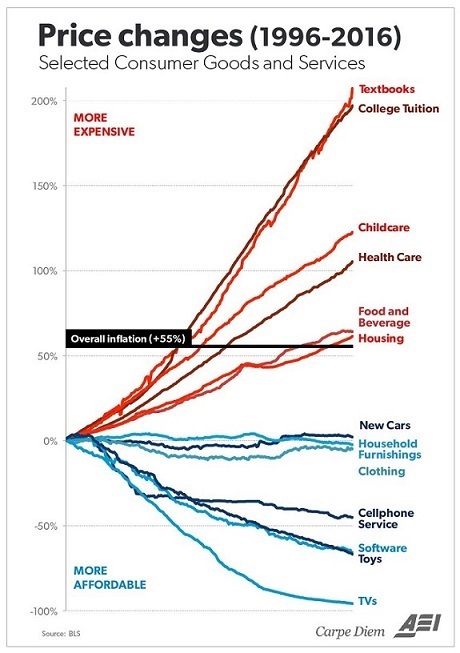
The same can be said of higher education: households paying tuition and other college costs are exposed to horrendously high rates of inflation, as illustrated in this chart:

inflation10-16.jpg

Revealing the Real Rate of Inflation Would Crash the System (August 3, 2016)

The Burrito Index: Consumer Prices Have Soared 160% Since 2001 (August 1, 2016)

Inflation Isn’t Evenly Distributed: The Protected Are Fine, the Unprotected Are Impoverished Debt-Serfs (May 25, 2017)

Then there’s the hedonic adjustments that are made to reflect improvements in quality, features, safety, etc. So the price of computers is discounted to reflect the increase in memory, etc. compared to previous models. This is a can of worms, as anyone shopping for a new car or truck can attest: yes, the vehicles have more safety features, but the sticker price is much higher. Do we knock $10,000 off the “price” because of these additional features? Why should we, when consumers have to pony up $10,000 more than they did a decade ago?

More honest and accurate estimates of real-world inflation that include the big-ticket categories of housing, healthcare and higher education reckon annual inflation is around 7% or even as high as 10% in high-cost metro areas, not 2%. This sets up a very peculiar cognitive dissonance in the financial media.

On the one hand, government agencies are bending over backward to under-report inflation. On the other, the Federal Reserve is whining that inflation is too low and their efforts to push it higher have failed. Heck, folks, the solution is obvious: just report real-world inflation without the hedonic adjustments and other shuck and jive, and when the rate of inflation comes in at a hot 7% instead of the official 2%, the Federal Reserve can declare victory.

Why does the Fed want higher inflation? The general explanation is higher inflation benefits bankers, borrowers and the expansion of credit that underpins our consumerist economy.

The idea is that as wages rise with inflation (assuming wages are rising, which they’re not for the bottom 90%), households will have an easier time servicing existing debt and getting new loans.

The payments due on existing debt become easier to make as inflation expands everyone’s paychecks. (Note that this expansion doesn’t mean the purchasing power of the wage has increased; it’s an illusory expansion that serves the credit industry.)

Banks benefit because they earn fees on originating new loans and rolling over existing debts into new loans.

But the supposed benefits of high inflation are undercut if wages don’t rise as fast as prices. As many observers have noted, wages for the bottom 90% have not kept pace with higher costs. For the bottom 90%, rising rents, higher property taxes, higher health insurance premiums, higher healthcare co-pays and deductibles, soaring college tuition and so on, have squeezed household budgets while household income has stagnated.

No wonder the government wants to mask the real rate of inflation. If it was widely understood that inflation is reducing our purchasing power at an annual rate of 7% while wages are rising at 1% or 2% if at all, people might realize the Fed and other authorities have stripmined the many to enrich the few.

income-real-quintile7-17b.png

So what the Federal Reserve is actually whining about is not low inflation–it’s that high inflation isn’t pushing wages higher like it’s supposed to. In the simplistic models of conventional economics, inflation is supposed to be a monetary function, i.e. a generalized secular dynamic that pushes everything higher–not just prices, but wages, too.

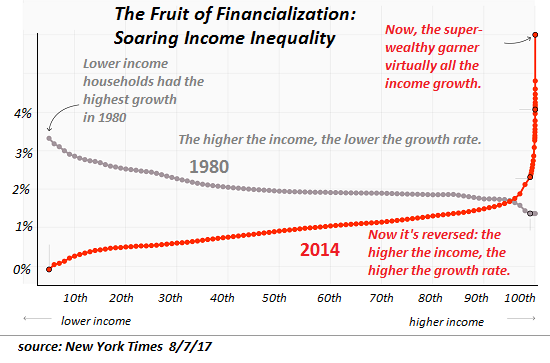
Alas, the world isn’t as simple as the economists’ models. So what we have instead is stagnating wages and soaring wealth-income inequality.

inequality-NYT8-17a.png

No wonder so many people reckon this was the real plan all along: it’s worked brilliantly for the eight years of “recovery”, greatly enriching the few at the expense of the many.
 
There are definite issues with how the CPI is calculated, but

- some of the above suggests he advocates using average costs instead of median costs for things like healthcare, which is silly because median costs are far more representative of what people spend. And as he amends, higher education costs really only apply to those who pay them, which is far less than a fifth of Americans including those still paying off loans (hence its low weight in the basket).

- He also doesn’t seem to understand the intended relationship between inflation and wage. Inflation is supposed to drive real wages down in order to boost employment. I’m not saying that we should be trying to drive down wages, but he doesn’t seem to understand the concept when he says “high inflation isn’t driving up wages like it’s supposed to.”

- Nor does he understand the relationship between banks and inflation. The Fed lowers interests rates, banks lend more, more money enters circulation leading to inflation. In his arguments, inflation leads to more loans, but the opposite is true. More loans lead to inflation; the interest rate is the Fed’s primary monetary tool.

- economics models are ridiculously complex. I don’t know why he thinks they are simple.

- Though this wasn’t mentioned, to the degree that we want to reduce our trade deficit, inflationary policies will do the trick. Given the US’s desire to do this, I wonder if the Fed will continue to push inflation even after we reach full employment (which we might already be at)
 

Users who are viewing this thread

Back
Top Bottom