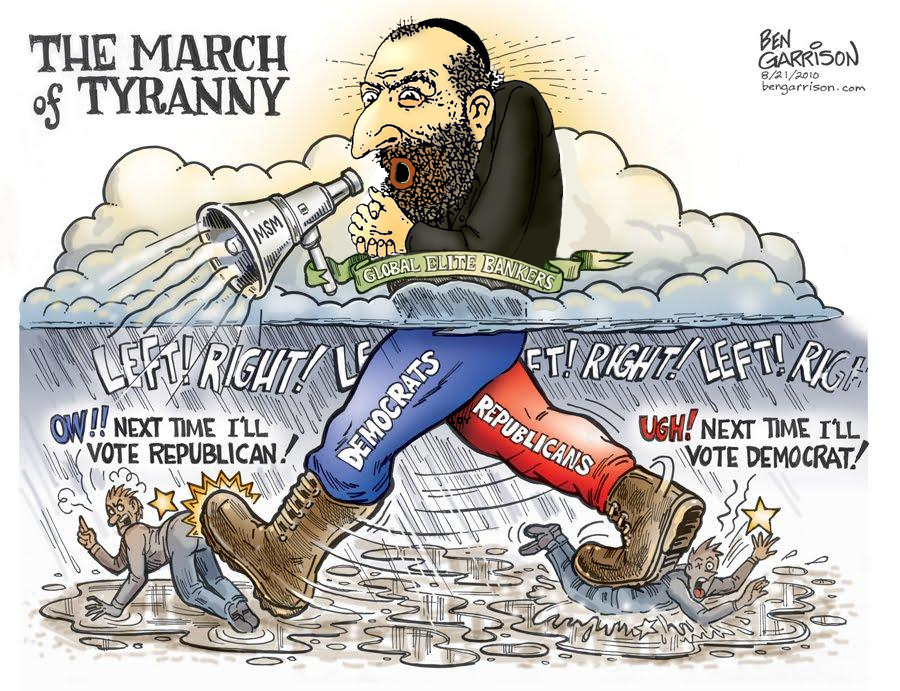
The Elite: It's a Big Club and You're Not in it

The money has EVERYTHING to do with it, because the money allows for this sort of social segregation to take root and flourish.

Hat tip for the Johnny 5 reference though.

Not really. Physical superiority, mental superiority, there are many ways to segregate and break societal bonds. The Nazis didn't have really any money to speak of.
 
Not really. Physical superiority, mental superiority, there are many ways to segregate and break societal bonds. The Nazis didn't have really any money to speak of.
The Nazi's had strength in numbers, and then once they took over the country they had all the money.

In the case of the TW tower in NY, its money.
 
Unless you are Johnny Five there is no way you read that whole thing before your first post. I'm the biggest speed reader I know and it took me like 15 minutes.

I did. I came over to post that quoted section, but went back and finished as soon as I did so.
 
The Nazi's had strength in numbers, and then once they took over the country they had all the money.

In the case of the TW tower in NY, its money.

The Nazi's has strength in ideas. They came from a couple dozen people, they didn't just show up as thousands. The lack of money actually was their selling point.

The problem in NYC is anonymity. It's a separate parallel society. Upper middle earners can get enough money to get into that place, that's not the issue. And conversely, a billionaire in who is engaged with society strengthens the community.

It isn't the money. It's the notion of being different.
 
I did. I came over to post that quoted section, but went back and finished as soon as I did so.

Well then you hadn't read the whole thing when you posted.

Input.gif
 
The money has nothing to do with it. There's a disturbing trend that is divorcing some people from society. In effect, there are two different realities that are diverging. Societal integration and commonality is what generates stability. This sort of trend is what causes war and revolution.

Warren Buffett epitomizes what you have laid out as Elite™, yet he is anathema to this sort of thing. This is the real danger, the lack of societal bonds. Dehumanization is a stones throw from divorced society, and then all sorts of false ideals are superimposed upon opposing groups. We end up with stuff like the Bolshevik Revolution and the Nazis genocide. Ungood.

On a lighter note though, when I first saw the article I was like "This is some shit Tom Brad and other celebrities would be around", and I'll be goddmaned if Tom Brady wasn't in the article. I lol'd.

I've commented on that trend before in this thread. I think I highlighted it with the helicopter culture in Brazil. I quite agree with you. The elite is going to great lengths to hide their identities, intentions, and completely separate themselves from the rest of the world. I think it also highlights of just how little value they really are. All those beautiful properties in NYC, full of rare artwork, just sit their lying fallow, it is a good metaphor for the social, tax and economic contributions made by the elite.


The money has EVERYTHING to do with it, because the money allows for this sort of social segregation to take root and flourish.

Precisely. I'm surprised you're debating this Doghouse, it's clearly the money that allows for this, and it's coupled with the banality of evil with attorneys, agents, and all kinds of hechmen facilitating these kinds of transactions, and in fact their entire lives, for clearly unscrupulous people.
 
Well then you hadn't read the whole thing when you posted.

Input.gif

I posted at 10:09 I had read the whole thing... you posted the article at 9:20. That's a 50 minute window. I even had time to pause and take a shit in between.
 
I posted at 10:09 I had read the whole thing... you posted the article at 9:20. That's a 50 minute window. I even had time to pause and take a shit in between.

On my screen it say you posted at 9:46
 
Not really. Physical superiority, mental superiority, there are many ways to segregate and break societal bonds. The Nazis didn't have really any money to speak of.

The Nazi's had strength in numbers, and then once they took over the country they had all the money.

You're both mistaken. The Nazi were heavily funded/armed by a combination of American financiers, the Rothschilds and a host of other money.

The Nazi's were originally installed because of Russia. The idea they emerged from nowhere is very, very naive.
 
You're both mistaken. The Nazi were heavily funded/armed by a combination of American financiers, the Rothschilds and a host of other money.

That is after the fact. They were 100% dirt poor to start, and plied on the psychoses of other broke Austro Germans.
 
On my screen it asks me "why the fuck is he harping on about this shit?" Or maybe that's the feed inside my head. I always get those two confused.

In his defense, it's always compelling to keep pushing when you think you have them caught in a lie.
 
On my screen it asks me "why the fuck is he harping on about this shit?" Or maybe that's the feed inside my head. I always get those two confused.

I dunno, was just responding to him.
 
The Nazi's has strength in ideas. They came from a couple dozen people, they didn't just show up as thousands. The lack of money actually was their selling point.

The problem in NYC is anonymity. It's a separate parallel society. Upper middle earners can get enough money to get into that place, that's not the issue. And conversely, a billionaire in who is engaged with society strengthens the community.

It isn't the money. It's the notion of being different.
Well, yes, but I was talking more about the critical mass, not when it was 12 guys in Hitler's garage.

Yes, anonymity is a problem, but what allows these people to access that level of anonymity? Money. Gobs and gobs of money. Its not exactly easy, or cheap, to insulate yourself through a series of shell corporations.

I honestly don't think the notion of being different has that much to do with it, unless by different you're referring to "look at how much more shit I have than you". These apartments are nothing more than investment vehicles for most of these people. Yes, they may stop in now and again, but these oligarchs and warlords need places to park their cash. An apartment is a great way to do so.

There are not many billionaires who are engaged with society on the level to which you speak. Buffett is a major outlier here. Outside of him, I really can't think of any.
 
Its not exactly easy, or cheap, to insulate yourself through a series of shell corporations.
Absolutely is.


I honestly don't think the notion of being different has that much to do with it,

It's the central theme for every issue in the world. West vs East, Repub vs Dem, Christian/Atheist/Islam/Buddhist, White vs Black. It's all the same thing. Dehumanization and separation.

The Nazi's were installed, they had all the backing they needed, it just wasn't in view.

Installed? Dude, I give up again. I don't even know why I came back in here. I guess it was to give you some food for thought for some legitimate problems the world is facing. You idiots keep up your bitter whining.
 
Installed? Dude, I give up again. I don't even know why I came back in here. I guess it was to give you some food for thought for some legitimate problems the world is facing. You idiots keep up your bitter whining.
Shut up about this nazi horseshit and get back to the current day issues. This was a good discussion.
 
Shut up about this nazi horseshit and get back to the current day issues. This was a good discussion.

It's the same thing. If you don't understand that you'll never understand the problem.

Peace.
 
The Nazi's has strength in ideas. They came from a couple dozen people, they didn't just show up as thousands. The lack of money actually was their selling point.

The problem in NYC is anonymity. It's a separate parallel society. Upper middle earners can get enough money to get into that place, that's not the issue. And conversely, a billionaire in who is engaged with society strengthens the community.

It isn't the money. It's the notion of being different.

Well, yes, but I was talking more about the critical mass, not when it was 12 guys in Hitler's garage.

Yes, anonymity is a problem, but what allows these people to access that level of anonymity? Money. Gobs and gobs of money. Its not exactly easy, or cheap, to insulate yourself through a series of shell corporations.

I honestly don't think the notion of being different has that much to do with it, unless by different you're referring to "look at how much more shit I have than you". These apartments are nothing more than investment vehicles for most of these people. Yes, they may stop in now and again, but these oligarchs and warlords need places to park their cash. An apartment is a great way to do so.

There are not many billionaires who are engaged with society on the level to which you speak. Buffett is a major outlier here. Outside of him, I really can't think of any.

It's more than anonymity, it's secrecy.

A few thousand $ can probably get you a shell corporation, and that's within the reach of many, why on earth would you need it save to shield yourself from the public? The fact that these people want to own these properties quietly, and that's it happening in such high volume indicates that it's a societal shift by the elite into deeper and deeper levels of secrecy. On the one hand, I can see why you don't want people to know where you live, but on the other, it's past privacy.

It's more than just anonymity, it's secrecy, hiding wealth, and scrutiny.

To doghouse's point, what came first, the money or the notion of being different? I suggest it's the money that came first, then you start to act like an elite. I suppose there are outliers like the pope, but in general you won't get an opportunity to explore these notions without the extreme wealth.
 
It's the same thing. If you don't understand that you'll never understand the problem.

Peace.
No, its not. The modern day resurgence of the Nazi movement is not the fundamental equivalent of the original German Nazi movement. Yes, the underpinnings are similar, but the current rise of Golden Dawn and the new nazi parties that are springing up around Europe have very little to do with the Jews hoarding all of the money and much more to do with the extreme imbalance of wealth and rise of austerity imposed on these people by their masters governments.
 
No, its not. The modern day resurgence of the Nazi movement is not the fundamental equivalent of the original German Nazi movement. Yes, the underpinnings are similar, but the current rise of Golden Dawn and the new nazi parties that are springing up around Europe have very little to do with the Jews hoarding all of the money and much more to do with the extreme imbalance of wealth and rise of austerity imposed on these people by their masters governments.

I think they have more to do with the rise of Lunatic Islam than any of these other factors.

Wealth disparity is easily placated. Having your nation lose it's identity thru violence, erosion of language, common values, abuse of social systems, wide disparity in values, customs and beliefs is not.
 
Interesting article by Matt Stoller on corporations:

http://www.ianwelsh.net/the-nature-...=feed&utm_campaign=Feed:+IanWelsh+(Ian+Welsh)

The nature of a corporation and how it changed in the 1980s
  • by Ian Welsh
  • 3 min read
By Matt Stoller

Let’s start with Pfizer, which announced the acquisition of generics maker Hospira for $17B this week. Pfizer isn’t a drug company. Pfizer is a financial company that happens to own some labs and drug factories. Pfizer’s business model is to acquire small companies who innovate, lay off their scientists, and ride the patent or other monopolies. Former employees of acquired companies explain this clearly. So does Pfizer itself.

Pfizer is telling Wall Street that the acquisition will be ‘accretive to earnings’ and it will cut $800M in costs. Laying off scientists. What this means, in reality, is that large pharma companies are actually innovation destroying machines. How did we get here?

Prior to the 1980s, Americans understood that corporations were private governments of resources and people. Large corporation consolidations in the 1890s were done under the auspices of rationalizing the economy. Then antitrust from the 1930s to the 1970s was done to force these private governments to act in the public interest. RCA, GE, Alcoa, Dupont, Xerox, etc – all were forced by antitrust actions to put their patents into the public domain. The US gov’t structured markets as a way of ensuring that these political entities had checks and balances on their activities.

Antitrust was a Madisonian solution to the monopoly problem of the 1890s-1920s, which was understood as political NOT economic. This had an incredible effect. Large companies, like Dupont, were forced to spend more on R&D instead of acquiring innovation. Because they had to compete against smaller firms and they couldn’t acquire (due to merger scrutiny). Pfizer’s business model, in other words, would have been illegal prior to the 1970s.

Most of the laws that forced this state of affairs are still on the books. The were just reinterpreted by Reagan. Any President can simply go back to the pre-1981 model through executive action. Every merger is still reviewed by DOJ.

In the 1980s, an intellectual revolution took hold. Corporations were no longer private governments. They became property. They weren’t political entities, but economic entities pursuing ‘efficiency’. Corporations exist only for shareholder benefit. This idea was radical. Prior to this, few thought large shareholders were the only stakeholders, or even the most important ones. Eliminating all other interests – workers, managers, customers, communities, national security, small shareholders – was truly radical.

It was a political fight, but the Reagan conservatives along with Wall Street Dems of the early 1980s won. Liberal Democrats had focused their energies on important social questions, rather than the nature of the corporation. The result was Wall Street primacy and a massive merger boom in the 1980s. Layoffs, offshoring, globalization, monopolies, etc.

This idea that these private governments – corporations – exist solely for shareholders has led to a dangerous unbalanced politics. In which the industrial base, worker rights, small businesses, consumers, don’t matter. Even China’s strategic threat is irrelevant.

This is changing. Net neutrality is the first significant antitrust concept to emerge and take hold since the Reagan revolution. Because tech companies and citizens intuitively understand but can’t articulate that telecoms are private governments, not just property.

Which brings us back to Pfizer. The ability to create/sell medicine is of deep public interest. Pfizer has a state charter to do this. That Pfizer instead is full of financial engineers who generate cash by destroying access to medicine is increasingly understood. Same with hospital monopolies. These should not be run to maximize cash generation over patient well-being. This is a consequence of the Reagan revolution in corporate governance. It is unsustainable. And the ideas behind it are stale and bad.

All it will take to reorganize our culture is relearning that corporations are part of our political system and need to be managed through a Madisonian checks and balances system of ensuring competition and the public interest as mattering.

Antitrust is popular, Zephyr Teachout got huge applause lines on it when she ran a shoestring campaign in NYC. Net neutralit generated 4 million comments to the FCC. People get it. It’s simple stuff. The liberal lawyer elites aren’t there yet. But we’re beginning to understand the importance of the government protecting private property from corporate predators. And Citizens United is opening up a new (or rather old) way to understand how political corporations really are.

And that is why these ideas are coming back. And why our political system feels deadened, but is on the verge of renewal.

(And to make the point another way: In 2008, Pfizer/Wyeth spent $13B on R&D. 2009, Pfizer bought Wyeth. In 2013, the combined company spent $6.55B on R&D. Down 50%.)
 
It's more than anonymity, it's secrecy.

A few thousand $ can probably get you a shell corporation, and that's within the reach of many, why on earth would you need it save to shield yourself from the public?
Shit, it wouldn't even take that much. This guy set one up for under $1k:

http://www.vice.com/read/setting-up-a-bogus-shell-corporation-is-really-easy-1215

Setting Up a Bogus Shell Corporation Is Really Easy

December 15, 2014

By Ken Silverstein

One of the simplest ways to crack down on organized crime and money laundering, most cops or FBI agents will tell you, is to make it harder for crooks to create so-called shellcompanies. These firms—typically set up in an offshore haven by the crook's attorney or bagman—are designed to hide the identity of their real owners and allow people to move money around the world without it being traced back to them.

So when guns, drugs, or human beings are trafficked, or a politician takes a bribe, or a company pulls off a tax scam or Ponzi scheme or pump-and-dump stock swindle, you can be virtually certain that a shell firm was used to move the dirty money and cover the trail. According to Dennis Lormel, the first chief of the FBI's Terrorist Financing Operations Section and a retired 28-year Bureau veteran, "Terrorists, organized crime groups, and pariah states need access to the international banking system. Shell firms are how they get it."

My story in the December issue of VICE reports on the activities of one particularly prolific shell-company creator, Mossack Fonseca, a law firm with operations in dozens of countries around the globe that has set up companies used by an astonishing assortment of money launderers, business oligarchs, and cronies of some of the world's worst dictators.

When you hear the term "offshore haven," you tend to think about places like Panama, where Mossack Fonseca is headquartered, or the Bahamas, the British Virgin Islands, or Switzerland. But as I reported in the story, the United States is the second-easiest country, after Kenya, in which to establish an anonymous shell firm, according to a a DC group called Global Financial Integrity. That's probably why Mossack Fonseca sets up so many shell firms in the US, specifically in Florida, Wyoming, and Nevada, where it works with closely affiliated local offices.

A recent report by the group Global Witness documented dozens of scams and crimes pulled off with American shell companies, ranging from massive Medicare fraud by an Armenian-American crime syndicate to money laundering by Mexico's Los Zetas drug cartel (which used some of the laundered funds to buy race horses, including one named "Number One Cartel," that won millions of dollars at the track).

Senator Carl Levin of Michigan, who is retiring next year, has long tried to pass legislation that would make it harder to incorporate anonymous companies in the US. He had support from groups like the Fraternal Order of Police, the Society of Former Special Agents of the FBI, and various financial watchdogs, but his efforts haven't led anywhere. This was in large part due to opposition from lawmakers in those states that rake in especially big revenues through incorporating companies, especially Delaware and Nevada.

If I were a real crook or bagman, experts I spoke with advised, I'd "layer" my money laundering network by setting up a firm in one haven and subsidiaries of it elsewhere.

But just how easy is it to establish a bogus, anonymously owned shell entity in the United States that could be used to funnel money offshore to evade taxes or finance terrorism or crime? I decided to see for myself.

If I were a real crook or bagman, experts I spoke with advised, I'd "layer" my money laundering network by setting up a firm in one haven and subsidiaries of it elsewhere. I started out in Delaware, where secrecy rules are as tight as anywhere in the world. My initial choice as registered agent—the company that files the requisite paperwork, collects fees to be paid to the state, and sometimes appoints "nominee" directors—was CT at 1209 Orange Street in Wilmington. That's the listed address for more than 200,000 companies, from corporate giants like Google, Coca-Cola, and General Motors to countless anonymous shell vehicles like the one I planned to create.

CT was a bit pricey, so I went with Agents and Corporations, Inc., which is also headquartered on Orange Street. Company president John Williams talks about why Delaware is such a great place for companies to incorporate in a video on the firm's website. "When you're an officer or a director, many other states impose liability on you for making bad decisions, whereas in Delaware you're protected by the Delaware Business Judgment Rule," he says. "What that does is provide a shield for you... so you can take risks without the threat of lawsuits from stockholders from those business risks being a bad decision."

Of course, there was no need to actually go to Delaware to form my company. The whole process can be done in 15 minutes online or—as I did, on October 28—over the phone. It cost $292. I had to provide the name of a contact person—in a real-life scenario this would have been a lawyer, and hence I would have been protected by attorney-client privilege, or a trusted bagman—but for the purposes of this story I just wanted to keep my name hidden, so I had a friend in Washington serve as my front. (Her name doesn't appear anywhere in public records either, but is kept internally by Agents and Corporations, Inc.) The following day she received incorporation papers for my firm—MCSE, an acronym for Medellín Cartel Successor Entity—which was already up and running.

I planned to set up a subsidiary of MCSE in Nevada, which also has incredibly lax rules on business incorporations and which has billed itself as the "Delaware of the West." Under state law, you need to identify your local registered agent and a company "manager" when you establish a shell, but they don't have to disclose anything about ownership unless compelled to by a court or law enforcement, and even then it can take a long time. Furthermore, the "manager" does not have to be a human being but can be another anonymous company located in a different secrecy haven.

I could have created the subsidiary over the phone, but I was flying to Las Vegas anyway (Mossack Fonseca creates shell firms through an affiliated company there), so I decided to do it in person. On the morning of November 3, I headed out from New York–New York Hotel & Casino on the Las Vegas Strip to meet Fe McGuffey of the Corporate Services Group (CSG), which I'd randomly selected from a list of registered agents on the Nevada Secretary of State's website. She'd assured me via email that even though I would control the firm, my name wouldn't appear in any publicly searchable records.

CSG is located at 723 S. Casino Center Blvd, in an area otherwise occupied by bail bonds offices and liquor stores. But the name on the front of its modest two-story stucco building, which has a yard with a few small palm trees that is circled by a chain-link fence, was Hilbrecht & Associates.

After she'd escorted me into her small office, McGuffey, a short, sturdy, middle-aged Asian woman who previously worked for the Navy in biological warfare programs, explained to me that CSG is one of five corporate incorporators operating from the address. They are all owned by her boss—who, I subsequently discovered, is a former state senator, Norman Ty Hilbrecht. Each of five incorporators had different purposes, McGuffey told me. For example, one sets up LLCs in neighboring Wyoming, while another registers firms for foreign clients. McGuffey never told me what Nevada Incorporating Company—which she picked to register my firm—specialized in, but she said it was her personal favorite of the five.

With Seabasstian Consulting and MCSE I was positioned to go into business as a drug trafficker or arms trader or dictator's bagman.

It took us about an hour to fill out the paperwork. Then we emailed two pages to my friend in Washington for her to sign and return. "You're not hiding from the law, are you?" McGuffey said with a chuckle after I'd asked, for roughly the tenth time, for confirmation that my name wouldn't appear anywhere in the shell firm's records.

"No, it's just a matter of privacy,"I replied. "It's a long story." She didn't ask for details and I was soon out the door.

Two days later, I checked the Nevada Secretary of State's website and was pleased to see that Seabasstian Consulting, LLC, named in honor of my daughter's pet Siamese fighting fish, was now a legitimate shell firm, operating from CSG's address and managed by MCSE, the Delaware shell. All this had been accomplished in less than a week and for under $1,000.

With Seabasstian Consulting and MCSE I was positioned to go into business as a drug trafficker or arms trader or dictator's bagman. But Heather Lowe, head of Global Financial Integrity, told me that I'd probably want to create several more subsidiaries offshore to put a few extra layers between me and my American shell companies. After that, I could open a foreign bank account that would be very hard for the IRS or international law enforcement to trace. "You might have to look around a little, but you would be able to find a foreign banker who'd open an account for you," she said.

The possibilities were virtually endless, and I could do it all without straying far from home. I could, for example, set up a Seabasstian Consulting subsidiary on Nevis, the Caribbean island that provides "complete secrecy" for company owners, according to a US-based firm called Offshore Corporation (which helps clients set up shells online or at its offices in Santa Clarita, California or Coral Springs, Florida). The Nevis shell could then be used to set up yet another dummy company in, say, Liberia, which may be a failed state currently being ravaged by Ebola but has a highly efficient, loosely regulated corporate registry that operates out of Vienna, Virginia, in the DC suburbs.

But if I really wanted to secretly funnel my money offshore, I'd make an appointment with Mossack Fonseca and fly down to Panama City. It would cost a little bit more, but why deal with second-rate competitors when I could go straight to the top of the international shell-company incorporation racket?
 
Look to see how the bacon gets made:

http://www.theguardian.com/business...-swiss-bank-clients-dodge-taxes-hide-millions

HSBC files show how Swiss bank helped clients dodge taxes and hide millions
HSBC’s Swiss banking arm helped wealthy customers dodge taxes and conceal millions of dollars of assets, doling out bundles of untraceable cash and advising clients on how to circumvent domestic tax authorities, according to a huge cache of leaked secret bank account files.

The files – obtained through an international collaboration of news outlets, including the Guardian, the French daily Le Monde, BBC Panorama and the Washington-based International Consortium of Investigative Journalists – reveal that HSBC’s Swiss private bank:

• Routinely allowed clients to withdraw bricks of cash, often in foreign currencies of little use in Switzerland.

• Aggressively marketed schemes likely to enable wealthy clients to avoid European taxes.

• Colluded with some clients to conceal undeclared “black” accounts from their domestic tax authorities.

• Provided accounts to international criminals, corrupt businessmen and other high-risk individuals.

The HSBC files, which cover the period 2005-2007, amount to the biggest banking leak in history, shedding light on some 30,000 accounts holding almost $120bn (£78bn) of assets.

Explainer
The revelations will amplify calls for crackdowns on offshore tax havens and stoke political arguments in the US, Britain and elsewhere in Europe where exchequers are seen to be fighting a losing battle against fleet-footed and wealthy individuals in the globalised world.

Approached by the Guardian, HSBC, the world’s second largest bank, has now admitted wrongdoing by its Swiss subsidiary. “We acknowledge and are accountable for past compliance and control failures,” the bank said in a statement. The Swiss arm, the statement said, had not been fully integrated into HSBC after its purchase in 1999, allowing “significantly lower” standards of compliance and due diligence to persist.

That response raises serious questions about oversight of the Swiss operation by the then senior executives of its parent company, HSBC Group, headquartered in London. It has now acknowledged that it was not until 2011 that action was taken to bring the Swiss bank into line. “HSBC was run in a more federated way than it is today and decisions were frequently taken at a country level,” the bank said.

HSBC was headed during the period covered in the files by Stephen Green – now Lord Green – who served as the global bank’s chief executive, then group chairman until 2010 when he left to become a trade minister in the House of Lords for David Cameron’s new government. He declined to comment when approached by the Guardian.

Although tax authorities around the world have had confidential access to the leaked files since 2010, the true nature of the Swiss bank’s misconduct has never been made public until now. Hollywood stars, shopkeepers, royalty and clothing merchants feature in the files along with the heirs to some of Europe’s biggest fortunes.

In one memo, an HSBC manager is recorded discussing how a London-based financier whom the bank codenamed “Painter”, and his partner, could cheat on Italian tax. “The risk for the couple is, of course, that when they return to Italy the UK tax authorities will pass on information on them to the Italian tax authorities. My own view on this was that … there clearly was a risk.”

According to the files, HSBC’s Swiss bankers were also prepared to help Emmanuel Shallop, who was subsequently convicted of dealing in “blood diamonds”, the illegal trade that fuelled war in Africa.

One memo records: “We have opened a company account for him based in Dubai … The client is currently being very careful because he is under pressure from the Belgian tax authorities who are investigating his activities in the field of diamond tax evasion.”

The records indicate HSBC managers were untroubled that a customer collecting cash bundles of kroner might be breaking Danish law. HSBC staff were instructed: “All contacts through one of her 3 daughters living in London. Account holder living in Denmark, i.e. critical as it is a criminal act having an account abroad non declared.”

HSBC’s Swiss bankers routinely handed over large sums of cash to visiting clients, asking few questions, the files show. The bank said it had since tightened its controls. “The amended terms and conditions allowed the private bank to refuse a cash withdrawal request, and placed strict controls on withdrawals over $10,000 [£6,600],” its statement said.

Interactive
One example of the old system detailed in the files involves Richard Caring, a British tycoon and owner of London’s celebrity-packed Ivy restaurant, who on one day in 2005 removed 5m Swiss francs (£2.25m) in cash. When the Guardian asked him why, he declined to explain. His lawyer said it was a private matter and involved no impropriety. Caring’s UK tax status allowed him legally to keep his accounts secret from the tax authorities.

The files show how HSBC in Switzerland keenly marketed tax avoidance strategies to its wealthy clients. The bank proactively contacted clients in 2005 to suggest ways to avoid a new tax levied on the Swiss savings accounts of EU citizens, a measure brought in through a treaty between Switzerland and the EU to tackle secret offshore accounts.

The documents also show HSBC’s Swiss subsidiary providing banking services to relatives of dictators, people implicated in African corruption scandals, arms industry figures and others. Swiss banking rules have since 1998 required high levels of diligence on the accounts of politically connected figures, but the documents suggest that at the time HSBC happily provided banking services to such controversial individuals.

The Guardian’s evidence of a pattern of misconduct at HSBC in Switzerland is supported by the outcome of recent court cases in the US and Europe. The bank was named in the US as a co-conspirator for handing over “bricks” of $100,000 a time to American surgeon Andrew Silva in Geneva, so that he could illegally post cash back to the US.

Another US client, Sanjay Sethi, pleaded guilty in 2013 to cheating the US tax authorities. He was one of a group of convicted HSBC clients. The prosecution said an HSBC banker promised “the undeclared account would allow [his] assets to grow tax-free, and bank secrecy laws in Switzerland would allow Sethi to conceal the existence of the account”.

In France, an HSBC manager, Nessim el-Maleh, was able to run a cash pipeline in which plastic bags full of currency from the sale of marijuana to immigrants in the Paris suburbs were collected. The cash was then taken round to HSBC’s respectable clients in the French capital. Bank accounts back in Switzerland were manipulated to reimburse the drug dealers.

HSBC is already facing criminal investigations and charges in France, Belgium, the US and Argentina as a result of the leak of the files, but no legal action has been taken against it in Britain.

Former tax inspector Richard Brooks tells BBC Panorama in a programme to be aired on Monday night: “I think they were a tax avoidance and tax evasion service. I think that’s what they were offering.

“There are very few reasons to have an offshore bank account, apart from just saving tax. There are some people who can use an ... account to avoid tax legally. For others it’s just a way to keep money secret.”
 
Do you want me to start you a "Why government is awful" thread? Because this has nothing to do with officepants thread topic.
 
Corporations give us the iphone, the internet, porn, alcohol, percocets and cashmere ties. Government takes your money without your consent, murders in your name, invades your privacy and sends you to prison for smoking dope.

I know which side I'm on.

Corporations facilitate all the things you complain about. Do you think we'd be out there dropping bombs on arabs if it wasn't for the profiteering of the military industrial complex? Wouldn't there be less spying if corporations got out of bed with the government and said no to all this bullshit? Aren't corporations the ones building all these systems to spy on us? And wouldn't there be a loosening of drug laws if liquor, tobacco and private prisons weren't such contributors of $ to their political ends?

All this hate the government talk is great, but you continually fail to realize that they are deeply interwoven.


It has everything to do with the "love the government" shit you've been posting.

I don't see any love of government in this thread.
 
Meltdown

Four-part investigation into a world of greed and recklessness that brought down the financial world.


Users who are viewing this thread

Back
Top Bottom