The Wide Scope Of The NSA's Secret Spying Program

This is an interesting insight into how Congress gets "briefed" about what's going on at the NSA:
http://www.washingtonpost.com/polit...e87394-004d-11e3-9a3e-916de805f65d_story.html

Lawmakers say obstacles limited oversight of NSA’s telephone surveillance program
The Obama administration points to checks and balances from Congress as a key rationale for supporting bulk collection of Americans’ telephone communications data, but several lawmakers responsible for overseeing the program in recent years say that they felt limited in their ability to challenge its scope and legality.

The administration argued Friday that lawmakers were fully informed of the surveillance program and voted to keep it in place as recently as 2011. Officials say they have taken unusual steps to make information available to Congress, and committee leaders say they have carefully examined the National Security Agency’s data collection.

Yet some other members of the intelligence and judiciary committees paint a different picture.

They describe regular classified briefings in which intelligence officials would not volunteer details if questions were not asked with absolute precision.

Unlike typical congressional hearings that feature testimony from various sides of a debate, the briefings in 2010 and 2011 on the telephone surveillance program were by definition one-sided affairs, with lawmakers hearing only from government officials steeped in the legal and national security arguments for aggressive spying.

Additional obstacles stemmed from the classified nature of documents, which lawmakers may read only in specific, secure offices; rules require them to leave their notes behind and restrict their ability to discuss the issues with colleagues, outside experts or their own staff.

While Senate Intelligence Committee members can each designate a full-time staffer for the committee who has full access, House members must rely on the existing committee staff, many of whom used to work for the spy agencies they are tasked with overseeing.

Agency officials, meantime, aggressively court the committee, giving lawmakers a sense of being insiders in a clandestine world and at times treating them to a real-life version of the Spy Museum, former members said.

And when a handful of skeptics on each panel raised concerns about the surveillance program or proposed changes, such as shifting the data collection to the companies rather than the government, they were handily defeated by bipartisan majorities who saw the program as a crucial tool in preventing terrorist attacks.

“In terms of the oversight function, I feel inadequate most of the time,” said Rep. Jan Schakowsky (D-Ill.), a member of the House Intelligence Committee and an NSA critic. Bulk surveillance “certainly was approved by Congress. Was it approved by a fully knowing Congress? That is not the case.”

Rep. Adam B. Schiff (D-Calif.), another member of the House Intelligence Committee, said the biggest challenge has been figuring out exactly what questions to ask. “Sometimes you wonder if you’re missing big things that you shouldn’t be missing,” Schiff said. The task is made harder, he said, because members must leave their briefing materials in the committee offices in the Capitol basement, where each member’s documents are kept in three-ring binders labeled “Top Secret.”

“The members have to maintain their own notes and their own follow-up and keep the issues very much in their own minds,” he said.

Similar concerns have come from some Republicans, including Rep. F. James Sensenbrenner Jr. of Wisconsin, a key author of the law authorizing the bulk data surveillance who has in recent weeks become a critic. He said classified briefings for lawmakers were a “rope-a-dope operation” designed to silence “those who are on the trail of something that isn’t right” because rules restrict their ability to speak with other members and the public.

The administration’s move Friday to issue a fuller defense of the surveillance program, disclosed publicly in June by former NSA contractor Edward Snowden, seemed designed to stem a growing bipartisan tide on Capitol Hill against bulk collection of Americans’ data. A measure co-sponsored by a young libertarian, Rep. Justin Amash (R-Mich.), and an old liberal, Rep. John Conyers Jr. (D-Mich.), to halt the bulk data collection was narrowly defeated in a close call that surprised administration officials.

On Friday, Obama and his administration sought to remind the public that many of these same lawmakers moving to undercut the program had previously signed off on it.

The White House issued a statement saying the administration had “engaged Congress on these issues on 35 occasions, including several committee hearings and all-Senate and all-House Members’ meetings.”

A 22-page white paper from the Department of Justice laying out the legal rationale for the bulk collection program singled out Congress’s access to the details of the program and its role in repeatedly approving the underlying provision, known as Section 215 of the USA Patriot Act.

“Information concerning the use of Section 215 to collect telephony metadata in bulk was made available to all Members of Congress, and Congress reauthorized Section 215 without change after this information was provided,” the document said. “It is significant to the legal analysis of the statute that Congress was on notice of this activity and of the source of its legal authority when the statute was reauthorized.”

Friday’s release followed the recent declassification of letters to lawmakers showing that administration officials had repeatedly told Congress about the bulk collections. One summary sent in 2009 mentioned “critical and highly sensitive intelligence collection programs under which NSA collects and analyzes large amounts of transactional data.” The document added: “Although the programs collect a large amount of information, the vast majority of that information is never reviewed by anyone in the government, because the information is not responsive to the limited queries that are authorized for intelligence purposes.”

James R. Clapper, director of national intelligence, said in a letter to lawmakers released last month that the government made “special efforts” undertaken by officials to give all members of Congress the chance to learn about the program beyond the required oversight of the intelligence and judiciary committees. People familiar with the all-member briefings in 2010 and 2011 say the sessions were highly unusual, even risky, because such a wide swath of lawmakers were granted access to highly sensitive materials.

Obama on Friday outlined a series of proposed changes that he said would enhance public confidence in the surveillance program and strengthen oversight, including the addition of an adversarial view when the government seeks orders from the top-secret Foreign Intelligence Surveillance Court. Currently, the judges hear only from the officials in a non-adversarial process.

His calls for change have been echoed in recent days by other defenders of the NSA program, including Senate Intelligence Committee Chairwoman Dianne Feinstein (D-Calif.), who said Friday she would launch a “major review” this fall of the bulk collection program. A similar effort is being planned by the Republican chairman of the House Intelligence Committee, Rep. Mike Rogers of Michigan. The reviews are geared toward increasing public confidence in programs that remain fully supported by the committees — and are not designed to end the bulk collection.

Rogers, in a Saturday interview, rejected the complaints from critics, saying that he and the committee’s ranking Democrat, Rep. C.A. Dutch Ruppersberger of Maryland, have worked together to increase scrutiny of intelligence program budgets. The committee, he said, poses tough questions to agency officials and engages in spirited, behind-the-scenes debates over the bulk data program.

“You may not like the program, but we were doing plenty of oversight to make sure it was legal and constitutional,” he said.

Rogers said “very few members” take advantage of his invitations to receive quarterly staff briefings on counterterrorism operations, and others skipped briefings on the NSA bulk surveillance.

“If you have individual members who say they don’t have time to be on the intelligence committee, then I say get off the intelligence committee,” he said.

Ruppersberger said all members benefit from an expert staff and a push in recent years for greater bipartisanship on the panel. The issues are complex and time-consuming, he said, “but we have to learn them. We have to hold these agencies accountable, but we also have to give them the resources they need to protect our country.”

Sen. John D. Rockefeller IV (D-W.Va.), a member of the Senate Intelligence Committee who expressed anger that Congress was kept in the dark about interrogation and surveillance tactics under the George W. Bush administration, now feels that Congress has what it needs. He credits Feinstein and the Senate panel’s ranking Republican, Sen. Saxby Chambliss of Georgia, for inviting every senator into the committee offices to examine classified materials.

“The intelligence oversight committees have kicked the tires on these programs very hard, with hearings and legislation and oversight, and the programs have overwhelming bipartisan support on these committees,” a Rockefeller spokeswoman said.

Congress’s 2011 reauthorization vote approved, at Obama’s urging, a four-year extension to the Patriot Act provisions, until June 2015. The reauthorization passed with overwhelming bipartisan majorities, despite objections from civil liberties groups and a handful of lawmakers, including some who were fully aware of the telephone data collection and issued carefully worded yet vague warnings in public debate.

Sen. Patrick J. Leahy (D-Vt.), chairman of the Senate Judiciary Committee, co-sponsored a measure with Sen. Rand Paul (R-Ky.) to increase congressional oversight of the intelligence community’s record-gathering under the 215 provision, but it was never voted on. Another effort at limiting the surveillance failed during the 2006 reauthorization, when House-Senate negotiators declined to adopt a measure backed by a majority of senators that would have required stronger privacy protections. Instead of only allowing the government to gain telephone business records if the records were “relevant” to an authorized investigation, the Senate-approved bill would have also required that the records be linked to the activities of a foreign power, an agent of a foreign power or an individual in contact with such an agent of a foreign power.

Critics with deep knowledge of the congressional oversight committees say lawmakers’ ability to regulate the sprawling and complex intelligence network provides only a limited check on executive power.

“I am astounded that so many members of Congress could be informed about the specifics of the program and fail to see the urgent need for public discussions,” said former representative Lee Hamilton (D-Ind.), a longtime member of the House Intelligence Committee who co-chaired the 9/11 Commission.

Noting that a handful of skeptical lawmakers, such as Sen. Ron Wyden (D-Ore.), had tried to apply pressure behind closed doors, Hamilton added: “Even they were simply unable to get it into the open. It took a leaker to do it.”

Rep. Jerrold Nadler (D-N.Y.), a House Judiciary Committee member who was briefed multiple times by senior intelligence officials, said classification rules prevented him and others from being able to make a coherent case for amendments.

“Even if members know about it, they can’t say it, so how do you change it?” Nadler asked. “Even when it comes up for renewal, you say, ‘We have to change the law with this language.’ Why? You can’t say. How do you get political support to change a law when you can’t say the reason?”

Rep. Rush D. Holt (D-N.J.), a former House Intelligence Committee member who clashed frequently with officials from the NSA and other agencies, said he felt the agencies would confuse members rather than earnestly try to respond to concerns.

“Even if, in the game of 20 questions, they give us an answer that is precisely correct, they often delight in obfuscating behind a flurry of tech speak,” Holt said.

“The result,” Holt added, “is that Congress has not been able to, and in many cases has not wanted to, exert serious oversight of the intelligence community.”

But outside committee meetings, Holt said agency officials were assertive in their efforts to “ingratiate” themselves with intelligence committee members by letting them experience some tools of the spy trade.

One time, in between meetings with agency officials, for instance, Holt and several colleagues were invited to shoot high-caliber weapons at a CIA firing range.

Carol D. Leonnig contributed to this report.
 
And here we are! A nice little loophole for the NSA to collect American's data. Without a warrant, mind you:

http://www.theguardian.com/world/2013/aug/09/nsa-loophole-warrantless-searches-email-calls
NSA loophole allows warrantless search for US citizens' emails and phone calls
  • Aug. 9, 2013

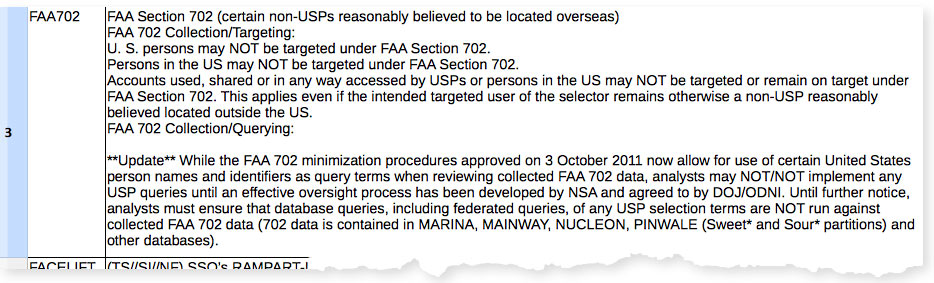
Detail of Section 702 of the Fisa Amendments Act (FAA), which gives the NSA authority to target without warrant the communications of foreign targets.

The National Security Agency has a secret backdoor into its vast databases under a legal authority enabling it to search for US citizens' email and phone calls without a warrant, according to a top-secret document passed to the Guardian by Edward Snowden.

The previously undisclosed rule change allows NSA operatives to hunt for individual Americans' communications using their name or other identifying information. Senator Ron Wyden told the Guardian the NSA's authorities provide loopholes that allow "warrantless searches for the phone calls or emails of law-abiding Americans".

The authority, approved in 2011, appears to contrast with repeated assurances from Barack Obama and senior intelligence officials to both Congress and the American public that the privacy of US citizens is protected from the NSA's dragnet surveillance programs.

The intelligence data is being gathered under Section 702 of the of the Fisa Amendments Act (FAA), which gives the NSA authority to target without warrant the communications of foreign targets, who must be non-US citizens and outside the US at the point of collection.

The communications of Americans in direct contact with foreign targets can also be collected without a warrant, and the intelligence agencies acknowledge that purely domestic communications can also be inadvertently swept into its databases. That process is known as "incidental collection" in surveillance parlance.

But this is the first evidence that the NSA has permission to search those databases for specific US individuals' communications.

A secret glossary document provided to operatives in the NSA's Special Source Operations division – which runs the Prism program and large-scale cable intercepts through corporate partnerships with technology companies – details an update to the "minimization" procedures that govern how the agency must handle the communications of US persons. That group is defined as both American citizens and foreigners located in the US.

"While the FAA 702 minimization procedures approved on 3 October 2011 now allow for use of certain United States person names and identifiers as query terms when reviewing collected FAA 702 data," the glossary states, "analysts may NOT/NOT [not repeat not] implement any USP [US persons] queries until an effective oversight process has been developed by NSA and agreed to by DOJ/ODNI [Office of the Director of National Intelligence]."

The term "identifiers" is NSA jargon for information relating to an individual, such as telephone number, email address, IP address and username as well as their name.

The document – which is undated, though metadata suggests this version was last updated in June 2012 – does not say whether the oversight process it mentions has been established or whether any searches against US person names have taken place.

Wyden, an Oregon Democrat on the Senate intelligence committee, has obliquely warned for months that the NSA's retention of Americans' communications incidentally collected and its ability to search through it has been far more extensive than intelligence officials have stated publicly. Speaking this week, Wyden told the Guardian it amounts to a "backdoor search" through Americans' communications data.

"Section 702 was intended to give the government new authorities to collect the communications of individuals believed to be foreigners outside the US, but the intelligence community has been unable to tell Congress how many Americans have had their communications swept up in that collection," he said.

"Once Americans' communications are collected, a gap in the law that I call the 'back-door searches loophole' allows the government to potentially go through these communications and conduct warrantless searches for the phone calls or emails of law-abiding Americans."

Wyden, along with his intelligence committee colleague Mark Udall, have attempted repeatedly to warn publicly about the ability of the intelligence community to look at the communications of US citizens, but are limited by their obligation not to reveal highly classified information.

But in a letter they recently wrote to the NSA director, General Keith Alexander, the two senators warned that a fact sheet released by the NSA in the wake of the initial Prism revelations to reassure the American public about domestic surveillance was misleading.

In the letter, they warned that Americans' communications might be inadvertently collected and stored under Section 702, despite rules stating only data on foreigners should be collected and retained.

"[W]e note that this same fact sheet states that under Section 702, 'Any inadvertently acquired communication of or concerning a US person must be promptly destroyed if it is neither relevant to the authorised purpose nor evidence of a crime,'" they said.

"We believe that this statement is somewhat misleading, in that it implied the NSA has the ability to determine how many American communications it has collected under Section 702, or that the law does not allow the NSA to deliberately search for the records of particular Americans."

The foreign intelligence surveillance (Fisa) court issues approvals annually authorizing such operations, with specific rules on who can be targeted and what measures must be taken to minimize any details "inadvertently" collected on US persons.

Secret minimization procedures dating from 2009, published in June by the Guardian, revealed that the NSA could make use of any "inadvertently acquired" information on US persons under a defined range of circumstances, including if they held usable intelligence, information on criminal activity, threat of harm to people or property, are encrypted or are believed to contain any information relevant to cybersecurity.

At that stage, however, the rules did not appear to allow for searches of collected data relating to specific US persons.

Assurances from Obama and senior administration officials to the American public about the privacy of their communications have relied on the strict definition of what constitutes "targeting" while making no mention of the permission to search for US data within material that has already been collected.

The day after the Guardian revealed details of the NSA's Prism program, President Obama said: "Now, with respect to the internet and emails, this doesn't apply to US citizens and it doesn't apply to people living in the United States."

Speaking at a House hearing on 18 June this year, deputy attorney general James Cole told legislators "[T]here's a great deal of minimization procedures that are involved here, particularly concerning any of the acquisition of information that deals or comes from US persons.

"As I said, only targeting people outside the United States who are not US persons. But if we do acquire any information that relates to a US person, under limited criteria only can we keep it."

Dianne Feinstein, the California Democrat who chairs the Senate intelligence committee, said in June 2012 that she believed the intelligence agencies and the Justice Department were sufficiently mindful of Americans' privacy.

"The intelligence community is strictly prohibited from using Section 702 to target a US person, which must at all times be carried out pursuant to an individualized court order based upon probable cause," Feinstein stated in a report provided to the Senate record.

While there are several congressional proposals to constrain the NSA's bulk collection of Americans' phone records, there has to date been much less legislative appetite to abridge its powers under Section 702 – as lawmakers are satisfied it doesn't sufficiently violate Americans' privacy.

"702 is focused outside the United States at non-citizens," said Adam Schiff, a member of the House intelligence committee. "The evidence of the effectiveness of 702 is much more substantial than 215 [the bulk phone records collection]. So I think there are fewer fourth amendment concerns and more evidence of the saliency of the program."

Wyden and Udall – both of whom say foreign surveillance conducted under Section 702 has legitimate value for US national security – have tried and failed to restrict the NSA's ability to collect and store Americans' communications that it accidentally acquires.

Wyden told the Guardian that he raised concerns about the loophole with President Obama during an August 1 meeting with legislators about the NSA's surveillance powers.

"I believe that Congress should reform Section 702 to provide better protections for Americans' privacy, and that this could be done without losing the value that this collection provides," he said.

The Guardian put the latest revelations to the NSA and the Office of the Director of National Intelligence but no response had been received by the time of publication.
 
In case you guys hadn't heard, President Better Than Us is appointing a task force to review the all the bullshit that's been going on in NSA fantasy land. His choice to head said force? James Clapper. That's right, the same James Clapper, Director of National Intelligence, and noted liar-in front of-Congress
http://www.theverge.com/2013/8/12/4...a-james-clapper-dni-surveillance-review-group

President Obama orders intelligence chief accused of lying to Congress to lead NSA review
By T.C. Sottek on August 12, 2013 04:13 pm

When President Obama announced a series of intelligence reforms last Friday he called for the creation of an independent advisory group made up of "outside experts" who will review controversial surveillance programs. But based on a memorandum issued today by the White House, it's not clear how independent the effort will be. The president has directed the Director of National Intelligence, James Clapper, to establish the "review group" that will be responsible for issuing a report about how surveillance programs "impact our security, our privacy, and our foreign policy." The review group is intended in part, as the president said last week, to "maintain the trust of the people" — so why did the president put a man at the center of the spying controversy in charge?

While Clapper may be technically well-suited to direct a review group given the intelligence community's unique need for secrecy, it may be difficult to sell the process to the American people with current skepticism about his accountability. Earlier this month, lawmakers concerned with the government's broad surveillance efforts said that Clapper should resign for lying to Congress. "[Clapper] was here in March and unambiguously lied to Congress," Rep. Thomas Massie (R, KY) told Democracy Now. "And I believe he was under oath. And it really sets a bad precedent for the whole organization to let him keep his post." Several other lawmakers including Rep. Justin Amash (R, MI), who led a charge to curb the NSA's telephone surveillance program, echoed the call for Clapper's resignation.

Tech titans may be involved, but the review group is still largely a mystery

There's still a lot we don't know about the review group, including the process for appointing members and who those members might be. President Obama and Director Clapper may solicit advice from notable figures in the technology industry; the president reportedly met with several leaders last Thursday, including Apple CEO Tim Cook and Google VP Vint Cerf. But with both Apple and Google implicated in some level of cooperation with the government under PRISM, the government may need to solicit input from a broader coalition of stakeholders. President Obama suggested the government may tap such a coalition last Friday, noting that "it makes sense for us to go ahead, lay out exactly what we're doing, have a discussion with Congress, have a discussion with industry... have a discussion with civil libertarians, and see if we can do this better."

Regardless of who is selected to participate in the program, the results may not become part of the public debate. Last week, President Obama merely suggested that more details about government surveillance may be publicly disclosed. Furthermore, the review group will not directly report to the public or to the president; the memorandum notes that the president will be briefed on both the interim report and the final report and recommendations through Director Clapper.
 
And, like clockwork, Ian Welsh is here to echo my thoughts on this bullshit:

http://www.ianwelsh.net/the-beauty-of-obamas-clapper-appointment/

The Beauty of Obama’s Clapper Appointment
2013 August 13
by Ian Welsh

As you’ve probably heard, Obama has appointed James Clapper (the man who lied under oath to Congress about NSA spying) to review NSA spying.

I am in awe, few things have impressed me this deeply.

This isn’t just a middle finger to everyone to everyone who is against blanket surveillance (aka. the majority of Americans), it is Obama saying “Kiss My Ass.”

It’s really hard for most people to understand just how much contempt our lords and masters have for us. They really don’t give a fuck what’s good for us, what we like, or what we think. They are rich, or powerful, or famous because they deserve it, and if we aren’t any of those things then they don’t give two fucks what we think. By not being rich, powerful or famous we have proven we don’t deserve any say. After all, if we had any qualities that were worthwhile beyond the sort of qualities you praise in a dog, we wouldn’t be peons, would we.

In this, Obama is very similar to Bush, actually, but in general it’s a characteristic of everyone near the top of our current society. Starting at about the Senior VP level, people decide that they deserve everything they’ve got and everyone else doesn’t. If they did, they’d have it.

The media is full of studies showing that power decreases empathy, and I’ll bet that’s true throughout history. But I’ll also bet this, the degree to which it is true is social, and in many times and places it has been less true. Over the last couple generations we’ve seen a significant, measurable fall in the general level of empathy in the population as a whole. If you have an ideology which glorifies greed and which claims that society is a meritocracy when there is copious evidence to the contrary, those who win will believe they “deserve” what they have, and everyone else “deserves” what they have. Add to that objective circumstances which amount to dog-eat-dop (there simply are not enough good jobs to go around) and people will either band together, or turn on each other. Generally, we’ve chosen, for ideological reasons, to turn on each other.

This isn’t necessary: it isn’t what happened in the US in the Great Depression, for example. It’s a choice, and our choice is to be bastards to each other.
 
We have some real first class assholes in charge of things.

Hold that thought...

http://www.newrepublic.com/article/114276/obama-surveillance-comments-dishonesty-isnt-only-problem
The Lies Aren't What Makes Obama's NSA Stance So Awful
President Obama’s repeated comments that “there is no spying on Americans” and that “we don’t have a domestic spying program,” as he told Jay Leno, were contradicted by two revelations at the end of last week. On Thursday, the New York Times reported that the NSA is "searching the contents of vast amounts of Americans' e-mail and text communications into and out of the country,” looking not only for Americans who communicate with foreigners under surveillance but also for those who mention information about them. On Friday, The Guardian reported that the NSA has a previously secret backdoor allowing it to query the names of American citizens in the course of searching phone calls and emails collected about foreign targets.

These revelations led news outlets like the Huffington Post and others to ask: “Did Obama lie on national television?” And it’s certainly true that the evasive language the administration uses to describe what it’s doing is increasingly corrosive. The administration feels it can’t reveal the details about its surveillance program, so it uses funny language and then gets caught “lying,” creating an atmosphere of dishonesty and distrust. Obama’s Clintonian equivocations have made this the administration of what James Clapper called the “least untruthful answer,” and that seems troubling.

But another, less noticed document released last week shows that there is a difference between the equivocations of Clinton and Obama. Clinton, in parsing the meaning of “is,” was acting like a too-clever lawyer, splitting legal hairs to craft the tightest possible legal defense. The Obama administration’s 22-page White paper setting out the supposed legal basis for NSA surveillance demonstrates that the Obama administration, by contrast, is not relying on legal defenses that are too clever. Rather, it's relying on defenses that are too flimsy and weak. Many of these are warmed over versions of arguments that principled judges and officials rejected during the Bush administration, and that the Supreme Court is now being asked to reject once and for all.

Obama lamely redefines the word "relevance."

The White Paper, released on August 9, is surprisingly mostly in the lameness of its effort to justify what it calls “Bulk Collection of Telephony Metadata under Section 215 of the Patriot Act.” The core of the argument is an attempt to redefine the meaning of the word “relevance” beyond recognizing, just as the administration’s earlier, and equally flimsy, drone memos attempted to redefine the meaning of the word “imminence” in the context of responding to an imminent threat.

The key paragraph in the 22 page white paper occurs in a discussion of what Congress meant in section 215 of the Patriot Act, which authorizes the Foreign Intelligence Surveillance Court to issue an order for the "production of any tangible things (including books, records, papers, documents, and other items) for an investigation to obtain foreign intelligence information not concerning a United States person or to protect against international terrorism.” The Government’s application for an order must include “a statement of facts showing that there are reasonable grounds to believe that the tangible things sought are relevant to an authorized investigation.” In its white paper, the administration cites a series of cases involving the discovery of documents in “ordinary civil discovery and criminal and administrative investigations” and says the standard of relevance under Section 215 should be “at least as broad.” Then comes the crucial hedging paragraph:

To be sure, the cases that have been decided in these contexts do not involve collection of data on the scale at issue in the telephony metadata collection program, and the purpose for which information was sought in these cases was not as expansive in scope as a nationwide intelligence collection effort designed to identify terrorist threats. While these cases do not demonstrate that bulk collection of the type at issue here would routinely be permitted in civil discovery or a criminal or administrative investigation, they do show that the “relevance” standard affords considerable latitude, where necessary, and depending on the context, to collect a large volume of data in order to find the key bits of information contained within.

This “to be sure” is one for the ages. Far from authorizing the warrantless fishing expeditions into millions of records, Congress in amending Section 215 meant explicitly to forbid what the Justice Department now seeks to justify. As the Electronic Privacy Information Center notes in a brief filed last week with the Supreme Court, both Congressional supporters and opponents of Section 215 explicitly interpreted the “relevance” language to limit bulk collection of data, not to permit it. On July 17, during a House judiciary committee hearing, Representative James Sensenbrenner, the author of section 215, said that Congress amended the law in 2006 to impose the relevance requirement in “an attempt to limit what the intelligence community could be able to get pursuant to Section 215.” And during the debate over the 2006 amendments, Sen. Ron Wyden and others stressed that the relevance standard would address “concerns about government ‘fishing expeditions.’”

Moreover, as the EPIC brief makes clear the government’s claim that all telephone metadata on all U.S. persons is “relevant to authorized investigation” is simply not credible because it eliminates the relevance standard in two ways. First, it applies the relevance requirement only after data are collected, not before, allowing the mass collection that Congress meant to forbid. Second, it makes the remarkable claim that all telephone metadata is relevant under Section 215 because somewhere within that vast dataset there may be individual data elements that are, in fact, relevant.” In other words, the government argues that the FISC can authorize the collection of data from hundreds of billions of Verizon calls, even though “only a small portion of the data that is collected is ever actually reviewed, because the vast majority of that data is never going to be responsive to one of these terrorism- related queries.”

As the EPIC brief makes clear, the government’s practice of collecting data on hundreds of billions of calls each year and then later, unilaterally, deciding what is actually relevant (fewer than 300 last year) is not permitted by section 215. Moreover, given the scope of material covered by section 215, if it were permitted, it would allow the government to sweep up almost any data on the basis that some of it might prove relevant later. For example, the argument, if accepted, would allow the government to seize billions of medical records or book or library records without a warrant—the textbook definition of an unconstitutional fishing expedition. The White Paper’s attempt to disavow this possibility boils down to: trust us. Here is the legalese: “This conclusion does not mean that the scope of Section 215 is boundless and authorizes the FISC to order the production of every type of business record in bulk—including medical records or library or book sale records, for example,” the White Paper notes. “Although there could be individual contexts in which the Government has an interest in obtaining medical records or library records for counterterrorism purposes, these categories of data are not in general comparable to communications metadata as a means of identifying previously unknown terrorist operatives or networks.” In other words, we don’t think bulk collection of medical records is necessary to stop terrorism, but if we did, we could collect it.

It is not only the words “relevance” and “imminence” that the Obama administration has redefined beyond recognition. Now it has turned its sites to the word “targeted.” The administration has claimed repeatedly that “we do not target the content of U.S. person communications without a specific warrant anywhere on the earth,” as the Deputy Director of the NSA told Congress in June. But as Charles Savage reported in the Times, the administration has now introduced a secret rule arguing that if the target is a foreign communication, bulk communications of U.S. citizens tangentially associated with the target are permissible, and individual names of U.S. citizens may be queried as long as the communications aren’t stored. The legal analysis justifying this twisting of the Foreign Intelligence Surveillance law, according to Savage, echoes still secret reasoning first introduced in 2008 by the Bush administration to justify to real time scanning of communications for malicious computer codes.

Until the administration issues the legal memos justifying its latest contortions of Foreign Intelligence Surveillance law, it’s impossible to make a firm judgment about just how elastic the arguments are. But as the belated release of the drone and Section 215 memos show, once the administration’s legal arguments are exposed to light, they are underwhelming and unconvincing. In other words, it’s not the secret nature of the programs that requires the president to tie himself in knots by giving the “least untruthful answer.” It’s the flimsiness of the legal arguments on which he is relying to justify his actions.​
 
Does this warrant a collective 'our bad' from the NSA? I doubt it, especially as these "errors" can keep our data in their systems forever. Really great piece, but its a long read. Totally worth it though:

http://www.washingtonpost.com/world...10e554-05ca-11e3-a07f-49ddc7417125_story.html
NSA broke privacy rules thousands of times per year, audit finds
  • by Barton Gellman
  • Aug. 15, 2013

The National Security Agency has broken privacy rules or overstepped its legal authority thousands of times each year since Congress granted the agency broad new powers in 2008, according to an internal audit and other top-secret documents.

Most of the infractions involve unauthorized surveillance of Americans or foreign intelligence targets in the United States, both of which are restricted by statute and executive order. They range from significant violations of law to typographical errors that resulted in unintended interception of U.S. e-mails and telephone calls.

The documents, provided earlier this summer to The Washington Post by former NSA contractor Edward Snowden, include a level of detail and analysis that is not routinely shared with Congress or the special court that oversees surveillance. In one of the documents, agency personnel are instructed to remove details and substitute more generic language in reports to the Justice Department and the Office of the Director of National Intelligence.

In one instance, the NSA decided that it need not report the unintended surveillance of Americans. A notable example in 2008 was the interception of a “large number” of calls placed from Washington when a programming error confused the U.S. area code 202 for 20, the international dialing code for Egypt, according to a “quality assurance” review that was not distributed to the NSA’s oversight staff.

In another case, the Foreign Intelligence Surveillance Court, which has authority over some NSA operations, did not learn about a new collection method until it had been in operation for many months. The court ruled it unconstitutional.

[FISA judge: Ability to police U.S. spying program is limited]

The Obama administration has provided almost no public information about the NSA’s compliance record. In June, after promising to explain the NSA’s record in “as transparent a way as we possibly can,” Deputy Attorney General James Cole described extensive safeguards and oversight that keep the agency in check. “Every now and then, there may be a mistake,” Cole said in congressional testimony.

The NSA audit obtained by The Post, dated May 2012, counted 2,776 incidents in the preceding 12 months of unauthorized collection, storage, access to or distribution of legally protected communications. Most were unintended. Many involved failures of due diligence or violations of standard operating procedure. The most serious incidents included a violation of a court order and unauthorized use of data about more than 3,000 Americans and green-card holders.

In a statement in response to questions for this article, the NSA said it attempts to identify problems “at the earliest possible moment, implement mitigation measures wherever possible, and drive the numbers down.” The government was made aware of The Post’s intention to publish the documents that accompany this article online.

“We’re a human-run agency operating in a complex environment with a number of different regulatory regimes, so at times we find ourselves on the wrong side of the line,” a senior NSA official said in an interview, speaking with White House permission on the condition of anonymity.

“You can look at it as a percentage of our total activity that occurs each day,” he said. “You look at a number in absolute terms that looks big, and when you look at it in relative terms, it looks a little different.”

There is no reliable way to calculate from the number of recorded compliance issues how many Americans have had their communications improperly collected, stored or distributed by the NSA.

The causes and severity of NSA infractions vary widely. One in 10 incidents is attributed to a typographical error in which an analyst enters an incorrect query and retrieves data about U.S phone calls or e-mails.

But the more serious lapses include unauthorized access to intercepted communications, the distribution of protected content and the use of automated systems without built-in safeguards to prevent unlawful surveillance.

The May 2012 audit, intended for the agency’s top leaders, counts only incidents at NSA’s Fort Meade headquarters and other facilities in the Washington area. Three government officials, speaking on the condition of anonymity to discuss classified matters, said the number would be substantially higher if it included other NSA operating units and regional collection centers.

Senate Intelligence Committee Chairman Dianne Feinstein (D-Calif.), who did not receive a copy of the 2012 audit until The Post asked her staff about it, said in a statement late Thursday that the committee “can and should do more to independently verify that NSA’s operations are appropriate, and its reports of compliance incidents are accurate.”

Despite the quadrupling of NSA’s oversight staff after a series of significant violations in 2009, the rate of infractions increased throughout 2011 and early 2012. An NSA spokesman declined to disclose whether the trend has continued since last year.

One major problem is largely unpreventable, the audit says, because current operations rely on technology that cannot quickly determine whether a foreign mobile phone has entered the United States.

In what appears to be one of the most serious violations, the NSA diverted large volumes of international data passing through fiber-optic cables in the United States into a repository where the material could be stored temporarily for processing and selection.

The operation to obtain what the agency called “multiple communications transactions” collected and commingled U.S. and foreign e-mails, according to an article in SSO News, a top-secret internal newsletter of the NSA’s Special Source Operations unit. NSA lawyers told the court that the agency could not practicably filter out the communications of Americans.

In October 2011, months after the program got underway, the Foreign Intelligence Surveillance Court ruled that the collection effort was unconstitutional. The court said that the methods used were “deficient on statutory and constitutional grounds,” according to a top-secret summary of the opinion, and it ordered the NSA to comply with standard privacy protections or stop the program.

James R. Clapper Jr., the director of national intelligence, has acknowledged that the court found the NSA in breach of the Fourth Amendment, which prohibits unreasonable searches and seizures, but the Obama administration has fought a Freedom of Information lawsuit that seeks the opinion.

Generally, the NSA reveals nothing in public about its errors and infractions. The unclassified versions of the administration’s semi-annual reports to Congress feature blacked-out pages under the headline, “Statistical Data Relating to Compliance Incidents.”

Members of Congress may read the unredacted documents, but only in a special secure room and are not allowed to take notes. Fewer than 10 percent of lawmakers employ a staff member who has the security clearance to read the reports and provide advice about their meaning and significance.

The limited portions of the reports that can be read by the public acknowledge “a small number of compliance incidents.”

Under NSA auditing guidelines, the incident count does not usually disclose the number of Americans affected.

“What you really want to know, I would think, is how many innocent U.S. person communications are, one, collected at all, and two, subject to scrutiny,” said Julian Sanchez, a research scholar and close student of the NSA at the Cato Institute.

The documents provided by Snowden offer only glimpses of those questions. Some reports make clear that an unauthorized search produced no records. But a single “incident” in February 2012 involved the unlawful retention of 3,032 files that the surveillance court had ordered the NSA to destroy, according to the May 2012 audit. Each file contained an undisclosed number of telephone call records.

One of the documents sheds new light on a statement by NSA Director Keith B. Alexander last year that “we don’t hold data on U.S. citizens.”

Some Obama administration officials, speaking on the condition of anonymity, have defended Alexander with assertions that the agency’s internal definition of “data” does not cover “metadata” such as the trillions of American call records that the NSA is now known to have collected and stored since 2006. Those records include the telephone numbers of the parties and the times and durations of conversations, among other details, but not their content or the names of callers.

The NSA’s authoritative definition of data includes those call records. “Signals Intelligence Management Directive 421,” which is quoted in secret oversight and auditing guidelines, states that “raw SIGINT data . . . includes, but is not limited to, unevaluated and/or unminimized transcripts, gists, facsimiles, telex, voice, and some forms of computer-generated data, such as call event records and other Digital Network Intelligence (DNI) metadata as well as DNI message text.”

In the case of the collection effort that confused calls placed from Washington with those placed from Egypt, it is unclear what the NSA meant by a “large number” of intercepted calls. A spokesman declined to discuss the matter.

The NSA has different reporting requirements for each branch of government and each of its legal authorities. The “202” collection was deemed irrelevant to any of them. “The issue pertained to Metadata ONLY so there were no defects to report,” according to the author of the secret memo from March 2013.

The large number of database query incidents, which involve previously collected communications, confirms long-standing suspicions that the NSA’s vast data banks — with code names such as MARINA, PINWALE and XKEYSCORE — house a considerable volume of information about Americans. Ordinarily the identities of people in the United States are masked, but intelligence “customers” may request unmasking, either one case at a time or in standing orders.

In dozens of cases, NSA personnel made careless use of the agency’s extraordinary powers, according to individual auditing reports. One team of analysts in Hawaii, for example, asked a system called DISHFIRE to find any communications that mentioned both the Swedish manufacturer Ericsson and “radio” or “radar” — a query that could just as easily have collected on people in the United States as on their Pakistani military target.

The NSA uses the term “incidental” when it sweeps up the records of an American while targeting a foreigner or a U.S. person who is believed to be involved in terrorism. Official guidelines for NSA personnel say that kind of incident, pervasive under current practices, “does not constitute a . . . violation” and “does not have to be reported” to the NSA inspector general for inclusion in quarterly reports to Congress. Once added to its databases, absent other restrictions, the communications of Americans may be searched freely.

In one required tutorial, NSA collectors and analysts are taught to fill out oversight forms without giving “extraneous information” to “our FAA overseers.” FAA is a reference to the FISA Amendments Act of 2008, which granted broad new authorities to the NSA in exchange for regular audits from the Justice Department and the office of the Director of National Intelligence and periodic reports to Congress and the surveillance court.

Using real-world examples, the “Target Analyst Rationale Instructions” explain how NSA employees should strip out details and substitute generic descriptions of the evidence and analysis behind their targeting choices.

“I realize you can read those words a certain way,” said the high-ranking NSA official who spoke with White House authority, but the instructions were not intended to withhold information from auditors. “Think of a book of individual recipes,” he said. Each target “has a short, concise description,” but that is “not a substitute for the full recipe that follows, which our overseers also have access to.”

Julie Tate and Carol D. Leonnig contributed to this report.

Share/export
Did this article display correctly? Yes No

Font & Color

Column Width

Text Size

Send to Kindle
Your Kindle is not set up yet.

Kindle setup…
What did we miss?
  • Title incorrect or missing
  • Author incorrect or missing
  • Date incorrect or missing
  • Article images incorrect or missing
  • Article content incorrect or missing
  • Article pages repeated or missing
  • Other
Other details:
 
You know that 'magic' court that's supposed to oversee everything? Yeah, they don't know what the fuck is going on either:

http://www.washingtonpost.com/polit...8c8c44-05cd-11e3-a07f-49ddc7417125_story.html
Court: Ability to police U.S. spying program limited
  • by Carol D. Leonnig
  • Aug. 15, 2013

The leader of the secret court that is supposed to provide critical oversight of the government’s vast spying programs said that its ability do so is limited and that it must trust the government to report when it improperly spies on Americans.

The chief judge of the Foreign Intelligence Surveillance Court said the court lacks the tools to independently verify how often the government’s surveillance breaks the court's rules that aim to protect Americans’ privacy. Without taking drastic steps, it also cannot check the veracity of the government’s assertions that the violations its staff members report are unintentional mistakes.

“The FISC is forced to rely upon the accuracy of the information that is provided to the Court,” its chief, U.S. District Judge Reggie Walton, said in a written statement to The Washington Post. “The FISC does not have the capacity to investigate issues of noncompliance, and in that respect the FISC is in the same position as any other court when it comes to enforcing [government] compliance with its orders.”

Walton’s comments came in response to internal government records obtained by The Post showing that National Security Agency staff members in Washington overstepped their authority on spy programs thousands of times per year. The records also show that the number of violations has been on the rise.

The court’s description of its practical limitations contrasts with repeated assurances from the Obama administration and intelligence agency leaders that the court provides central checks and balances on the government’s broad spying efforts. They have said that Americans should feel comfortable that the secret intelligence court provides robust oversight of government surveillance and protects their privacy from rogue intrusions.

President Obama and other government leaders have emphasized the court’s oversight role in the wake of revelations this year that the government is vacuuming up “metadata” on Americans’ telephone and Internet communications.

“We also have federal judges that we’ve put in place who are not subject to political pressure,” Obama said at a news conference in June. “They’ve got lifetime tenure as federal judges, and they’re empowered to look over our shoulder at the executive branch to make sure that these programs aren’t being abused.”

Privacy advocates and others in government have voiced concerns about the ability of overseers to police secret programs of immense legal and technological complexity. Several members of the House and Senate intelligence committees told The Post last week that they face numerous obstacles and constraints in questioning spy agency officials about their work.

In 2009, for example, a Justice Department review uncovered a major operational glitch that had led to a series of significant violations of the court’s order and notified the court, according to records that were declassified July 31 by the Office of the Director of National Intelligence.

The government described the problem as one of “over-collection” of metadata records for U.S. phone calls.

In September 2009, NSA Director Keith B. Alexander made a presentation to the FISA court about the agency’s effort to remedy the problem.

“FISA Court placed several restrictions on aspects of the business records collection program until the compliance processes were improved to its satisfaction,” the memo stated.

The public summaries of the violations do not say how long the problem went undetected and unreported to the court, or what information was improperly gathered by the agency’s automated collection systems.

“The problems generally involved the implementation of highly sophisticated technology in a complex and ever-changing communications environment which, in some instances, results in the automated tools operating in a manner that was not completely consistent with the specific terms of the Court’s orders,” according to unredacted portions of a December 2009 memo provided to the Senate and House intelligence committees.

Two people familiar with the 2009 flaw said that the agency was collecting more “fields” of information from the customer records of telephone companies than the court had approved. The NSA declined to answer questions about the event.

One senior intelligence official, who was authorized by the White House to speak on the condition of anonymity, described the 2009 incident as a “major event” that prompted the agency to dramatically increase its compliance staff.

“We uncovered some disconnects between us and our overseers, disconnects between what we had put in documentation, the way we had described things in documentation,” the official said.

Although the violation was unintentional, the official said, “it wasn’t always the easiest of discussions” with the court.

The agency paused, “got ourselves with our overseers back into fair territory,” and has since made “substantial improvement” in compliance, the official said.

Privacy advocates say they fear that some violations are never reported to the court.

In January 2008, the NSA appeared to have mistakenly collected data on numerous phone calls from the Washington area code 202, thinking they were foreign phone calls from Egypt, whose country code is 20. According to a 2013 “quality assurance” review of the incident, a communications switch misread the coding of the calls and presumed they were international. The NSA has broad authority that is not subject to the FISA court to collect and monitor foreign communications under certain circumstances.

The description of the 2008 problem suggests that the inadvertent collection of U.S. phone calls was not reported to the FISA court.

“[H]owever, the issue pertained to Metadata ONLY so there were no defects to report,” the review stated.

Under FISA rules, the government is required to immediately notify the court if it believes it has violated any of its orders on surveillance. The government does not typically provide the court with case-specific detail about individual compliance cases, such as the names of people it later learned it was improperly searching in its massive phone or e-mail databases, according to two people familiar with the court’s work.

Unlike the dozens of staff available to Congress’s intelligence and judiciary committees, the FISA court has five lawyers to review compliance violation reports.

A staff lawyer can elevate a concern about a significant compliance issue to a judge on the court, according to a letter Walton recently sent to the Senate describing the court’s role.

The court can always demand and obtain more details about cases, but it is unclear how often that occurs. In the past, while grappling with rules for implementing the surveillance programs, judges on the court have requested a visit to NSA headquarters to inspect the operations, the officials said.

Last week, the president said that he recognizes that some Americans may lack trust in the oversight process — in which the secret court approves the rules for collecting Americans’ communications — and that he will work with Congress on reforms, which could include a privacy advocate to the court.

“In other words, it’s not enough for me as president to have confidence in these programs,” Obama said in his news conference. “The American people need to have confidence in them, as well. “

Barton Gellman, Peter Wallsten and Alice Crites contributed to this report.
 
Seems that Ed Snowden had access to this shit while he was at Dell!
http://www.reuters.com/article/2013/08/15/us-usa-security-snowden-dell-idUSBRE97E17P20130815
Snowden downloaded NSA secrets while working for Dell, sources say

By Mark Hosenball

WASHINGTON | Thu Aug 15, 2013 6:14pm EDT

(Reuters) - Former intelligence contractor Edward Snowden began downloading documents describing the U.S. government's electronic spying programs while he was working for Dell Inc in April 2012, almost a year earlier than previously reported, according to U.S. officials and other sources familiar with the matter.

Snowden, who was granted a year's asylum by Russia on August 1, worked for Dell from 2009 until earlier this year, assigned as a contractor to U.S. National Security Agency facilities in the United States and Japan.

Snowden downloaded information while employed by Dell about eavesdropping programs run by the NSA and Britain's Government Communications Headquarters, and left an electronic footprint indicating when he accessed the documents, said the sources, speaking on condition of anonymity.

David Frink, a spokesman for Round Rock, Texas-based Dell, declined to comment on any aspect of Snowden's employment with the company, saying Dell's "customer" - presumably the NSA - had asked Dell not to talk publicly about him.

Since Snowden disclosed documents on previously secret U.S. internet and phone surveillance programs in June, his three-month tenure with U.S. contractor Booz Allen Hamilton Holding Corp starting in late March of this year has been the focus of considerable attention. His time at Dell has received little attention.

Lawmakers have questioned how a relatively low-level systems administrator was able to gain access to so many top-secret documents without raising red flags. Some lawmakers have called the leaks one of the worst security breaches in U.S. history.

News that Snowden was downloading documents while he worked at Dell could increase pressure on U.S. intelligence agencies to tighten security protocols to prevent future leaks. The NSA has said it would tighten access to classified material and put in place stricter controls for accessing and downloading such information.

TRANSOCEANIC CABLES

Some of the material Snowden downloaded in April 2012 while a Dell employee related to NSA collection from fiber-optic cables, including transoceanic cables, of large quantities of internet traffic and other communications, the sources said.

Snowden has said he left Dell for a job at Booz Allen Hamilton in Hawaii around March of this year, specifically to gain access to additional top-secret documents that could be leaked to the media.

Booz Allen Hamilton fired Snowden after he fled to Hong Kong with a trove of secret material. The company has said it is cooperating with a number of inquiries into Snowden's hiring and security lapses.

It is not clear whether Dell has taken similar steps.

"We are honoring our customer's request that we not comment on this matter," said Frink, the Dell spokesman.

Two U.S. officials said the investigations into Snowden's activities confirmed that his downloading of sensitive information began at Dell. He is believed to have moved from Dell to Booz Allen with little time off in between.

In February 2010, while working for Dell, Snowden wrote in an internet technology forum, Ars Technica, that he was bothered by technology companies allegedly giving the U.S. government access to private computer servers.

"It really concerns me how little this sort of corporate behavior bothers those outside of technology circles," Snowden wrote under the screen name "The True HooHA." "Society really seems to have developed an unquestioning obedience towards spooky types.

In addition to a Justice Department investigation, which has produced criminal charges against Snowden, U.S. intelligence agencies are conducting an extensive inquiry to determine precisely what documents Snowden had access to, what he downloaded and how much damage his actions have caused.
 
Quick recap on all that oversight we've been hearing about:
http://www.emptywheel.net/2013/08/15/all-three-branches-conduct-vaunted-nsa-oversight/
All Three Branches Conduct Vaunted NSA Oversight!
  • by emptywheel
  • Aug. 15, 2013
Today, we learned this is what the vaunted Congressional oversight of NSA spying looks like.

Senate Intelligence Committee Chairman Dianne Feinstein (D-Calif.), who did not receive a copy of the 2012 audit [showing thousands of violations] until The Post asked her staff about it, said in a statement late Thursday that the committee “can and should do more to independently verify that NSA’s operations are appropriate, and its reports of compliance incidents are accurate.”

We learned this is what the vaunted FISA Court oversight of NSA spying looks like.

The chief judge of the Foreign Intelligence Surveillance Court said the court lacks the tools to independently verify how often the government’s surveillance breaks the court’s rules that aim to protect Americans’ privacy. Without taking drastic steps, it also cannot check the veracity of the government’s assertions that the violations its staff members report are unintentional mistakes.

“The FISC is forced to rely upon the accuracy of the information that is provided to the Court,” its chief, U.S. District Judge Reggie Walton, said in a written statement to The Washington Post. “The FISC does not have the capacity to investigate issues of noncompliance, and in that respect the FISC is in the same position as any other court when it comes to enforcing [government] compliance with its orders.”

We learned this is what the vaunted internal NSA oversight of NSA spying looks like.

The NSA uses the term “incidental” when it sweeps up the records of an American while targeting a foreigner or a U.S. person who is believed to be involved in terrorism. Official guidelines for NSA personnel say that kind of incident, pervasive under current practices, “does not constitute a . . . violation” and “does not have to be reported” to the NSA inspector general for inclusion in quarterly reports to Congress. Once added to its databases, absent other restrictions, the communications of Americans may be searched freely.

In one required tutorial, NSA collectors and analysts are taught to fill out oversight forms without giving “extraneous information” to “our FAA overseers.” FAA is a reference to the FISA Amendments Act of 2008, which granted broad new authorities to the NSA in exchange for regular audits from the Justice Department and the office of the Director of National Intelligence and periodic reports to Congress and the surveillance court.

Using real-world examples, the “Target Analyst Rationale Instructions” explain how NSA employees should strip out details and substitute generic descriptions of the evidence and analysis behind their targeting choices.

Vaunted. For well over 2 months. This is what they’ve been hailing.
​
 
http://www.theguardian.com/world/2013/aug/16/nsa-revelations-privacy-breaches-udall-wyden
NSA revelations of privacy breaches 'the tip of the iceberg' – Senate duo
  • by Spencer Ackerman
  • Aug. 16, 2013

Two US senators on the intelligence committee said on Friday that thousands of annual violations by the National Security Agency on its own restrictions were "the tip of the iceberg."

"The executive branch has now confirmed that the rules, regulations and court-imposed standards for protecting the privacy of Americans' have been violated thousands of times each year," said senators Ron Wyden and Mark Udall, two leading critics of bulk surveillance, who responded Friday to a Washington Post story based on documents provided by whistleblower Edward Snowden.

"We have previously said that the violations of these laws and rules were more serious than had been acknowledged, and we believe Americans should know that this confirmation is just the tip of a larger iceberg."

On July 31, Wyden, backed by Udall, vaguely warned other senators in a floor speech that the NSA and the director of national intelligence were substantively misleading legislators by describing improperly collected data as a matter of innocent and anodyne human or technical errors.

In keeping with their typically cautious pattern when discussing classified information, Wyden and Udall did not provide details about their claimed "iceberg" of surveillance malfeasance. But they hinted that the public still lacks an adequate understanding of the NSA's powers to collect data on Americans under its controversial interpretation of the Patriot Act.

"We believe the public deserves to know more about the violations of the secret court orders that have authorized the bulk collection of Americans' phone and email records under the Patriot Act," Wyden and Udall said.

"The public should also be told more about why the Fisa court has said that the executive branch's implementation of section 702 of the Foreign Intelligence Surveillance Act has circumvented the spirit of the law, particularly since the executive branch has declined to address this concern."

In October 2011, the Fisa court secretly ruled that an NSA collection effort violated the fourth amendment, a fact first disclosed last year by Wyden. The Post disclosed the effort involved diverting international communications via fiberoptic cables inside the US into a "repository."

Shortly before Wyden and Udall hinted at even broader NSA violations of its surveillance authorities, the chairwoman of the Senate intelligence committee came to the NSA's defense.

Senator Dianne Feinstein, a California Democrat, said the majority of "compliance incidents" are "unintentional and do not involve any inappropriate surveillance of Americans."

"The large majority of NSA's so-called 'compliance incidents' are called 'roaming' incidents, in which the NSA is collecting the phone or electronic communications of a non-American outside the United States, and that person then enters the United States," Feinstein said.

"The NSA generally won't know that the person has traveled to the United States. As the laws and rules governing NSA surveillance require different procedures once someone enters the U.S.—generally to require a specific FISA court order—NSA will cite this as a 'compliance incident,' and either cease the surveillance or obtain the required FISA court order."

Feinstein's counterpart in the House of Representatives, Mike Rogers of Michigan, issued a similar defense of the NSA.

"The disclosed documents demonstrate that there was no intentional and willful violation of the law and that the NSA is not collecting the email and telephone traffic of all Americans, as previously reported," Rogers said.

"Congress and the court have put in place auditing, reporting, and compliance requirements to help ensure that the executive branch, the Congress, and the court each have insight into how the authorities granted to the NSA are used. As a result, even the inadvertent and unintentional errors are documented.

"We demand these reviews so the NSA can constantly improve and correct any technical missteps that may impact Americans. The committee has been apprised of previous incidents, takes seriously each one, and uses the oversight and compliance regime to provide us insight into these operations and whether further adjustments must be made.

"The committee does not tolerate any intentional violation of the law. Human and technical errors, like all of the errors reported in this story, are unfortunately inevitable in any organization and especially in a highly technical and complicated system like NSA. The committee will continue to work with the executive branch to reduce these errors."

Feinstein also denied an aspect of the Post's reporting that claimed she was unaware of a 2012 NSA "compliance" report. Feinstein said that she received it in a different format.

But Feinstein also suggested that her committee does not have full visibility into the NSA's operations.

"The committee does not receive the same number of official reports on other NSA surveillance activities directed abroad that are conducted pursuant to legal authorities outside of Fisa (specifically executive order 12333), but I intend to add to the committee's focus on those activities."

Executive order 12333 is one of the foundational texts of modern US intelligence. A decades-old presidential order, it is an informal guide to the rules and regulations of American spycraft, such as the nominal ban on assassinations. It lacks the force of law in name if not in practice; lawyers in the intelligence agencies keep copies on their desks. "It is the Bible," said Vicki Divoll, a former legal counsel for the CIA and the Senate intelligence committee.

The Democratic leader of the House of Representatives, Nancy Pelosi, a former senior member of the House intelligence committee, criticized the NSA on Friday, saying reports that it had overstepped its boundaries "extremely disturbing."

"Congress must conduct rigorous oversight to ensure that all incidents of non-compliance are reported to the oversight committees and the FISA court in a timely and comprehensive manner, and that appropriate steps are taken to ensure violations are not repeated," Pelosi said.

Pelosi was one of very few legislators briefed about the expansions of NSA surveillance activities after 9/11. She became a vocal critic of them when they were partially exposed under the Bush administration, yet once Barack Obama took office, her criticism ceased. She and the rest of the Democratic leadership worked hard last month to quash a legislative effort to end the bulk collection of Americans' phone records.

The office of the director of national intelligence and the White House did not respond to a request for comment.
 
http://www.newyorker.com/online/blo...en-breaking-the-rules-thousands-of-times.html

Breaking the Rules Thousands of Times at the N.S.A.
  • by Amy Davidson
  • Aug. 16, 2013

What does the National Security Agency consider a small or a big number? The Washington Post’s Barton Gellman has a report based on documents the paper got from Edward Snowden about an N.S.A. audit that found two thousand seven hundred and seventy-six “incidents” in 2012 in which it broke its own rules about spying on Americans, either accidentally or on purpose. That is seven times a day, which sounds less like a slip than a ritual. But to call those violations frequent, according to the agency, would be to misunderstand the scale of its operations: “You can look at it as a percentage of our total activity that occurs each day,” a senior N.S.A. official told the paper. “You look at a number in absolute terms that looks big, and when you look at it in relative terms, it looks a little different.” We spy so much that the math gets hard; even thousands of privacy and legal violations can’t really be held against us.

But how many thousands? As it turns out, there are numbers packed into the numbers. An “incident” can have affected multiple people—even multitudes. In a single one of the two thousand seven hundred and seventy-six cases, someone at the N.S.A. made a mistake in entering a number into a search request. As a result, instead of intercepting phone calls for Egypt (country code 20) the agency collected “a large number” of calls in Washington, D.C. (area code 202). How many, and who listened? There are more Egyptians than there are Washingtonians, but the N.S.A.’s mandate forbids it from spying on Americans, and singling out an area as politicized as Washington seems particularly unfortunate. (Mistyping the country code for Iran could have left analysts looking at calls in North Carolina and Louisiana.) Another incident involved “the unlawful retention of 3,032 files that the surveillance court had ordered the NSA to destroy…. Each file contained an undisclosed number of telephone call records.” The Post said that it was not able to tell how many Americans were affected in all. Those two examples suggest that the number could be very, very big—even by the N.S.A.’s standards.

There are other ways the number multiplies. One incident involved someone the N.S.A. continued to target well after it confirmed that he had a green card, and was therefore off limits. There were four “selectors” associated with this person—these might be things like e-mail addresses or phone number—which led to requests for “881 cuts in NUCLEON,” a program that collects the contents of phone calls; thirty-two reports; and “serialized dissemination” of information to other parts of the government. There are many ways to get on a list; what seems hard is getting off of one.

The information spreads, and it contracts or is flattened: in a training document the Post published (in redacted form), analysts were told not to give their “overseers” any “extraneous information.” The rationale for a surveillance request should be “no longer than one short sentence”—and in particular that “your rationale MUST NOT contain any additional information including: probable cause-like information.” One fictional example in the training document involves a target named “Mohammad Badguy” whose name was found on the buddy list of his brother-in-law, who had some connection to Al Qaeda in Somalia. In the request, the part about being brothers-in-law is omitted: there is just selector, buddy list, Al Qaeda. Suspicion becomes an indexing label. Everyone is a Badguy.

The audit shows that the N.S.A. considered most of the incidents to be errors—“operator error” or “computer error.” There were a lot of typos; that’s darkly funny, if you’re in the right mood. But “error” is a bit of a dodge. It includes categories like “did not follow standard operating procedures”—by mistake?—“training issues” and “workload issues.” Also, too-broad search terms, like “any communications that mentioned both the Swedish manufacturer Ericsson and ‘radio’ or ‘radar’.” What that seems to mean is that a great deal of private American communications are swept into databases because the N.S.A. has people who work for it who don’t follow the rules, don’t know the rules, or are assigned tasks in a way that just leads to rules being broken. That is a structural scandal, not a mistake.

The agency does train its people not to talk too much about broken rules. (The 20-202 error was not reported to the FISA court or Congress, whose members likely had phones with that area code.) The documents make it clear that the agency was not telling the court or Congress even less than the little we thought it did. On Friday, Nancy Pelosi, the House Minority leader, called the new report “extremely disturbing”; in another piece, the Post’s Carol Leonnig spoke to the chief judge of the FISA court, Reggie Walton, who said that there wasn’t much he and the other judges could do other than rely on what the N.S.A. told them: the court “does not have the capacity to investigate issues of noncompliance.” The audit shows that the majority of these violations were caught thanks to automated alerts, and not because someone at the N.S.A. raised his or her hand. (The one who did, ultimately and emphatically, was Edward Snowden.) Is that because the alerts were so strict, or the humans so lax? Which number is wrong?
 
Wow, the British government just went off the deep end:

http://www.huffingtonpost.com/2013/...detained-david-miranda-airport_n_3776825.html

Glenn Greenwald's Partner Detained At UK Airport Under Terrorism Act


Glenn Greenwald's partner was detained by authorities at London's Heathrow airport for nearly nine hours, the Guardian reported on Sunday.

David Miranda, who lives with Greenwald in Brazil, was held under Britain's Terrorism Act. The paper said he was held for the maximum amount of time allowed under the law:

According to official figures, most examinations under schedule 7 – over 97% – last under an hour, and only one in 2,000 people detained are kept for more than six hours.
Miranda was then released without charge, but officials confiscated electronics equipment including his mobile phone, laptop, camera, memory sticks, DVDs and games consoles.

Miranda was coming from Berlin, where, the Guardian said, he had stayed with Laura Poitras, the filmmaker and journalist who, along with Greenwald, has been at the center of the storm surrounding NSA leaker Edward Snowden. Ironically, Poitras, whose work usually involves sensitive national security issues, re-located to Berlin from America because she had grown tired of being constantly detained and questioned at airports.

In a separate post, Greenwald said that Miranda had been questioned in detail about the work that he and Poitras were doing.

Britain is, of course, an extremely close ally of the United States, and the Guardian has published several major stories about the reach of its own intelligence service, GCHQ.

As one of the journalists most responsible for the revelations about the NSA's survaillance practices—and as someone in continuing contact with Snowden—Greenwald has become a target himself.

Republican congressman Peter King, for instance, called for his prosecution. Former NSA chief Michael Hayden said he was a "co-conspirator" with Snowden. NBC's David Gregory memorably asked him why he thought he shouldn't be charged with a crime.

In his blog post, Greenwald said that the detention would not deter him from continuing his reporting:

This is obviously a rather profound escalation of their attacks on the news-gathering process and journalism. It's bad enough to prosecute and imprison sources. It's worse still to imprison journalists who report the truth. But to start detaining the family members and loved ones of journalists is simply despotic. Even the Mafia had ethical rules against targeting the family members of people they feel threatened by. But the UK puppets and their owners in the US national security state obviously are unconstrained by even those minimal scruples.
If the UK and US governments believe that tactics like this are going to deter or intimidate us in any way from continuing to report aggressively on what these documents reveal, they are beyond deluded. If anything, it will have only the opposite effect: to embolden us even further. Beyond that, every time the US and UK governments show their true character to the world - when they prevent the Bolivian President's plane from flying safely home, when they threaten journalists with prosecution, when they engage in behavior like what they did today - all they do is helpfully underscore why it's so dangerous to allow them to exercise vast, unchecked spying power in the dark.

Journalist Choire Sicha summed up the general attitude of many on Twitter:

This is FUCKED UP. RT @janinegibson: Thankfully David is ok and on his way home but a very concerning incident. http://t.co/2zVVinQiGp

— Choire Sicha (@Choire) August 18, 2013​
 
Jesus, take a read at what the British Government is trying to pull with The Guardian. This is completely ridiculous:

http://www.theguardian.com/commentisfree/2013/aug/19/david-miranda-schedule7-danger-reporters

David Miranda, schedule 7 and the danger that all reporters now face
As the events in a Heathrow transit lounge – and the Guardian offices – have shown, the threat to journalism is real and growing

Alan Rusbridger The Guardian, Monday 19 August 2013 17.30 EDT

In a private viewing cinema in Soho last week I caught myself letting fly with a four-letter expletive at Bill Keller, the former executive editor of the New York Times. It was a confusing moment. The man who was pretending to be me – thanking Keller for "not giving a shit" – used to be Malcolm Tucker, a foul-mouthed Scottish spin doctor who will soon be a 1,000-year-old time lord. And Keller will correct me, but I don't remember ever swearing at him. I do remember saying something to the effect of "we have the thumb drive, you have the first amendment".

The fictional moment occurs at the beginning of the DreamWorks film about WikiLeaks, The Fifth Estate, due for release next month. Peter Capaldi is, I can report, a very plausible Guardian editor.

This real-life exchange with Keller happened just after we took possession of the first tranche of WikiLeaks documents in 2010. I strongly suspected that our ability to research and publish anything to do with this trove of secret material would be severely constrained in the UK. America, for all its own problems with media laws and whistleblowers, at least has press freedom enshrined in a written constitution. It is also, I hope, unthinkable that any US government would attempt prior restraint against a news organisation planning to publish material that informed an important public debate, however troublesome or embarrassing.

On Sunday morning David Miranda, the partner of Guardian columnist Glenn Greenwald, was detained as he was passing through Heathrow airport on his way back to Rio de Janeiro, where the couple live. Greenwald is the reporter who has broken most of the stories about state surveillance based on the leaks from the former NSA contractor Edward Snowden. Greenwald's work has undoubtedly been troublesome and embarrassing for western governments. But, as the debate in America and Europe has shown, there is considerable public interest in what his stories have revealed about the right balance between security, civil liberties, freedom of speech and privacy. He has raised acutely disturbing questions about the oversight of intelligence; about the use of closed courts; about the cosy and secret relationship between government and vast corporations; and about the extent to which millions of citizens now routinely have their communications intercepted, collected, analysed and stored.

In this work he is regularly helped by David Miranda. Miranda is not a journalist, but he still plays a valuable role in helping his partner do his journalistic work. Greenwald has his plate full reading and analysing the Snowden material, writing, and handling media and social media requests from around the world. He can certainly use this back-up. That work is immensely complicated by the certainty that it would be highly unadvisable for Greenwald (or any other journalist) to regard any electronic means of communication as safe. The Guardian's work on the Snowden story has involved many individuals taking a huge number of flights in order to have face-to-face meetings. Not good for the environment, but increasingly the only way to operate. Soon we will be back to pen and paper.

Miranda was held for nine hours under schedule 7 of the UK's terror laws, which give enormous discretion to stop, search and question people who have no connection with "terror", as ordinarily understood. Suspects have no right to legal representation and may have their property confiscated for up to seven days. Under this measure – uniquely crafted for ports and airport transit areas – there are none of the checks and balances that apply once someone is in Britain proper. There is no need to arrest or charge anyone and there is no protection for journalists or their material. A transit lounge in Heathrow is a dangerous place to be.

Miranda's professional status – much hand-wringing about whether or not he's a proper "journalist – is largely irrelevant in these circumstances. Increasingly, the question about who deserves protection should be less "is this a journalist?" than "is the publication of this material in the public interest?"

The detention of Miranda has rightly caused international dismay because it feeds into a perception that the US and UK governments – while claiming to welcome the debate around state surveillance started by Snowden – are also intent on stemming the tide of leaks and on pursuing the whistleblower with a vengeance. That perception is right. Here follows a little background on the considerable obstacles being placed in the way of informing the public about what the intelligence agencies, governments and corporations are up to.

A little over two months ago I was contacted by a very senior government official claiming to represent the views of the prime minister. There followed two meetings in which he demanded the return or destruction of all the material we were working on. The tone was steely, if cordial, but there was an implicit threat that others within government and Whitehall favoured a far more draconian approach.

The mood toughened just over a month ago, when I received a phone call from the centre of government telling me: "You've had your fun. Now we want the stuff back." There followed further meetings with shadowy Whitehall figures. The demand was the same: hand the Snowden material back or destroy it. I explained that we could not research and report on this subject if we complied with this request. The man from Whitehall looked mystified. "You've had your debate. There's no need to write any more."

During one of these meetings I asked directly whether the government would move to close down the Guardian's reporting through a legal route – by going to court to force the surrender of the material on which we were working. The official confirmed that, in the absence of handover or destruction, this was indeed the government's intention. Prior restraint, near impossible in the US, was now explicitly and imminently on the table in the UK. But my experience over WikiLeaks – the thumb drive and the first amendment – had already prepared me for this moment. I explained to the man from Whitehall about the nature of international collaborations and the way in which, these days, media organisations could take advantage of the most permissive legal environments. Bluntly, we did not have to do our reporting from London. Already most of the NSA stories were being reported and edited out of New York. And had it occurred to him that Greenwald lived in Brazil?

The man was unmoved. And so one of the more bizarre moments in the Guardian's long history occurred – with two GCHQ security experts overseeing the destruction of hard drives in the Guardian's basement just to make sure there was nothing in the mangled bits of metal which could possibly be of any interest to passing Chinese agents. "We can call off the black helicopters," joked one as we swept up the remains of a MacBook Pro.

Whitehall was satisfied, but it felt like a peculiarly pointless piece of symbolism that understood nothing about the digital age. We will continue to do patient, painstaking reporting on the Snowden documents, we just won't do it in London. The seizure of Miranda's laptop, phones, hard drives and camera will similarly have no effect on Greenwald's work.

The state that is building such a formidable apparatus of surveillance will do its best to prevent journalists from reporting on it. Most journalists can see that. But I wonder how many have truly understood the absolute threat to journalism implicit in the idea of total surveillance, when or if it comes – and, increasingly, it looks like "when".

We are not there yet, but it may not be long before it will be impossible for journalists to have confidential sources. Most reporting – indeed, most human life in 2013 – leaves too much of a digital fingerprint. Those colleagues who denigrate Snowden or say reporters should trust the state to know best (many of them in the UK, oddly, on the right) may one day have a cruel awakening. One day it will be their reporting, their cause, under attack. But at least reporters now know to stay away from Heathrow transit lounges.
 
Ian Welsh again, laying down the coming end of freedom and what should be done to stop it:
http://www.ianwelsh.net/surveillanc...=feed&utm_campaign=Feed:+IanWelsh+(Ian+Welsh)

Surveillance States and the End of Freedom
The detention of David Miranda, Glenn Greenwald’s husband has led to much hand wringing. He was forced to give up the passwords to his phone and his computer, was threatened with jail, and was only allowed to have a lawyer if he chose one of the police’s list. He was not, of course, allowed to be silent. This is the law, nothing illegal was done.

But of more interest to me is an article by Alan Rusbridger, the editor of the Guardian. He details the threats made by the government if he did not destroy or hand over the files, including the destruction of hard drives in the Guardian’s basement. The most telling graph is this one:

The state that is building such a formidable apparatus of surveillance will do its best to prevent journalists from reporting on it. Most journalists can see that. But I wonder how many have truly understood the absolute threat to journalism implicit in the idea of total surveillance, when or if it comes – and, increasingly, it looks like “when”.

We are not there yet, but it may not be long before it will be impossible for journalists to have confidential sources. Most reporting – indeed, most human life in 2013 – leaves too much of a digital fingerprint.

It’s not just digital in the sense of online. Again the endgame is this: recognition software linked to cameras, drones, even spy satellites. Facial recognition, gait recognition, IR signatures and more. This stuff is pretty reliable. You will be tracked 24/7. You will go nowhere without it being possible to know where you have gone. You will do nothing online without it being tracked. The hysteria over online bullying will be used to make online anonymity (as limited as it already is), straight up illegal.

Everything you do will be tracked. Audio is being added to many cameras now, as well, so they won’t just see what you do, they will hear it. Fools will dismiss this as paranoia, it is simply fact, this is the end game, this is where the surveillance web leads, when you add the telecom revolution on top of this. This is more intrusive than what Orwell had in Big Brother, because they didn’t record, if someone wasn’t listening at the time, you were ok.

I have long said that I will know people are serious about change when it is a public ethic that a surveillance camera is evil, and the moment one is put up, it is destroyed. If you want to stop this short of that, you will need draconian laws.

1) No audio surveillance. Period.

2) The government cannot use surveillance to follow, watch or listen to anyone without a court warrant. That court warrant expires in X years (probably 3), and once it expires, the person is given all records gained. Furthermore there can be no blanket court orders, every one must be individual.

3) No public cameras. If you need a place watched, hire someone to do it. We have an unemployment problem anyway.

4) Private surveillance cameras in private places only, no transmission of those records off-site, no linking of those records to anything else (the standard practice in many stores is to photograph you as you pay and link that to your credit card) and all records are destroyed after 24 hours. This applies not just to customers, but to employees, who should have rights as well. As a business the results of their work are your business, the second by second record of how they do the job is rarely your business and if it is, hire a supervisor.

5) A right to privacy. The current laws assume that if you are in a public place you have no reasonable expectation of privacy. Those laws were not made with blanket surveillance and the telecom revolution in mind. To put it in vulgar terms, regular photography is ok, but you cannot be stalked. Someone cannot follow you around, photographing you, whether in person or remotely, without your permission, the above mentioned court-order or perhaps, reasonable suspicion you are about to commit a crime. I”m leery of the last, simply because of the abuse of such clauses we’ve seen from the police. (ie. good laws cannot protect bad people, see Machiavelli.)

All of the above laws must be backed up with criminal sentences, not fines, or they will not be obeyed.

As I have said repeatedly, individuals have the right to know what their government is doing, and government has no right to know what citizens are doing except under very prescribed circumstances.

If you want some form of surveillance, the only good form would be making sure that every police officer has a camera on them at all times. Even that I have doubts about, since sometimes it actually is best to let someone off with a warning.

A working society requires people to have discretion and use it. No set of laws works in all circumstances. But as with children, if they won’t use their discretion, if they won’t behave properly, then draconian laws are necessary. It is clear that our lords and masters think they have a right to track us 24/7. That can’t be allowed, and what will happen if it occurs (and it’s close) is far worse than a few criminals getting away because there wasn’t a camera nearby.
 
^ ya guys... keep dreaming if you think a single one of those things will happen.

Thru this unraveling, I have realized that Britain is the worst of the lot. America may have more technology, but the British actually believe they are James Bond. Idiot country, really.
 
The NSA has no clue what Snowden got his hands on.

http://investigations.nbcnews.com/_...oesnt-know-what-snowden-took-sources-say?lite
US doesn't know what Snowden took, sources say
  • by Michael Isikoff, Matthew Cole, and Richard EspositoNBC News

More than two months after documents leaked by former contractor Edward Snowden first began appearing in the news media, the National Security Agency still doesn’t know the full extent of what he took, according to intelligence community sources, and is “overwhelmed” trying to assess the damage.

Officials, including NSA director Keith Alexander, have assured the public that the government knows the scope of the damage, but two separate sources briefed on the matter told NBC News that the NSA has been unable to determine the full extent of the data he removed.

Sources said authorities believe the trove of unreleased materials includes details of data collection by U.S. allies, including England, Canada, Australia and New Zealand. These English-speaking allies, known along with the U.S. as the "Five Eyes," are critical to U.S. intelligence efforts.

Snowden was working for Booz Allen Hamilton in Hawaii as a contractor for the NSA before he flew to Hong Kong in May 2013. Documents that he had leaked then became the basis of a series of articles by Guardian journalist Glenn Greenwald and Barton Gellman of the Washington Post about the extent of the NSA’s monitoring of electronic communications. Greenwald has told reporters that Snowden has leaked him and Laura Poitras, a documentary filmmaker, thousands of documents -- all of which have since been encrypted -- and that the encoded files have been shared with others

NSA had poor data compartmentalization, said the sources, allowing Snowden, who was a system administrator, to roam freely across wide areas. By using a “thin client” computer he remotely accessed the NSA data from his base in Hawaii.

One U.S. intelligence official said government officials “are overwhelmed" trying to account for what Snowden took. Another said that the NSA has a poor audit capability, which is frustrating efforts to complete a damage assessment.

The NSA and the office of the Director of National Intelligence did not immediately respond to a request for comment.

The news comes two days after British authorities detained and questioned Greenwald’s partner, David Miranda, for nine hours at Heathrow airport outside London. On Sunday, Miranda was reportedly carrying a thumb drive of Snowden-related material from Berlin to Rio de Janeiro, where he and Greenwald live, when he was detained. British authorities kept the drive and his other computer hardware, according to published reports.

Miranda now says he plans to file a legal action against British authorities on Wednesday.

The U.S. charged Snowden with the theft of classified documents and espionage. He is currently living in Russia, where he has been granted temporary asylum.
 
Whitehall feels justified in detaining Miranda for 9 hours because he had "sensitive information"...

http://www.theguardian.com/world/2013/aug/20/david-miranda-sensitive-stolen-information
Miranda had 'highly sensitive stolen information', Home Office suggests
Home Office claims nine-hour detention of Guardian journalist's partner was justified to protect public from threat of terrorism

The government has embarked on an aggressive offensive to justify the detention of David Miranda by suggesting that the partner of the Guardian journalist Glenn Greenwald possessed "highly sensitive stolen information that would help terrorism".

Amid calls from across the political spectrum for a fuller explanation of the treatment of Miranda at Heathrow after a detailed statement from the White House, the Home Office made clear that his nine-hour detention was fully justified on the grounds that he was carrying leaked documents.

A Home Office spokesperson said: "The government and the police have a duty to protect the public and our national security. If the police believe that an individual is in possession of highly sensitive stolen information that would help terrorism, then they should act and the law provides them with a framework to do that. Those who oppose this sort of action need to think about what they are condoning. This is an ongoing police inquiry so will not comment on the specifics."

The statement by the Home Office, including a challenge to critics to think about condoning the leaking of sensitive documents, marks a significant change in tone by the government.

Downing Street and the Home Office had declined to answer questions about the detention of Miranda on the grounds that it was an operational police matter.

But in the face of growing criticism across the political spectrum, the Home Office has decided to go on the offensive and offer wholehearted support for the police with some details of the operation that led to the detention of Miranda.

The suggestion that Miranda was in possession of stolen documents, following the White House disclosure that Britain gave the US authorities a "heads-up" before he was detained, suggests that the intelligence services had been monitoring his movements and communications in some detail between Berlin and London.

Miranda was stopped at Heathrow en route to Rio de Janeiro, where he lives with Greenwald, who has written a series of stories for the Guardian revealing mass surveillance programmes by the NSA.

He was returning to their home from Berlin when he was stopped at Heathrow under schedule 7 of the Terrorism Act 2000, allowing officials to take away his mobile phone, laptop, camera, memory sticks, DVDs and games consoles.

During his trip to Berlin, Miranda met Laura Poitras, the US film-maker who has been working with Greenwald and the Guardian. The Guardian paid for Miranda's flights. Miranda is not a Guardian employee but often assists Greenwald in his work.

The statement from the Home Office was issued shortly after Labour stepped up the pressure on the government to give a full explanation of the detention of Miranda by demanding a statement from the home secretary, Theresa May.

The shadow home secretary, Yvette Cooper, said: "If the White House knew about the decision to detain David Miranda at Heathrow, surely the home secretary knew too? It isn't good enough for the Home Office to dismiss this as a matter for the police. The White House have made clear it was 'a decision by the British government' and the police have said it was a 'detailed decision making process … reviewed throughout'.

"Given the sensitivity of this operation and the continued questions about the use of terrorism legislation in this case, Theresa May cannot simply refer this to the police."

The Liberal Democrat home affairs spokesman, Julian Huppert, said he was concerned about "political interference" in the police's use of anti-terror laws to hold Miranda. He said it looked like the Guardian was "being victimised for publishing stories" and called on the government to clarify exactly who knew about the decision to take Miranda into custody at Heathrow airport on Sunday.
 
The Wall Street Journal with a good piece on how the NSA basically looks at 75% of all US internet traffic:
http://online.wsj.com/article/SB10001424127887324108204579022874091732470.html

New Details Show Broader NSA Surveillance Reach
Programs Cover 75% of Nation's Traffic, Can Snare Emails


By SIOBHAN GORMAN and JENNIFER VALENTINO-DEVRIES CONNECT

WASHINGTON—The National Security Agency—which possesses only limited legal authority to spy on U.S. citizens—has built a surveillance network that covers more Americans' Internet communications than officials have publicly disclosed, current and former officials say.

The system has the capacity to reach roughly 75% of all U.S. Internet traffic in the hunt for foreign intelligence, including a wide array of communications by foreigners and Americans. In some cases, it retains the written content of emails sent between citizens within the U.S. and also filters domestic phone calls made with Internet technology, these people say.

The NSA's surveillance network covers more Americans' Internet communications than officials have publicly disclosed, reaching roughly 75 percent of all U.S. internet traffic. Siobhan Gorman reports on the News Hub. Photo: Getty Images.

The NSA's filtering, carried out with telecom companies, is designed to look for communications that either originate or end abroad, or are entirely foreign but happen to be passing through the U.S. But officials say the system's broad reach makes it more likely that purely domestic communications will be incidentally intercepted and collected in the hunt for foreign ones.

The programs, code-named Blarney, Fairview, Oakstar, Lithium and Stormbrew, among others, filter and gather information at major telecommunications companies. Blarney, for instance, was established with AT&T Inc., T -1.15% former officials say. AT&T declined to comment.

This filtering takes place at more than a dozen locations at major Internet junctions in the U.S., officials say. Previously, any NSA filtering of this kind was largely believed to be happening near points where undersea or other foreign cables enter the country.

Details of these surveillance programs were gathered from interviews with current and former intelligence and government officials and people from companies that help build or operate the systems, or provide data. Most have direct knowledge of the work.

The NSA defends its practices as legal and respectful of Americans' privacy. According to NSA spokeswoman Vanee Vines, if American communications are "incidentally collected during NSA's lawful signals intelligence activities," the agency follows "minimization procedures that are approved by the U.S. attorney general and designed to protect the privacy of United States persons."

As another U.S. official puts it, the NSA is "not wallowing willy-nilly" through Americans' idle online chatter. "We want high-grade ore."

To achieve that, the programs use complex algorithms that, in effect, operate like filters placed over a stream with holes designed to let certain pieces of information flow through. After the 2001 terrorist attacks, NSA widened the holes to capture more information when the government broadened its definition of what constitutes "reasonable" collection, according to a former top intelligence official.

The NSA's U.S. programs have been described in narrower terms in the documents released by former NSA contractor Edward Snowden. One, for instance, acquires Americans' phone records; another, called Prism, makes requests for stored data to Internet companies. By contrast, this set of programs shows the NSA has the capability to track almost anything that happens online, so long as it is covered by a broad court order.

The NSA programs are approved and overseen by the secret Foreign Intelligence Surveillance Court. NSA is required to destroy information on Americans that doesn't fall under exceptions to the rule, including information that is relevant to foreign intelligence, encrypted, or evidence of a crime.


The NSA is focused on collecting foreign intelligence, but the streams of data it monitors include both foreign and domestic communications. Inevitably, officials say, some U.S. Internet communications are scanned and intercepted, including both "metadata" about communications, such as the "to" and "from" lines in an email, and the contents of the communications themselves.

Much, but not all, of the data is discarded, meaning some communications between Americans are stored in the NSA's databases, officials say. Some lawmakers and civil libertarians say that, given the volumes of data NSA is examining, privacy protections are insufficient.

Sen. Ron Wyden, an Oregon Democrat, in 2012 sought but failed to prohibit the agency from searching its databases for information on Americans without a warrant. He has also pushed intelligence agencies to detail how many Americans' communications have been collected and to explain whether purely domestic communications are retained in NSA's databanks. They have declined.

"Technology is moving us swiftly into a world where the only barriers to this kind of dragnet surveillance are the protections enshrined into law," Mr. Wyden says.

This month President Barack Obama proposed changes to NSA surveillance to improve oversight. Those proposed changes wouldn't alter the systems in the U.S. that NSA relies upon for some of its most sensitive surveillance.

The systems operate like this: The NSA asks telecom companies to send it various streams of Internet traffic it believes most likely to contain foreign intelligence. This is the first cut of the data.

These requests don't ask for all Internet traffic. Rather, they focus on certain areas of interest, according to a person familiar with the legal process. "It's still a large amount of data, but not everything in the world," this person says.

The second cut is done by NSA. It briefly copies the traffic and decides which communications to keep based on what it calls "strong selectors"—say, an email address, or a large block of computer addresses that correspond to an organization it is interested in. In making these decisions, the NSA can look at content of communications as well as information about who is sending the data.

One U.S. official says the agency doesn't itself "access" all the traffic within the surveillance system. The agency defines access as "things we actually touch," this person says, pointing out that the telecom companies do the first stage of filtering.

The surveillance system is built on relationships with telecommunications carriers that together cover about 75% of U.S. Internet communications. They must hand over what the NSA asks for under orders from the secret Foreign Intelligence Surveillance Court. The firms search Internet traffic based on the NSA's criteria, current and former officials say.

Verizon Communications Inc., VZ -1.34% for example, has placed intercepts in the largest U.S. metropolitan areas, according to one person familiar with the technology. It isn't clear how much information these intercepts send to the NSA. A Verizon spokesman declined to comment.

Not all telecommunications providers handle the government demands the same way, says the person familiar with the legal process. According to a U.S. official, lawyers at telecom companies serve as checks on what the NSA receives. "The providers are independently deciding what would be responsive," the official says.

Lawyers for at least one major provider have taken the view that they will provide access only to "clearly foreign" streams of data—for example, ones involving connections to ISPs in, say, Mexico, according to the person familiar with the legal process. The complexities of Internet routing mean it isn't always easy to isolate foreign traffic, but the goal is "to prevent traffic from Kansas City to San Francisco from ending up" with the NSA, the person says.

At times, the NSA has asked for access to data streams that are more likely to include domestic communications, this person says, and "it has caused friction." This person added that government officials have said some providers do indeed comply with requests like this.

The person says talks between the government and different telecoms about what constitutes foreign communications have "been going on for some years," and that some in the industry believe the law is unclear on Internet traffic. "Somebody should enunciate a rule," this person says.

Intelligence officials and the White House argue NSA's surveillance provides early warnings of terror threats that don't respect geographic boundaries. "It's true we have significant capabilities," Mr. Obama said in his NSA remarks last week. "What's also true is we show a restraint that many governments around the world don't even think to do."

Mr. Obama and top intelligence officials say NSA's programs are overseen by all three branches of government, citing procedures approved by the secret surveillance court that require the NSA to eliminate "incidentally acquired" data on Americans. "If you say, 'We don't want the NSA to be scanning large amounts of traffic,' you're saying you don't want it to do its job," says one former official.

Blarney, Fairview, Oakstar, Lithium and Stormbrew were mentioned, but not fully explained, in documents released by Mr. Snowden. An NSA paper released this month mentioned several but didn't describe them beyond saying, "The government compels one or more providers to assist NSA with the collection of information responsive to the foreign intelligence need."

The system is built with gear made by Boeing Co.'s BA -0.69% Narus subsidiary, which makes filtering technology, and Internet hardware manufacturers Cisco Systems Inc. CSCO -1.03% and Juniper Networks Inc., JNPR -2.02% among other companies, according to former intelligence officials and industry figures familiar with the equipment.

Narus didn't respond to requests for comment. Cisco and Juniper declined to comment.

The NSA started setting up Internet intercepts well before 2001, former intelligence officials say. Run by NSA's secretive Special Services Office, these types of programs were at first designed to intercept communications overseas through arrangements with foreign Internet providers, the former officials say. NSA still has such arrangements in many countries, particularly in the Middle East and Europe, the former officials say.

Within NSA, former officials say, intelligence officers joked that the Blarney intercept program with AT&T was named in homage to the NSA program Shamrock, which intercepted telegraphic messages into and out of the U.S. and was an inspiration for the 1978 Foreign Intelligence Surveillance Act, which created the secret national-security court and placed intelligence activities under its supervision.

Blarney was in use before the 2001 terror attacks, operating at or near key fiber-optic landing points in the U.S. to capture foreign communications coming in and out of the country. One example is an AT&T facility in San Francisco that was revealed in 2006 during the debate over warrantless wiretapping. A similar facility was built at an AT&T site in New Jersey, former officials say.

After the 2001 attacks, a former official says, these intercept systems were expanded to include key Internet networks within the U.S. through partnerships with U.S. Internet backbone providers. Amid fears of terrorist "sleeper cells" inside the U.S., the government under President George W. Bush also began redefining how much domestic data it could collect.

For the 2002 Winter Olympics in Salt Lake City, officials say, the Federal Bureau of Investigation and NSA arranged with Qwest Communications International Inc. to use intercept equipment for a period of less than six months around the time of the event. It monitored the content of all email and text communications in the Salt Lake City area.

At that point, the systems fed into the Bush administration's program of warrantless wiretapping, which circumvented the surveillance court on the authority of the president's power as commander in chief. The Bush administration came under criticism from lawmakers and civil libertarians for sidestepping court supervision.

The current legal backing for Blarney and its related programs stems from a section of a 2008 surveillance law. It permits the government, for foreign intelligence investigations, to snoop on foreigners "reasonably believed" to be outside the U.S.

Previously, the law had tighter standards. It allowed the government to spy on people if there were "probable cause" to believe they were an "agent of a foreign power."

NSA has discretion on setting its filters, and the system relies significantly on self-policing. This can result in improper collection that continues for years.

For example, a recent Snowden document showed that the surveillance court ruled that the NSA had set up an unconstitutional collection effort. Officials say it was an unintentional mistake made in 2008 when it set filters on programs like these that monitor Internet traffic; NSA uncovered the inappropriate filtering in 2011 and reported it.

"NSA's foreign intelligence collection activities are continually audited and overseen internally and externally," Ms. Vines says. "When we make a mistake in carrying out our foreign intelligence mission, we report the issue internally and to federal overseers and aggressively get to the bottom of it."

Another Snowden document describes the procedures NSA uses to protect American information that is retained. Any such information is "minimized," meaning that it is destroyed. The document highlights several exceptions, including encrypted communications and information of foreign intelligence significance.

Officials acknowledged some purely domestic communications are incidentally swept into the system. "We don't keep track of numbers of U.S. persons," a U.S. official says. "What we try to do is minimize any exposure."

When searching the data, intelligence officials say they are permitted to look only for information related to a "foreign intelligence interest." In practice, the NSA has latitude under that standard, and an American's communication could be read without a warrant, another U.S. official says.

Paul Kouroupas, a former executive at Global Crossing Ltd. and other telecom companies responsible for security and government affairs, says the checks and balances in the NSA programs depend on telecommunications companies and the government policing the system themselves. "There's technically and physically nothing preventing a much broader surveillance," he says.

An official at Global Crossing's parent, Level 3 Communications Inc., says the company complies with laws requiring it to assist government investigations and declined to disclose the assistance provided.

It is difficult to know how much domestic data NSA is inadvertently retaining. The filtering technology relies on algorithms to seek out valuable communications. A U.S. official says analysts guide the use of these algorithms to make them as precise as possible.

—Devlin Barrett contributed to this article.

WSJ-NSAB08202013.jpg
 
Seems Ze Germans know something is fishy with Microsoft
http://www.testosteronepit.com/home...ment-warns-key-entities-not-to-use-windo.html

LEAKED: German Government Warns Key Entities Not To Use Windows 8 – Links The NSA
Wednesday, August 21, 2013 at 7:37PM

“A Special Surveillance Chip”

According to leaked internal documents from the German Federal Office for Information Security (BSI) that Die Zeit obtained, IT experts figured out that Windows 8, the touch-screen enabled, super-duper, but sales-challenged Microsoft operating system is outright dangerous for data security. It allows Microsoft to control the computer remotely through a built-in backdoor. Keys to that backdoor are likely accessible to the NSA – and in an unintended ironic twist, perhaps even to the Chinese.

The backdoor is called “Trusted Computing,” developed and promoted by the Trusted Computing Group, founded a decade ago by the all-American tech companies AMD, Cisco, Hewlett-Packard, IBM, Intel, Microsoft, and Wave Systems. Its core element is a chip, the Trusted Platform Module (TPM), and an operating system designed for it, such as Windows 8. Trusted Computing Group has developed the specifications of how the chip and operating systems work together.

Its purpose is Digital Rights Management and computer security. The system decides what software had been legally obtained and would be allowed to run on the computer, and what software, such as illegal copies or viruses and Trojans, should be disabled. The whole process would be governed by Windows, and through remote access, by Microsoft.

Now there is a new set of specifications out, creatively dubbed TPM 2.0. While TPM allowed users to opt in and out, TPM 2.0 is activated by default when the computer boots up. The user cannot turn it off. Microsoft decides what software can run on the computer, and the user cannot influence it in any way. Windows governs TPM 2.0. And what Microsoft does remotely is not visible to the user. In short, users of Windows 8 with TPM 2.0 surrender control over their machines the moment they turn it on for the first time.

It would be easy for Microsoft or chip manufacturers to pass the backdoor keys to the NSA and allow it to control those computers. NO, Microsoft would never do that, we protest. Alas, Microsoft, as we have learned from the constant flow of revelations, informs the US government of security holes in its products well before it issues fixes so that government agencies can take advantage of the holes and get what they’re looking for.

Experts at the BSI, the Ministry of Economic Affairs, and the Federal Administration warned unequivocally against using computers with Windows 8 and TPM 2.0. One of the documents from early 2012 lamented, “Due to the loss of full sovereignty over the information technology, the security objectives of ‘confidentiality’ and ‘integrity’ can no longer be guaranteed.”

Elsewhere, the document warns, “This can have significant consequences on the IT security of the Federal Administration.” And it concludes, “The use of ‘Trusted Computing’ technology in this form ... is unacceptable for the Federal Administration and for operators of critical infrastructure.”

Another document claims that Windows 8 with TPM 2.0 is “already” no longer usable. But Windows 7 can “be operated safely until 2020.” After that other solutions would have to be found for the IT systems of the Administration.

The documents also show that the German government tried to influence the formation of the TPM 2.0 specifications – a common practice in processes that take years and have many stakeholders – but was rebuffed. Others have gotten what they wanted, Die Zeit wrote. The NSA for example. At one of the last meetings between the TCG and various stakeholders, someone dropped the line, “The NSA agrees.”

Rüdiger Weis, a professor at the Beuth University of Technology in Berlin, and a cryptographic expert who has dealt with Trusted Computing for years, told Die Zeit in an interview that Microsoft wanted to completely change computing by integrating “a special surveillance chip” in every electronic device. Through that chip and the processes of Windows 8, particularly Secure Boot, “users largely lose control over their own hardware and software.”

But wouldn’t it contribute to higher levels of security? Certain aspects actually raise the risks, he said. For example, during production, the secret key to that backdoor is generated outside the chip and then transferred to the chip. During this process, copies of all keys can be made. “It’s possible that there are even legal requirements to that effect that cannot be reported.” And so the TPM is “a dream chip of the NSA.”

Perhaps even more ominously, he added: “The other realistic scenario is that TPM chip manufactures don’t sit within reach of the NSA, but in China....”

Apple phased out the surveillance chips in 2009. Linux doesn’t comply with the standards, and Linux machines cannot use the technology. Microsoft defended itself the best it could. The TPM is activated by default because most users accept defaults, it said. If users would have to activate the functions themselves, many users would end up operating a less secure system. And of course, government regulations that would require that users have the option to opt in or out would be unwise.

Instead, hardware manufactures could build machines with the chips deactivated, Microsoft said. If you want to have control over your computer, that’s what you’d have to buy. Another option would be to switch to Linux machines, something that the city government of Munich has started 10 years ago; the changeover should be complete before the year is up. This aspect of the NSA debacle cannot possibly be twisted into bullish news for Microsoft.
 
So it turns out that the NSA can basically hack any encryption. All that shit you thought was safe? Yeah, not so much:
http://www.theguardian.com/world/2013/sep/05/nsa-gchq-encryption-codes-security

NSA and GCHQ unlock privacy and security on the internet
• NSA and GCHQ unlock encryption used to protect emails, banking and medical records
• $250m-a-year US program works covertly with tech companies to insert weaknesses into products
• Security experts say programs 'undermine the fabric of the internet'

Computer-screen-data-008.jpg

Through covert partnerships with tech companies, the spy agencies have inserted secret vulnerabilities into encryption software. Photograph: Kacper Pempel/Reuters
US and British intelligence agencies have successfully cracked much of the online encryption relied upon by hundreds of millions of people to protect the privacy of their personal data, online transactions and emails, according to top-secret documents revealed by former contractor Edward Snowden.

This story has been reported in partnership between the New York Times, the Guardian and ProPublica based on documents obtained by the Guardian.

For the Guardian: James Ball, Julian Borger, Glenn Greenwald

  1. For the New York Times: Nicole Perlroth, Scott Shane

    For ProPublica: Jeff Larson Read the New York Times story here

The files show that the National Security Agency and its UK counterpart GCHQ have broadly compromised the guarantees that internet companies have given consumers to reassure them that their communications, online banking and medical records would be indecipherable to criminals or governments.

The agencies, the documents reveal, have adopted a battery of methods in their systematic and ongoing assault on what they see as one of the biggest threats to their ability to access huge swathes of internet traffic – "the use of ubiquitous encryption across the internet".

Those methods include covert measures to ensure NSA control over setting of international encryption standards, the use of supercomputers to break encryption with "brute force", and – the most closely guarded secret of all – collaboration with technology companies and internet service providers themselves.

Through these covert partnerships, the agencies have inserted secret vulnerabilities – known as backdoors or trapdoors – into commercial encryption software.

The files, from both the NSA and GCHQ, were obtained by the Guardian, and the details are being published today in partnership with the New York Times and ProPublica. They reveal:

• A 10-year NSA program against encryption technologies made a breakthrough in 2010 which made "vast amounts" of data collected through internet cable taps newly "exploitable".

• The NSA spends $250m a year on a program which, among other goals, works with technology companies to "covertly influence" their product designs.

• The secrecy of their capabilities against encryption is closely guarded, with analysts warned: "Do not ask about or speculate on sources or methods."

• The NSA describes strong decryption programs as the "price of admission for the US to maintain unrestricted access to and use of cyberspace".

• A GCHQ team has been working to develop ways into encrypted traffic on the "big four" service providers, named as Hotmail, Google, Yahoo and Facebook.

NSA-diagram-001.jpg
This network diagram, from a GCHQ pilot program, shows how the agency proposed a system to identify encrypted traffic from its internet cable-tapping programs and decrypt what it could in near-real time. Photograph: Guardian
The agencies insist that the ability to defeat encryption is vital to their core missions of counter-terrorism and foreign intelligence gathering.

But security experts accused them of attacking the internet itself and the privacy of all users. "Cryptography forms the basis for trust online," said Bruce Schneier, an encryption specialist and fellow at Harvard's Berkman Center for Internet and Society. "By deliberately undermining online security in a short-sighted effort to eavesdrop, the NSA is undermining the very fabric of the internet." Classified briefings between the agencies celebrate their success at "defeating network security and privacy".

"For the past decade, NSA has lead [sic] an aggressive, multi-pronged effort to break widely used internet encryption technologies," stated a 2010 GCHQ document. "Vast amounts of encrypted internet data which have up till now been discarded are now exploitable."

An internal agency memo noted that among British analysts shown a presentation on the NSA's progress: "Those not already briefed were gobsmacked!"

The breakthrough, which was not described in detail in the documents, meant the intelligence agencies were able to monitor "large amounts" of data flowing through the world's fibre-optic cables and break its encryption, despite assurances from internet company executives that this data was beyond the reach of government.

The key component of the NSA's battle against encryption, its collaboration with technology companies, is detailed in the US intelligence community's top-secret 2013 budget request under the heading "Sigint [signals intelligence] enabling".

NSA-Bullrun-1-001.jpg
Classified briefings between the NSA and GCHQ celebrate their success at 'defeating network security and privacy'. Photograph: Guardian
Funding for the program – $254.9m for this year – dwarfs that of the Prism program, which operates at a cost of $20m a year, according to previous NSA documents. Since 2011, the total spending on Sigint enabling has topped $800m. The program "actively engages US and foreign IT industries to covertly influence and/or overtly leverage their commercial products' designs", the document states. None of the companies involved in such partnerships are named; these details are guarded by still higher levels of classification.

Among other things, the program is designed to "insert vulnerabilities into commercial encryption systems". These would be known to the NSA, but to no one else, including ordinary customers, who are tellingly referred to in the document as "adversaries".

"These design changes make the systems in question exploitable through Sigint collection … with foreknowledge of the modification. To the consumer and other adversaries, however, the systems' security remains intact."

The document sets out in clear terms the program's broad aims, including making commercial encryption software "more tractable" to NSA attacks by "shaping" the worldwide marketplace and continuing efforts to break into the encryption used by the next generation of 4G phones.

Among the specific accomplishments for 2013, the NSA expects the program to obtain access to "data flowing through a hub for a major communications provider" and to a "major internet peer-to-peer voice and text communications system".

Technology companies maintain that they work with the intelligence agencies only when legally compelled to do so. The Guardian has previously reported that Microsoft co-operated with the NSA to circumvent encryption on the Outlook.com email and chat services. The company insisted that it was obliged to comply with "existing or future lawful demands" when designing its products.

The documents show that the agency has already achieved another of the goals laid out in the budget request: to influence the international standards upon which encryption systems rely.

Independent security experts have long suspected that the NSA has been introducing weaknesses into security standards, a fact confirmed for the first time by another secret document. It shows the agency worked covertly to get its own version of a draft security standard issued by the US National Institute of Standards and Technology approved for worldwide use in 2006.

"Eventually, NSA became the sole editor," the document states.

The NSA's codeword for its decryption program, Bullrun, is taken from a major battle of the American civil war. Its British counterpart, Edgehill, is named after the first major engagement of the English civil war, more than 200 years earlier.

A classification guide for NSA employees and contractors on Bullrun outlines in broad terms its goals.

"Project Bullrun deals with NSA's abilities to defeat the encryption used in specific network communication technologies. Bullrun involves multiple sources, all of which are extremely sensitive." The document reveals that the agency has capabilities against widely used online protocols, such as HTTPS, voice-over-IP and Secure Sockets Layer (SSL), used to protect online shopping and banking.

The document also shows that the NSA's Commercial Solutions Center, ostensibly the body through which technology companies can have their security products assessed and presented to prospective government buyers, has another, more clandestine role.

It is used by the NSA to "to leverage sensitive, co-operative relationships with specific industry partners" to insert vulnerabilities into security products. Operatives were warned that this information must be kept top secret "at a minimum".

A more general NSA classification guide reveals more detail on the agency's deep partnerships with industry, and its ability to modify products. It cautions analysts that two facts must remain top secret: that NSA makes modifications to commercial encryption software and devices "to make them exploitable", and that NSA "obtains cryptographic details of commercial cryptographic information security systems through industry relationships".

The agencies have not yet cracked all encryption technologies, however, the documents suggest. Snowden appeared to confirm this during a live Q&A with Guardian readers in June. "Encryption works. Properly implemented strong crypto systems are one of the few things that you can rely on," he said before warning that NSA can frequently find ways around it as a result of weak security on the computers at either end of the communication.

The documents are scattered with warnings over the importance of maintaining absolute secrecy around decryption capabilities.

NSA-Bullrun-2-001.jpg
A slide showing that the secrecy of the agencies' capabilities against encryption is closely guarded. Photograph: Guardian
Strict guidelines were laid down at the GCHQ complex in Cheltenham, Gloucestershire, on how to discuss projects relating to decryption. Analysts were instructed: "Do not ask about or speculate on sources or methods underpinning Bullrun." This informaton was so closely guarded, according to one document, that even those with access to aspects of the program were warned: "There will be no 'need to know'."

The agencies were supposed to be "selective in which contractors are given exposure to this information", but it was ultimately seen by Snowden, one of 850,000 people in the US with top-secret clearance.A 2009 GCHQ document spells out the significant potential consequences of any leaks, including "damage to industry relationships".

"Loss of confidence in our ability to adhere to confidentiality agreements would lead to loss of access to proprietary information that can save time when developing new capability," intelligence workers were told. Somewhat less important to GCHQ was the public's trust which was marked as a moderate risk, the document stated.

"Some exploitable products are used by the general public; some exploitable weaknesses are well known eg possibility of recovering poorly chosen passwords," it said. "Knowledge that GCHQ exploits these products and the scale of our capability would raise public awareness generating unwelcome publicity for us and our political masters."

The decryption effort is particularly important to GCHQ. Its strategic advantage from its Tempora program – direct taps on transatlantic fibre-optic cables of major telecommunications corporations – was in danger of eroding as more and more big internet companies encrypted their traffic, responding to customer demands for guaranteed privacy.

Without attention, the 2010 GCHQ document warned, the UK's "Sigint utility will degrade as information flows changes, new applications are developed (and deployed) at pace and widespread encryption becomes more commonplace." Documents show that Edgehill's initial aim was to decode the encrypted traffic certified by three major (unnamed) internet companies and 30 types of Virtual Private Network (VPN) – used by businesses to provide secure remote access to their systems. By 2015, GCHQ hoped to have cracked the codes used by 15 major internet companies, and 300 VPNs.

Another program, codenamed Cheesy Name, was aimed at singling out encryption keys, known as 'certificates', that might be vulnerable to being cracked by GCHQ supercomputers.

Analysts on the Edgehill project were working on ways into the networks of major webmail providers as part of the decryption project. A quarterly update from 2012 notes the project's team "continue to work on understanding" the big four communication providers, named in the document as Hotmail, Google, Yahoo and Facebook, adding "work has predominantly been focused this quarter on Google due to new access opportunities being developed".

To help secure an insider advantage, GCHQ also established a Humint Operations Team (HOT). Humint, short for "human intelligence" refers to information gleaned directly from sources or undercover agents.

This GCHQ team was, according to an internal document, "responsible for identifying, recruiting and running covert agents in the global telecommunications industry."

"This enables GCHQ to tackle some of its most challenging targets," the report said. The efforts made by the NSA and GCHQ against encryption technologies may have negative consequences for all internet users, experts warn.

"Backdoors are fundamentally in conflict with good security," said Christopher Soghoian, principal technologist and senior policy analyst at the American Civil Liberties Union. "Backdoors expose all users of a backdoored system, not just intelligence agency targets, to heightened risk of data compromise." This is because the insertion of backdoors in a software product, particularly those that can be used to obtain unencrypted user communications or data, significantly increases the difficulty of designing a secure product."

This was a view echoed in a recent paper by Stephanie Pell, a former prosecutor at the US Department of Justice and non-resident fellow at the Center for Internet and Security at Stanford Law School.

"[An] encrypted communications system with a lawful interception back door is far more likely to result in the catastrophic loss of communications confidentiality than a system that never has access to the unencrypted communications of its users," she states.

Intelligence officials asked the Guardian, New York Times and ProPublica not to publish this article, saying that it might prompt foreign targets to switch to new forms of encryption or communications that would be harder to collect or read.

The three organisations removed some specific facts but decided to publish the story because of the value of a public debate about government actions that weaken the most powerful tools for protecting the privacy of internet users in the US and worldwide.
 
Security expert and researcher Bruce Schneider on how remain safe against the NSA:
http://www.theguardian.com/world/2013/sep/05/nsa-how-to-remain-secure-surveillance

How to remain secure against NSA surveillance
The NSA has huge capabilities – and if it wants in to your computer, it's in. With that in mind, here are five ways to stay safe

Now that we have enough details about how the NSA eavesdrops on the internet, including today's disclosures of the NSA's deliberate weakening of cryptographic systems, we can finally start to figure out how to protect ourselves.

For the past two weeks, I have been working with the Guardian on NSA stories, and have read hundreds of top-secret NSA documents provided by whistleblower Edward Snowden. I wasn't part of today's story – it was in process well before I showed up – but everything I read confirms what the Guardian is reporting.

At this point, I feel I can provide some advice for keeping secure against such an adversary.

The primary way the NSA eavesdrops on internet communications is in the network. That's where their capabilities best scale. They have invested in enormous programs to automatically collect and analyze network traffic. Anything that requires them to attack individual endpoint computers is significantly more costly and risky for them, and they will do those things carefully and sparingly.

Leveraging its secret agreements with telecommunications companies – all the US and UK ones, and many other "partners" around the world – the NSA gets access to the communications trunks that move internet traffic. In cases where it doesn't have that sort of friendly access, it does its best to surreptitiously monitor communications channels: tapping undersea cables, intercepting satellite communications, and so on.

That's an enormous amount of data, and the NSA has equivalently enormous capabilities to quickly sift through it all, looking for interesting traffic. "Interesting" can be defined in many ways: by the source, the destination, the content, the individuals involved, and so on. This data is funneled into the vast NSA system for future analysis.

The NSA collects much more metadata about internet traffic: who is talking to whom, when, how much, and by what mode of communication. Metadata is a lot easier to store and analyze than content. It can be extremely personal to the individual, and is enormously valuable intelligence.

The Systems Intelligence Directorate is in charge of data collection, and the resources it devotes to this is staggering. I read status report after status report about these programs, discussing capabilities, operational details, planned upgrades, and so on. Each individual problem – recovering electronic signals from fiber, keeping up with the terabyte streams as they go by, filtering out the interesting stuff – has its own group dedicated to solving it. Its reach is global.

The NSA also attacks network devices directly: routers, switches, firewalls, etc. Most of these devices have surveillance capabilities already built in; the trick is to surreptitiously turn them on. This is an especially fruitful avenue of attack; routers are updated less frequently, tend not to have security software installed on them, and are generally ignored as a vulnerability.

The NSA also devotes considerable resources to attacking endpoint computers. This kind of thing is done by its TAO – Tailored Access Operations – group. TAO has a menu of exploits it can serve up against your computer – whether you're running Windows, Mac OS, Linux, iOS, or something else – and a variety of tricks to get them on to your computer. Your anti-virus software won't detect them, and you'd have trouble finding them even if you knew where to look. These are hacker tools designed by hackers with an essentially unlimited budget. What I took away from reading the Snowden documents was that if the NSA wants in to your computer, it's in. Period.

The NSA deals with any encrypted data it encounters more by subverting the underlying cryptography than by leveraging any secret mathematical breakthroughs. First, there's a lot of bad cryptography out there. If it finds an internet connection protected by MS-CHAP, for example, that's easy to break and recover the key. It exploits poorly chosen user passwords, using the same dictionary attacks hackers use in the unclassified world.

As was revealed today, the NSA also works with security product vendors to ensure that commercial encryption products are broken in secret ways that only it knows about. We know this has happened historically: CryptoAG and Lotus Notes are the most public examples, and there is evidence of a back door in Windows. A few people have told me some recent stories about their experiences, and I plan to write about them soon. Basically, the NSA asks companies to subtly change their products in undetectable ways: making the random number generator less random, leaking the key somehow, adding a common exponent to a public-key exchange protocol, and so on. If the back door is discovered, it's explained away as a mistake. And as we now know, the NSA has enjoyed enormous success from this program.

TAO also hacks into computers to recover long-term keys. So if you're running a VPN that uses a complex shared secret to protect your data and the NSA decides it cares, it might try to steal that secret. This kind of thing is only done against high-value targets.

How do you communicate securely against such an adversary? Snowden said it in an online Q&A soon after he made his first document public: "Encryption works. Properly implemented strong crypto systems are one of the few things that you can rely on."

I believe this is true, despite today's revelations and tantalizing hints of "groundbreaking cryptanalytic capabilities" made by James Clapper, the director of national intelligence in another top-secret document. Those capabilities involve deliberately weakening the cryptography.

Snowden's follow-on sentence is equally important: "Unfortunately, endpoint security is so terrifically weak that NSA can frequently find ways around it."

Endpoint means the software you're using, the computer you're using it on, and the local network you're using it in. If the NSA can modify the encryption algorithm or drop a Trojan on your computer, all the cryptography in the world doesn't matter at all. If you want to remain secure against the NSA, you need to do your best to ensure that the encryption can operate unimpeded.

With all this in mind, I have five pieces of advice:

1) Hide in the network. Implement hidden services. Use Tor to anonymize yourself. Yes, the NSA targets Tor users, but it's work for them. The less obvious you are, the safer you are.

2) Encrypt your communications. Use TLS. Use IPsec. Again, while it's true that the NSA targets encrypted connections – and it may have explicit exploits against these protocols – you're much better protected than if you communicate in the clear.

3) Assume that while your computer can be compromised, it would take work and risk on the part of the NSA – so it probably isn't. If you have something really important, use an air gap. Since I started working with the Snowden documents, I bought a new computer that has never been connected to the internet. If I want to transfer a file, I encrypt the file on the secure computer and walk it over to my internet computer, using a USB stick. To decrypt something, I reverse the process. This might not be bulletproof, but it's pretty good.

4) Be suspicious of commercial encryption software, especially from large vendors. My guess is that most encryption products from large US companies have NSA-friendly back doors, and many foreign ones probably do as well. It's prudent to assume that foreign products also have foreign-installed backdoors. Closed-source software is easier for the NSA to backdoor than open-source software. Systems relying on master secrets are vulnerable to the NSA, through either legal or more clandestine means.

5) Try to use public-domain encryption that has to be compatible with other implementations. For example, it's harder for the NSA to backdoor TLS than BitLocker, because any vendor's TLS has to be compatible with every other vendor's TLS, while BitLocker only has to be compatible with itself, giving the NSA a lot more freedom to make changes. And because BitLocker is proprietary, it's far less likely those changes will be discovered. Prefer symmetric cryptography over public-key cryptography. Prefer conventional discrete-log-based systems over elliptic-curve systems; the latter have constants that the NSA influences when they can.

Since I started working with Snowden's documents, I have been using GPG, Silent Circle, Tails, OTR, TrueCrypt, BleachBit, and a few other things I'm not going to write about. There's an undocumented encryption feature in my Password Safe program from the command line); I've been using that as well.

I understand that most of this is impossible for the typical internet user. Even I don't use all these tools for most everything I am working on. And I'm still primarily on Windows, unfortunately. Linux would be safer.

The NSA has turned the fabric of the internet into a vast surveillance platform, but they are not magical. They're limited by the same economic realities as the rest of us, and our best defense is to make surveillance of us as expensive as possible.

Trust the math. Encryption is your friend. Use it well, and do your best to ensure that nothing can compromise it. That's how you can remain secure even in the face of the NSA.
 
http://www.theguardian.com/world/2013/sep/30/nsa-americans-metadata-year-documents

NSA stores metadata of millions of web users for up to a year, secret files show
  • by James Ball
  • Sept. 30, 2013

The National Security Agency is storing the online metadata of millions of internet users for up to a year, regardless of whether or not they are persons of interest to the agency, top secret documents reveal.

Metadata provides a record of almost anything a user does online, from browsing history – such as map searches and websites visited – to account details, email activity, and even some account passwords. This can be used to build a detailed picture of an individual's life.

The Obama administration has repeatedly stated that the NSA keeps only the content of messages and communications of people it is intentionally targeting – but internal documents reveal the agency retains vast amounts of metadata.

An introductory guide to digital network intelligence for NSA field agents, included in documents disclosed by former contractor Edward Snowden, describes the agency's metadata repository, codenamed Marina. Any computer metadata picked up by NSA collection systems is routed to the Marina database, the guide explains. Phone metadata is sent to a separate system.

"The Marina metadata application tracks a user's browser experience, gathers contact information/content and develops summaries of target," the analysts' guide explains. "This tool offers the ability to export the data in a variety of formats, as well as create various charts to assist in pattern-of-life development."

The guide goes on to explain Marina's unique capability: "Of the more distinguishing features, Marina has the ability to look back on the last 365 days' worth of DNI metadata seen by the Sigint collection system, regardless whether or not it was tasked for collection." [Emphasis in original.]

On Saturday, the New York Times reported that the NSA was using its metadata troves to build profiles of US citizens' social connections, associations and in some cases location, augmenting the material the agency collects with additional information bought in from the commercial sector, which is is not subject to the same legal restrictions as other data.

The ability to look back on a full year's history for any individual whose data was collected – either deliberately or incidentally – offers the NSA the potential to find information on people who have later become targets. But it relies on storing the personal data of large numbers of internet users who are not, and never will be, of interest to the US intelligence community.

Marina aggregates NSA metadata from an array of sources, some targeted, others on a large scale. Programs such as Prism – which operates though legally-compelled "partnerships" with major internet companies – allow the NSA to obtain content and metadata on thousands of targets without individual warrants.

The NSA also collects enormous quantities of metadata from the fibre-optic cables that make up the backbone of the internet. The agency has placed taps on undersea cables, and is given access to internet data through partnerships with American telecoms companies.

About 90% of the world's online communications cross the US, giving the NSA what it calls in classified documents a "home-field advantage" when it comes to intercepting information.

By confirming that all metadata "seen" by NSA collection systems is stored, the Marina document suggests such collections are not merely used to filter target information, but also to store data at scale.

A sign of how much information could be contained within the repository comes from a document voluntarily disclosed by the NSA in August, in the wake of the first tranche of revelations from the Snowden documents.

The seven-page document, titled "The National Security Agency: Missions, Authorities, Oversight and Partnerships", says the agency "touches" 1.6% of daily internet traffic – an estimate which is not believed to include large-scale internet taps operated by GCHQ, the NSA's UK counterpart.

The document cites figures from a major tech provider that the internet carries 1,826 petabytes of information per day. One petabyte, according to tech website Gizmodo, is equivalent to over 13 years of HDTV video.

"In its foreign intelligence mission, NSA touches about 1.6% of that," the document states. "However, of the 1.6% of the data, only 0.025% is actually selected for review.

"The net effect is that NSA analysts look at 0.00004% of the world's traffic in conducting their mission – that's less than one part in a million."

However, critics were skeptical of the reassurances, because large quantities of internet data is represented by music and video sharing, or large file transfers – content which is easy to identify and dismiss without entering it into systems. Therefore, the NSA could be picking up a much larger percentage of internet traffic that contains communications and browsing activity.

Journalism professor and internet commentator Jeff Jarvis noted: "[By] very rough, beer-soaked-napkin numbers, the NSA's 1.6% of net traffic would be half of the communication on the net. That's one helluva lot of 'touching'."

Much of the NSA's data collection collection is carried out under section 702 of the Fisa Amendments Act. This provision allows for the collection of data without individual warrants of communications, where at least one end of the conversation, or data exchange, involves a non-American located outside the US at the time of collection.

The NSA is required to "minimize" the data of US persons, but is permitted to keep US communications where it is not technically possible to remove them, and also to keep and use any "inadvertently" obtained US communications if they contain intelligence material, evidence of a crime, or if they are encrypted.

The Guardian has also revealed the existence of a so-called "backdoor search loophole", a 2011 rule change that allows NSA analysts to search for the names of US citizens, under certain circumstances, in mass-data repositories collected under section 702.

According to the New York Times, NSA analysts were told that metadata could be used "without regard to the nationality or location of the communicants", and that Americans' social contacts could be traced by the agency, providing there was some foreign intelligence justification for doing so.

The Guardian approached the NSA with four specific questions about the use of metadata, including a request for the rationale behind storing 365 days' worth of untargeted data, and an estimate of the quantity of US citizens' metadata stored in its repositories.

But the NSA did not address any of these questions in its response, providing instead a statement focusing on its foreign intelligence activities.

"NSA is a foreign intelligence agency," the statement said. "NSA's foreign intelligence activities are conducted pursuant to procedures approved by the US attorney general and the secretary of defense, and, where applicable, the foreign intelligence surveillance (Fisa) court, to protect the privacy interests of Americans.

"These interests must be addressed in the collection, retention, and dissemination of any information. Moreover, all queries of lawfully collected data must be conducted for a foreign intelligence purpose."

It continued: "We know there is a false perception out there that NSA listens to the phone calls and reads the email of everyday Americans, aiming to unlawfully monitor or profile US citizens. It's just not the case.

"NSA's activities are directed against foreign intelligence targets in response to requirements from US leaders in order to protect the nation and its interests from threats such as terrorism and the proliferation of weapons of mass destruction."
 
http://www.nytimes.com/2013/09/29/u...orks-of-us-citizens.html?pagewanted=all&_r=1&

N.S.A. Gathers Data on Social Connections of U.S. Citizens
By JAMES RISEN and LAURA POITRAS
Published: September 28, 2013 851 Comments

WASHINGTON — Since 2010, the National Security Agency has been exploiting its huge collections of data to create sophisticated graphs of some Americans’ social connections that can identify their associates, their locations at certain times, their traveling companions and other personal information, according to newly disclosed documents and interviews with officials.

The policy shift was intended to help the agency “discover and track” connections between intelligence targets overseas and people in the United States, according to an N.S.A. memorandum from January 2011. The agency was authorized to conduct “large-scale graph analysis on very large sets of communications metadata without having to check foreignness” of every e-mail address, phone number or other identifier, the document said. Because of concerns about infringing on the privacy of American citizens, the computer analysis of such data had previously been permitted only for foreigners.

The agency can augment the communications data with material from public, commercial and other sources, including bank codes, insurance information, Facebook profiles, passenger manifests, voter registration rolls and GPS location information, as well as property records and unspecified tax data, according to the documents. They do not indicate any restrictions on the use of such “enrichment” data, and several former senior Obama administration officials said the agency drew on it for both Americans and foreigners.

N.S.A. officials declined to say how many Americans have been caught up in the effort, including people involved in no wrongdoing. The documents do not describe what has resulted from the scrutiny, which links phone numbers and e-mails in a “contact chain” tied directly or indirectly to a person or organization overseas that is of foreign intelligence interest.

The new disclosures add to the growing body of knowledge in recent months about the N.S.A.’s access to and use of private information concerning Americans, prompting lawmakers in Washington to call for reining in the agency and President Obama to order an examination of its surveillance policies. Almost everything about the agency’s operations is hidden, and the decision to revise the limits concerning Americans was made in secret, without review by the nation’s intelligence court or any public debate. As far back as 2006, a Justice Department memo warned of the potential for the “misuse” of such information without adequate safeguards.

An agency spokeswoman, asked about the analyses of Americans’ data, said, “All data queries must include a foreign intelligence justification, period.”

“All of N.S.A.’s work has a foreign intelligence purpose,” the spokeswoman added. “Our activities are centered on counterterrorism, counterproliferation and cybersecurity.”

The legal underpinning of the policy change, she said, was a 1979 Supreme Court ruling that Americans could have no expectation of privacy about what numbers they had called. Based on that ruling, the Justice Department and the Pentagon decided that it was permissible to create contact chains using Americans’ “metadata,” which includes the timing, location and other details of calls and e-mails, but not their content. The agency is not required to seek warrants for the analyses from the Foreign Intelligence Surveillance Court.

N.S.A. officials declined to identify which phone and e-mail databases are used to create the social network diagrams, and the documents provided by Mr. Snowden do not specify them. The agency did say that the large database of Americans’ domestic phone call records, which was revealed by Mr. Snowden in June and caused bipartisan alarm in Washington, was excluded. (N.S.A. officials have previously acknowledged that the agency has done limited analysis in that database, collected under provisions of the Patriot Act, exclusively for people who might be linked to terrorism suspects.)

But the agency has multiple collection programs and databases, the former officials said, adding that the social networking analyses relied on both domestic and international metadata. They spoke only on the condition of anonymity because the information was classified.

The concerns in the United States since Mr. Snowden’s revelations have largely focused on the scope of the agency’s collection of the private data of Americans and the potential for abuse. But the new documents provide a rare window into what the N.S.A. actually does with the information it gathers.

A series of agency PowerPoint presentations and memos describe how the N.S.A. has been able to develop software and other tools — one document cited a new generation of programs that “revolutionize” data collection and analysis — to unlock as many secrets about individuals as possible.

The spy agency, led by Gen. Keith B. Alexander, an unabashed advocate for more weapons in the hunt for information about the nation’s adversaries, clearly views its collections of metadata as one of its most powerful resources. N.S.A. analysts can exploit that information to develop a portrait of an individual, one that is perhaps more complete and predictive of behavior than could be obtained by listening to phone conversations or reading e-mails, experts say.

Phone and e-mail logs, for example, allow analysts to identify people’s friends and associates, detect where they were at a certain time, acquire clues to religious or political affiliations, and pick up sensitive information like regular calls to a psychiatrist’s office, late-night messages to an extramarital partner or exchanges with a fellow plotter.

“Metadata can be very revealing,” said Orin S. Kerr, a law professor at George Washington University. “Knowing things like the number someone just dialed or the location of the person’s cellphone is going to allow them to assemble a picture of what someone is up to. It’s the digital equivalent of tailing a suspect.”

The N.S.A. had been pushing for more than a decade to obtain the rule change allowing the analysis of Americans’ phone and e-mail data. Intelligence officials had been frustrated that they had to stop when a contact chain hit a telephone number or e-mail address believed to be used by an American, even though it might yield valuable intelligence primarily concerning a foreigner who was overseas, according to documents previously disclosed by Mr. Snowden. N.S.A. officials also wanted to employ the agency’s advanced computer analysis tools to sift through its huge databases with much greater efficiency.

The agency had asked for the new power as early as 1999, the documents show, but had been initially rebuffed because it was not permitted under rules of the Foreign Intelligence Surveillance Court that were intended to protect the privacy of Americans.

A 2009 draft of an N.S.A. inspector general’s report suggests that contact chaining and analysis may have been done on Americans’ communications data under the Bush administration’s program of wiretapping without warrants, which began after the Sept. 11 attacks to detect terrorist activities and skirted the existing laws governing electronic surveillance.

In 2006, months after the wiretapping program was disclosed by The New York Times, the N.S.A.’s acting general counsel wrote a letter to a senior Justice Department official, which was also leaked by Mr. Snowden, formally asking for permission to perform the analysis on American phone and e-mail data. A Justice Department memo to the attorney general noted that the “misuse” of such information “could raise serious concerns,” and said the N.S.A. promised to impose safeguards, including regular audits, on the metadata program. In 2008, the Bush administration gave its approval.

A new policy that year, detailed in “Defense Supplemental Procedures Governing Communications Metadata Analysis,” authorized by Defense Secretary Robert M. Gates and Attorney General Michael B. Mukasey, said that since the Supreme Court had ruled that metadata was not constitutionally protected, N.S.A. analysts could use such information “without regard to the nationality or location of the communicants,” according to an internal N.S.A. description of the policy.

After that decision, which was previously reported by The Guardian, the N.S.A. performed the social network graphing in a pilot project for 1 ½ years “to great benefit,” according to the 2011 memo. It was put in place in November 2010 in “Sigint Management Directive 424” (sigint refers to signals intelligence).

In the 2011 memo explaining the shift, N.S.A. analysts were told that they could trace the contacts of Americans as long as they cited a foreign intelligence justification. That could include anything from ties to terrorism, weapons proliferation or international drug smuggling to spying on conversations of foreign politicians, business figures or activists.

Analysts were warned to follow existing “minimization rules,” which prohibit the N.S.A. from sharing with other agencies names and other details of Americans whose communications are collected, unless they are necessary to understand foreign intelligence reports or there is evidence of a crime. The agency is required to obtain a warrant from the intelligence court to target a “U.S. person” — a citizen or legal resident — for actual eavesdropping.

The N.S.A. documents show that one of the main tools used for chaining phone numbers and e-mail addresses has the code name Mainway. It is a repository into which vast amounts of data flow daily from the agency’s fiber-optic cables, corporate partners and foreign computer networks that have been hacked.

The documents show that significant amounts of information from the United States go into Mainway. An internal N.S.A. bulletin, for example, noted that in 2011 Mainway was taking in 700 million phone records per day. In August 2011, it began receiving an additional 1.1 billion cellphone records daily from an unnamed American service provider under Section 702 of the 2008 FISA Amendments Act, which allows for the collection of the data of Americans if at least one end of the communication is believed to be foreign.

The overall volume of metadata collected by the N.S.A. is reflected in the agency’s secret 2013 budget request to Congress. The budget document, disclosed by Mr. Snowden, shows that the agency is pouring money and manpower into creating a metadata repository capable of taking in 20 billion “record events” daily and making them available to N.S.A. analysts within 60 minutes.

The spending includes support for the “Enterprise Knowledge System,” which has a $394 million multiyear budget and is designed to “rapidly discover and correlate complex relationships and patterns across diverse data sources on a massive scale,” according to a 2008 document. The data is automatically computed to speed queries and discover new targets for surveillance.

A top-secret document titled “Better Person Centric Analysis” describes how the agency looks for 94 “entity types,” including phone numbers, e-mail addresses and IP addresses. In addition, the N.S.A. correlates 164 “relationship types” to build social networks and what the agency calls “community of interest” profiles, using queries like “travelsWith, hasFather, sentForumMessage, employs.”

A 2009 PowerPoint presentation provided more examples of data sources available in the “enrichment” process, including location-based services like GPS and TomTom, online social networks, billing records and bank codes for transactions in the United States and overseas.

At a Senate Intelligence Committee hearing on Thursday, General Alexander was asked if the agency ever collected or planned to collect bulk records about Americans’ locations based on cellphone tower data. He replied that it was not doing so as part of the call log program authorized by the Patriot Act, but said a fuller response would be classified.

If the N.S.A. does not immediately use the phone and e-mail logging data of an American, it can be stored for later use, at least under certain circumstances, according to several documents.

One 2011 memo, for example, said that after a court ruling narrowed the scope of the agency’s collection, the data in question was “being buffered for possible ingest” later. A year earlier, an internal briefing paper from the N.S.A. Office of Legal Counsel showed that the agency was allowed to collect and retain raw traffic, which includes both metadata and content, about “U.S. persons” for up to five years online and for an additional 10 years offline for “historical searches.”
 
This is an incredibly disturbing documentary. Its a MUST SEE. It starts with the innocuous changes to privacy policies, and moves to things like people tweeting about planning a protest and being jailed for it. The internet is pretty useless. Power that be do not want an free exchange of information. And Google and Facebook are very much evil. I recommend everyone not use Facebook.

We are opting in one centimeter at a time, and by proxy feeding this surveillance state.

Terms and Conditions May Apply

terms-and-conditions-may-apply-0a.jpg
 
Last edited:
This is an incredibly disturbing documentary. Its a MUST SEE. It starts with the innocuous changes to privacy policies, and moves to things like people tweeting about planning a protest and being jailed for it. The internet is pretty useless. Power that be do not want an free exchange of information. And Google and Facebook are very much evil. I recommend everyone not use Facebook.

We are opting in one centimeter at a time, and by proxy feeding this surveillance state.

Terms and Conditions May Apply

terms-and-conditions-may-apply-0a.jpg
Re: General UNprivacy. Saw this while out at the mall today. Posted on the mall map.View attachment 1446


See the connection?
 
INteresting piece from The Verge on the Lavabit email founder and what happened when the NSA and the FBI came knocking, and why he decided to shut down:
http://www.theverge.com/2013/10/7/4812102/lavabit-and-the-fight-for-the-soul-of-american-software

Lavabit vs. the FBI: the fight for the soul of American software
Ladar Levison is having a rough summer. It’s a little less than two months since the Lavabit founder was forced to shutter his secure email service amid legal complications. While the tech press has been piecing through the details, Levison has been slugging it out in the Fourth Circuit Court of Appeals, trying to defend the principles of cryptography in a federal courthouse. When I see him, he’s in the midst of a press tour through New York, raising funds for his legal defense. So far, he’s raised about $80,000 of the $96,000 he estimates he’ll need for the trial. It’s a sign of how popular he’s become in recent months, and how much help he thinks he’ll need to get through the rest of the year.

"I had to figure out a way to fight this."

The troubles started in June of this year with a Lavabit user who — for reasons unknown — suddenly became very interesting to the FBI. There's been speculation that the user was Edward Snowden, the source of this summer's NSA leaks, but Levison has consistently refused to confirm it. Whoever it was, they brought a lot of heat with them, so much that the FBI eventually asked for admin-level access to the entire network, and threatened Levison with a contempt charge if he didn’t comply. "It suddenly hit me that even though I probably couldn't afford $5,000 for a lawyer, I had to figure out a way to fight this. Because any of the options they were giving me could end up with me being arrested."

"I didn't realize that real-time decryption of SSL streams was even possible."

The critical moment came when the FBI asked for Lavabit’s private SSL keys. He'd complied with warrants in the past, but this went beyond anything he’d anticipated. "I thought: I've never heard of the feds compelling a company to hand over SSL keys before. Has the law changed? Wait a minute. I didn't even realize that real-time decryption of SSL streams was even possible." That seemed to explain why the feds had been so secretive about the request, and why they showed up a month in advance for a background check on Levison. Just by serving the court order, they were tipping their hand to the scarily advanced state of NSA code-breaking. These were state secrets — secrets that would find their way to the front page of The New York Times just a few months later.

To pull off the attack, the FBI didn't need the user encryption keys, but they needed Levison's SSL keys. The FBI had started looking for a single user’s email, but it seemed that mission creep had set in, and once they had access to the network, they could go much further. "Verbally, FBI agents actually told me they were going to collect content and passwords," Levison says. "And I had a big problem with that."

"They're kidnapping your reputation and using it for their own purposes."

Levison says he tried to serve the court order without granting full-blown network access, but the government’s stance made it impossible. "One of my big demands was that they provide transparency," Levison says, "that they allow me to confirm that the device they wanted to stick on my network was only going to collect information on the account in question. And they wouldn't do it." The result, by now, is well-known: Levison handed over the keys in an unreadably small font, then shut down the service for good. "I was afraid they would come after me for obstructing justice," he says. "They wanted to, but I think the publicity was what stopped them."

Now that the court records have been unsealed, Levison is finally able to explain why the service had to be shut down. Having unfettered access to Lavabit’s SSL certificate was just too much. "They're kidnapping your reputation and using it for their own purposes," Levison says. As long as the service was still active, those keys would allow the FBI to scan everyone's email for keywords or use the certificates for Flame-style malware delivery. The network would simply belong to the FBI.

That’s worlds beyond a simple wiretap, and Levison sees the very idea as an existential threat to trusted third-party software. If law enforcement can hijack any network in the country with a court order, how can anyone be trusted? "How can you trust a piece of software that's signed by Microsoft or Symantec?" he asks. "If it's signed by their keys, the government can always demand those keys, create a modified version with malware and send it to you, and you wouldn't know if it's the modified malware version or the legit version because it's signed by the same people." Without trust, the whole system collapses.

If law enforcement can hijack any network in the country with a court order, how can anyone be trusted?

Which brings it back to Levison’s case, currently working its way through federal court. If Lavabit wins, it could set a precedent that services can’t be compelled to give away their certificates. That’s not a total victory, but in a world where FISA court orders can grant seemingly limitless legal authorities, it’s a good start. "What I think Congress really needs to do is set up protected classes of information," Levison says. "Things that the feds cannot demand from an innocent third-party service. Things like company encryption keys like SSL keys, source code, and admin-level passwords. If we don't get that, it will be difficult — if not impossible — to trust the security of American products and services for the foreseeable future."

That’s a big ask, the kind of grand, trust-restoring gesture we can hope for but rarely expect. But without it, it’s hard to see how American companies can regain users’ trust. It’s all the more troubling because Lavabit is an outlier in the tech world — built on promises of privacy yet small enough to be shut down over a principle. And while the Lavabit case has become a rallying point for anti-surveillance cases, there’s no reason to think Levison is the first person who’s been compelled to give up a service’s SSL keys. He’s just the first person to shut down a network over it.
 

Users who are viewing this thread

Back
Top Bottom