All About Watches

Indeed it is Milanese. But It is OEM Omega and they say MESH so I say mesh

Shark proof Milanese sounds ghey

how many milanese do you know personally?

i know lots
and they are shark proof

and another reason why omega is so much worse than ROLEX
 
Omega SEAmaster not a dive watch? Bit of a waste of the 2000ft water resistant then.
No pro diver in their right mind would dive with a fucking Omega. Yes, its a "dive" watch, and it was used by James Bond, but that is all for show.
 
No pro diver in their right mind would dive with a fucking Omega. Yes, its a "dive" watch, and it was used by James Bond, but that is all for show.

No pro diver in their right mind would dive with an analogue watch nowadays, regardless of the brand.

It's been close to 20 years since I last went scuba-diving, but no matter where I went - Micronesia, Maldives, north Queensland, or various other places - every experienced diver was wearing a digital dive computer, not an analogue wristwatch.

These watches are pretty much all for show and not for practical use nowadays, which makes the whole "water resistant" arms race all the more ridiculous.
 
No pro diver in their right mind would dive with a fucking Omega. Yes, its a "dive" watch, and it was used by James Bond, but that is all for show.

Not just for show. Purpose built for diving. But unless issued by the company, most pro divers are not going to wear expensive Rolex or Omega to get banged up. Many won't use mechanical watches either.

Non-scuba commercial for sure and even commercial scuba have their dives timed from above and are not relying on the watch on their wrists to time their dives.
 
No pro diver in their right mind would dive with an analogue watch nowadays, regardless of the brand.

It's been close to 20 years since I last went scuba-diving, but no matter where I went - Micronesia, Maldives, north Queensland, or various other places - every experienced diver was wearing a digital dive computer, not an analogue wristwatch.

These watches are pretty much all for show and not for practical use nowadays, which makes the whole "water resistant" arms race all the more ridiculous.
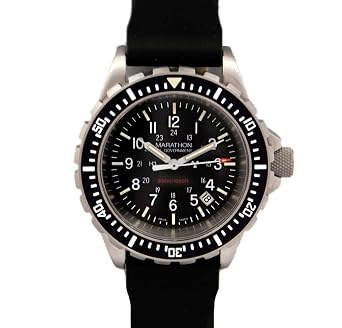
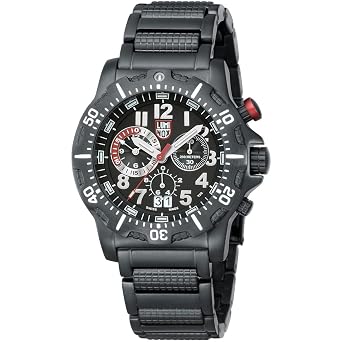
Very true but many pro's, and even the military types, will still wear an analog watch, just in case their dive computer shits the bed and dies. Just one that is made for diving, like these:

71HlurL9XFL._UX342_.jpg


Seiko-Prospex-Kinetic-GMT-SUN023-1.jpg


71T3MEHc7rL._UY445_.jpg


61vukWGWRfL._UX342_.jpg


seiko-SBBN017.jpg


gshock-frogman-GF1000NV-2.jpg
 
Not just for show. Purpose built for diving.
In the old days, sure:

SEAMASTER | omegamuseum.com

SEAMASTER

Launched in 1948 to coincide with the brand's 100th anniversary, the OMEGA Seamaster line is the oldest in the current collection. Loosely based on the waterproof wristwatches made for the British military at the end of World War II, the Seamaster was first intended as a robust yet elegant watch for active individuals who wanted a watch for “town, sea and country”.
The first watches were equipped with self-winding movements in both standard and chronometer versions, the latter being universally appreciated for their robustness, accuracy and reliability.

The Seamaster's first diving-record was achieved in 1955, when diver Gordon McLean reached a depth of 62.5 metres in Australia.

The key to these watches was the O-ring gasket. At this time, water-resistant watches generally used lead or shellac gaskets which were susceptible to temperature changes. The Seamaster, however, used a rubber gasket of the type that had proven its abilities in submarines during the Second World War. In fact the Seamaster was independently tested by the Swiss Laboratory for Watch Research which subjected 50 cases to tests at a simulated depth of 60 meters. After temperature changes of -40° C to 50° C in quick succession, the cases showed no sign of water infiltration. The engineers at OMEGA were so sure of the Seamaster that one flew the Polar Route over the North Atlantic attached to the outside of a Douglas DC6 aircraft in 1956.

The following year saw the introduction of the “Professional” range of Seamaster watches with the launch of the Seamaster 300. Though OMEGA was not a newcomer to the world of divers' watches, the 1932 OMEGA "Marine" accompanied the father of modern diving, Yves Le Prieur, on many of his dives and American explorer Charles William Beebe took the OMEGA "Marine" to a depth of 14 metres as early as 1936, citing the watch’s resistance to such an environment as “veritable progress in the science of watchmaking”. It marked a decisive turning point for the line which has been associated with robust divers' watches ever since.

The Seamaster 300 has been the choice of many of the world’s most famous explorers and divers over the years. Jacques-Yves Cousteau’s team used the Seamaster 300 during its “Precontinent II” experiments in the Red Sea in the summer of 1963 to prove that divers could live in a submerged saturated gas environment for long periods without adverse effects.

The Seamaster 300 would also go on to be the watch of choice of military divers around the world, including the British Special Boat Service among others.

The ever-increasing depths at which divers were working led to the creation of the famous “Ploprof” (PLOngeur PROFessional or "professional diver" in English) Seamaster 600, launched to the public in 1970 after four years of intensive research and testing. This watch proved to be more than equal to the new challenges faced by professional divers.


COMEX, a French underwater research and exploration company, used the Seamaster 600 extensively during test dives in the late 1960s and in September 1970, the watch accompanied the three divers of Janus II. During this dive the divers spend four hours per day over eight days in the water and set a world record for underwater exploration at a depth of 253 meters in the Ajaccio Gulf in France. Later Cousteau’s divers would use the watches off the coast of Marseille during a set of experiments to test the effects on divers working at depths up to 500 meters.

In fact, Seamaster 600 underwent a series of hypostatic tests that revealed that the watch functioned up to a simulated depth of 1370 meters at which point the 4mm thick crystal touched the seconds hand, stopping the watch.

The “big brother” of the 600, the Seamaster 1000, was launched in 1971. It was created and tested alongside the 600 and was also tested and used by the same divers. The highlight of the 1000's early exploration career was undoubtedly its dive on IUC's (International Underwater Contractors) submarine “Beaver Mark IV” where the watch was attached to the submarine's robotic arm to test the effects on the crystal at a depth of 1000 meters.

All of the lessons learned during the testing of these watches would be used across the entire Seamaster “Professional” range and went a long way toward reinforcing the Seamaster's position as the divers' watch of choice. Thus, OMEGA was also associated with the Faré mission organised by the French Institute for Oceanic Research of 25 July 1988, in which the submersible Nautile descended to a depth of 4,400 metres to install the first link in a system for monitoring seismic activity.

The Seamaster’s records of the 1980s were set in shallower waters, but under equally challenging circumstances. In 1981, famous French free diver Jacques Mayol tested the newly launched Seamaster 120 in style by setting a new world free dive record at a depth of 101 metres off the coast of the Isle of Elba, Italy. In the 1990s, another French diver, Roland Specker, set two new lake diving records in Lake Neuchâtel with the support of OMEGA: he reached a depth of 80 metres in 1993 – without breathing apparatus!

Other than recording and making diving history, the Seamaster line was also the home for much of the brand's research into alternative case materials and treatments that included titanium in the late 1960s, tungsten and PVD in the early 1970s, ceramics in the late 1970s and forged carbon in the 1980s; many of the designs in these exotic materials actually made it into production.

With what can be considered two lines in one, the “Professional” and “Dress” ranges of the Seamaster line have, for over half a century, complemented each other and ensured the Seamaster's place on the wrists of some of the world most famous royalty, divers, treasure hunters and even a spy or two.
 
Very true but many pro's, and even the military types, will still wear an analog watch, just in case their dive computer shits the bed and dies. Just one that is made for diving, like these:

71HlurL9XFL._UX342_.jpg


Seiko-Prospex-Kinetic-GMT-SUN023-1.jpg


71T3MEHc7rL._UY445_.jpg


61vukWGWRfL._UX342_.jpg


seiko-SBBN017.jpg


gshock-frogman-GF1000NV-2.jpg

True. Quartz. Cheap. So you won't cry if it gets fucked up.

But you can dive with the Seamaster just as you can with a Rolex or a Doxa.
 
Better to say it's a watch made for diving which no one serious will ever dive with. That doesn't mean you can't dive with it, just that you probably wouldn't.

Like you wouldn't take your rare non-PooPoker model Ferrari to a gymkhana.
 
Of course you can. And its a "dive" watch. But its not really a watch made for diving.
That's not remotely true. Plenty of divers wear Omegas and Doxas and all kinds of shit for backups, I see it all the time. You people are all retarded.
 
That's not remotely true. Plenty of divers wear Omegas and Doxas and all kinds of shit for backups, I see it all the time. You people are all retarded.
Yes yes yes. We've already been through all of the qualifications. You're late to the party.
 
exactly. i've literally seen people try to rebook dive trips just to find expensive jewelry they've lost on dives.

Just an excuse to take another trip.


You are a lot more likely to lose these watches doing other stuff than diving anyway. It takes a lot of manipulation and unlatching to get one off.
 
Last edited:
Let me get this straight.
There are watches that cost the price of a new family car that are called diving watches. They are made to withstand water pressure and look as fugly as possible. They are mainly sold to Asian business men and Americans generally to wear with suits at work. These days real divers don't use them. But some do. The diving watches aren't for diving but on the other hand they definitely are for diving.
 
Let me get this straight.
There are watches that cost the price of a new family car that are called diving watches. They are made to withstand water pressure and look as fugly as possible. They are mainly sold to Asian business men and Americans generally to wear with suits at work. These days real divers don't use them. But some do. The diving watches aren't for diving but on the other hand they definitely are for diving.

The nuances of modern menswear & watches.

Sort of like all Sikhs are Singhs but not all Singhs are Sikhs
 
Let me get this straight.
There are watches that cost the price of a new family car that are called diving watches. They are made to withstand water pressure and look as fugly as possible. They are mainly sold to Asian business men and Americans generally to wear with suits at work. These days real divers don't use them. But some do. The diving watches aren't for diving but on the other hand they definitely are for diving.
They are not "fugly", they are "ruggedly handsome". At least, that's what I tell myself when recoil in horror from the mirror.

And you got the part about Americans wrong - they are usually middle-aged fatsos who wear their dive watches when they eat at nautical themed fast food establishments. Only the Asians with 3.2" wrists wear the big 50mm dive watches under a suit.

c61c4cc9-ed08-4f7f-a333-7349e56cb06f_zps2bb7679b.jpg~original


The Watch Appreciation Thread (Reviews and Photos of Men's Timepieces by Rolex, Patek Philippe, Breitling, JLC etc...) - Page 2531
 
I want a watch made then or a reproduction!
Hmmm.. spend 5x as much on a modern reproduction of a WWI era watch, or buy one with some actual history? Trench watches are pretty easy to find and quite reasonable as they are not in vogue like the 60s Omegas or 70s Rolexes etc. Especially in the States where you were only in WWI for about 5 minutes so all the military issue watches (and their wearers) never had a chance to be blown to smithereens by Fritz.
 
Hmmm.. spend 5x as much on a modern reproduction of a WWI era watch, or buy one with some actual history? Trench watches are pretty easy to find and quite reasonable as they are not in vogue like the 60s Omegas or 70s Rolexes etc. Especially in the States where you were only in WWI for about 5 minutes so all the military issue watches (and their wearers) never had a chance to be blown to smithereens by Fritz.

I know nothing of watches. Glad to hear originals are cheaper if they can still keep time.

Anything you know to recommend me?
 
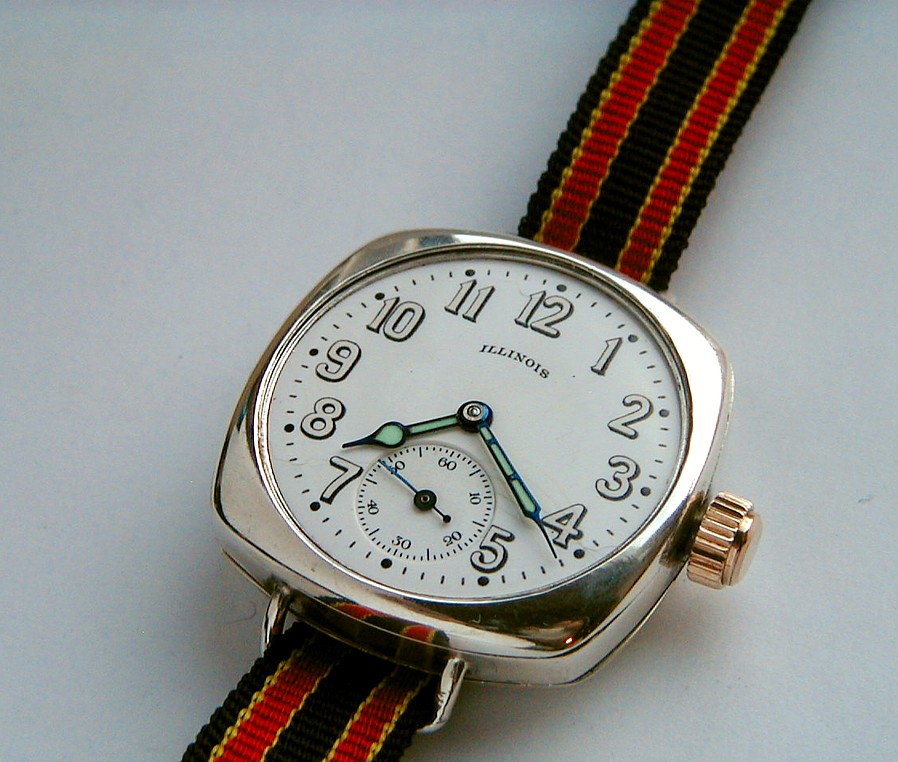
You mean brands to recommend? Well, a few good ones that used to be great in 1914 but are either gone to God or junk now include Illinois, Hamilton, Cyma, Elgin, Waltham - some are actual USA-made watches that were as good as or better than the Swiss equivalents at the time, and were certainly, actually used by REAL AMERICAN RAILROAD EMPLOYEES.

Personally I quite like the look of some of the 1910s-1920s wrist watches. As I said they are relatively cheap and run pretty well, albeit not as accurately as later watches. Though many have had parts swapped out and won't be 100% original given their age and the fact they have probably been repaired a few times, especially if they were worn at some stage and not kept in a drawer for 100 years.

Some of the porcelain dial models are especially handsome, if you can find one without cracks. Also, because a lot of them have fixed lugs, you can legitimately wear them on NATO straps, e.g.:

ill3395_big.jpg
 

Users who are viewing this thread

Back
Top Bottom