- Messages
- 40,417
I never said it was a scientific journal...I mean, that's not wrong but to quote Wikipedia as a source?
Follow along with the video below to see how to install our site as a web app on your home screen.
Note: This feature may not be available in some browsers.
I never said it was a scientific journal...I mean, that's not wrong but to quote Wikipedia as a source?
Crimea Votes On Joining Russia
| by By MIKE ECKEL and JOHN-THOR DAHLBURG
Posted: 03/16/2014 2:17 am EDT Updated: 03/16/2014 7:59 pm EDT
SIMFEROPOL, Ukraine (AP) — Just two weeks after Russian troops seized their peninsula, Crimeans voted Sunday to leave Ukraine and join Russia, overwhelmingly approving a referendum that sought to unite the strategically important Black Sea region with the country it was part of for some 250 years.
The vote was widely condemned by Western leaders, who planned to move swiftly to punish Russia with economic sanctions.
As the votes were counted, a jubilant crowd gathered around a statue of Vladimir Lenin in the center of Simferopol to celebrate with song and dance. Many held Russian flags, and some unfurled a handwritten banner reading "We're Russian and proud of it." Fireworks exploded in the skies above.
"We want to go back home, and today we are going back home," said Viktoria Chernyshova, a 38-year-old businesswoman. "We needed to save ourselves from those unprincipled clowns who have taken power in Kiev."
Ukraine's new government in Kiev called the referendum a "circus" directed at gunpoint by Moscow, referring to the thousands of troops that now occupy the peninsula, which has traded hands repeatedly since ancient times.
The referendum offered voters the choice of seeking annexation by Russia or remaining in Ukraine with greater autonomy. After 50 percent of the ballots were counted, more than 95 percent of voters had approved splitting off and joining Russia, according to Mikhail Malishev, head of the referendum committee.
Final results were not expected until Monday.
Opponents of secession appeared to have stayed away Sunday, denouncing the vote as a cynical power play and land grab by Russia.
Putin insisted the referendum was conducted in "full accordance with international law and the U.N. charter."
Russia was expected to face strong sanctions Monday from the U.S. and Europe for going forward with the vote, which could also encourage rising pro-Russian sentiment in Ukraine's east and lead to further divisions in this nation of 46 million. Residents in western Ukraine and the capital, Kiev, are strongly pro-West and Ukrainian nationalist.
Andrew Weiss, vice president for Russian and East European studies at the Carnegie Endowment for International Peace, suggested the confrontation could intensify.
Russia "is really turning its back on the outside world and is basically going to say to the West, 'Now, go ahead. Show us how tough you are.' And the West, I think, is struggling to come with an adequate response."
The Crimean parliament planned to meet Monday to formally ask Moscow to be annexed, and Crimean lawmakers were to fly to Moscow later in the day for talks, Crimea's pro-Russia prime minister said on Twitter.
Russian lawmaker Vladimir Zhirinovsky said the annexation could take "from three days to three months," according to the Interfax news agency.
Some residents in Crimea said they feared the new Ukrainian government that took over when President Viktor Yanukovych fled to Russia last month would oppress them.
"It's like they're crazy Texans in western Ukraine. Imagine if the Texans suddenly took over power (in Washington) and told everyone they should speak Texan," said Ilya Khlebanov, a voter in Simferopol.
Ukraine's new prime minister insisted that neither Ukraine nor the West would recognize the vote.
"Under the stage direction of the Russian Federation, a circus performance is underway: the so-called referendum," Prime Minister Arseniy Yatsenyuk said Sunday. "Also taking part in the performance are 21,000 Russian troops, who with their guns are trying to prove the legality of the referendum."
As soon as the polls closed, the White House again denounced the vote.
"The international community will not recognize the results of a poll administered under threats of violence," it said in a statement. "Russia's actions are dangerous and destabilizing."
Russia raised the stakes Saturday when its forces, backed by helicopter gunships and armored vehicles, took control of the Ukrainian village of Strilkove and a key natural gas distribution plant nearby — the first Russian military move into Ukraine beyond the Crimean peninsula of 2 million people.
The Russian forces later returned the village but kept control of the gas plant. On Sunday, Ukrainian soldiers were digging trenches and erecting barricades between the village and the gas plant.
"We will not let them advance further into Ukrainian territory," said Serhiy Kuz, commander of a Ukrainian paratrooper battalion.
Despite the threat of sanctions, Putin has vigorously resisted calls to pull back in Crimea. At the United Nations on Saturday, Russia vetoed a Security Council resolution declaring the referendum illegal.
However, Putin spoke with President Barack Obama and supported a proposal from Germany to expand an international observer mission in Ukraine, the Kremlin said Sunday in a statement after the vote.
"The heads of state noted that despite the differences in their assessments, it was necessary to work together to find a way to stabilize the situation in Ukraine," the statement said.
German Chancellor Angela Merkel, who also spoke with Putin on Sunday, wants more observers sent to tense areas, particularly in eastern Ukraine, her spokesman said. Putin told Obama that such a mission would be welcome but would need to be extended to all regions in Ukraine, the Kremlin said.
In Donetsk, one of the main cities in eastern Ukraine, pro-Russia demonstrators called Sunday for a referendum similar to the one in Crimea.
In the streets of Sevastopol, the Crimean port where Russia now leases a major naval base from Ukraine for $98 million a year, speakers blared the city anthem, but the military threat was not far away — a Russian naval warship still blocked the port's outlet to the Black Sea, trapping Ukrainian boats.
At a polling station inside a historic school, tears came to Vladimir Lozovoy, a 75-year-old retired Soviet naval officer, as he talked about his vote.
"I want to cry. I have finally returned to my motherland. It is an incredible feeling. This is the thing I have been waiting for for 23 years," he said.
But Crimea's large Muslim Tatar minority — whose families had been forcibly removed from their homeland and sent to Central Asia during Soviet times — remained defiant.
The Crimea referendum "is a clown show, a circus," Tatar activist Refat Chubarov said on Crimea's Tatar television station. "This is a tragedy, an illegitimate government with armed forces from another country."
The fate of Ukrainian soldiers trapped in their Crimean bases by pro-Russian forces was still uncertain. But Ukraine's acting defense minister, Igor Tenyuk, was quoted as saying Sunday that an agreement had been reached with Russia not to block Ukrainian soldiers in Crimea through Friday. It was not clear exactly what that meant.
Ethnic Ukrainians interviewed outside the Ukrainian Orthodox cathedral of Vladimir and Olga said they refused to take part in the referendum, calling it an illegal charade stage-managed by Moscow. Some said they were scared of the potential for widespread harassment.
Vasyl Ovcharuk, a retired gas pipe layer, predicted dark days ahead for Crimea.
"This will end up in military action, in which peaceful people will suffer. And that means everybody," he said. "Shells and bullets are blind."
___
Associated Press writers Dalton Bennett in Sevastopol, Yuras Karmanau in Strilkove, Jim Heintz and Maria Danilova in Kiev and David Melendy in Washington, D.C., contributed to this report.
Ukraine's new prime minister insisted again Sunday that neither Ukraine nor the West will recognize the referendum, which they say is being conducted at gunpoint.
"Now, on the territory of the autonomous republic of Crimea under the stage direction of the Russian Federation, a circus performance is underway: the so-called referendum," Prime Minister Arseniy Yatsenyuk told a government meeting. "Also taking part in the performance are 21,000 Russian troops, who with their guns are trying to prove the legality of the referendum."
Russia raised the stakes Saturday when its forces, backed by helicopter gunships and armored vehicles, took control of a Ukrainian village outside Crimea — the first military move beyond the peninsula of 2 million people. The Russian forces also took control of a nearby natural gas distribution station, claiming the need to prevent possible terrorist acts.
Serhiy Astakhov, a spokesman for Ukraine's Border Guard, told The Associated Press on Sunday that Ukrainian forces retook control of the village late Saturday after negotiations with the Russian forces, but the Russian still controlled the gas plant.
If the referendum passes, Russia faces the prospect of quick sanctions from Western nations. So far, however, Russian President Vladimir Putin has vigorously resisted calls to pull back in Crimea. At the United Nations, Russia vetoed a Security Council resolution declaring the referendum illegal, and China, its ally, abstained in a sign of Moscow's isolation on the issue.
In Sevastopol, Crimea's key port and the site of the Russian naval base, more than 70 people surged into a polling station within the first 15 minutes of voting Sunday.
"Today is a holiday!" said 66-year-old Vera Sverkunova. Asked how she voted, she broke into a patriotic war song: "I want to go home to Russia. It's been so long since I've seen my mama."
"Today is an important day for all Crimea, Ukraine and Russia," said voter Manita Meshchina.
Speakers blared the city anthem up and down the streets, giving Sevastopol a feeling of a block party. But the military threat was clear — a Russian naval warship still blocked the port's outlet to the Black Sea, trapping Ukrainian boats. Under a disputed new lease, Russia pays Ukraine $98 million a year in rent for the naval base.
At a polling station inside a historic school building in Sevastopol, Vladimir Lozovoy, a 75-year-old retired Soviet naval officer, began tearing up as he talked about his vote.
"I want to cry. I have finally returned to my motherland. It is an incredible feeling. This is the thing I have been waiting for for 23 years," he said.
Since Yanukovych fled to Russia, Crimea has come under the control of local militias as well as heavily armed troops under the apparent command from Moscow. Crimea's pro-Russia authorities say if Ukrainian soldiers resolutely occupying their garrisons on the peninsula don't surrender after Sunday's vote, they will be considered "illegal."
But Ukraine's acting defense minister, Igor Tenyuk, remained defiant and Crimea's large Tatar Muslim minority still fiercely opposes any annexation to Russia.
"This is our land and we're not going anywhere from this land," Tenyuk said Sunday in an interview published by the Interfax news agency.
The Crimea referendum "is a clown show, a circus," Tatar activist Refat Chubarov said on Crimea's Tatar television station Sunday. "This is a tragedy, an illegitimate government with armed forces from another country."
Blue-and-yellow Ukrainian flags were nowhere to seen around the streets of the regional capital of Simferopol but Red, white and blue Russian and Crimean flags fluttered in abundance.
Ethnic Ukrainians interviewed outside the Ukrainian Orthodox cathedral of Vladimir and Olga said they refused to take part in the referendum, calling it an illegal charade stage-managed by Moscow. Some said they were scared of the potential for ethnic cleansing in the coming weeks, like what happened in parts nearby Georgia, another former Soviet republic.
"We're just not going to play these separatist games," said Yevgen Sukhodolsky, a 41-year-old prosecutor from Saki, a town outside Simferopol. "Putin is the fascist. The Russian government is fascist."
Vasyl Ovcharuk, a retired gas pipe layer who also worked on the Chernobyl nuclear disaster in 1986, predicted dark days ahead for Crimea.
"This will end up in military action, in which peaceful people will suffer. And that means everybody. Shells and bullets are blind," he said.

Is harvey inseminating you people with his stupidity?Stupid people are stupid.
Is harvey inseminating you people with his stupidity?
""It's like they're crazy Texans in western Ukraine. Imagine if the Texans suddenly took over power (in Washington) and told everyone they should speak Texan," said Ilya Khlebanov, a voter in Simferopol."
Unanalogous analogy is unanalogous.

It's why the UN is a crock of shit in the first place. When a resolution being aimed against a county can be vetoed by that very country it will never do anything of value. I hate the idea of the UN to begin with but that's just a load of shit.
It's a permanent member.
Apropos of. I believe this video was shot in the Crimea last year. One can see why Putin wanted in on the party.

The Danger of False Narrative
Exclusive: Like a decade ago with Iraq, Official Washington’s pundits and pols are locked shoulder-to-shoulder in a phalanx of misguided consensus on Ukraine, presenting a false narrative that is taking U.S. policy into dangerous directions, writes Robert Parry.
- March 27, 2014
- 15 min read
- original
By Robert Parry
The American people got a nasty taste of the danger that can come with false narrative when they were suckered into the Iraq War based on bogus claims that Saddam Hussein was hiding weapons of mass destruction that he planned to share with al-Qaeda.
Nearly 4,500 U.S. soldiers died in the conflict along with hundreds thousands of Iraqis. The war’s total financial cost probably exceeded $1 trillion, a vast sum that siphoned off America’s economic vitality and forced cutbacks in everything from education to road repair. Plus, the war ended up creating an Iraqi base for al-Qaeda terrorists that had not existed before.
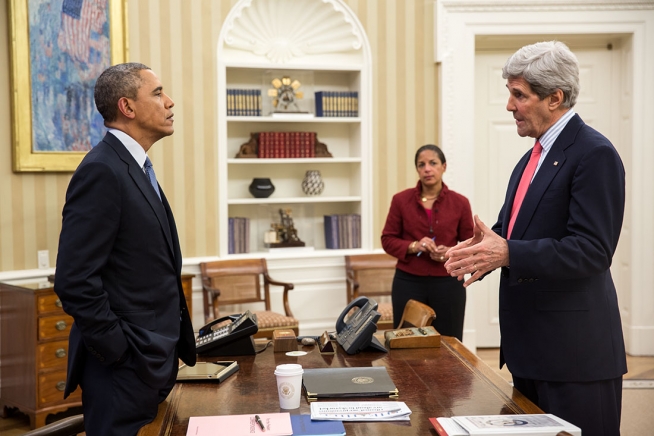
President Barack Obama talks with Secretary of State John Kerry and National Security Advisor Susan E. Rice in the Oval Office on March 19, 2014. (Official White House Photo by Pete Souza)
But perhaps an even more dangerous problem coming out of the Iraq War was that almost no one in Official Washington who pushed the false narrative – whether in politics or in the press – was held accountable in any meaningful way. Many of the same pols and pundits remain in place today, pushing similar false narratives on new crises, from Ukraine to Syria to Iran.
Those false narratives – and their cumulative effect on policymaking – now represent a clear and present danger to the Republic and, indeed, to the world. The United States, after all, is the preeminent superpower with unprecedented means for delivering death and destruction. But almost nothing is being done to address this enduring American crisis of deception.
Today, Official Washington is marching in lockstep just as it did in 2002-03 when it enforced the misguided consensus on Iraq’s WMD. The latest case is Ukraine where Russian President Vladimir Putin is accused of committing “aggression” to expand Russian territory at the expense of noble ”democratic” reformers in Kiev.
Not only is this the dominant storyline in the U.S. media; it is virtually the only narrative permitted in the mainstream press. But the real narrative is that the United States and the European Union provoked this crisis by trying to take Ukraine out of its traditional sphere of influence, Russia, and put it in to a new association with the EU.
While there’s nothing inherently wrong with Ukraine joining with the EU or staying with Russia (or a combination of the two) – depending on the will of the people and their elected representatives – this latest U.S./EU plan was motivated, at least in part, by hostility toward Russia.
That attitude was expressed in a Sept. 26, 2013, op-ed in the Washington Post by Carl Gershman, the neoconservative president of the National Endowment for Democracy, which doles out more than $100 million in U.S. funds a year to help organize “activists,” support “journalists” and finance programs that can be used to destabilize targeted governments.
Gershman, whose job amounts to being a neocon paymaster, expressed antagonism toward Russia in the op-ed and identified Ukraine as “the biggest prize,” the capture of which could ultimately lead to the ouster of Putin, who “may find himself on the losing end not just in the near abroad but within Russia itself.”
The NED, which was founded in 1983 to do in relative openness what the CIA had long done in secret, listed 65 projects that it was financing in Ukraine, using U.S. taxpayers’ money. In other words, Gershman’s op-ed reflected U.S. policy – at least inside the State Department’s still-neocon-dominated bureaucracy – which viewed the EU’s snatching of Ukraine from Russia’s embrace as a way to weaken Russia and hurt Putin.
‘European Aspirations’
Later, as the Ukrainian crisis unfolded, another neocon, Assistant Secretary of State for European Affairs Victoria Nuland, reminded Ukrainian businessmen that the United States had invested $5 billion in their “European aspirations,” implying that the U.S. expected something for all this money.
You might wonder why the American taxpayers should spend $5 billion on the “European aspirations” of Ukraine when there are so many needs at home, but a more relevant question may be: Why is the United States spending that much money to stir up trouble on Russia’s border? The Cold War is over but the hostility continues.
Former Defense Secretary Robert Gates described this thinking in his memoir, Duty, explaining the view of President George H.W. Bush’s Defense Secretary Dick Cheney: “When the Soviet Union was collapsing in late 1991, Dick wanted to see the dismantlement not only of the Soviet Union and the Russian empire but of Russia itself, so it could never again be a threat to the rest of the world.”
As Vice President, Cheney and the neocons around him pursued a similar strategy during George W. Bush’s presidency, expanding NATO aggressively to the east and backing anti-Russian regimes in the region including the hardline Georgian government, which provoked a military confrontation with Moscow in 2008.
Since President Barack Obama never took full control of his foreign policy apparatus – leaving the Bush Family apparatchik Gates at Defense and naming neocon-leaning Democrat Hillary Clinton as Secretary of State – the bureaucratic momentum toward confronting Russia continued. Indeed, the elevation of operatives like Nuland, the wife of prominent neocon Robert Kagan, gave new impetus to the anti-Russian strategy.
Secretary of State John Kerry, who got his “dream job” last year with the considerable help of his neocon chum Sen. John McCain, has acted as a kind of sock puppet for this neocon-dominated State Department bureaucracy.
Either because he is overly focused on his legacy-building initiative of an Israeli-Palestinian peace deal or because he has long since sold out his anti-war philosophy from the Vietnam War era, Kerry has repeatedly taken the side of the hawks: on Syria, Iran and now Ukraine.
On Syria and Iran, it was largely the behind-the-scenes cooperation between Obama and Putin that tamped down those crises last year and opened a pathway for diplomacy – much to the chagrin of the neocons who favored heightened confrontations, U.S. military strikes and “regime change.” Thus, it became a neocon priority to divide Obama from Putin. Ukraine became the wedge.
The Crisis
The Ukrainian crisis took a decisive turn on Nov. 21, 2013, when President Viktor Yanukovych rebuffed a deal offered by the EU and the International Monetary Fund because it would have imposed harsh austerity on the already suffering Ukrainian people. Yanukovych opted instead for a more generous aid package of $15 billion from Russia, with few strings attached.
But Yanukovych’s turning away from the EU infuriated the U.S. State Department as well as pro-European demonstrators who filled the Maidan square in Kiev. The protests reflected the more anti-Russian attitudes of western Ukraine, where Kiev is located, but not the more pro-Russian feelings of eastern and southern Ukraine, Yanukovych’s strongholds that accounted for his electoral victory in 2010.
Though the Maidan protests involved hundreds of thousands of Ukrainians simply eager for a better life and a less corrupt government, some of the most militant factions came from far-right parties, like Svoboda, and even neo-Nazi militias from the Right Sektor. When protesters seized City Hall, Nazi symbols and a Confederate battle flag were put on display.
As the protests grew angrier, U.S. officials, including Assistant Secretary Nuland and Sen. McCain, openly sided with the demonstrators despite banners honoring Stepan Bandera, a World War II-era fascist whose paramilitary forces collaborated with the Nazis in the extermination of Poles and Jews. Nuland passed out cookies and McCain stood shoulder to shoulder with right-wing Ukrainian nationalists. [For more on the role of Ukrainian neo-Nazis, watch this report from the BBC.]
On Feb. 20, the violence intensified as mysterious snipers fired on both protesters and police. As police fought back, neo-Nazi militias hurled Molotov cocktails. More than 80 people were killed including more than a dozen police officers, but the U.S. press blamed the Yanukovych government for the violence, portraying the demonstrators as innocent victims.
Official Washington’s narrative was set. Yanukovych, who had been something of a hero when he was moving toward the EU agreement in the early fall, became a villain after he decided that the IMF’s demands were too severe and especially after he accepted the deal from Putin. The Russian president was undergoing his own demonization in the U.S. news media, including an extraordinary denunciation by NBC at the end of the Sochi Winter Olympics.
In the U.S. media’s black-and-white scenario, the “pro-democracy” demonstrators in the Maidan were the good guys who were fired upon by the bad-guy police. The New York Times even stopped reporting that some of those killed were police, instead presenting the more pleasing but phony narrative that “more than 80 protesters were shot to death by the police as an uprising spiraled out of control in mid-February.”
To this day, the identity of the snipers who touched off the conflagration remains in serious doubt. I was told at the time that some U.S. intelligence analysts believed the shooters were associated with the far-right opposition groups, not with the Yanukovych government.
That analysis gained support when a phone call surfaced between Estonia’s Foreign Minister Urmas Paet and European Union foreign affairs chief Catherine Ashton, Paet reported on a conversation that he had with a doctor in Kiev who said the sniper fire that killed protesters was the same that killed police officers.
As reported by the UK Guardian, “During the conversation, Paet quoted a woman named Olga – who the Russian media identified her as Olga Bogomolets, a doctor – blaming snipers from the opposition shooting the protesters.”
Paet said, “What was quite disturbing, this same Olga told that, well, all the evidence shows that people who were killed by snipers from both sides, among policemen and people from the streets, that they were the same snipers killing people from both sides.
“So she also showed me some photos, she said that as medical doctor, she can say it is the same handwriting, the same type of bullets, and it’s really disturbing that now the new coalition, that they don’t want to investigate what exactly happened. … So there is a stronger and stronger understanding that behind snipers it was not Yanukovych, it was somebody from the new coalition.”
Ashton replied: “I think we do want to investigate. I didn’t pick that up, that’s interesting. Gosh.”
Though this exchange does not prove that the opposition used snipers to provoke the violence, it is relevant information that could have altered how Americans viewed the worsening crisis in Ukraine. However, except for an on-the-scene report from CNN with the same doctor, the Paet-Ashton phone call disappeared into the U.S. media’s black hole reserved for information that doesn’t fit with a preferred narrative.
Black Hats/White Hats
So, with giant black hats glued onto Yanukovych and Putin and white hats on the protesters, the inspiring but false U.S. narrative played out in heroic fashion, with only passing reference to the efforts by Yanukovych to make concessions and satisfy the protesters’ demands.
On Feb. 21, Yanukovych tried to defuse the violence by signing an agreement with three European countries in which he accepted reduced powers, moved up elections so he could be voted out of office, and pulled back the police. That last step, however, opened the way for the neo-Nazi militias to seize government buildings and force Yanukovych to flee for his life.
Then, on Feb. 22, under the watchful eye of these modern-day storm troopers, a rump parliament – in violation of constitutional procedures – voted to impeach Yanukovych, who reemerged in Russia to denounce the actions as a coup.
Despite this highly irregular process, the U.S. government – following the lead of the State Department bureaucracy – immediately recognized the new leadership as Ukraine’s “legitimate” government. Putin later appealed to Obama in support of the Feb. 21 agreement but was told the ouster of Yanukovych and the installation of the U.S.-backed government were a fait accompli.
The rump parliament in Kiev also accused Yanukovych of mass murder in connection with the shootings in the Maidan — an accusation that got widespread play in the U.S. media – although curiously the new regime also decided not to pursue an investigation into the identity of the mysterious snipers, a point that drew no U.S. media interest.
And, a new law was passed in line with the desires of right-wing Ukrainian nationalists to eliminate Russian as one of the country’s official languages. New government leaders also were dispatched to the Russian-ethnic regions to take charge, moves that, in turn, prompted resistance from Russian-ethnic citizens in the east and south.
It was in this context – and with appeals from Yanukovych and ethnic Russians for help – that Putin got permission from the Duma to intervene militarily if necessary. Russian troops, already stationed in bases in Crimea, moved to block the Kiev regime from asserting its authority in that strategic Black Sea peninsula.
Amidst this political chaos, the Crimean parliament voted to break away from Ukraine and join Russia, putting the question to a popular vote on March 16. Not surprisingly, given the failed Ukrainian state, its inability to pay for basic services, and Crimea’s historic ties to Russia, Crimean voters approved the switch overwhelmingly. Exit polls showed about a 93 percent majority, just three points less than the official results.
Russia then moved to formally reclaim Crimea, which had been part of Russia dating back to the 1700s, while also massing troops along the borders of eastern Ukraine, presumably as a warning to the Kiev regime not to crush popular resistance to the anti-Yanukovych coup.
A Divergent Narrative
So, the factual narrative suggests that the Ukrainian crisis was stoked by elements of the U.S. government, both in the State Department and in Congress, encouraging and exploiting popular resentments in western Ukraine. The goal was to pull Ukraine out of Russia’s orbit and put it into the EU’s gravitational pull.
When Yanukovych balked at IMF’s demands, a process of “regime change” was put in motion with the U.S. and EU even turning their backs on the Feb. 21 agreement in which Yanukovych made a series of concessions negotiated by European countries. The deal was cast aside in a matter of hours with no attempt by the West to uphold its terms.
Meanwhile, Putin, who was tied up with the Sochi Olympics and obsessed over fears that it would be targeted by Islamist terrorists, appears to have been caught off-guard by the events in Ukraine. He then reacted to the alarming developments on Russia’s border, including the emergence of neo-Nazis as prominent figures in the coup regime in Kiev.
In other words, a logical – and indeed realistic – way to see the Ukraine-Crimea crisis is that Putin was largely responding to events that were outside his control. And that is important to understand, because that would mean that Putin was not the aggressor spoiling for a fight.
If there was premeditation, it was coming from the West and particularly from the neocons who remain highly influential in Official Washington. The neocons also had motive to go after Putin, since he helped Obama use diplomacy to quiet down dangerous crises with Syria and Iran while the neocons were pushing for more confrontation and U.S. military strikes.
But how did the U.S. news media present the Ukraine story to the American people?
First, there was the simplistic and misleading depiction of the pro-EU demonstrations as “democratic” when they mostly reflected the discontent of the pro-European population of western Ukraine, not the views of the more pro-Russian Ukrainians in the east and south who had pushed Yanukovych to victory in the 2010 election. Last time I checked, “democracy” referred to rule by the majority, not mob rule.
Then, despite the newsworthiness of the neo-Nazi role in the protests, the U.S. news media blacked-out these brown shirts because that ugly reality undercut the pleasing good-guys-vs.-bad-guys storyline. Then, when the snipers opened fire on protesters and policemen, the U.S. news media jumped to the conclusion that the killers were working for Yanukovych because that, too, fit with the desired narrative.
The violent overthrow of the democratically elected Yanukovych was hailed as an expression of “democracy,” again with the crucial role of the neo-Nazi militias largely airbrushed from the picture. The unanimous and near unanimous parliamentary votes that followed – as storm troopers patrolled the halls of government buildings – were further cited as evidence of “democracy” and “reform.”
The anger and fear of Ukrainians in the east and south were dismissed as Russian “propaganda” and Crimea’s move to extract itself from this political chaos was denounced as Russian “aggression.” U.S. news outlets casually denounced Putin as a “thug.” Washington Post columnist George F. Will called Putin “Stalin’s spawn.”
Former Secretary of State Clinton cited the Crimea situation to compare Putin to Hitler and to suggest that Putin was intent on recreating the old Soviet empire, though Crimea is only 10,000 square miles, about one-tenth of one percent the size of the old Soviet Union.
And, it wasn’t just that some or nearly all mainstream U.S. news organizations adopted this one-sided and misguided narrative. It was a consensus throughout all major U.S. news outlets. With a uniformity that one would normally associate with a totalitarian state, no competing narrative was permitted in the Big Media, regardless of the actual facts.
Whenever any of the more complex reality was included in a story, it was presented as Russian claims that were then followed by argumentative challenges. Yet, when U.S. officials made preposterous remarks about how uncivilized it was to violate another country’s sovereignty, the hypocrisy of their points went uncontested.
For instance, Secretary of State Kerry denounced Putin’s intervention in Crimea by declaring, “you just don’t in the 21st Century behave in 19th Century fashion by invading another country on completely trumped-up pretext.” But you had to look on the Internet to find any writer who dared note Kerry’s breathtaking double standard, since he voted in 2002 to authorize the U.S. invasion of Iraq in pursuit of hidden WMD stockpiles that didn’t exist.
This cognitive dissonance pervaded the U.S. press and the political debate over Ukraine and Crimea. The long history of U.S. interventions in foreign countries – almost always in violation of international law – was forgotten, except for the rare occasion when some Russian “claim” about American hypocrisy was cited and then swatted down. [See Consortiumnews.com’s “America’s Staggering Hypocrisy.”]
Careerism Prevails
Having worked many years in the mainstream U.S. news media, I fully understand how this process works and why it happens. Amid the patriotic chest-thumping that usually accompanies a U.S. military operation or American righteous outrage over some other nation’s actions, it is dangerous for your career to go against the flag-waving.
But it’s always been my view that such self-censorship is faux patriotism, as much as the happy storylines are false narratives. Even if many Americans don’t want the truth, it is still the job of journalists to give them the truth. Otherwise, the U.S. democratic process is distorted and made dangerous.
Propaganda leads to bad policies as politicians – even when they know better – start parroting the errant conventional wisdom. We’ve seen this now with President Obama who – more than anyone – realizes the value of Putin’s cooperation on Syria and Iran but now must join in denouncing the Russian president and demanding sanctions.
Obama also surely knows that Yanukovych’s ouster violated both Ukraine’s constitution and principles of democracy, but he pretends otherwise. And, he knows that Crimea’s secession reflected the will of the people, but he must insist that their vote was illegitimate.
At a March 25 news conference in the Netherlands, Obama toed the line of the hypocritical false narrative. He declared, “we have said consistently throughout this process is that it is up to the Ukrainian people to make their own decisions about how they organize themselves and who they interact with.” He then added that the Crimean referendum was “sloppily organized over the course of two weeks” and thus a sham.
If Obama were telling the truth, he would have noted that Yanukovych – for all his faults – was democratically elected in a process that was deemed fair by international observers. Obama would have acknowledged that Yanukovych agreed on Feb. 21 to a process that would have allowed for an orderly and legal process for his replacement.
Obama would have admitted, too, that the violent coup and the actions of the rump parliament in Kiev were both illegal and, indeed, “sloppily organized” – and that the U.S. government acted hastily in recognizing this coup regime. But double standards seem to be the only standards these days in Official Washington.
What is perhaps tragic about Obama is that he does know better. He is not a stupid man. But he doesn’t dare go against the grain for fear of being denounced as “naïve” about Putin or “weak” in not facing down “Russian aggression.” So, he reads the lines that have been, in effect, dictated by neocons within his own administration.
I’m told that Obama, like Putin, was caught off-guard by the Ukraine crisis. But Obama’s unwillingness or inability to recast the false narrative left him with no political choice but to join in the Putin-bashing. That, in turn, means that Putin won’t be there to help Obama navigate around future U.S. war plans that the neocons have in mind for Syria and Iran.
Indeed, neutralizing the Obama-Putin relationship may have been the chief reason why the neocons were so eager to stoke the Ukrainian fires — and it shows how false narratives can get people killed.

Ukrainians Get IMF’s Bitter Medicine
Exclusive: Though lacking legitimacy from national elections, Ukraine’s coup regime has approved a harsh IMF austerity plan that hits Ukraine’s “99 percent” the hardest and asks little from the country’s “1 percent,” including the corrupt “oligarchs,” reports Robert Parry.
- April 2, 2014
- 3 min read
- original
By Robert Parry
It’s a safe bet that most of the Ukrainians who flooded Maidan Square in Kiev in February did not do so because they wanted the International Monetary Fund to make their lives even more miserable by slashing subsidies for heat, gutting pensions and devaluing the currency to make everyday goods more expensive.
But thanks to the U.S.-backed coup that ousted elected President Viktor Yanukovych and replaced him with a regime including far-right parties, super-rich ”oligarchs” and technocrats with little sympathy for the suffering of average people, that’s exactly what happened. Although lacking legitimacy that would come from national elections, the coup regime pushed through the demands of the Washington-based IMF.
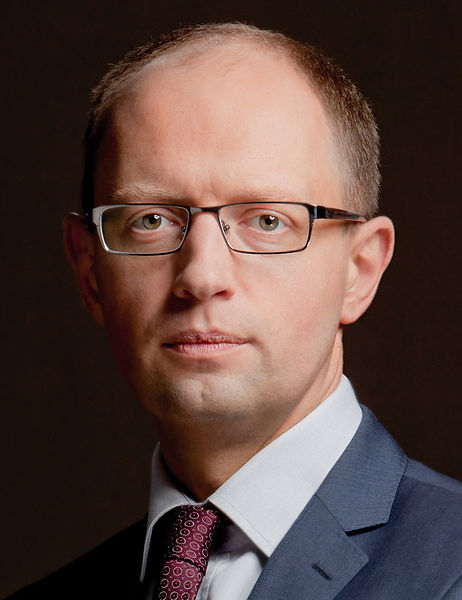
Ukraine’s acting Prime Minister Arseniy Yatsenyuk. (Photo credit: Ybilyk)
The process began just 10 days after the violent Feb. 22 coup that forced Yanukovych to flee for his life. IMF officials landed in Kiev on March 4 to hammer out a deal that acting Prime Minister Arseniy Yatsenyuk, himself a chilly bank technocrat, has acknowledged is “very unpopular, very difficult, very tough.”
What is also striking about the IMF plan is that it puts virtually all the pain on average Ukrainians. There is nothing in the economic “reform” package that extracts some of the ill-gotten gains from Ukraine’s ten or so “oligarchs,” the multimillionaires and even billionaires who largely plundered Ukraine’s wealth after the collapse of the Soviet Union in 1991.
There is no plan for demanding that these “oligarchs” kick in some percentage of their net worth to help their own country. Instead, hard-pressed citizens of the United States and Europe are expected to carry the financial load.
The U.S. Congress voted by large bipartisan majorities to have the American taxpayers provide $1 billion in aid to Ukraine’s coup regime. Further, the IMF predicts that its $18 billion in loan guarantees could generate up to $27 billion from the international community over the next two years.
Though the IMF plan includes some promises about fighting corruption, there is no requirement that the West’s billions of dollars will go toward government programs that might actually strengthen Ukraine and help the average Ukrainian by putting the jobless to work. Nothing about upgrading the infrastructure or providing improved educational opportunities, better health care and other programs that might reduce some of Ukraine’s social pressures and make it a more viable nation.
For instance, investing in roads and rail could make Ukraine a more attractive investment opportunity for agricultural corporations eying the country’s rich soil which historically has made it the breadbasket for much of Central and Eastern Europe.
Cookie-Cutter Approach
Instead, the IMF has applied its usual cookie-cutter approach toward a troubled nation: reduce public spending, slash social programs, eliminate energy subsidies, devalue the currency, raise taxes, impose triggers for more austerity if inflation rises, etc.
Some economists project that the cumulative impact of the IMF “reforms” could result in a 3 percent contraction of Ukraine’s already depressed economy, which fell into a severe recession after the Wall Street crash of 2008 and has been inching along at almost zero growth the past two years. But Yatsenyuk warned parliament that the drop in the GDP could be more like 10 percent if corrective actions were not taken.
But those actions will inflict more hardship on the Ukrainian people — their “99 percent” — while giving Ukraine’s “1 percent” pretty much a pass. Yet, beyond fairness, there’s also the question of the legitimacy of the coup regime taking on new debt obligations without the consent of the Ukrainian people.
After the violent ouster of elected President Yanukovych on Feb. 22 — after he rejected the IMF’s terms – the post-coup parliament cobbled together a new government which involved handing out four ministries to far-right parties whose armed neo-Nazi militias had spearheaded the coup.
Yatsenyuk was the personal choice of U.S. Assistant Secretary of State for European Affairs Victoria Nuland to lead the new regime. Weeks before the coup, Nuland was caught discussing with U.S. Ambassador to Ukraine Geoffrey Pyatt who should serve in a new government. Nuland said in a phone call to Pyatt that was intercepted and posted online that “Yats is the guy” — and he was installed as prime minister once Yanukovych was gone. [See Consortiumnews.com’s “What Neocons Want from Ukraine Crisis.”]
Ukraine’s parliament has set a presidential election for May 25, and protesters in the Maidan also sought quick parliamentary elections. But Western diplomats have been urging a delay in the parliamentary balloting as well as postponement of the most onerous IMF provisions until after the May 25 vote. That way the election will have come and gone before the beleaguered Ukrainians truly understand how painful the IMF austerity will be.
As the New York Times reported, “Senior Western officials said on [March 26] that the loans from the United States and from the I.M.F. would be structured to get the government through its first few months without undue political upheaval, putting off some of the more difficult changes until after the May election. The West has also chosen not to press for early parliamentary elections, one senior official said, because ‘the priority now is stabilization in Kiev and de-escalation with Moscow.’”
Given such bleak economic prospects — and evidence of Western manipulation of the political process – is it any wonder that more than 90 percent of the voters in Crimea opted to leave Ukraine and rejoin Russia?
Bill Black: The Kamikaze Economics of Forcing Austerity on the Ukraine
By Bill Black, the author of The Best Way to Rob a Bank is to Own One and an associate professor of economics and law at the University of Missouri-Kansas City. Originally published at New Economic Perspectives
- by Yves Smith
- April 6, 2014
- 4 min read
- original
We all understand why Russia is waging economic war on the Ukraine, but why is Obama doing so? The New York Times’ web site has posted a remarkable Reuters story (dated April 5, 2014) entitled “Ukraine PM Says Will Stick to Austerity Despite Moscow Pressure.”
The Kiev government will stick to unpopular austerity measures ‘as the price of independence’ as Russia steps up pressure on Ukraine to destabilise it, including by raising the price of gas, Prime Minister Arseny Yatseniuk told Reuters.
“Unpopular austerity measures” are, of course, among the best things Ukraine can do to aid Russia’s effort to “destabilize” the Ukraine. Indeed, Yatseniuk admits this point later in the article.
The subtext of Russia’s message to Ukraine’s Russian-speaking population, he said, was that they would enjoy higher living standards in Russia, with higher wages and better pensions and without the austerity that the Kiev government was now offering
‘They’re saying: if you go to Russia, you’ll be happy, smiling, and not living in a Western hell,’ he said.
‘They (the Russians) are trying to compensate (for the Western sanctions). But we can pay the price of independence,’ he said, with financial support from the West.
So, our strategy is to play into Putin’s hands by inflicting austerity and turning the Ukraine into “a Western hell.” Not to worry says our man in Kiev, because he’s sure that ten million ethnically-Russian citizens of Ukraine will gladly “pay the price of independence” to live in “a Western hell.” That strategy seems suicidal. Indeed, Yatseiuk emphasizes that he knows the strategy he is following is suicidal.
[Yatseiuk] has called himself the leader of a ‘kamikaze’ government, doomed by unpopular austerity measures it must take, but he said Ukraine would stick to the measures, which include doubling gas prices for domestic consumers from May 1 and holding down state pensions and salaries against a background of a 3 percent contraction of the economy and double-digit inflation.
IMF support – a $14-18 billion financial lifeline in return for tough economic reforms – would be a “tremendous step forward”, he said.
‘We will regain trust and credibility from foreign investors. This is the roadmap for Ukraine,’ he added.
The Kiev government has said that without the IMF-mandated austerity measures, the economy could shrink by up to 10 percent this year.
Six Crazy Degrees of Austerity
The Reuters article presents a stream of incoherent odes to the supposed benefits of financial and political suicide (kamikaze economics and politics). It was at this juncture in reading the article that I began to have a sick suspicion about Yatseiuk’s ideological dogmas and likely background. Sure enough, the article soon confirmed my worst fears: “Yatseniuk [is] a former economy minister, lawyer, and economist by education.” Another theoclassical economics acolyte is eager to sacrifice his economy and his fellow-citizens on the altar of austerity.
The rush to austerity is not a product primarily of Yatseiuk’s ideology, but of the EU’s worship of austerity. The IMF serves as the EU’s “leg breaker” for the Ukraine. The EU is making clear that it will only provide aid if the IMF is in place to extort the Ukraine to inflict austerity on an economy that is already in recession.
This is crazy on multiple dimensions. First, the Ukraine defines the concept of “political instability.” Playing into Putin’s hands by inflicting austerity on the Ukraine and producing “hell” is ludicrous.
Second, the Ukraine is in a severe recession. Austerity makes recessions worse. The Ukraine should be spending material amounts of money (from its perspective; tiny amounts from our perspective – or compared to the cost of a military conflict) dealing with Ukraine’s acute problems.
Third, the Ukraine has an inflation problem not because of excessive demand (demand is grossly inadequate) but because Russia has dramatically increased the cost of energy. Austerity is not the answer to this variant of cost-push inflation.
Fourth, the Ukraine has a tiny economy and small debts (relative to the West). The EU and the U.S. can easily pay off Ukraine’s debts (or if they prefer any debt owed to non-Russian entities) and replace it with very low interest rate debt in the Ukraine’s own currency with interest payments deferred for a decade. Ukraine has made the double mistake of trying to peg its currency to the dollar and to borrow in foreign currencies. The U.S. and EU could solve these problems, going forward, by giving the Ukraine a fresh start. This would speed the Ukraine’s economic recovery and remove one of the potential sources of an economic shock that could harm the EU and U.S. economic recoveries.
Fifth, the Obama administration purports to oppose the eurozone’s austerity policies. The case against inflicting austerity on the Ukraine is even stronger. Obama is under enormous criticism from Republicans for failing to take more decisive actions to support the Ukraine. The Ukraine offers the administration the perfect opportunity to do the right thing economically and politically, to demonstrate his leadership, and to force the Republicans to admit that austerity is a destructive policy that the U.S. needs to prevent by forceful action.
Sixth, instead, austerity dogma trumps – simultaneously – good economics, good domestic politics in the U.S. and the Ukraine, and U.S. national security. That’s how insanely powerful the failed dogma of austerity has become. The CEOs who run the banks that loan money to the Ukraine are more powerful than the Pentagon and our State Department.
Conclusion
The Ukraine faces severe problems beyond Russia and its energy dependence on Russia. It has an enormous informal business sector because it is so difficult to start a legitimate business. Ecuador recently adopted a law, and new technology, to make it radically faster to start a legitimate small business. This is great for entrepreneurs, growth, reduced corruption, and collecting taxes. It is a radical reform that people of all political stripes can support. Similarly, ant-fraud and corruption efforts can save the Ukraine billions of dollars and spur growth. President Obama could develop an aid, stimulus, debt relief, and reform package for the Ukraine based on ideas like this that would that have broad appeal and help the working class and entrepreneurs. It would also be good for peace and security without being hostile to anyone. Instead, we are committing kamikaze capitalism that is so crazy that it should be criminal.