The Elite: It's a Big Club and You're Not in it

Taxes are voluntary as a portion of living in a country that has them. If you do not like paying taxes then renounce your citizenship and move to a different country.

Good luck. Not too many places left that are not in on that gambit.
 
Who is forcing you to use the stock market?

Nobody. But that wasn't the point. If your free will dictates you want to participate, then you should have the ability, unencumbered. This hidden world has been running for over a decade and nobody with the will to stop it. The black dude that was choked in NYC was killed over selling a single cigarette... and these machines are illegally scraping off of every transaction that happens in the market. An estimated $50 billion has been scraped from our pockets thru this. But a black dude is dead over a cigarette: he wasn't elite.

The reason HFT doesn't stop is because it's run by the elite. If this was a kid in a basement, he'd have been indicted within a year. There is no will, and there is a reason why.

The simplified version:

http://www.cbsnews.com/news/is-the-us-stock-market-rigged/


The more expansive and technical version:

 
Last edited:
If your free will dictates you want to participate, then you should have the ability, unencumbered.

And this is pretty much the issue. There is no "should". It doesn't exist. It's a construct of man. There is or isn't, and that's all. I'm not obfuscating here, or sidestepping, or any of that. this is the basis of the whole concept, and what I mentioned all those pages ago in my first real comment.

That's all it's ever been about since the beginning of time, and also how it's supposed to work.

It's dead simple. Everything in this thread is just rearranging ideas and false connections to create an explanation for a moral conception.

I find it amusing and disconcerting that humans by nature always figure out subconsciously how to play out the natural impulse to the benefits of social interaction, yet when trying to conceptualize it always invert it. The simple becomes complex and the nuanced becomes binary. Humans are unquestionably driven by natural social instinct which benefits us as a species. We are communal by nature. We aren't going to collectively subvert our tribe, and as our tribe globalizes, we are going to end up with a single community most likely. We do that very subconsciously, along with a million other communal behaviors we don't even realize we are doing. When we try and conceptualize it, many come to completely inverse conclusions from reality. We put all sorts of complex imaginary systems and groupings to explain basic forces, and hyper simplify individual desire and reaction to stimuli. Karl Marx, who has basically been completely discredited in serious academic work for a couple decades now, is a prime culprit. The notion of two classes was just as hilariously ignorant in his work as it is in this thread. There are constant gradations of status and rank, with each individual subgroup of finer and finer gradation with it's owns needs and impulses. It's no different here than anywhere else. That's the reality.

Everyone is out for his self to maximize the power they can wield, with conscious or subconscious tradeoffs of what they are willing to do to get it. Some are going to always be at the bottom, and known in their psyche they are being bought off, some refuse to let any moral compunction get in their way to that top, and the vast majority are somewhere in between and subconsciously understand that self interest includes a functioning society and therefore basic social constructs.


This is pretty much all I have to say on the topic, and I say it in all seriousness. It's not a rationalization, it's reality.

P.S. David Cannadine does a great book called Class in Britain, which is very good at analyzing and conceptualizing class structure and is applicable way beyond Britain.
 
And this is pretty much the issue. There is no "should". It doesn't exist. It's a construct of man. There is or isn't, and that's all. I'm not obfuscating here, or sidestepping, or any of that. this is the basis of the whole concept, and what I mentioned all those pages ago in my first real comment.


It's dead simple. Everything in this thread is just rearranging ideas and false connections to create an explanation for a moral conception.

I find it amusing and disconcerting that humans by nature always figure out subconsciously how to play out the natural impulse to the benefits of social interaction, yet when trying to conceptualize it always invert it. The simple becomes complex and the nuanced becomes binary. Humans are unquestionably driven by natural social instinct which benefits us as a species. We are communal by nature. We aren't going to collectively subvert our tribe, and as our tribe globalizes, we are going to end up with a single community most likely. We do that very subconsciously, along with a million other communal behaviors we don't even realize we are doing. When we try and conceptualize it, many come to completely inverse conclusions from reality. We put all sorts of complex imaginary systems and groupings to explain basic forces, and hyper simplify individual desire and reaction to stimuli. Karl Marx, who has basically been completely discredited in serious academic work for a couple decades now, is a prime culprit. The notion of two classes was just as hilariously ignorant in his work as it is in this thread. There are constant gradations of status and rank, with each individual subgroup of finer and finer gradation with it's owns needs and impulses. It's no different here than anywhere else. That's the reality.

Everyone is out for his self to maximize the power they can wield, with conscious or subconscious tradeoffs of what they are willing to do to get it. Some are going to always be at the bottom, and known in their psyche they are being bought off, some refuse to let any moral compunction get in their way to that top, and the vast majority are somewhere in between and subconsciously understand that self interest includes a functioning society and therefore basic social constructs.


This is pretty much all I have to say on the topic, and I say it in all seriousness. It's not a rationalization, it's reality.

P.S. David Cannadine does a great book called Class in Britain, which is very good at analyzing and conceptualizing class structure and is applicable way beyond Britain.

In my life experience, everything seems to become binary. People tend to drift towards simple explanations to complexity, such as "That's all it's ever been about since the beginning of time, and also how it's supposed to work." Or Marx bad, Capitalism good. Government bad arguments. Or go back in time where God created the Earth in 7 days.

I see that inversion at times, but it tends to be in the interests of obfuscation, for example the climate change arguments.

I know there is no line between elite or non-elite. I just know it when I see it (the porn post). There is a class of people that have extraordinary access and power and use it on the wider population, for example HFT. At no point did gradations get ignored or discounted, they got dropped as an irrelevant part of the conversation because it didn't matter in regards to the big club. If you're not in it, then you're not in it. Fuck the others.

My intention was simply to document the operations of the elite, not to debate it's existence. Or to let anyone in on the big secret.

While in general, your psychological construction is reasonable, you remain firm discounting a big club exists. I'm not here railing for change or to occupy WellDressed. I'm just sharing the observations because there is nothing I can reasonably do, and will remain a dispassionate observer, regardless of any perception I've created to the contrary.

Edit: I suppose I have advocated that people should stop voting and to stop believing anything the political class ever says.
 
Last edited:
I'm with you on concept doghouse doghouse but the reality of these constructs is far different than the perceived ideals. The stock market is absolutely rigged. Even if you read the news badly it's quite clear. And it's a suckers game for anyone to play on their own.
 
The notion of two classes was just as hilariously ignorant in his work as it is in this thread.
I disagree. In a tribe there are leaders and followers, throughout the bulk of history there were lords and serfs, masters and slaves. The less hierarchical structure and the notion of a middle class are very modern and they seem to be disintegrating.

"My dear brothers, never forget, when you hear the progress of enlightenment vaunted, that the devil's best trick is to persuade you that he doesn't exist!" -Baudelaire
 
http://www.socialeurope.eu/2014/05/us-democracy/


The Majority Does Not Rule In US Democracy
06/05/2014 by Benjamin I. Page


Benjamin-Page1.jpg
Your study “Elites, Interest Groups, and Average Citizens” is set to appear in the fall issue of Perspectives on Politics and has already been acclaimed as “historically important”. The study shows that the preferences of average Americans have little to no impact on the formulation of public policy. How do you arrive at this conclusion?

Marty Gilens and several assistants spent ten years assembling a unique data set on 1,779 cases of U.S. policy making. They gathered comprehensive information on each case including preferences of the average American and affluent Americans, along with the line-up of how many business or mass based interest groups took positions (pro or con). We then used regression analysis to analyze policy outcomes. This seems like a good way to estimate influence, but of course there was nothing easy about measuring the presence or absence of policy change for each of the 1,779 different cases. Gilens and his team spent hours poring over news accounts, government data, Congressional Quarterly publications, academic papers and the like.

By studying these policy cases, we found that even overwhelmingly large pro-change majorities of up to 80 percent in the population managed to effect policy changes in only about 43 percent of the cases. Narrow pro-change majorities of the public got the policy changes they wanted even only in about 30 percent of the cases. The data shows that average citizens and mass-based interest groups actually have little or no independent influence on policies. This is troubling news for advocates of “populistic” democracy, who want governments to respond primarily or exclusively to the policy preferences of their citizens. In the United States, our findings indicate that the majority does not rule – at least not in the causal sense of actually determining policy outcomes.

If – as you argue – the majority does not rule, who does?

Mostly affluent Americans, corporations, and business oriented interest groups. Our research shows that economic elites and groups that represent business interests have substantial independent impacts on U.S. government policy. These results provide substantial support for theories of Economic Elite Domination and for theories of Biased Pluralism. In contrast, it seems that theories of Majoritarian Electoral Democracy or Majoritarian Pluralism fail to adequately describe the process of U.S. policy formulation today.

Of course, the fact that interest groups enjoy substantial influence is not new per se. But our results are particularly striking since little or no previous research has been able to estimate the actual extent of group influence. Our evidence indicates that organized interest groups have a very substantial independent policy impact. In contrast, the estimated impact of average citizens’ preferences drops to a, non-significant, near-zero level. Clearly, the “median voter” at the heart of theories of Majoritarian Electoral Democracy does not do well when compared to economic elites and organized interest groups. Not only do ordinary citizens not have uniquely substantial power over policy decisions; they have little or no independent influence on policy at all.

US democracy is not ruled by the majority of people but elites and special interest groups (photo: CC Bjoertvedt)

This questions some previously held assumptions. It has often been assumed that organized interest groups as a whole tend to do a rather good job of representing the political aspirations and values of the general population.

Our findings completely refute this claim. This may be the most important new finding of our research. On the one hand, it turns out that the preferences of average citizens are positively and fairly highly correlated with the preferences of economic elites on a whole range of issues.

But this is different when you look at net interest groups. Their stands are not substantially correlated with the preferences of average citizens. Taking all interest groups together, preferences of interest groups do not significantly correlate with average citizens’ preferences. This really casts grave doubt on the argument that organized interest groups actually adequately represent the general population. Theoretically, one might argue that perhaps economic elites and interest group leaders enjoy greater policy expertise than the average citizen and so, perhaps know better which policies will benefit everyone. Perhaps these groups seek the common good, rather than selfish ends. But we tend to doubt it.

Does this mean that the interest of the average voter always loses out? Under what circumstances do ordinary citizens get what they want?

Paradoxically, most Americans do not lose out most of the time. Often, they simply agree with the affluent. The preferences of ordinary citizens tend to be largely in synch with the preferences of economic elites. So, at the end of the day, ordinary citizens often win the policies they want. But they are more or less coincidental beneficiaries rather than causes of this development.

At the same time, however, average voters disagree with existing policies in some very important matters. These include aspects of trade restrictions, tax policy, corporate regulation, abortion, and school prayer. On these issues, average citizens nearly always lose even when a majority of citizens disagrees with economic elites and/or with organized interests.

Furthermore, citizens seldom get government action (as opposed to inaction) when they favor it. Our evidence indicates that the responsiveness of the U.S. political system is severely limited when the general public wants government action. This is partly due to the impediments to majority rule that were built into the U.S. political system – federalism, separation of powers, bicameralism. Combined with further impediments such as anti-majoritarian congressional rules and procedures, the system has a substantial status quo bias. As a consequence, popular majorities that favor the status quo and oppose a given policy change are likely to get their way. But when a majority – even a very large majority – of the public favors change, it is not likely to get what it wants. In our 1,779 policy cases, narrow pro-change majorities of the public got the policy changes they wanted only about 30 percent of the time. And again, even overwhelmingly large pro-change majorities, with 80 percent of the public favoring a policy change, got that change only about 43 percent of the time.

What are the implications for the future of American democracy? Is there a way to reverse this trend?

This is an important question. What are we to make of findings that go against volumes of persuasive theorizing and much quantitative research? What do we do when the average citizen has little or no independent influence on public policy? Against this background, it is important to revive limits on political money giving and to disclose givers and limit lobbying. Of course, this may require new appointees to the Supreme Court, and sustained political efforts.
 
Yup. Great job giving the power to the people. Print more change posters.

If – as you argue – the majority does not rule, who does?

Mostly affluent Americans, corporations, and business oriented interest groups. Our research shows that economic elites and groups that represent business interests have substantial independent impacts on U.S. government policy. These results provide substantial support for theories of Economic Elite Domination and for theories of Biased Pluralism. In contrast, it seems that theories of Majoritarian Electoral Democracy or Majoritarian Pluralism fail to adequately describe the process of U.S. policy formulation today.
 
Interesting. The two "policy issues" that Americans overwhelmingly support but never goes anywhere is locking down on immigration and making English the national language. I know why the elites oppose the former...

Here's what comes to mind for me. The Garden State Parkway, for some time, banned motorcycles. It's a major artery through New Jersey, and motorcyclists are not unorganized or devoid of legislative advocacy groups. However, the man that got the ban removed was Malcolm Forbes.
 
Yeah and North Korea is a democracy. Just because you call yourself something doesn't actually make you that thing.

Oh fucking hell yes. Like guys that call themselves uniters not dividers. I just don't know the difference you are trying to demonstrate. This isn't a democracy or a republic. It's an oligarchy posing as an elected government, the elected officials are just corporate representatives, so you can pledge of allegiance to the republic for which it stands, but it stands for Exxon, IBM, WalMart, Bechtel and Haliburton homey.
 
The majority are a bunch of assholes. We don't live in a democracy, America is a republic. I would hate to live in a democracy.

Please explain to me why you think that a (true) republic is not a democracy. A republic is defined by being a form of government where the people rule - which includes having the power to vote, and also to elect and re-elect as the majority wishes.
Obviously, the UDSSR, and even the GDR, called themselves republics, but they weren´t.

Although I understand that it might not look like the USA are a democracy, they are. They are neither a monarchy, nor a dictatorship - so, yeah. You could argue that America is being governed by corporations, but even then, the public would have a right to vote, by their power to favor certain brands over others.
 
Lol, IBM.
Still a $100 billion company.
https://en.wikipedia.org/wiki/IBM

The US is a democratic republic. Democracy, where people would vote directly, was deemed "mob rule" by the egalitarian elite that founded the nation. Is there a nationwide election on anything? No, not even for President. The Electoral College is in charge of that.

A democratic republic allows for elite rule without aristocracy (see hereditary parliament), and some level of accountability. The people democratically elect their representatives, aka the elite, and they do the actual voting to make decisions. There is a middle man. Voters do not vote directly on issues, only on people to represent them.

State referendums are democratic. They also tend to get over-ruled by the courts. There are no national referendums.
 
Please explain to me why you think that a (true) republic is not a democracy. A republic is defined by being a form of government where the people rule - which includes having the power to vote, and also to elect and re-elect as the majority wishes.
Obviously, the UDSSR, and even the GDR, called themselves republics, but they weren´t.

I suppose we can argue that America is in fact ruled by the people, and you can make a technical case for it that would pass the Fox News muster test, but it's a just a show. The majority is given the illusion that they have a choice, which they don't.

Although I understand that it might not look like the USA are a democracy, they are. They are neither a monarchy, nor a dictatorship - so, yeah. You could argue that America is being governed by corporations, but even then, the public would have a right to vote, by their power to favor certain brands over others.

No, it's not. Per above, you are given the illusion of a vote and the illusion of choice. Your taxes are spent without your consent in ways that are directly in violation of the constitution that frames it. The more you look at it, the more nation-states are just deals with the devil.

If you are actually suggesting the team with better branding wins, then bingo! You're right. These elected officials don't give a fuck about you, they just care about accumulating a bigger campaign war chest than the next guy.
 
www.ianwelsh.net/a-few-notes-on-the-economy

A few notes on the economy
2015 January 15
by Ian Welsh
1) While job growth is decent in the US, the essential job picture remains unchanged. The percentage of adults with jobs is still about where it was after the financial crisis, and wages are flat. The last US job report was good, but wages dropped. That is not an indication of a good job market.

2) The Eurozone is flirting with deflation, and commodities have heavily deflated (almost all of them, not just oil). This is due to reduced demand. Reduced demand is bad. Let me repeat, bad.

3) The reason there is reduced demand is because most people are poorer than they were pre financial crisis, and governments are engaged in austerity.

4) The stock market is a ponzi scheme. Its prices are justified by the fact that corporations are being given essentially free money by the Fed (directly or indirectly) and allowed to engage in oligopoly pricing of services which people must have (like the internet, or phone service). This has led to high profits, and some of those profits are pumped back into the stock market, which is in executives interests, so they can cash out their options at a profit.

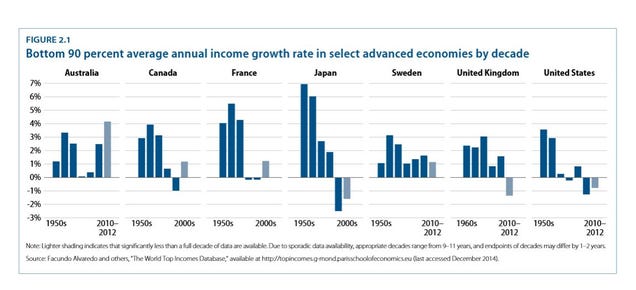
5) The entire gain of this business cycle has gone to the top 10%, and by the top 10% we really mean to the top 3% or so, with the .1% and .01% being the real winners. The bottom 90% has lost ground.

6) Rich people buy securities. The middle class and below buy goods.

7) While low oil prices are good for many countries, that they are driven by soft demand is not good.

Predicting this economy remains difficult because it is driven by the decisions of a very few people. Less than a hundred worldwide are key. The people who can create money, as credit, are key. They are almost completely unhinged from the economy as a whole: money creation is fiat, and being treated as such.

The great realization of the financial crisis was “hey, we can just create money and give it to the people we approve of and no one can stop us.” The people they approve of, unfortunately, are rich people playing ponzi games. Giving money to bankers who don’t lend to the regular economy (and why would they, regular people aren’t getting raises and don’t have vastly inflated housing prices) does very little for the economy that most people live in.

This leads to strong relative gains: not only are the rich richer, but everyone else is poorer. Austerity lets them buy up oligopolistic assets at fire-sale prices (see dismantling of the NHS in England for an example.) Their money increases, their relative power increases, and these policies are a win for them.

The thing is, hardly anyone has pricing power except people who are in an oligopolistic position. It makes no sense to loan money right now to anyone who doesn’t have pricing power, because they can’t pay it back.

There will be; there are, ways out of this. But they do require creating actual pricing power for the masses, breaking up oligopolies and dealing properly with the energy problem. The creation of some actual competitive markets (gasp!) combined with allowing anyone but the rich to have pricing power would do wonders for the world economy.

But that isn’t something your lords and masters want. The current situation suits them perfectly—compared to everyone else they are getting richer and more powerful. There is no reason for them to change how they are doing things.

Or is there? The resource barons are hurting, and they will want changes. But I doubt they are willing to see anything like widespread prosperity as a solution, because it would lead to a long term collapse of many of their fortunes, rather than a boom and bust cycle which the smart resource barons are perfectly capable of riding and using to their advantage.

Until the calculus of the powerful is changed, or they lose their power, while there will be ups and down the basic feature of the economy of the developed world (Depression) will not change, and the rest of the world will continue to suffer through huge boom bust cycles.
 
Jesus Christ, does your socialism know no bounds? Deflation would be good for the poorz. It means their money would be worth more. Inflating money for the next generation just means prices rise and your $1.50 per hour is worth less.
Where did that discuss inflation?
 
6) Rich people buy securities. The middle class and below buy goods.

You can sum that article up with this line. This is one of the grand differentiators between the elite and everyone else.

Rich understand that you're already rich, no need to get rich twice. Just invest in securities and dividend income and you're good. A person with 100m in assets can comfortably earn 5m a year on it. No rich person (save maybe some stupid athletes) spends 5% of their wealth in a year, so that money compounds. Lastly, the system is rigged so they pay much lower taxes on investment income, while the middle class pays 2x and 3x as much.


Jesus Christ, does your socialism know no bounds? Deflation would be good for the poorz. It means their money would be worth more. Inflating money for the next generation just means prices rise and your $1.50 per hour is worth less.

You don't understand deflation. It's generally a signal of some bad shit happening, and the elite live way above that dynamic. So their $1.50 may be worth more short term, but when have you ever known the poor to do anything but squander it? Once the shakeout behind deflation is elaborated, they usually have no jobs.
 
Fox at it again with it's news-o-tainment. There are no-go zones, but they are nothing like this. Fox is a joke.


Embedded media from this media site is no longer available
 
America the Unequal Can't Last Forever
njabc0f0r5xwgf8xodpg.jpg


America has money. Which is better than not having money. But all of the money in America is going to the rich. This is our basic problem.

We have prosperity, in the aggregate, but we do not have much equality in the distribution of all of that prosperity. This is America's most pressing economic and social flaw. It is important to keep talking about it and talking about it some more, until it changes. If you have a taste for soberly presented data, you should explore this new report from the Center for American Progress (accompanying analysis by David Leonhardt here), which takes a very "mainstream" look at the growth of economic inequality in America and in much of the rest of the Western world, and presents various "mainstream" proposals for fixing it. ("Mainstream" here is defined as "maybe something Hillary Clinton might say at some point.") It is a useful reminder of some basic facts about how we got here. For example: the decline of organized labor and the rise in power of corporations relative to workers.

Declining worker bargaining power, for example, appears to be a global trend. A job in many European countries can be offshored as easily as a job in the U.S. Midwest, which has been the case for workers across the manufacturing sector in high-wage countries. Yet nations that have robust minimum wages and protections for workers that empower their voice in the workplace have not seen such a strong divergence between worker productivity and worker pay. Indeed, Australia's workers face the same global trends, yet its switch to collective bargaining over and above a strong set of minimum conditions has helped workers keep more of their productivity gains in take-home earnings.

And an important effect of the current corporate incentive structure:

The shift to large equity-based compensation practices is a logical outcome of the shareholder-value movement, which purports that the share price of a publicly traded firm is an accurate market valuation of how well it is managed. In principle, tying executive pay to market valuations aligns the incentives of managers and shareholders, though experience suggests it is not so simple, and the shift to equity-based pay has caused management to devote resources to maximizing short-term share prices at the expense of the long-term value of the firm.

A testable prediction of this theory is that firms where managers and owners have similar information and incentives will be more responsive to market forces and more profitable in the long run. A recent study that compares similar privately and publicly held firms found that private firms invest nearly 10 percent of total assets annually, about twice as much as public firms, which invest closer to 4 percent of assets. Interestingly, the study's authors note that not only do private firms invest more, they invest better, responding strongly to changes in investment opportunities, while public firms barely respond at all.

Issues like CEO pay and general corporate governance are important not just because of how they affect the performance of a single company, but because the incentives that they put in place drive the behavior of the corporate leaders who ultimately drive much of the performance of the national and global economy.

When you consider also the role that the financial sector of the economy plays in leeching money away from everyone else like a great big, uh, leech, you may be encouraged to learn that earnings of the largest Wall Street banks are almost uniformly lower now. The banks tend to attribute this to various one-off problems that can quickly be corrected, but there is also the chance that it will turn out to be attributable to the long-term evolution of our society towards rationality and fairness and downright efficiency
 
Azerbaijan, a former Soviet Republic on the shores of the Caspian Sea, is a nation where the average citizen makes $420 a month. The family of Azerbaijan's President Ilham Aliyev has accumulated property and business interests around the world that are worth billions.


Embedded media from this media site is no longer available
 
Despite being a shit president, this is very important and necessary change. Fuck the bullshit about making community college free, you need to give the non-elite a tax break.

http://www.forbes.com/sites/robertw...gain-hike-to-31-8-in-simpler-fairer-tax-code/

Don't worry elite, this won't happen. But the biggest wealth generator for the elite is the income derived from dividends and is the largest reason that the wealth gap keeps increasing, so that's what this would target.

But fuck all the free shit he wants to give people. Do the tax break, asshole.
 
So basically he wants to increase taxes and expenditures? How is this new, he has raised taxes at every opportunity and failed to pass any budget that lowers expenditures.

He wants to increase taxes to fund a small tax break for the middle class, and then pay for more free shit. In general, bad moves. The only bright side is targeting the dividend income elite payoff that exists today that allows guys like Romney to pay shit for tax compared to their income.
 
How is this not an issue for you? Why should one group pay for everyone else? You admit it is bad moves but your class hatred blinds you to the reality of the situation.

People pay according to the tax code. Fairness has nothing to do with taxes, it is institutionalized theft.

You're not going to get away from the theft. Somehow our forefathers were stupid enough to allow us to be taxed. Now we're trapped, otherwise it's jail.

Fairness might not be the right word... more like balanced. Probably not the right word either. In the end, the wealth gap is getting to be 3rd world in America. The skimming the elite do is getting over the top so it's time to trim it so the middle class can eat too.
 
Why is it balanced for one group to be robbed at a greater rate so that other people get robbed less? More government intervention leads to a smaller elite with a higher concentration of power. This sounds like typical elite/liberal drivel - throwing the small fish into the fryer so the big fish just get bigger.

Tell me, why do the rich pay such a lower dividend income tax when everyone else pays so much more for their income?
 
Because that's money that was already taxed when it was earned in the first place. Whether that was 10 or 100 years ago it was already taxed. Why should money be taxed twice?
So how does this little program of yours work when the rich just bank all their dividends over and over again?
 
I'm fine with that. That's where (when the government isn't subsidizing loans to poor people that can't be paid back) loans come from.
Alright then dr. If this is your stance then I'm confused. Because you have a problem with capital gains tax and you have a problem with dividend income tax. Yet you're ok with the rich essentially bankrolling themselves for life off investments. What gives?
 
Yes. It's not my business where their money comes from. Especially now. You communists need to stop thinking in 20th century terms. We are going to live forever. If not dividend and cap gains income then what? You expect us to have to work forever? SS is going insolvent in 20 years so it's invest or rust.
You're completely off your nut.
 
Because that's money that was already taxed when it was earned in the first place. Whether that was 10 or 100 years ago it was already taxed. Why should money be taxed twice?

This is a fundamental misunderstanding of what income is. Rambo is 100% correct.

There's really only 2 things the rich can do with their money. Save it or spend it.

You missed the most important one to the wealthy: they can also invest it. And the modern elite invests it in a way that neither creates jobs or anything else of any tangible value really because it goes into shareholdings with the specific purpose of deriving dividend income. Any they have games the system so that their investment income/dividend income to be taxed at a very, very low rate relative to what the rest of us pay.

You're still trapped in this idea that the rich create jobs. The rich sit back and take vacations. Why on earth would they work?


Why should they not be fine bankrolling themself for life? They earned their money, why should it be taxed again and again until everyone is poor?

One common thread with these populist arguments is that they don't seek to make everyone rich - just to not let anyone have more then the person making the argument. Avarice is not becoming.

This is banal.

The income being taxed is profit. It's as if I earn 100k and start a business, and from that moment forward I never have to pay a lick of tax because the money was already taxed. Wouldn't that be grand?

Regarding inheritance, I tend to agree. It's more like a transfer. But with income generated from money you already have, it makes perfect sense to tax it. My would the elite love you as their senator.
 

Users who are viewing this thread

Back
Top Bottom