
- Messages
- 40,417
Your security is my utmost priority.Yes, I realize that. But now I know that they're there.
Follow along with the video below to see how to install our site as a web app on your home screen.
Note: This feature may not be available in some browsers.
Your security is my utmost priority.Yes, I realize that. But now I know that they're there.


16 August 2013 Last updated at 21:00 ET
Share this page
1.1K
Does it make statistical sense to sack a football manager?
Hannah Barnes BBC News
The top three clubs in the Premier League have new managers. But statistically speaking, do managers really make a difference to a team's performance?
Paolo Di Canio's enthusiasm was cited by the press as the reason Sunderland remained in the top flight last season.
When he took over the reins at the club, they were teetering on the edge of relegation and without a win in nine matches. Sunderland's future was not looking good.
After defeat to Chelsea in his opening game in charge, Di Canio secured back-to-back wins, first against local north-east of England rivals Newcastle and then Everton. But how much of this seemingly miraculous turnaround in form can be attributed to Di Canio himself?
Not much, according to Dutch economist Dr Bas ter Weel.
"Changing a manager during a crisis in the season does improve the results in the short term," he says. "But this is a misleading statistic because not changing the manager would have had the same result."
Ter Weel analysed managerial turnover across 18 seasons (1986-2004) of the Dutch premier division, the Eredivisie. As well as looking at what happened to teams who sacked their manager when the going got tough, he looked at those who had faced a similar slump in form but who stood by their boss to ride out the crisis.
He found that both groups faced a similar pattern of declines and improvements in form.

Chart compares relative performance of teams over time. At point "t", the manager is sacked or voluntarily departs. The analysis is based on 81 sackings, 103 voluntary departures and 212 performance dips in the Dutch football league from 1986-2004
While Ter Weel's research focused on Dutch football, he argues that this finding is not specific to the Netherlands. Major football leagues in Europe, including England, Germany, Italy and Spain also bore out the same conclusion - teams suffering an uncharacteristic slump in form will bounce back and return to their normal long-term position in the league, regardless of whether they replace their manager or not.
Continue reading the main story
“Start Quote
In the same way that water seeks its own level, numbers and series of numbers will move towards the average, move towards the ordinary.”
David Sally, co-author of The Numbers Game
And his theory seems to work if you look at what happened to other clubs in the English Premier League last season. The same week in March which spurred Sunderland to change the personnel in charge, Aston Villa were sitting at 17th in the table, struggling against relegation.
Villa too had been struggling to find form. Instead of dispensing with the services of manager Paul Lambert, however, the Villa board hung on and witnessed a turnaround in form. Over the same period of five matches Villa notched up two wins, a draw and two losses - exactly the same results that Paolo Di Canio achieved in his first five games in charge.
So how can this be explained? It's an age-old statistical phenomenon known as regression to the mean.
"In the same way that water seeks its own level, numbers and series of numbers will move towards the average, move towards the ordinary," David Sally, co-author of the football statistics book The Numbers Game, explains.
"The extraordinary, numbers-wise, is followed by the ordinary; the ordinary is followed by the ordinary; the ordinary is what happens. The average is what happens more often than not."
It's this phenomenon which is taking place when we witness a small bounce-back in performance immediately after a new manager is appointed. But crucially, it would have happened anyway, and may well have been much cheaper for clubs who sacked their managers to hang on rather than be faced with a hefty pay-off.
To put it bluntly, according to Sally "a short term decline in performance is not a good reason to be firing your manager".
And of course, there are some football clubs who change manager and continue to see a lousy run of form.
Languishing in the relegation zone last season, Reading dispensed with their manager, and brought in new blood - Nigel Adkins. Unlike Sunderland's turnaround though, Reading continued their dire run, recording three losses and two draws in Adkins' first five matches in charge. They were relegated.
If slumps in form are often naturally corrected, does it make no difference at all who's at the helm?
Not quite.
Ter Weel suggests that selection is at play.
"Managers and players sort in such a way that the best end up at the best clubs and the worst at the worst clubs. It is not a coincidence that Mourinho is with Chelsea and Guardiola with Bayern Munich. These clubs only attract the best managers. However, changing managers does not seem to improve the result. After releasing Villas-Boas [in March 2012] the performance of Chelsea did not improve."
Chelsea were fifth when AVB was sacked and ended the season in sixth. New manager Roberto Di Matteo did unexpectedly lead the club to Champions League glory. But Ter Weel's research looks only at league performance, not cups.
According to Sally, football clubs can be seen as any other business or company. Business research suggests that structural factors - such as how long it has been operating and which industry it is part of - are much more important than who the chief executive is. In money terms, around 15% profitability can be determined by the quality of the man or woman in charge and the same can be said for football managers, Sally estimates.
So back to this season of the English Premier League and the all-important question of whether Manchester United will retain the title. Sally is withholding judgement.
"The things that are set in stone at a club like United - that has a great stadium, a great tradition, all the facilities you would want - are very fixed in the long run and will ensure its success. But the performance of the manager - in this case Ferguson moving to Moyes - will be an important factor in its short term position in the table."

Argentines make their mark on El Tri
Posted by Hector Quispe
MEXICO CITY -- A glance at the list of naturalized citizens on the Mexican national team reveals that Argentines are the import of choice, with a total of nine, and that in the past decade, they have been the likeliest to play in the World Cup for Mexico.
Of the 16 foreign players who made their way onto El Tri, Brazil holds second place, Cuba and Spain have two players and there is one Peruvian: the great Julio Lores, striker for the legendary Necaxa team of the '30s and part of the "11 Hermanos" (Eleven Brothers), and who was, in fact, the first player born abroad to be tapped, playing from 1936 to 1938.
This tally also shows that naturalizing players hasn't been a trend but an emergency, according to Ricardo Antonio La Volpe, alternate goalkeeper for Ubaldo Fillol in the 1978 Argentina World Cup, and who guided Mexico's fate in Germany 2006. La Volpe activated Guillermo Franco, from the city of Corrientes, and Antonio Naelson "Sinha," from Itaja, Brazil, because two strikers of their quality couldn't be found in Mexico. "And if we look at all the lineups, we'll find the same thing, except in the goal box," La Volpe said.
Forty years count for something...
A whole 40 years would pass before a naturalized citizen would be considered for El Tri, and it was Gabriel Caballero to take the staff from Carlos "Charro" Lara in the Argentina-born relay.
The player who opened the door to the latest era of naturalized citizens was Gabriel Caballero, led to the 2002 Korea-Japan World Cup by Javier Aguirre, after rescuing Mexico from not qualifying with Enrique Meza at the helm. The midfielder was at the top of his game when he lead Pachuca. But on World Cup Asian turf, the former Tuzos coach (his coaching stint ended last Monday, Sept. 2) was too passive in his approach.
Caballero, who started his Mexico stint as a striker in Santos Laguna, didn't score at the World Cup, and will be remembered with El Tri's dark night falling to the United States in the knockout round.
Eriksson's surprises
Swede Sven Goran-Eriksson surprised everyone when he played Brazilian Leandro Augusto and Argentines Lucas Ayala, also a midfielder, and Matias Vuoso, striker, in a game en route to South Africa 2010. The only one who succeeded from the group was Vuoso, who scored the goal that moved Mexico to the Hexagonal for the CONCACAF qualifying round.
Ayala finished his run for the national team very quickly and Franco was kept on by "Vasco" Aguirre who, in his second round as the Tricolor coach, took the reins of the national team when its South Africa dreams were in jeopardy, forcing him to pick up the pieces left by Hugo Sanchez and Sven.
Initially, "Guille" Franco was well-received by Mexican fans, but when Aguirre used him as a starter instead of "Chicharito" Hernandez in the last World Cup, Azteca fans promptly directed their wrath at him, a unique case that ended in Franco's exile.
True love?
For some naturalized players, the decision to join the Mexican national team was not a first choice. Before getting his papers, "Chaco" Gimenez had not claimed true interest in joining El Tri because deep down he felt "very Argentine."
Sinha is a special case, prepping for the naturalization process and tests with great discipline. Long before his naturalization, he even learned the Mexican national anthem by heart. He has also been the busiest import on the Mexican national team, with 58 games since 2004, when he was called by Ricardo La Volpe for the qualifying rounds en route to Germany 2006. In the era of "Chepo," he was considered eight times, the last one facing Guyana in the CONCACAF elimination semifinals in 2012.
"Guille," who played in the 2006 Germany and 2010 South Africa World Cups, had 27 appearances but was benched only three times. In the first with La Volpe and then with Aguirre in South Africa, he has been the strongest foreigner, with seven goals scored.
More Gauchos heading toward Brazil 2014
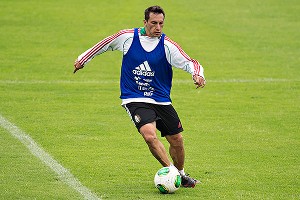
Miguel Tovar/Getty ImagesChristian Gimenez is the latest Argentine who was naturalized Mexican to play for El Tri.
"Chepo" de la Torre has revived the debate over naturalized players, first by calling Argentine Damian Alvarez, left winger for Tigres in Liga MX, to play in a friendly with Colombia in February 2012, but for only 16 minutes. It seemed he wouldn't be played again, until a year and a half later when he was, alongside his countryman Christian "Chaco" Gimenez, becoming Mexican only in July 2013.
Both had already shined at Pachuca, as CONCACAF champions in 2008. And in the 4-1 win on Aug. 14 in the friendly with the Ivory Coast, both delivered: "Chaco" because of his fresh spark to the Mexican midline, right when El Tri seemed in crisis again, and its World Cup road to Brazil 2014 uncertain.
The scroll of naturalized El Tri Argentines could get longer if "Chepo" calls upon La Plata native Lucas Lobos, 32, brains of Tigres, who nationalized about as recently as "Chaco." That would reach the double digits of imports. Ten "simple and charismatic" Argentines hitting the trenches for El Tri.
Sounds like a Sportsbook bet to me...Fantastic. US/CR tonight. 8 USMNT players are on yellow right now.
The ref? Mexican.
We play Mexico in 4 days.
Let's see how many US players pick up random yellows tonight, forcing them to miss the MX game on Tuesday? Odds on 5+?
Sounds like a Sportsbook bet to me...
Go here:If I knew how to set that up, I'd be all over it.
True, but I was just trying to get him to understand the example.Or you could just make even odds for both outcomes to discourage the whole... you know... weird randomness that I'm trying to get people to stop doing.
Also 400/100 is 4/1. You don't need to go into hundreds for that. And that's a really high payout.
This. The -3, +6 looks confusing visually.Then just write it out.
Correct. Also, higher perceived difficulty of it actually happening.Yes. Well, I believe the number will be higher for discriminatory reasons, but hope the ref doesn't follow suit. The point of greater odds = a higher payout if it happens, no?
The point spread - also called "the line" or "the spread" - is used as a margin to handicap the favorite team. For betting purposes, the oddsmaker predicts that the favored team will win by a certain number of points. This number of points is the point spread. The favorite is always indicated by a minus sign (e.g. -5.5) and the underdog without (e.g.5.5). If you bet on the favorite, you win your bet if the favorite wins AND their margin of victory is greater than the point spread. If you bet on the underdog, you win if the underdog wins, ties, or if the favored team wins but fails to exceed the point spread. It is standard for point spread bets in most sports that you wager $110 to win $100.
A money line, used in baseball and hockey, takes the place of a point spread. Money line betting is simply wagering on the contest based on a given price rather than a point spread. The team wagered on has to win the game outright, regardless of the score. The minus sign (e.g.-130) always indicates the favorite and the amount you must bet to win $100. The line without the minus sign (e.g.120) always indicates the underdog and the amount you win for every $100 bet. Using this example, therefore, you would bet $130 to win $100 on the favorite, while for the underdog you would bet $100 to win $120.
The over/under is the number of points oddsmakers expect will be the total score for the contest (both teams combined, overtime included). You bet on whether the total points scored will be more or less than this number. As with point spread bets, you must generally wager $110 to win $100.
Betting on a point spread or money line is sometimes called betting "sides" - that is, betting that one side or the other will be the winner - while betting the over/under is referred to as betting "totals".
Ooooh, I like that one!I still recommend using oddschecker.com
It's an aggrigate of a lot of betting sites.
For example: there are 195 possible wagers on Costa Rica vs USA right now:
http://www.oddschecker.com/football/world-cup/matches/costa-rica-v-usa/betting-markets
I'm sure I ran across it. I just made the mistake of not bookmarking it. Fixed that now.Apparently nobody reads anything I post in here, since that's the same one I recommended on page 1 of the sportsbook thread.
http://wdwv.net/forum/threads/sportsbook-the-official-thread.432/#post-18238


And now he's injured....Excited for Bale's debut today.