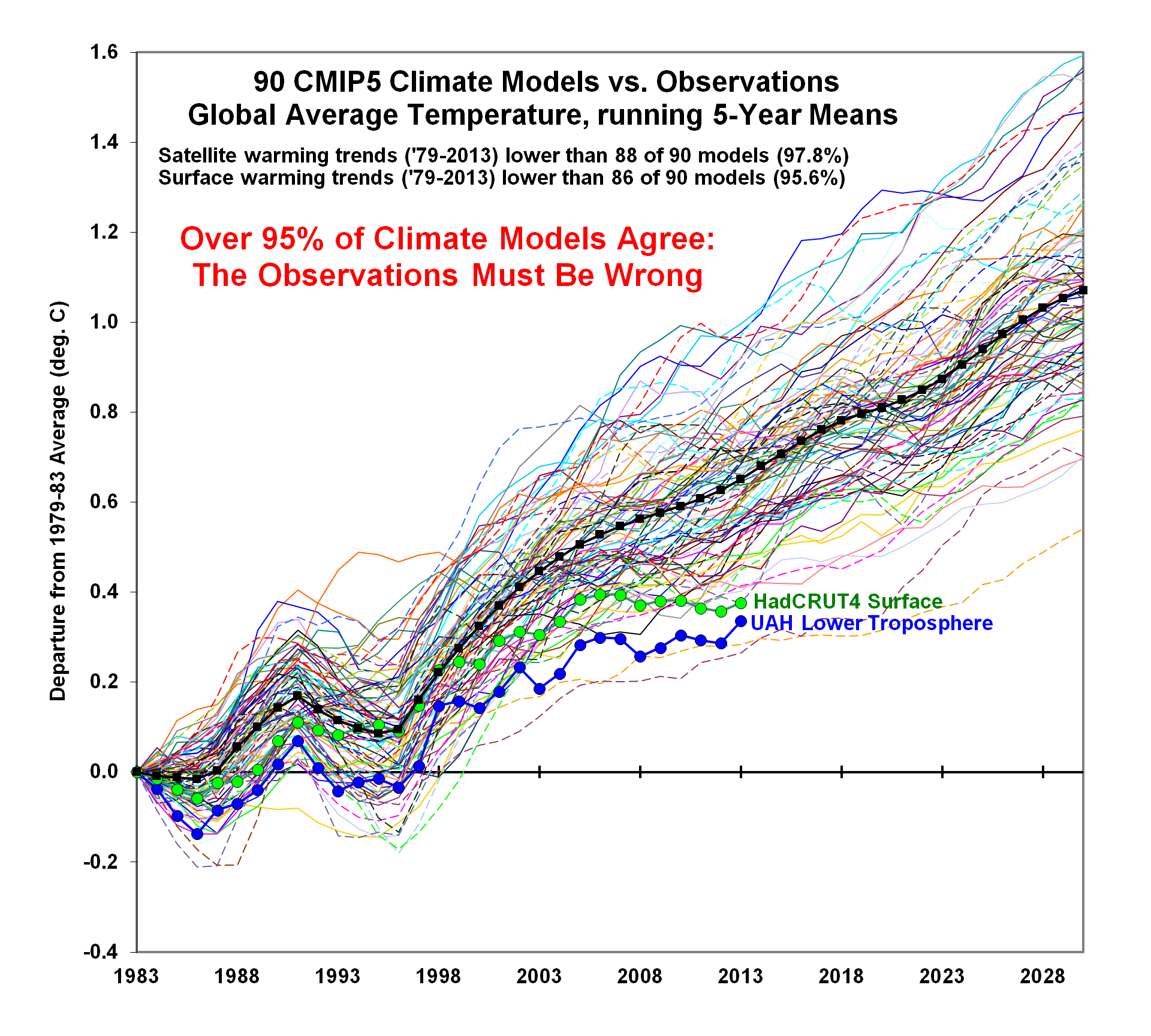
Climate Change Is The Biggest Threat & Will Kill Us All

The north pole is basically a giant lake now.

Glaciers are disappearing at a never seen before rate.

We are injecting a gas into the atmosphere that warms the planet at a massive and consistent rate.

The jet stream is moving slower. It's just a measurement versus the past. And its moving slower because the temperature difference between the poles and the equator is less.

I don't see much prediction there. Just seems like obvious stuff.
 
True. But this one is man made. There is overwhelming evidence. There have been all kinds of climatic eruptions in the past, but we're behind this one. There was an ice age 15,000 years ago.

Point to another factor that explains the changes in weather patterns, the warming of the oceans, and the melting of the ice caps.
 
So I ask how you interpret results an you answer a bunch of people said this is right so it's right. How is this any different from Jimmy listening to fox news and climate chance skeptics?

The burden of proof for a scientific hypothesis is not on the deniers. The null hypothesis, in this case firstly that climate change is not occurring and secondly that humans are not causing climate change, must be dis-proven. What overwhelming evidence do you have that is not disputed by other scientists, or shown by revealed communications to not have been fabricated or misrepresented?

Read up on the science if you need convincing.

Most if not all disputed evidence comes from companies damaged by the change that would need to happen to control greenhouse gas emissions, namely fossil fuel providers. It's a manufactured debate. I am not aware of any reputable institution or scientist that denies human emission of greenhouse gasses are the main culprit, unless they are oil company funded. You know, the cow farts crowd.

Here is some evidence, but unfortunately since it's a granola tree hugging organization, it might roundly be dismissed. I hope not.

http://www.greenpeace.org/usa/en/campaigns/global-warming-and-energy/polluterwatch/koch-industries/
 
Not sure if you're trolling or didn't understand the CO2 graph I posted earlier in the thread, unless you deny CO2 as a greenhouse gas. :scratchchin:
 
Like I said before, the onus is on the people saying that something is happening to provide proof. You can talk about any amount of evidence that you want, but have failed to put forward a single point of peer reviewed evidence. Sure is nice to read that someone is paying money to have their viewpoint heard, but there is no difference between you posting a piece from greenpeace and posting a piece from an oil company. Neither one is a scientific paper, nor do they mean anything to me as they are both pushing a fully funded agenda. I will again ask you, what evidence do you have that shows conclusively that: 1, the climate is changing; 2, that human emissions are the cause of the aforementioned climate change; 3, that your findings allow you in any way to predict the effects of climate change on a system.

I find that when people talk about manufactured debates it is quite often a sign of lack of knowledge in a field. Personally I do more than read papers on climate change, I have a paper in publication on the effects of latitudinal gradient focusing on temperature gradients in intertidal snails. Additionally I currently do research on fish populations in the great lakes, modelling the effects of temperature and possible changes from the ecosystem. I'm not denying that climate change exists, I just doubt the claims you are making and not supporting.

I'm not making the claims, scientists are. With my available understanding, I happen to support their claims.

I think the point I was substantiating in my link is that oil interests are funding research to deny the idea human activity is largely responsible for climate change with CO2 emissions. I can't find any examples of the opposite happening.
 
As you keep repeating, yet you continue to fail to produce a shred of evidence. If they are such widely held beliefs than you should have no problems finding proof.


So you feel that an organization whose funding relies on environmental issues has no stake in future environmental controversies? That people who work for these organizations or get funding for scientific research from organizations who publicly push a climate change driven agenda have no stake in the issue?

I guess what I'm saying is that I don't need to be tasked with searching out evidence to substantiate my views. I'm not asking anyone for the opposite. I'm welcome to a viewpoint, and if evidence is so important, then by all means go and search for it.

Regarding funding, I feel an organization whose fundamental business relies on burning a resource that is directly responsible for the effects of climate change and is vastly more wealthy should have it's funding of research scrutinized. As far as I know, Greenpeace is not funding research into climate change, in that article they are merely pointing out that the Koch brothers are spending on the topic like drunken sailors.

I posted earlier in this thread about the issue having a manufactured debate creates. I understand you view that label differently, but I see manufactured debate as being more the norm than the exception.
 

Technically, he's correct. You can fuck with statistics and "facts" to suit your interests. I find it hard to understand how your graphs can be interpreted as anything but what they are (humans are filling the atmosphere with CO2 and heating it), but there are countless instances of it, my personal favorite:


But lets not forget the media on climate change. They're fair and balanced. Lots of fact based discussion here.

 
Last edited by a moderator:
Would be nice to see a systematic review of the evidence to throw out the scientifically un-rigorous reports/papers/tweets/Facebook postings etc. and focus on research with merit. Maybe their is one but unfortunately it is easier for the media, the pro-side, the con-side to just dabble in snippets of information often taken out of contest. No side is without blame.

The biggest flaw on the scientific side is the marshalling of scientists who have no business spouting off about it.

It reminds me of astronomers & physics who spend more time dissing the competition and blowing their own horns.
 
Would be nice to see a systematic review of the evidence to throw out the scientifically un-rigorous reports/papers/tweets/Facebook postings etc. and focus on research with merit. Maybe their is one but unfortunately it is easier for the media, the pro-side, the con-side to just dabble in snippets of information often taken out of contest. No side is without blame.

The biggest flaw on the scientific side is the marshalling of scientists who have no business spouting off about it.

It reminds me of astronomers & physics who spend more time dissing the competition and blowing their own horns.

I disagree. The industries manufacturing the debate are to blame in my view.

I'm going to quote myself so I don't have to write it again:


I take similar but slightly opposite view. I think you have a large number of scientists that are very alarmed, and has a pretty significant body of evidence that it's related to human activity. I think the marketing campaign is the innumerable body of vested interested adversely affected by the kinds of change the science is indicating is necessary.

This seems like a derivative of the discussion about the ice bucket challenge. Everything's a marketing campaign.

I think we largely agree on these chicken little scenarios, but I also think there is early evidence that storms are becoming increasingly more powerful, that the jet stream is slowing, etc.

My suspicion is that the warming camp feels like they need to present an extreme viewpoint because the business/political class is undermining the valid science.
 
Technically, he's correct. You can fuck with statistics and "facts" to suit your interests.

If my graph were say on methane rather than carbon, then it would be misleading in favor of the denial camp. I also pointed out earlier Russell misled by posting Arctic area graphs rather than volume graphs.
 
I disagree. The industries manufacturing the debate are to blame in my view.

I'm going to quote myself so I don't have to write it again:

It is not as simple as saying industries are fanning the flames of debate for their own self-interests.

We have seen scientists lying and manipulating data which is not the same as making dire predictions to try and have the world recognize the problem. They have flat out lied.
 
It is not as simple as saying industries are fanning the flames of debate for their own self-interests.

We have seen scientists lying and manipulating data which is not the same as making dire predictions to try and have the world recognize the problem. They have flat out lied.

That may be true, I don't know. But the oil industry is out and out lying at almost every turn. Are you going to point to a couple of scientists or an entire industry manufacturing a campaign to keep it's profits safe? And by proxy ignoring the wealth of science that demonstrates climate change is caused by humans?
 
Except only one side is proposing the implementation of costly regulations. Its great for everyone to have their own opinions but when one side starts pushing for the other to be penalized, such as exactly what the website that was posted calls for, facts need be be checked. Just because someone feels that something is right or that something is happening does not make it so. To base legislation and policy off of feelings is absurd, yet seems to happen quite frequently when environmentalists are concerned.

Personally I don't care about either side, I just would like someone to put forward evidence to back their claims that has not been fabricated, is not misinterpreted, and has been peer reviewed.

Then have the oil industry prove it's not true, and find the culprit. One side is pushing to save the planet from a massive upheaval, the other wants to preserve it's margins. For me, enough evidence exists to say it's CO2 and not cow farts.
 
What's the upheaval going to be?

Edit - seems that climate changers are the ones who want a massive upheaval by shutting down all industry and making us live like peasants. Oh, except for the chosen few, who will rule us from their golden towers.

Please, it's money on one side vs. power on the other. They're all whores.

Oh JimmyRustler, how naive can you be?

I read you post on how the tipping point of oil was all hoopla. Balderdash. I saw the tipping point coming, adapted and have never looked back. Good luck running the jag-you-are on Mazola.

Wind power for the win

image.webp
 
http://www.vox.com/2014/12/1/7314727/un-climate-talks-lima

7 charts to help make sense of this week's UN climate talks
Updated by Brad Plumer on December 1, 2014, 2:20 p.m. ET @bradplumer brad@vox.com


15922670961_4a45545d02_k.0.0.jpg

A photo from the UN climate change conference in Lima, December 1, 2014. UNclimatechange/Flickr
This week, thousands of diplomats from across the globe are gathered in Lima, Peru, to start hashing out a new agreement to address global warming. The hope is that they'll have a final deal in place by the end of 2015.

It's a daunting task. Scientists warn that the world is currently on pace to heat up around 4°C (7.2°F) or more by the end of the century. That much extra heat could have disastrous consequences: the eventual loss of Greenland's ice sheet, steep sea-level rise, crop failures, mass extinctions, and so on.

Even if we zeroed out fossil-fuel emissions, the world would still be hotter in 2100

The clearest way to avoid that fate is to reduce global greenhouse-gas emissions in the coming decades. But even if the world managed to zero out fossil-fuel emissions this century — an exceedingly ambitious goal — we may still be on pace for 2°C (3.6°F) or more of warming by 2100. That's not quite as drastic, but it would still mean some amount of sea-level rise, widespread flooding, increased drought, and so on. Poorer countries, in particular, could struggle to adapt.

So the point of the UN talks is for countries to figure out how best to navigate this increasingly difficult situation: How much should global emissions be cut? What actions should individual countries take? How much aid should wealthier nations offer to poorer nations to adapt to whatever level of warming we do get? These questions won't all get answered definitively by 2015, but the hope is for an agreement that at least gets things started.

In the past, these talks have often been gridlocked by deep disagreements over how to divvy up these tasks. Poorer countries have argued that the US, Europe, and other rich nations are to blame for most of the man-made carbon-dioxide currently in the atmosphere, so they should bear the burden for both cutting emissions and providing aid to poorer countries. Richer countries, for their part, argue that you also have to look at future emissions to tackle the problem — so fast-growing nations like China and India need to do more.

In November, the US and China had a mini-breakthrough of sorts on this impasse when both countries pledged to curb their emissions between now and 2030. That's led to some optimism about these upcoming talks. But that deal wasn't enough, on its own, to decisively alter the trajectory of global emissions and avoid 4°C or more of warming. A lot more is still needed for that.

So below are 7 key charts from the Global Carbon Project that give a sense for what's at stake in these talks — and why it's so difficult to come to a deal:

1) The world is currently failing to meet its climate goals
failing_at_two-degree_goal.0.png


(Global Carbon Project)

Let's start with the big picture on climate change. The black line above shows the current growth of annual carbon-dioxide emissions worldwide. The colored lines show various future pathways and what they'd mean for global warming.

We're currently on pace for somewhere between 5.8°F and 9.7°F of warming

The world's nations have all agreed that it would be "dangerous" to allow global average temperatures to rise more than 2°C (or 3.6°F) above pre-industrial levels. (See here for why.) But to have a decent chance of staying below 2°C, global emissions would likely have to follow the blue or yellow trajectories — peaking in the very near future and declining sharply by century's end.

Instead, emissions keep rising. And if emissions continue on their present course, scientists estimate, we can expect somewhere between 3.2°C and 5.4°C of warming by the end of the century (that's between 5.8°F and 9.7°F). Various reports have warned that this would entail dramatic and irreversible changes, like destabilizing Greenland's ice sheet or large-scale extinctions. The World Bank, for one, thinks this much warming could be impossible for many countries to adapt to.

Recently, countries like the United States, Europe, and China have all made various pledges to reduce their emissions in the future. But even if you take all those pledges seriously, analysts at the Climate Action Tracker have found that we're still on pace for between 3°C and 4.6°C of warming by century's end. That's not much better. (The range is largely due to uncertainty over exactly how the climate would respond to so much carbon — but scientists are quite confident that it would get a lothotter.)

2) We'll blow through our "carbon budget" for 2°C in 20 to 30 years
remaining_carbon_budget.0.png


(Global Carbon Project)

Here's another way to look at the climate issue. If we want to avoid more than 2°C of global warming, scientists estimate, then humans can only put about 3,200 gigatons of carbon dioxide into the atmosphere. (This gives us a two-thirds chance of staying below the limit.)

We're about two-thirds of the way through our carbon budget

Since the Industrial Revolution, we've loaded roughly 2,000 gigatons of carbon dioxide into the atmosphere. So we only have about 1,200 gigatons left. And at current growth rates, we'll blow through that in about two or three decades.

That's our "carbon budget." Meeting the 2°C goal would, in theory, entail divvying up the remaining 1,200 gigatons among various countries. Country A gets to emit this much carbon. Country B gets to emit this much carbon. And so on. But that's incredibly hard to do. For one, setting these sorts of top-down goals hasn't had much success to date. And, as we'll see below, allocating responsibility isn't easy.

By the way, there's a good argument that the 2°C limit has become impossible, and that something like 3°C (or 5.4°F) is a more realistic goal. If that were the case, the carbon budget would be a bit bigger (we'd have around 2,000 to 2,500 gigatons left), but we'd still be on pace to blow through it within several decades.

3) The US and Europe are responsible for much of the CO2 already in the atmosphere...
cumulative_historical_emissions.0.png


(Global Carbon Project)

Now comes the blame game. The chart above shows cumulative emissions from fossil fuels and cement over time. For any given year, it more or less shows who is responsible for what fraction of the carbon-dioxide in the atmosphere.

The US and Europe have had their fossil fuel party, now India and China want theirs

As you can see, the United States and Europe are responsible for 49 percent of all carbon emissions from fossil fuels and cement that have been emitted since 1870. They've long enjoyed the growth benefits from using fossil fuels — and now other countries want theirs. This chart also explains why many people put the blame for current global warming squarely on the United States and Europe and are asking for aid to adapt.

But the US and Europe, by contrast, argue that the situation is now shifting rapidly. If you only look since 1990, China has been responsible for 20 percent of the cumulative emissions in the atmosphere — more than Europe (14 percent) and on par with the United States (20 percent). That's why wealthier nations often point instead to charts like the one below:

4) ...But nowadays it's developing countries who emit the most carbon
upload_2014-12-2_3-52-15.gif


(Global Carbon Project)

The previous climate treaty — the Kyoto Protocol of 1997 — divided the world into two sections: wealthy nations ("Annex B") and developing countries ("non-Annex B"). The former were supposed to cut their emissions. The latter were allowed a free pass so that they could keep growing.

Emissions from wealthy nations are declining

As the chart above shows, that more or less happened. Annual emissions from Europe, the United States, and other wealthy "Annex B" countries are declining, albeit slowly. But emissions from developing countries have exploded.

Today, developing countries produce 58 percent of the world's annual carbon-dioxide emissions. China alone is responsible for 27 percent. This is why negotiators from wealthy countries often insist that China and other poorer countries need to commit to reductions in any new treaty. China, for its part, has recently pledged to have its emissions peak by around 2030 (although it won't say at what level). It remains to be seen if other developing countries follow suit.

5) China's per capita emissions are now higher than the EU's
upload_2014-12-2_3-52-15.gif


(Global Carbon Project)

Here's another chart on the same theme. China's overall emissions are currently higher than those of the US or Europe. But Chinese negotiators have long argued that that's only fair — after all, China has 1.3 billion people, so of course it's emissions will be higher.

But now China is crossing a different threshold. It's per capita emissions are actually higher than those in Europe. (They are still far below America's, although America's have been dropping sharply.)

By the way, that chart above also shows why India is so reluctant to heed calls to reduce its emissions — especially when its per-capita emissions are still so low and 300 million people still have no access to electricity.

6) That's partly because rich nations are "outsourcing" their carbon
outsourcing_emissions_2.0.png


(Global Carbon Project)

Here's another tricky issue. Emissions can also be "outsourced" abroad. Say, for instance, a US factory moves to China and produces goods that are then shipped back to the United States. America's emissions decrease. China's emissions increase. But who's responsible for that carbon, really?

This isn't a trivial issue. The Global Carbon Budget 2014 report notes that virtually all of the reductions in emissions made by wealthy countries like the US and Europe since 1990 have been offset by "outsourced" emissions to places like China. These emissions transfers are now growing at a rate of 11 percent per year.

7) Divvying up the remaining carbon budget is... complicated
divvying_up_to_meet_the_budget.0.png


(Global Carbon Project)

So now, if we want to stay below the 2°C limit (or 2.5°C or 3°C), negotiators have to take all of the factors above and come up with some way to divvy up the remaining carbon budget.

As this chart from the Global Carbon Project shows, there are lots of ways to do this. Negotiators could agree to let everyone maintain their current share of emissions (an "inertia"). The United States emits 18 percent of the world's emissions today and gets 18 percent of the remaining carbon budget. But that's not terribly fair, since India would get penalized for being poor — it would miss out on the growth benefits of burning fossil fuels.

Alternatively, you could take an "equity" approach. India is a big and poor country in dire need of more growth. So it should be allowed to take up a bigger share of the carbon budget. The United States and Europe get a much smaller share, by contrast — they need to enact draconian emissions cuts. The problem is that it's not clear whether this is even technically feasible.

A third approach, described here, is a "blended" approach that tries to compromise on all these different issues. A recent paper in Nature Climate Change argued that this was the best way to stay below the carbon budget. Whether national governments agree with that, of course, is another story.

More realistically, the world's nations will set their own individual goals based on what they each think makes the most sense for themselves. Most analysts think this is the most likely outcome of the current UN talks — each nation sets voluntary goals for themselves and the new treaty sets up some sort of monitoring and verification mechanism.

Now, whether all those voluntary pledges add up to staying within the carbon budget and below 2°C is much less clear. Which brings us all the way back to chart #1 up top…

Further reading
Past UN climate talks have failed. Will this one be any different?

How to stop global warming, in 7 steps.

An in-depth look at the 2°C climate goal — and what happens if it's no longer feasible

Here's what the world would look like if we took global warming seriously
upload_2014-12-2_3-52-15.gif
 
What's the upheaval going to be?

Edit - seems that climate changers are the ones who want a massive upheaval by shutting down all industry and making us live like peasants. Oh, except for the chosen few, who will rule us from their golden towers.

Please, it's money on one side vs. power on the other. They're all whores.

Rising sea levels, to start.
 
This is exactly what I mean. You want someone else to prove the negative, which if you can understand statistics is much much harder. Then in the meanwhile you want to cause the destruction of entire industries because of your feelings, all while being unable to reference a single paper that supports your points. This is not science but rather fear mongering.

All I want to see is facts before action. Jimmy is the voice of reason, neither side is anything but whores for differing agendas.

I feel the science is pretty conclusive, you don't. It seems very clear to me that human emission of CO2 is changing the climate. That's the positive proved in my mind. Now, if the oil industry feels it's another culprit, then the onus is on them to identify it. So far, it's a bunch of mush designed to confuse the public. Cow farts and volcanoes, etc.

Note the hole in the ozone was identified as being from human activity. We do have the power to change the atmosphere.

Rustler is not voicing reason. He's repeating the same comment over and over again about prediction. I'm not so concerned about that as I am the alarming levels of CO2 in the atmosphere, which I really don't know what has to do with prediction.
 
Horseshit.

"Even if we zeroed out bullshit we'd still be hotter by 2100"

I can't copy paste so that's my quote. I will bet you $1 trillion the world is not hotter by 2100.

Jimmy, tell us, do you disagree the planet is warming? If so, what is causing it?

Above, the reason we'd still be hotter is because of the amount of CO2 humans have already emitted in the atmosphere. I'd like to understand what you think the cause of this warming is?
 
Prediction is a big part of what makes science. Replication of results. So if every time you throw a baseball in the air it falls to the ground you have a pretty good idea that if you throw another baseball in the air it'll fall to the ground too. Climate changers are incapable of making that type of prediction because their science is junk, based on supposition, insufficient sample size, and political ideology. They can't tell you whether next year will be the hottest or coldest on record, they can't tell you how many hurricanes we'll have next year or how many feet of snow we'll get. They can't tell us this because they're goddamn morons.

You seriously want to compare tossing a ball in the air to complex climate models and humiliate intelligent researchers because the science their developing is not perfect yet?

Just because a science is new doesn't make them morons. Isaac Newton created modern physics, was he an idiot because he didn't derive relativity? Perhaps you can deride Thomas Edison because his first light bulbs only lasted for a moment?

Please specify the following that you keep saying with no substantiation: how is their science junk? What is an appropriate sample size? What evidence do you have that political ideology is at play? Where is this large scale scientific endeavor that is trying to predict whether next year is the hottest or coldest on record? The other large scale scientific endeavor trying to predict exactly how many hurricanes there will be next year? And the one that has scientists the world over trying to precisely derive how many feet of snow will fall next year?

Seems like a lot of distraction to me. When you see the weatherman projecting a hurricane's path, is he stupid because he can't track it to the millimeter 3 days out? The work being done is not perfect, but it's improving by leaps and bounds as modeling improves, more data is gathered, and computer power increases. Perhaps a lack of understanding on the complexity of the task at hand is fueling the idea that the work revolves around perfect prediction.
 
Like I said, you feel things are a certain way and have yet to put forward a single peer reviewed source backing a single one of your claims. You post graphs that make you feel good and ignore data that you don't like. The onus is not on people to prove that they have done nothing wrong, or did I forget about the systems we have in place for legality and science? He does not need to do more than repeat the same claim (which you fail to address every time), what proof do you have other than biased sources and how you feel?

I've address this. You're welcome to post a peer reviewed article identifying something else as the cause of global warming other than human activity.

At this point I have to conclude you are trolling. Leland has at least provided graphs, you have done nothing other than link sources which are non scientific and mostly funded by environmentalists who decry oil companies for a living.

It was a response to Smithee. I was trying to say that it has about the same value as that graph posted before it.
 
Yes, we keep going in circles. You have no proof for your claims so continue to say that we have to prove you are wrong. Quite asinine, but quite predictable considering the positions you are espousing. You are making unfounded claims and thereby trolling.

Posting a graph is quite different from posting a propaganda photo.

Posting a propaganda graph is no different than a photo.

To your other point, here is a list of 2,258 peer reviewed journal articles that in some form or another mention human contributions to global warming written across 2012 and 2013 in a study done by a USC professor.

http://www.jamespowell.org/resources/Nov2012thruDec2013.xlsx

In addition, he authored a follow on study on climate change articles found only 2 our of 13,000 or so that rejected human involvement.
 
Cool, so can you address the third point? That there is any reliable prediction of the effects of human action on the climate? I ask this because if you believe that making laws in first world countries would impact climate change you obviously must be able to predict the effects of your policies, right?

We have already seen the countries you propose make regulations merely shift their production of the regulated goods offshores. What effect do you see from your policies other than a shift of wealth from first world countries to those with much worse human rights and wealth inequality?

I'm not sure any claim I've made goes beyond believing that changes to the climate are man made. Perhaps someone here made other claims but I didn't, and so I feel I've substantiated my claim with thousands of articles to support it.

Yes, there is information out there on the amount of effect, but I don't get behind any of it as fool proof fact. The predictive models are improving, but they could be off by some margin, nevertheless, the impacts of human activity on climate are already substantial. All indications are storm intensity is increasing and other things I've already mentioned. Within this there might be some statistical anomaly, but the macro pattern trends with the models.

Lastly, I didn't propose any regulations. I did mention science is showing us changes are necessary to stop the influence of our activity on the climate, but never said what or by whom.

So now, can you please point us to any peer reviewed journals that demonstrate humans are not the culprits behind climate change?
 
Why? I already said I couldn't care less either way I just want to see proof for either side. All I know is that things in the atmosphere cause for temperature and thereby climatic changes. Stuff happens and the world changes. Firstly I don't understand how humans are not included in natural causes, when did we stop being natural - I never got my alien/robot body. Secondly I don't understand how it is understood from the data that changes are necessary. I believe the data shows that we need to make China and India lower their greenhouse gas output while not outsourcing it. Look at areas of highest pollution and population - most of them are in third world countries.

For someone that doesn't care either way, you sure did choose to poke at one side of the argument.

Humans are not considered part of the natural order because we're influencing the climate in a way that changes the natural course of the planet's evolution.
 

Users who are viewing this thread

Back
Top Bottom