
- Messages
- 6,461
Hey everybody, let's create a fiat commodity worth nothing that we can sell! We'll call it carbon offset credits!
Free money!
Follow along with the video below to see how to install our site as a web app on your home screen.
Note: This feature may not be available in some browsers.

In this argument only one side chooses to propose to devastate the economies of entire regions of the US. How is human change of the environment different than the change from the first photosynthesizers? Huge difference from adding oxygen to the atmosphere.

OfficePants has been doing a yeoman's job of it in here. Kudos to him.


You are fighting a strawman with your argument, I have failed to make a single argument you are proposing for me. Every one of the things in your post is repugnant and shares the same flaws. They rely on a central government restricting individual freedom through laws to satisfy the liberal elite. I like your references to wealthy elite, how about the wealthy environmentalist elite - seems like they have gotten a huge case of "fuck you got mine." How do you see making huge regulations limiting mining, electrical generation, and carbon emissions will not effect these industries? Do you think that regulations just change things without having costs? Not to say I like large corporations but as of now they don't hold a monopoly on force, you are free to spend your money wherever the government lets you.
Primarily I see this as an intrusion of a centralized government making rules that limit freedom. The whole concept of fixing our impact is absurd - to claim that the earth should be the same as before we were here is sheer stupidity. People complain when it is convenient for them, when they have no stake in the failure of businesses that will go under from proposed changes. Saying you want to protect the environment is fine, why do you want to push your viewpoint onto everyone else. Whether you do this personally with force like the EDF or impersonally through the government the result is the same.
You rage about elites but it's not elites who suffer under climate changer rules. You're right they don't care about climate change, they're just doing this to increase their power. It's the workingman will have to pay higher prices, or lose his franking job
So you think the alternative to socialized losses privatized gains is what, socialized everything?
How has capitalism failed, it is the socialism injected into the working system that causes all the flaws.
When people have a safety net provided by the government we get tons of issues, such as companies ruining the environment - strip mining and logging everywhere. Citizens turning cities into smog central. It's a lack of accountability that drives this behavior, I believe that pure capitalism is the answer.

Government is a semi-necessary evil, in that there needs to be some form of contracts. However, government in the sense that it is now is quite unnecessary. For the masses it is best to not work, but instead get the government to make others pay for you to be alive. I find this to be abhorrent, yet inherent in any government handouts and/or payments to any group. Why would anyone logically vote against getting money?
In this sense giving any money out, whether this is welfare or programs for mothers in scientific fields to take maternity leave, creates a privileged class who gets the money and a working class who pays for the privileged class. This is tyranny of the majority in that if 51% of people are convinced it is in their interest to make the 49% slaves it is possible - nay it is a way to view the current system. How else do you see waging war on people above a certain income level as opposed to waging war on people who do wrong. Many laws are set up so you just need to be in a certain state to be in the wrong, you need not have done anything. For instance driving while intoxicated, you don't have to do anything wrong driving - you don't even have to be driving to get arrested and thrown in jail.
A second more insidious evil - paternity and child support. Child support is a holdover from when women did not work, now it is another means of economic transfer to get the assets of one class of people and give them to another. Look at the voting statistics, both in general elections and in child support laws. Seems kind of interesting that women support democrats who support child support payments increasing. And wait - the courts also get a cut!!!
I would argue from both of these it is more of an issue of class warfare then an issue of corruption from merely corporations. That is just another facet of class warfare where the corporations get a say based on their payments to politicians.

The financial bailout - you mean the largest theft in the history of America. Riddle me this - how does a debt secured by assets turn into an unsecured debt because the government got involved? That was the biggest fraud. To say companies are too big to fail is absurd - if they are too big to fail then your regulatory agencies failed. The whole thing was a giant swindling of the American middle class and upper middle class by leftist politicians.
I agree fully with you on the loopholes and benefits to the rich from the government. However it is also easily understood that the corrupt elite benefit from and support the poor conditions in lower class neighborhoods. They act behind the scenes, whether through fundraising or activism, to get politicians in power who promote their agenda. Its hard to keep an underclass who is willing to work in the face of inequality unless you keep them undereducated and under the thumb of the government. It seems obvious that "culture" like worldstar and society in their ghettos is subpar to even the minimum wage workers. How else do you continue to keep an underclass uneducated than through destroying the nuclear family by removing the father figure and then blaming the people who you cannot corrupt. Remove their paternal guidance and replace it with rappers - voila thug life. You have an underclass who votes when you say to, early and often, and acts out on command.
In this sense the great recession was an attack by liberal elite on the families that they were failing to target - making them look good to a higher proportion of workers. First you target peoples livelihoods and then you rush in to be the hero. Same as someone starting a fire and then "saving" their victims. The same corrupt leftist politicians then pushed through socialized health care, increased the debt levels, and continued - nay expanded - the wars of their predecessors. I don't overlook the people that really game the system, I just see it as one continuum. The whole system is flawed, back from the earliest 20th century the same families have enshrined their power perverting marx in the process.
Corporate control of government (aka Cronyism) is definitely a problem. The problem is that you can actually do anything about it. rich people are rich for a reason, it's because they hire better accountants and lawyers that are smarter than the government ones. It's because they bribe elected officials.
That government is corrupt doesn't mean we need more government. This corruption exists because of government power not through lack of it. The only reasonable solution is to deny government the power to do it in the first place.
Which was kind of what this country was set up as with limited government checks and balances and enumerated powers. But between last 100 years of ridiculous presidents that's all been forgotten.
I've met government lawyers. They are all dumbasses. That's why they're working a 56k a year job instead of billing $500 an hour. They are all morons.
They are morons, I was a public defender right out of law school, I had no idea what I was doing.
That's a big part of it, to be sure, but what do you think can be done about it? A bunch of Occupiers who barely vote are not much of a threat to Wal-Mart. Government will always be corrupt, we just have to try to minimize what we let them do. Running to them when we have a problem when they have absolutely no intention or ability to solve said problem is not the answer.

Beat me to it ya bastard.That would imply something has changed.


That wild weather nonsense has been debunked again and again.
The cabal of prejudiced journalists know where their bread is buttered.Can you point to any peer reviewed journals substantiating this?
Global Warming With the Lid Off
The emails that reveal an effort to hide the truth about climate science.
'The two MMs have been after the CRU station data for years. If they ever hear there is a Freedom of Information Act now in the U.K., I think I'll delete the file rather than send to anyone. . . . We also have a data protection act, which I will hide behind."
So apparently wrote Phil Jones, director of the University of East Anglia's Climate Research Unit (CRU) and one of the world's leading climate scientists, in a 2005 email to "Mike." Judging by the email thread, this refers to Michael Mann, director of the Pennsylvania State University's Earth System Science Center. We found this nugget among the more than 3,000 emails and documents released last week after CRU's servers were hacked and messages among some of the world's most influential climatologists were published on the Internet.
The "two MMs" are almost certainly Stephen McIntyre and Ross McKitrick, two Canadians who have devoted years to seeking the raw data and codes used in climate graphs and models, then fact-checking the published conclusions—a painstaking task that strikes us as a public and scientific service. Mr. Jones did not return requests for comment and the university said it could not confirm that all the emails were authentic, though it acknowledged its servers were hacked.
Yet even a partial review of the emails is highly illuminating. In them, scientists appear to urge each other to present a "unified" view on the theory of man-made climate change while discussing the importance of the "common cause"; to advise each other on how to smooth over data so as not to compromise the favored hypothesis; to discuss ways to keep opposing views out of leading journals; and to give tips on how to "hide the decline" of temperature in certain inconvenient data.
Global warming research suppressed due to intolerance of scepticism, claims scientist
A professor claims his paper questioning the speed of climate change was deliberately rejected for publication due to intolerance of views seen as "sceptical"
Professor Bengtsson's paper about global warming challenged the findings of the UN’s Intergovernmental Panel on Climate Change
A climate change researcher has claimed that scientists are confusing their role as impartial observers with green activism after his paper challenging predictions about the speed of global warming was rejected because it was seen as “less than helpful.”
Professor Lennart Bengtsson says recent McCarthy-style pressure from fellow academics forced him to resign from his post on a climate sceptic think-tank.
The research fellow from the University of Reading believes a paper he co-authored was deliberately suppressed from publicatoin in a leading journal because of an intolerance of dissenting views about climate change by scientists who peer-reviewed the work.
“The problem we have now in the scientific community is that some scientists are mixing up their scientific role with that of climate activist,” he told the Times.
Scientists as Liars: From Global Warming to Biological Psychiatry
Someone hacked into the email files of director Phil Jones and his colleagues at Britain's leading Climate Research Unit (CRU). This is one of the most influential scientific groups for establishing man-made global warming and the need for dramatic, costly political and economic interventions to save the environment.
The emails show these men using intimidation and fraud to make their scientific reputations, carve out their fiefdoms, push their global agendas, and promote their progressive politics. They exclude and discredit skeptical scientists. When faced with a Freedom of Information (FOIA) request, they discuss purging contrary data. They describe how to falsify and manipulate the facts in order to explain away the lack of global warming since 2001.
These hacked emails undermine the credibility of leading climate change advocates.
See updated post above with the top story on the CRU and the hacked e-mails.
It's a fraud and the real scientists are bullied by the monied influential frauds.
which one?Rambo's post

which one?
http://www.sciencemag.org/content/310/5750/1013.abstractIce sheets in Greenland and Antarctica: down
http://www.sciencemag.org/content/310/5750/1013.abstractSince 1992, there have been more than 6,600 major climate, weather and water disasters worldwide
http://www.sciencedirect.com/science/article/pii/S0301479709001054The effects of climate change can be seen in harsher fire seasons.

Eh, I think you're having some issues with this one. First off, that link is from 2005. Science, and the study of the climate, has come a LONG way since then. Secondly, the changes have gotten much more severe since then. That's almost a decade ago for fucks sake. If you can find OfficePants something from the last 2 years I'd be glad to read it.http://www.sciencemag.org/content/310/5750/1013.abstract
http://www.sciencemag.org/content/310/5750/1013.abstract
http://www.sciencedirect.com/science/article/pii/S0301479709001054
By and large, it's all sophistry. They cite some figures, omit others, massage data and basically no real conclusion is ever found. BTW, this title says it all:
http://judithcurry.com/2013/09/19/peer-review-the-skeptic-filter/
Your quote appears to be substantiating climate changes:This is such a joke. A ten year sample size. For fuck's sake. That doesn't appear to be peer reviewed but if it is it's probably by the same people who peer reviewed Andrew Wakefield.
This does not exactly help your argument.While climate-related, not all can be blamed on man-made warming or climate change. Still, extreme weather has noticeably increased over the years, says Debby Sapir, who runs the center and its database. From 1983 to 1992 the world averaged 147 climate, water and weather disasters each year. Over the past 10 years, that number has jumped to an average 306 a year.
In the United States, an index of climate extremes — hot and cold, wet and dry — kept by the National Oceanic and Atmospheric Administration has jumped 30 percent from 1992 to 2013, not counting hurricanes, based on 10-year averages.
What new scientific methods have been developed, and how do they help in comparing to climate of past decades and centuries?Science, and the study of the climate, has come a LONG way since then.
You can only prove that humans cause global warming by removing humans from the globe, which is actually what the environmental extremists want.

The inability to predict the future goes back to quantum mechanics uncertainty principle. That's why stuff has error and confidenceintervals


No climate-change deniers to be found in the reinsurance business
ERIC REGULY
The Globe and Mail
The Bavarian city of Passau, about 200 kilometres east of Munich, has been called Germany’s Venice. It floats like a battleship, with church towers as funnels, at the confluence of one mighty river, the Danube, and two lesser ones, the Inn and the Ilz. The city is famous for its baroque and Gothic architecture; its star attraction, St. Stephen’s Cathedral, is home to Europe’s biggest pipe organ.
It is also famous for its floods.
They happen every few decades or so, turning public squares and narrow, cobblestone streets into canals. So the rains that began at the end of May seemed routine, certainly no equal to Passau’s worst flood in memory, dating to 1954, when the Danube swelled to a depth of 12.2 metres.
But the rains proved incessant and Passau’s three rivers kept rising mercilessly. By the morning of Sunday, June 2, it was obvious that the city of 50,000 was in trouble; anyone with a street-level shop, restaurant or office scrambled back to the old town to do what they could to minimize the inevitable damage.
Martin Kronawitter bolted to the Passau offices of Caritas, a Catholic aid agency, at 9 that morning. The agency is housed in a century-old, three-storey building that faces the Danube. When Kronawitter arrived, the water had already risen over the river embankment and had flowed into the parking lot and two-lane road that separates Caritas from the embankment. Wearing boots, Kronawitter sloshed his way to the front door. The 44-year-old caregiver’s mission was to retrieve paperwork and the keys of the patients whom its staff treats in their homes. “On the Saturday, it was raining but everything looked as usual,” he says. “But on Sunday morning, the river came up very, very fast.”
Kronawitter shifted records from the lower to the upper floor. The water kept rising. By the early afternoon, the main floor was submerged and he realized that leaving by the front door would be suicidal. “So I hopped out the back window,” he says. “We’ve never seen water so high.”
Over the next few days, Passau was a crisis zone. Plying what used to be streets in their inflatable boats, soldiers rescued residents from upper floors. Drinking water and electricity were cut off. Debris floated everywhere and light poles were submerged. When the water receded, the streets were buried in mud. Wrecked furniture, yanked out of shops and offices, made the city look like a war zone. The Caritas building was inaccessible for five days.
The Danube peaked at 12.8 metres, making it worse than not just the 1954 inundation, but the worst flood since 1501.
Passau was just one of many cities in Germany and Eastern Europe to get hit with record or near-record flooding that month. Munich Re, the German giant of reinsurance—the business of insuring the policies of insurers—put the damage from the June floods at €12 billion. It was estimated that insurance covered only about €3 billion of that amount, meaning a lot of people were out a lot of money. Munich Re’s primary insurance arm, ERGO, alone paid €83 million in claims to German flood victims—twice as much as for the last big flood, which was in 2002.
Less than three weeks after the European inundation, Calgary and other parts of Alberta got hit with the worst floods in the province’s history. About 100,000 people were displaced and five were killed. Damages were estimated to be as high as $6 billion (Canadian), of which $1.7 billion was insured, making it either Canada’s costliest or second-costliest natural disaster—the final claims tally was still being calculated in the early autumn. The Alberta floods were brutally expensive for homeowners because “overland” flood insurance is not available in Canada, though some relief came from the federal government’s Disaster Financial Assistance Arrangements.
In September, three months after the German floods, the Caritas building in Passau, which is owned by the Catholic church, was still a wreck, the ground floor and walls all but destroyed. “They want to tear down the building,” Kronawitter says. “The damage is greater than the value of the building.”
*******************************************************
In the aftermath of the German and Canadian floods, the victims, the insurers, the media, the politicians and the scientists were all asking the same questions: What caused them? Was it the relentless buildup of atmospheric carbon dioxide? Could “extreme” weather events become the new normal or were they once-a-millennium acts of god?
In Munich Re’s offices, there wasn’t much debate as the claims cheques flew out the door: The higher frequency of extreme weather events is influenced by climate change; and recent climate change is largely due to burning hydrocarbons. “I’m quite convinced that most climate change is caused by human activity,” says Peter Höppe, head of geo-risks research at Munich Re.
His statement is not remarkable, even though the big American insurers don’t like to put the words “climate change” and “anthropogenic” in the same sentence. What is remarkable is that Munich Re first warned about global warming way back in 1973, when it noticed that flood damage was increasing. It was the first big company to do so—two decades before the Rio de Janeiro Earth Summit triggered a planetary anxiety attack by publicizing the concepts of “global warming” and “climate change.”
Munich Re, Swiss Re and the other reinsurers, along with the Lloyd’s of London insurance market (unrelated to the bank of the same name), stand out from the rest of the business world by being on the same page as scientists on climate change. What’s more, while most of the planet has its head in the sand about the reality and requirements of global warming, the reinsurance industry has already moved on to mastering the math on other catastrophes.
Like any industry, the reinsurers and insurers stay in business by not losing money year after year. To accomplish that, they have to turn ever-greater portions of “unexpected” losses stemming from the weather into “expected” losses, which requires that they become adept at risk modelling.
Reinsurers and insurers lose money when they misjudge risks that come back to bite them. To reduce their own risk profiles, the insurers have to become expert at matching the premiums to the estimated risk. Charging too little for, say, flood risk in a region that is becoming flood-prone is bad business. Equally, charging too much for premiums on natural catastrophes that are not on the rise, like earthquakes, is bad business because it scares away potential insurance buyers.
Just as recognizing the trend lines on climate change is good business for the reinsurers, the oil companies’ skepticism was designed to prevent or dilute regulations that would hurt their business. The reinsurers had no such axe to grind. The question: Will they be right on emerging risks, such as genetically modified crops and Arctic shipwrecks?
Munich Re—Münchener Rückversicherungs-Gesellschaft AG, to use its proper name—is one of the world’s biggest reinsurers. In 2012, it wrote €52 billion in insurance and reinsurance and earned €3.2 billion. It has 45,000 employees and a market value of €27 billion as of early November, putting it neck and neck with rival Swiss Re. There are no Canadian players of this scale in the business. The American biggie, General Re, is privately held. Like Munich Re, it’s an investment held by Warren Buffett’s Berkshire Hathaway Inc.
Höppe, 59, is “Prof. Dr. Dr.” on his business card—he has doctorates in both meteorology and human biology. His endless CV, which includes advisory positions at the Max Planck Institute for Meteorology and the OECD’s advisory board on the “financial management of large-scale catastrophes,” underlines his stature as one of the world’s top climate-change specialists. His main areas of research have been the effects of atmospheric processes (heat, cold, ultraviolet radiation, air pressure) and pollutants (ozone, soot) on we poor humans.
Höppe is compact, intense and enthusiastic. A bit rumpled, like a scientist from Central Casting, he loves to back up his statements with official sources, jumping up every few minutes during an interview to retrieve documents. The 1973 document he prints out for me is a source of pride within the company, which bills itself as “the first alerter to global warming.” The warning notes “the rising temperature of the Earth’s atmosphere [as a result of which glaciers and the polar caps recede, surfaces of lakes are reduced and ocean temperatures rise].” It points to the “rise of the CO2 content of the air, causing a change in the absorption of solar energy.”
The warning ends with a pledge: “We wish to enlarge on this complex of problems in greater detail, especially as—as far as we know—its conceivable impact on the long-range risk trend has hardly been examined to date.”
The pledge was fulfilled. Munich Re has been examining climate change since then, compiling the world’s most extensive database on natural disasters, covering some 33,000 events and drawing on research by its own staff and more than 200 other sources. “There hasn’t been any industry or company that has addressed climate change this early,” Höppe says.
How did Munich Re and the other reinsurers get it right so early? The answer, in a word, is fear—fear of losses that could destroy their business. No industry has more incentive to know the effects of climate change than the reinsurance and insurance industries.
Worldwide, the insurers pay weather-related claims of about $50 billion (U.S.) a year, a figure that has more than doubled every decade since the 1980s, adjusted for inflation. In 2012, the 10 costliest natural catastrophes, from Hurricane Sandy to floods in Pakistan, caused $131 billion (U.S.) in damages, of which about $56 billion (U.S.) was insured, Munich Re says.
Canada fits the global trend. The Co-operators Group, an insurance co-operative with more than $34 billion of assets under administration, says the costs of natural disasters have doubled every five to seven years for the last 50 years. The Co-operators General Insurance Co. unit lost $5.9 million in the second quarter of this year thanks to being under water $77 million on policies affected by the Alberta floods. The figure would have been higher if it had not collected reinsurance from the big reinsurers.
If the reinsurers had not adjusted their premiums to reflect the greater frequency, intensity and cleanup costs of weather-related disasters, they probably would have declared bankruptcy years ago. But they have become so good at forecasting that, as a group, they manage to pump out profits even in years when claims go sky-high. In 2011, the costliest year ever for loss claims thanks to floods in Thailand and the earthquake that caused the Fukushima disaster, the 40 largest reinsurers made pretax profits of $5.4 billion (U.S.), according to Standard & Poor’s. (Low interest rates also put pressure on reinsurers’ profits, because their investment portfolios are weighted toward bonds.)
“They have been leaders on climate change for a long time,” says Gordon McBean, co-director of the Centre for Environment and Sustainability at Western University and president-elect of the International Council for Science. “We should give them credit because they raised the awareness of climate change for governments.”
*******************************************************
As for said governments, it’s not like they haven’t had sufficient warning about climate change.
According to McBean, the first inkling of what would later become known as the “greenhouse effect” came in 1824, when a French mathematician, Jean-Baptiste Joseph Fourier, wrote a paper positing that the atmosphere blocks outgoing radiation from Earth and radiates a portion of it back. In the late 19th century, a Swedish Nobel laureate, Svante Arrhenius, developed the first theoretical model on how atmospheric CO2 affects our planet’s temperatures.
In the late 1950s, the International Council of Scientific Unions (which now is known as the International Council for Science) initiated the first global measurements of atmospheric CO2 and stratospheric ozone. At the same time, a seminal paper from the Scripps Institute of Oceanography came out with a stark warning: “Human beings are now carrying out a large-scale geophysical experiment,” said the report, which added that “we are returning to the atmosphere and oceans the concentrated organic carbon stored in sedimentary rock over hundreds of millions of years.”
The 1960s saw the first computer modelling of the consequences of treating the atmosphere as a CO2 dump. The pioneer was the U.S. National Oceanic and Atmospheric Administration. In 1967, its scientists Suki Manabe and Richard Wetherald reached a stunning conclusion that still shapes climate change policy and debate: “A doubling of the CO2 content in the atmosphere has the effect of raising the temperature of the atmosphere [whose relative humidity is fixed] by about two degrees C.”
It took about a decade for the scientific agenda to seep into the policy agenda. The first World Climate Conference was held in 1979, in Geneva, leading to the birth of the Intergovernmental Panel on Climate Change (IPCC) in 1988. The 1980s and 1990s saw a seemingly endless string of conferences whose reports built the case for anthropogenic climate change, while also inspiring an onslaught of skepticism from the oil and coal industries and climate-change deniers, whose ferocious foot-dragging continues largely unabated today.
One of the key gatherings was held in 1988 in Canada, which hosted the Toronto Conference on the Changing Atmosphere: Implications for Global Security. Opened by then-prime ministers Brian Mulroney of Canada and Gro Harlem Brundtland of Norway, the conference summary contained an attention-grabber: “Humanity is conducting an unintended, uncontrolled, globally pervasive experiment whose ultimate consequences could be second only to a global nuclear war.”
The IPCC reports have followed a similar, if somewhat less histrionic, trajectory. The second report, in 1995, meekly noted, “The balance of evidence suggests that there is a discernible human influence on global climate.” The latest one, from September, concluded that it was “extremely likely that human influence has been the dominant cause of the observed warming since the mid-20th century.”
In other words, all those years of conferences still haven’t taken the ball down the field from where Munich Re put it decades ago.
“It was just a gut feeling that things had changed,” Höppe says, noting that insurance losses at the time were rising. “The weather extremes showed some strange patterns and we wanted to learn more about this. Was this a natural fluctuation or a long-term trend that we had to consider in our risk models?”
In 1974, Munich Re recruited its first meteorologist. Over the years, it has hired a small army of natural scientists specializing in geology, geophysics, meteorology, hydrology and geography. The team now numbers 35 scientists. By the early 1990s, with more than a decade of data in its computers, Munich Re spotted unmistakable patterns and trends “that are only explainable by changes in the atmosphere due to the emissions of greenhouse gases,” Höppe says.
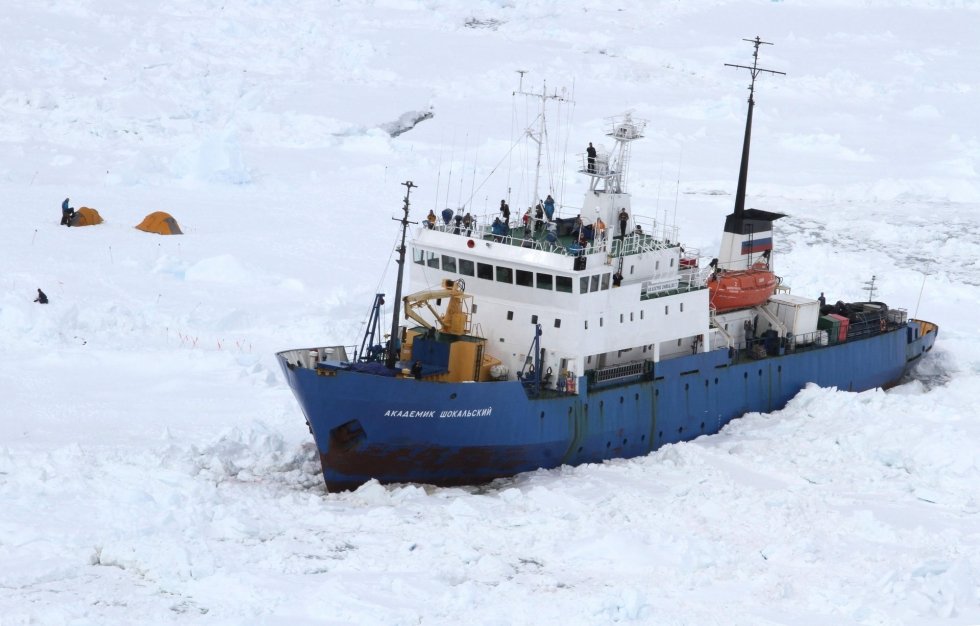
The reinsurers’ anxiety levels went through the roof when, in early 2002, the Western Antarctic’s Larsen B ice shelf, measuring more than 3,000 square kilometres, collapsed, disintegrating an estimated 500 billion tonnes of ice. While that particular area had always been one of global warming’s “hot spots”—it had been warming by about 0.5 degrees Celsius every decade since the 1940s—the speed and size of the breakup alarmed scientists. “It was an extraordinary event,” remembers Lord Julian Hunt, 72, who was director-general of Britain’s Meteorological Office from 1992 to 1997 and now teaches climate modelling at University College London. “It broke away within one month. It had been stable for 12,000 years.”
While the Larsen B disintegration did not raise sea levels directly, since the shelf was already floating, Hunt says that if the massive Western Antarctic ice sheet slid into the sea, it would raise sea levels by two to three metres, inundating vast numbers of coastal cities. “The reinsurance industry is very concerned about rising sea levels,” Hunt says. “The Western Antarctic ice sheet is what they really worry about, and it’s moving.”
During the database’s early years, Munich Re’s scientists did not know whether the changing climate was due to natural oscillations or human activity, though they certainly had their suspicions. That changed in the mid-1990s, when Höppe’s predecessor, Gerhard Berz, who was the first head of geo-risk research at Munich Re, began talking openly about anthropogenic climate change. Höppe too is utterly convinced that humans are to blame, as are the vast majority of the world’s climate scientists. Even some oil companies have come out of the closet to take the anthropogenic view.
The trend lines in Munich Re’s charts are compelling. They show that the insured and uninsured losses from natural catastrophes have been on the upswing since work on the company’s database began in earnest in 1980. Since 1995, there have been eight years when the total losses have exceeded $150 billion (U.S.) (in 2012 dollars) and four years when they exceeded $200 billion (U.S.). In record-setting 2011, the year of the Japanese earthquake and tsunami, the total shot above $400 billion (U.S.). Between 1980 and 1994, the annual losses were consistently below $150 billion (U.S.).
That said, anthropogenic climate change doesn’t explain everything. Roger Pielke Jr., professor of environmental studies at the University of Colorado at Boulder, argues that there is no meaningful trend in insured losses from extreme weather events. “The accumulation of wealth in disaster-prone areas is and will always remain by far the most important driver of future economic disaster damage,” he wrote in his blog, quoting a scientific paper.
Indeed, building in low-lying coastal and riverine areas is asking for trouble. More construction, more economic losses, end of story. (Lloyd’s notes that more than three billion people live within 200 kilometres of a coastline, a number that is likely to double by 2025.) “In the last 20 years, losses have gone up, but GDP and population have gone up too,” says Paul Kovacs, executive director for Western University’s Institute for Catastrophic Loss Reduction.
Munich Re does not dispute that losses increase as coastal areas get built up. But it does note that in the long run, the frequency of weather-related catastrophes rises in step with global warming, and is thus linked with CO2 concentrations—they hit 400 parts per million at a Hawaiian measuring station last spring, probably the highest level since the Pliocene Epoch, between 2.6 million and 5.3 million years ago.
The number of meteorological events (storms, hurricanes), hydrological events (floods) and climatological events (extreme temperatures, drought, forest fires) has infrequently dipped under 600 per year since 1996, and has climbed above 800 five times since 2006. During most of the 1980s and 1990s, the frequency ranged from 200 to 600 events per year. Meanwhile, the number of non-weather disasters—earthquakes, tsunamis, volcanic eruptions—has not spiked since 1980; in fact, the trend has inclined slightly downward since 2000. “This is why we now believe it to be anthropogenic global warming,” Höppe says. “But actually, to be honest, it doesn’t make any difference to our assumptions, or pricing, whether it’s anthropogenic or natural.”
Munich Re has no evidence to suggest the upward trend in weather-related disasters will reverse any time soon. For those in risky places, premiums will rise.
*******************************************************
Insurance companies don’t worry about climate change alone. They also worry about getting the premiums right for future, or “emerging,” risks. The asbestos debacle still haunts them. The industry totally misjudged the long-term risks of asbestosis, the lung disease caused by exposure to asbestos fibres, which continues to kill thousands each year. What they did not know was that asbestosis often appears decades after exposure to asbestos. Thousands of Lloyd’s “names”—the individual investors who had underwritten asbestos-related policies—went bankrupt in the 1990s, almost destroying the world’s premier insurance market.
The new beasts that the industry must reckon with would include the risks—from building collapses to epidemics—associated with the new breed of densely packed megacities, some of which are on track to have 20 million people (Karachi, for example) or almost 30 million (Delhi, Shanghai) by 2025. They would also include the risks of genetically modified foods, cyberattacks and shipping disasters, from the not-so-frozen Arctic to the dangerously narrow Bosporus. Some of these risks, and others, such as an earthquake and tsunami of the ferocity that hit Japan in 2011, had never been adequately modelled. That meant that estimating their risks, and therefore potential losses, were shots in the dark.
At the Lloyd’s insurance market, which celebrates its 325th anniversary this year, the worrier-in-chief is Trevor Maynard, head of exposure management and reinsurance. He is 42, with snowy-white hair, a mathematician and actuary by training and obsessive about judging risks even in his quotidian life. In a recent Financial Times article, he said he goes to the airport a couple of hours before most people would “as a rational response to risk,” such as a taxi breakdown.
It is hard to say when Lloyd’s figured out that climate change posed serious risks, because Lloyd’s is more concept than company. It’s a market composed, at last count, of 87 syndicates whose thousands of investors underwrite policies for everything from kidnappings to offshore oil rigs. But there is no doubt the market’s supervisors believe that the climate is changing. Lloyd’s thinks the IPCC reports should be taken seriously and that surging CO2 concentrations could create epic disasters.
Maynard is the author of the British reinsurer’s own seminal climate risk report, published in 2006, “Climate Change: Adapt or Bust.” It too opened with a grabber: “Fact: If the sea level were to rise just four metres due to climate change, almost every coastal city in the world would be inundated.”
He wrote the succinct, punchy report not just to highlight property risk from floods, but to encourage insurers to think about climate change’s ripple effects, such as desperate people killing one another, even if the report does not quantify those risks. The world got a taste of post-catastrophe social mayhem in September, when the Mexican resort of Acapulco and other nearby areas suffered some of their worst storms and flooding in decades, stranding tens of thousands of people and claiming 130 lives. After the storms, looting broke out. The military was called out to stop the ransacking.
“We thought about terrorism, impact on economic assets, how equity prices might fall and corporate bond spreads might widen, and food security,” Maynard says. “Imagine that climate-change increases lead to reductions in food yields. That would stress the food chain, and stressed communities will do whatever they need to to feed themselves. Well before those extremes, like war, are reached, you get pockets of terrorism coming up.”
Identifying the next asbestos—whose claims are projected to ultimately cost the insurance industry more than $200 billion (U.S.)—is what Lloyd’s in general and Maynard in particular look out for. One of the big emerging risks is wreck removal. It’s an “emerging” risk because ships are reaching absurd dimensions to meet the demands of the market and investor returns.
Lloyd’s says six wrecks in the last decade have cost more than $100 million (U.S.) each to remove. Salvaging the wreck of the Costa Concordia, which smashed into a reef off the Tuscan island of Giglio in January, 2012, killing 32, is expected to cost $800 million (U.S.)—a record. The Costa Concordia, while enormous, is half the size of the 225,000-tonne Oasis of the Seas and her near-identical twin, Allure of the Seas, the largest cruise ships in service. Imagine the costs were they to go down—or if the same fate met ships plying the newly navigable Northwest Passage.
Maynard identifies “synthetic biology” as another looming risk, one with a potential connection to climate change. Consider, he says, a world with nine billion people (the projected population by 2050, or earlier) and falling crop yields, due to higher temperatures, more drought and irrigation-water shortages. A new green revolution would be needed. Enter genetically modified crops designed to be salt-, heat- or drought-resistant. “The effects of the large-scale use of technologies that you might rush out to meet a global food shortage on ecosystems are unknown,” he says. As is a lot about the natural world, much as we humans think we know better. The question is, when will the rest of us recognize, as the reinsurers have, what’s known?
Example? There's a branch called theoretical physics.If you need such a literal means for proof, most of physics wouldn't exist.
Wait, I thought we were scared about glaciers melting and water levels rising. It's the opposite now? Or is this all just fearmongering randomly patched together without a common theme?
