Climate Change Is The Biggest Threat & Will Kill Us All

Wait, I thought we were scared about glaciers melting and water levels rising. It's the opposite now? Or is this all just fearmongering randomly patched together without a common theme?

Sea level rise comes from melting of the Arctic, Greenland, and Antarctic ice sheets in the ocean due to anthropogenic global warming. The seasonal snowpack and snowmelt in the Sierras, or reduction thereof in recent years, with the worst drought in over a millennium again due to anthropogenic global warming are responsible for the water problems in California.

You should be embarrassed for such begging the question and false dichotomy fallacies this stupid.

On an sympathetic note losing logic is a completely normal response during the anger/bargaining phase.

So the sea levels might rise to the levels they were two or three thousand years ago? I'll crank up the panic machine. Sure, many areas of the world will have more arable land, and plant growth worldwide will increase, but some Californians will have to give up their St. Augustine grass. So let's listen to the guys with five houses telling us to conserve more and give them more money to fight the problem.

By the way, I've noticed now that the "scientists" are now predicting less tropical storms, which is stark reversal from 2004, when global warming was going to cause many more hurricanes and that's why Florida had four that year. Presumably this is because they changed their climate modeling methodology. But the science on the original modelling was rock-solid and unimpeachable so I'm not sure why that happened.

Again, I have no doubt human activity is warming the planet. But you and others' reaction to it is hilarious. I thought conservatives were the ones who hated change?
 
Last edited:
Anyone who believes this is either
a) Spanish Descent
b) Communist
c) Hipster
d) Vegan
 
Last edited:
Rather than debating back and forth whether or not climate change is real, I think the better question is: do people have faith that Governments and science have the right solutions to deal with climate change? Will the proposed solutions actually have a positive impact?

We are not going solve it with wind and solar to reduce reliance on fossil fuels thus reducing the amount of greenhouse gasses released globally. Carbon capture?

So I will set aside my skepticism - which in a nutshell is centred on the magnitude of human contribution and the notion of being on a one-way street to destruction of the planet - and speculate that if indeed climate change is as it is being portrayed that no one knows what has to be done to fix it beyond speculation.

Let's look at the solutions being proposed and what they might mean in the short, medium and long term.

So let's debate a different null hypothesis: no solutions exist to fix the problem.
 
Solution in what sense, what is it intended to do and how far can it go?

That is the point, if we stipulate that climate change exists, what solutions have been forwarded that scientists who believe in climate change feel will have a positive impact and slow climate change?

What is the current thinking on fixing the problem other than getting governments to reduce greenhouse emissions?
 
Nobody will fix shit. The very notion that you can turn back the aircraft carrier of corporate influencing government and globalization is a joke.

There are too many individual changes required and too many emerging countries that feel entitled to burn all the fossil fuels they want because other countries did it on their way to modernization. Not to mention lots of smart people being mistaken for Latin, vegan, tree hugging communists.

My view is dystopian, but it's the most logical trajectory given the available evidence of human behavior.

Million to one chance, but I think the only real solution is fusion power. And for people to stop the farce that is voting.
 
Nuclear power or lowering the populations of certain third world countries with atrocious environmental records would work. However the first only addresses first world countries and the second is unexpected to ever occur. Without china (and possibly india) involved no real consensus can be made, and seeing how they mess up their country I doubt they care about the global ecosystem.
Well China's already on board. I believe India will be brought into the fold soon as well.
 
Nuclear power or lowering the populations of certain third world countries with atrocious environmental records would work. However the first only addresses first world countries and the second is unexpected to ever occur. Without china (and possibly india) involved no real consensus can be made, and seeing how they mess up their country I doubt they care about the global ecosystem.

There is a difference between fusion and fission.
 
How have they made any steps whatsoever to stop destroying the environment of their country, let alone working as part of a larger coalition? Or are you talking about their shifting their focus to raping and pillaging Africa?
Google it
 
That is the rub, all of the alternatives to fossil fuels are inefficient. Nuclear power has a stigma and countries are backing away from it.
 
Nuclear power has huge costs if anything goes wrong, that has been shown time and again. But everything else has huge costs even when things don't go wrong. It's a tricky problem.
Actually, that's not true at all. There aren't huge costs with solar and wind, nor are they any catastrophic problems should any of the systems fail.
 
Yeah if you consider the fossil fuel inputs for production and transport in "renewables" then it's a net loss for first ten years of use or so. And if you guys haven't been paying attention, it's decades too late for solutions. The only question is how quickly die-off will occur.
 
Solar and wind power kill the local birds, take up large amounts of space, and are huge energy sinks (in terms of time to recoup the initial energy investment).
"kill the local birds" is a bit much. Its not like wind turbines are wiping out all bird species.
 
But if wide spread wind turbine use is embraced it will have a much larger effect on birds and all that fly but small price to save humanity.

The subsidies or grants paid to consumers to embrace alternative energy sources is not worth it. When the cost of using solar or geothermal is passed on to the end user the uptake is low. If government was serious it would make it worthwhile for me to go this route. They should pay me to get off the grid and save the world.

By the way, bless the Saudis for ducking with the price of oil. Gas is 95 cents per litre. Sweet. I just idle all day
 
Actually, that's not true at all. There aren't huge costs with solar and wind, nor are they any catastrophic problems should any of the systems fail.

Solar and wind farms are grossly inefficient. It takes hundreds of thousands of acres just to replicate the power from one nuclear plant. Google (or wiki) it. And there would be HUGE costs if you were to actually try to replace nuke or carbon power with solar or wind.
 
Solar and wind farms are grossly inefficient. It takes hundreds of thousands of acres just to replicate the power from one nuclear plant. Google (or wiki) it. And there would be HUGE costs if you were to actually try to replace nuke or carbon power with solar or wind.

Solar and wind are supplemental. The only way to really make a dent in carbon emissions with power production is fission.
 
Yet when the plants have issues we have immense amounts of radioactive emissions, kind of a big deal. Maybe if we stop using reactors designed 50 years ago we might have better nuclear power plants.
I'm all up for this, Nuclear Safety has increasingly improved with time. I don't see any problem with it, first of all less use of fossil fuels, which will bring the prices even lower thanks to not depending so much on it. I think also Solar energy or any sort of renewable energy is great, but for isolated small towns or ranches where it would be more expensive to put all the necessary installation.

What happened in Fukushima its just a clear mix of bad luck and government cover up, perhaps if they had been more transparent about this from the very beginning a lot could have been avoided, but it is what it is and there is no much that it can be done at this point. The reasoning for the Japanese to make Fukushima next to the sea was for an scenario were non controllable over heating couldn't be stopped which would have evolved into a nuclear reaction and something worst to what happened in Chernobyl in 86. Now we have these politicians who know nothing about nuclear security, engineering, and so on that they just do whatever the hell they think is right, when they can't cleary distinguish a hole in the ground form their assholes and are only worried about the next election, instead of doing of what is right for both people and country.
 
Solar and wind farms are grossly inefficient. It takes hundreds of thousands of acres just to replicate the power from one nuclear plant. Google (or wiki) it. And there would be HUGE costs if you were to actually try to replace nuke or carbon power with solar or wind.
Efficiency is on the rise:

http://www.abc.net.au/environment/articles/2014/12/08/4144142.htm

Australian scientists announce solar energy record
ABC Environment 8 Dec 2014

AUSTRALIAN SCIENTISTS have set a new record in increasing the efficiency of solar panels, which they hope could eventually lead to cheaper sources of renewable energy.

In what the University of New South Wales described as a world first, the researchers were able to convert more than 40 per cent of sunlight hitting the panels into electricity.

"This is the highest efficiency ever reported for sunlight conversion into electricity," UNSW Professor Martin Green said in a statement.

"We used commercial solar cells, but in a new way, so these efficiency improvements are readily accessible to the solar industry," added Dr Mark Keevers, the UNSW solar scientist who managed the project.

While traditional methods use a single solar cell, which limits the conversion of sunlight to electricity to about 33 per cent, the newer technology splits the sunlight across four different cells, each optimised for the fraction of the sunlight they receive, which boosts the efficiency level, Green said.

The four-way solar cells can be used at the centre of a field of mirrors which are arranged to concentrate the Sun's rays. Specialised filters shuttle heat away from where it would reduce the solar cells' efficiency and towards the solar cell that can best handle the heat.

The record efficiency level was achieved in tests in Sydney and replicated at the United States government's National Renewable Energy Laboratory, the university said.

Green is hopeful the technology can also eventually be used for solar panels mounted on people's roofs, which he said currently had a 15 to 18 per cent efficiency rate.

"The panels that you have on the roof of your home, at the moment they just have a single cell but eventually they'll have several different cells... and they'll be able to improve their efficiency to this kind of level," he said.

German efficiency
Meanwhile in Germany, scientists set a new record for solar cell efficiency in a laboratory setting, converting 46 per cent of light into electricity.

The scientists from the Fraunhofer Institute for Solar Energy Systems used a type of solar cell called a multi-junction cell, made of layers of semiconducting materials, with the record-setting cell being a four-junction cell. Each of its sub-cells converts precisely one quarter of the incoming light, including all the colours of the rainbow plus infrared light (wavelength between 300 and 1750 nm), into electricity. The light is concentrated using a kind of magnifying glass called a Fresnel lens.

The new record efficiency was measured at a concentration of 508 suns and has been confirmed by the Japanese AIST (National Institute of Advanced Industrial Science and Technology), one of the leading centres for independent verification of solar cell performance results under standard testing conditions

Jocelyne Wasselin, vice president solar cell product development for Soitec, a company which partnered with the scientists said: "We are very proud of this new world record. It... clearly indicates that we can demonstrate 50 per cent efficiency in the near future."

http://www.solarserver.com/solar-ma...-competitiveness-of-european-pv-industry.html

New PV world record: Solar cell efficiency at 46% confirms competitiveness of European PV industry

A new world record for the direct conversion of sunlight into electricity has been established: The multi-junction solar photovoltaic (PV) cell converts 46% of the solar light into electrical energy and was developed by Soitec and CEA-Leti, France, together with the Fraunhofer Institute for Solar Energy Systems ISE, Germany.

Industry and research cooperation reaches second world record within one year

Multi-junction cells are used in concentrator photovoltaic (CPV) systems to produce low-cost electricity in photovoltaic power plants, in regions with a large amount of direct solar radiation. It is the cooperation’s second world record within one year, after the one previously announced in September 2013, and clearly demonstrates the strong competitiveness of the European photovoltaic research and industry.

Concentration of 508 suns confirmed by Japanese AIST

Multi-junction solar cells are based on a selection of III-V compound semiconductor materials. The world record cell is a four-junction cell, and each of its sub-cells converts precisely one quarter of the incoming photons in the wavelength range between 300 and 1750 nm into electricity.

When applied in concentrator PV, a very small cell is used with a Fresnel lens, which concentrates the sunlight onto the cell. The new record efficiency was measured at a concentration of 508 suns and has been confirmed by the Japanese AIST (National Institute of Advanced Industrial Science and Technology), one of the leading centers for independent verification of solar cell performance results under standard testing conditions.

CPV is the most efficient solar technology today

A special challenge that had to be met by this cell is the exact distribution of the photons among the four sub-cells. It has been achieved by precise tuning of the composition and thicknesses of each layer inside the cell structure.

”This is a major milestone for our French-German collaboration. We are extremely pleased to hear that our result of 46% efficiency has now been independently confirmed by AIST in Japan,” explains Dr. Frank Dimroth, project manager for the cell development at the German Fraunhofer Institute for Solar Energy Systems ISE.

“CPV is the most efficient solar technology today and suitable for all countries with high direct normal irradiance.”

50% solar cell efficiency visible in the near future

Jocelyne Wasselin, Vice President Solar Cell Product Development for Soitec, a company headquartered in France and a world leader in high performance semiconductor materials, added: “We are very proud of this new world record. It confirms we made the right technology choice when we decided to develop this four-junction solar cell and clearly indicates that we can demonstrate 50% efficiency in the near future.”

“To produce this new generation of solar cells, we have already installed a line in France. It uses our bonding and layer-transfer technologies and already employs more than 25 engineers and technicians. I have no doubt that this successful cooperation with our French and German partners will drive further increase of CPV technology efficiency and competitiveness.”
 
Efficiency is on the rise:

http://www.abc.net.au/environment/articles/2014/12/08/4144142.htm

ABC Environment 8 Dec 2014

AUSTRALIAN SCIENTISTS have set a new record in increasing the efficiency of solar panels, which they hope could eventually lead to cheaper sources of renewable energy.

In what the University of New South Wales described as a world first, the researchers were able to convert more than 40 per cent of sunlight hitting the panels into electricit....s.”

Sweet. So we'll need to pave over slightly fewer forests, prairies, and badlands to get what is still an incredibly inefficient power source.

Don't get me wrong, I'd love to see these things on rooftops everywhere. But using vacant land for these things is stupid as hell.
 
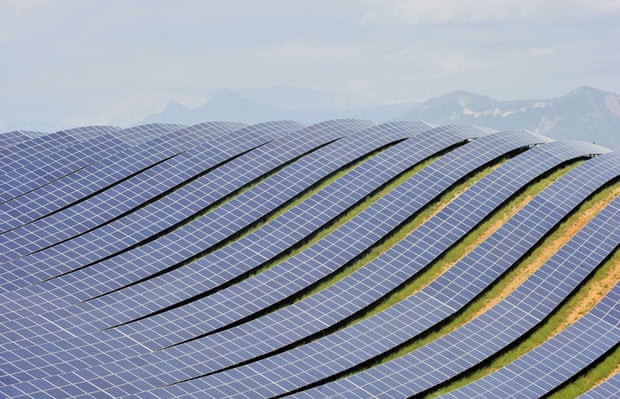
I was shown a field of solar panels that had a security guard SUV sitting idling at the entrance. I presume one is always there, and the engine is always on. This cracked me up.
 
Like I said, solar and wind are a waste of time. Wave energy has some efficacy, but not much. Fusion is the only real solution globally.
 
http://www.theguardian.com/environment/picture/2011/may/26/solar-photovoltaic-france

36 acres
18.2 MW
Annual output 26 million Kwh
supplies 8000 families
hardly noticeable

Les-Mees-solar-farm-the-b-001.jpg
 
So, that energy farm supplies how many barrels of oil per year and at what cost? What was the installation and creation energy sink, how long will it take to break even? Seems interesting but there are some important points missing.

I am confused at why we should care that Brazil is not managing its resources properly. They had enough money to spend billions on the last world cup, why can't they buy some water? And if they don't . . . population control.

My point is that huge tracts of land are required for solar and wind farms. And you are correct in asking what was the cost to build and when is the break even point. The largest windfarm in the USA is 3200'acres.
 
They don't need rain, they can buy it from a neighboring city or country. There is a quite well defined comodification of water on a massive scale, for examples of this see the great water wars.

Not sure if you're trolling.
 
I am confused at why we should care that Brazil is not managing its resources properly. They had enough money to spend billions on the last world cup, why can't they buy some water? And if they don't . . . population control.

Because those controlling/deploying the water supply don't give a shit.
 
LOL @ conservation biology.

Brazil has the largest freshwater reserves in the world, they're not gonna find a supply for 30 million people looking elsewhere that would resemble anything remotely considered sustainable. Building a thousand plus kilometer water pipeline from santa claus would take years anyways. Alto Tiete taps have 18 days supply left.

But what you've completely failed to articulate is why this is some sort of global problem or even noteworthy aside from some sort of smug schadenfreude. A city's population growth outpaced its infrastructure. Happens all the time.
 
But what you've completely failed to articulate is why this is some sort of global problem or even noteworthy aside from some sort of smug schadenfreude. A city's population growth outpaced its infrastructure. Happens all the time.
Not that I'm interested in getting involved in your constant pissing match in this thread, but are "outpacing infrastructure" and "completely running out of water" really equivalent?
 
Not that I'm interested in getting involved in your constant pissing match in this thread, but are "outpacing infrastructure" and "completely running out of water" really equivalent?

I'm not sure it's relevant. Humans used too much.
 
But what you've completely failed to articulate is why this is some sort of global problem or even noteworthy aside from some sort of smug schadenfreude. A city's population growth outpaced its infrastructure. Happens all the time.

Don't confuse local inhabitability caused by global warming plus regional destruction of rain forests as a global problem.

The magnitude of this drought, when it inflicts other parts of the world including California, will also become a local problem. Of course central valley grows a shit ton of veggies for the rest of the states, so you might see produce prices double but that just means one less shirt to purchase a month.

The worst case models have the entire Northern hemisphere unable to grow food within two decades, so don't worry global warming caused local problems will become global problems within our lifetime. Assuming your health isn't as bad as your cognitive abilities, you'll be able to witness local inhabitability firsthand.
 
Isn't that exactly what outpacing the infrastructure means? They had infrastructure to support x people, the population grew at a rate that exceed the rate at which they expanded the infrastructure. Now they cannot support their population. Hence their population growth outpaced its infrastructure expansion.

I guess. Just a lot of words to say humans used too much.
 
Yes, in other words Brazil made some stupid planning and spent billions on a world cup rather than on infrastructure for their slums. The income inequality led them to here, along with their desire to project an image that they clearly do not live up to.

Yup... the power of denial hits home. Now Brazilians can go waste time protesting in the streets, politicians will pretend to care, but the money is gone. Sepp Blatter FTW.
 
Not that I'm interested in getting involved in your constant pissing match in this thread, but are "outpacing infrastructure" and "completely running out of water" really equivalent?

"Constant pissing match"? :wegotabadass:

And yes, unless you have a city that is nothing but private wells and personal sewers running to rivers or the sea, infrastructure is what gets people their water.
 

Users who are viewing this thread

Back
Top Bottom