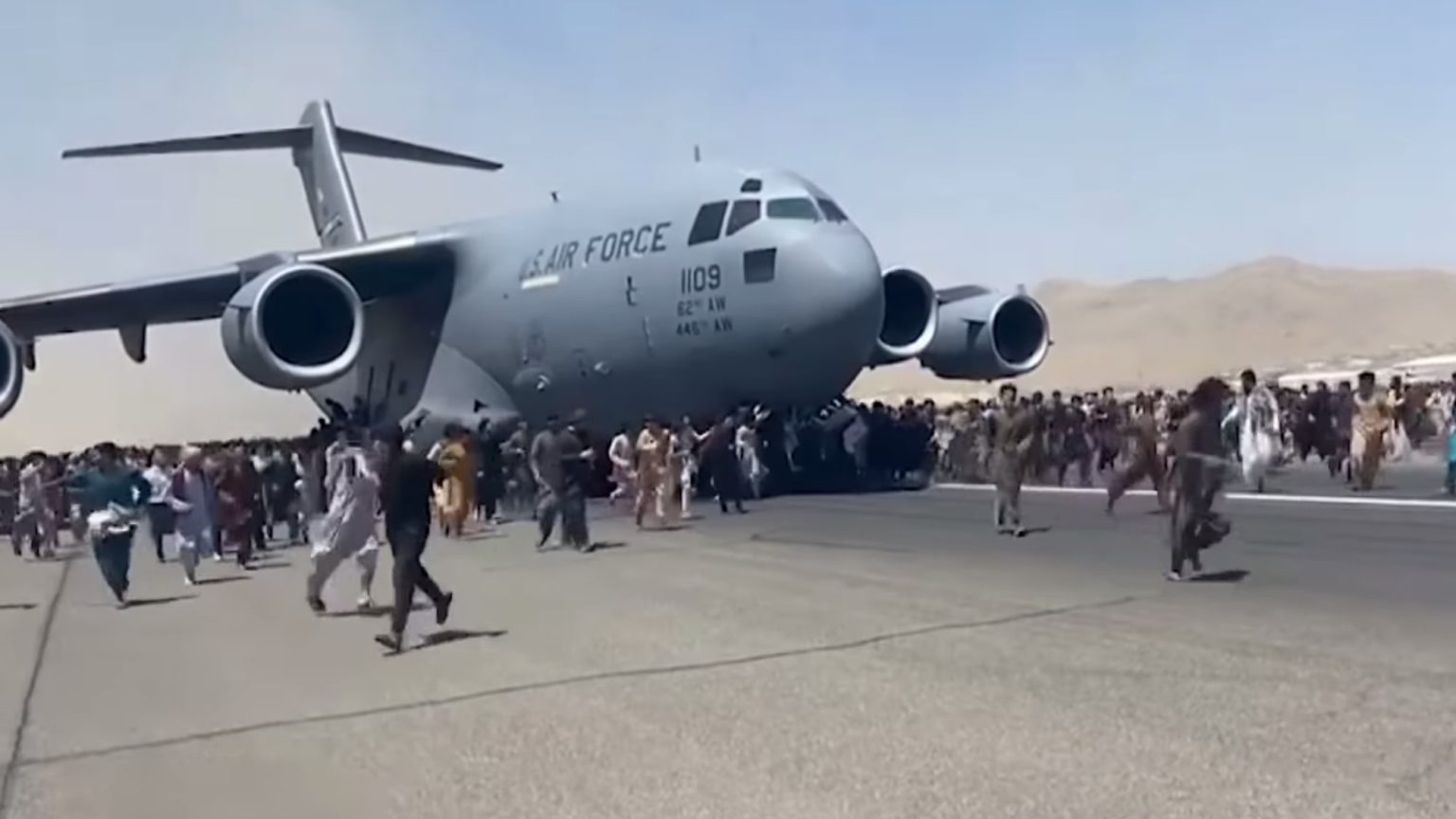
And now those same Americans have the full withdrawal from Afghanistan they apparently want:
Some 70 percent of the public supports a pullout. Not that they care that intensely about it; as the foreign-policy scholar Stephen Biddle recently observed, the war is practically an afterthought in U.S. politics. “You would need an electron microscope to detect the effect of Afghanistan on any congressional race in the last decade,”
Biddle said early this year. “It’s been invisible.” But Presidents Obama, Trump, and Biden all ran on getting out of the war, and now we’re out.
What the public does care about, however, is using Afghanistan as raw material for
cheap patriotism and partisan attacks (some right and some wrong, but few of them in good faith) on every president since 2001. After the worst attack on U.S. soil, Americans had no real interest in adult conversation about the reality of anti-terrorist operations in so harsh an environment as Afghanistan (which might have entailed a presence there long beyond 20 years), nor did they want to think about whether “draining the swamp” and modernizing and developing Afghanistan (which would mean a lot more than a few elections) was worth the cost and effort.
Maybe it would have been worth it. Or maybe such a project was impossible. We’ll never know for certain, because American political and military leaders only tried pieces of several strategies, never a coherent whole, mostly to keep the costs and casualties down and to keep the war off the front pages and away from a public that didn’t want to hear about it. Today, many claim that they did not know what the military or the government were really up to, and they point to
The Washington Post’s attempt to create a Pentagon Papers vibe around a set of revelations that were not nearly as shocking as the secrets of Vietnam—or should not have been, anyway, to anyone who read a newspaper during the past two decades.
Nor did Americans ever consider whether or when Afghanistan, as a source of terrorist threats to the U.S., had been effectively neutralized. Nothing is perfect, and risks are never zero. But there was no time at which we all decided that “close enough” was good enough, and that we’d rather come home than stay. Obama made
something like this case during the 2011 surge, and Donald Trump tried to make a similar argument, but because Trump was too stupid or too lazy to understand anything about international affairs (or much else), he made it purely as a weaponized political charge and, as with his inane attempts to engage North Korea, in a
search for a splashy and quick win.
Biden’s policy, of course, is not that different from Trump’s, despite all the partisan howling about it from Republicans. As my colleague David Frum
has put it: “For good or ill, the Biden policy on Afghanistan is the same as the Trump policy, only with less lying.”
But as comforting as it would be to blame Obama and Trump, we must look inward and admit that we told our elected leaders—of both parties—that they were facing a no-win political test. If they chose to leave, they would be cowards who abandoned Afghanistan. If they chose to stay, they were warmongers intent on pursuing “forever war.” And so here we are, in the place we were destined to be: resting on 20 years of safety from another 9/11, but with Afghanistan again in the hands of the Taliban.
A serious people—the kind of people we once were—would have made serious choices, long before this current debacle was upon them. They would today be trying to learn something from nearly 2,500 dead service members and many more wounded. They would be grimly assessing risk and preparing both overseas and at home for the reality of a terrorist nation making its way back onto the international map.
Instead, we’re bickering about masks. We’re
holding super-spreader events. We’re complaining and finger-pointing about who ruined our fall plans. (I’m part of that last group. Spoiler: It’s the people who
refused easily accessible vaccinations.)
Biden was right, in the end, to bite the bullet and
refuse to pass this conflict on to yet another president. His execution of this resolve, however, looks to be
a tragic and shameful mess and will likely be a case study in policy schools for years to come. But there was no version of “Stop the forever war” that didn’t end with the fall of Kabul. We believed otherwise, as a nation, because we wanted to believe it. And because we had shopping to do and television to watch and arguments to be had on social media.
But before we move on, before we head back to the mall, before we resume posting memes, and before we return to bickering with each other about whether we should have to mask up at Starbucks, let us remember that this day came about for one reason, and one reason only.
Because it is what we wanted.